{npm ’26 • 30 – & Fin}


This morning, Liz said she’s already like a mother who has forgotten the trouble and travail of childbirth, already halfway to missing the daily hour (or in my case, sometimes two or more) of this month’s practice of poetry. And I’m with her – taking a deliberate space of time to do anything on purpose – to no purpose – is near impossible, and my brain and my body already crave the unfocused-focus of deliberately creating poetry with art supplies and open eyes. Despite beginning this on Easter Weekend – not traditionally a “quiet” time if you’re a church chorister – this practice gave me a little quiet – a little arbitrary time wherein I could loftily recuse myself from the world, citing Art. Mind, I write books, but somehow my brain can make that – with its entreaties and appeasement, with its pushes and pulls from readers and revisions and editors and such – much more mundane. That’s just “work,” that is attached to Filthy Lucre, despite the fact that it is, in my heart of hearts, still quite magical to create worlds and escape into them. But poetry – especially since I only have two anthology credits to my name thus – is still somehow …far Different.

Hah. Whatever I have to tell myself, I guess.

It would be a simple matter to extend this Artful Practice a bit – to try to at least get a little sketching and coloring in, but to be honest, it’s hard to justify. It’s time-consuming. It’s resource-consuming. And it pokes the voices in my head that remind me that there’s always something I should be doing – who am I to be skivving off of paying work or not Helping Others or Doing Good with my scant moments on this Earth? The idea that we are not enough on our own to make art or enjoy it is… destructive. And, unfortunately, how I was raised.

The self who I was would be astounded – shouldn’t All be known by now? Wasn’t adulthood meant to Answer All Questions? Who would have though that officially in Middle Age now I would still be so uncertain? But I am uncertain enough to make art, uncertain enough to learn and unlearn, and uncertain enough to still question and change. So as frustrating and difficult as it is to be myself sometimes – and ye squirrelly squids and monsters it is not simple – I guess the uncertainty and discomfort is…necessary. Vital for my personal…formation or whatnot. So, I’ll take it. I’ll keep this self, O Mighty Pen.

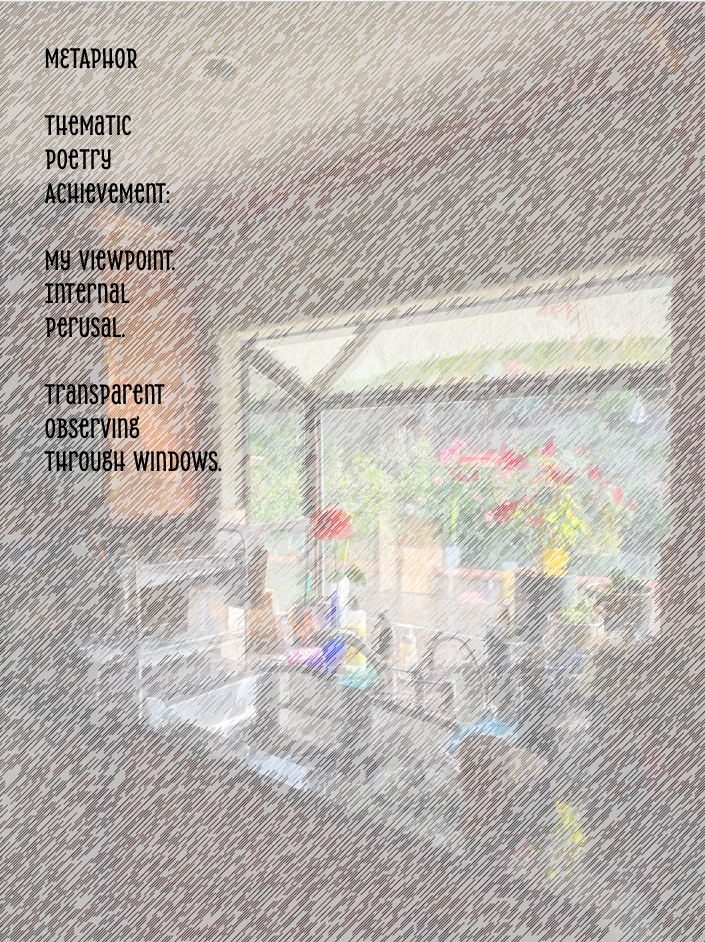
That’s what the month of observation has been to me – space for self-examining, deliberately censoring the world without as much as possible. All month long I’ve considered what I can see, peering through windows, looking out of in-groups and into spaces where I am not myself a member. It’s odd how closely aligned middle age is with adolescence; the same observable dance of declaration and denial, of conviction and conjecture. Amidst the swirl of alliance and estrangement, the same echoing queries of “Where do I belong in all of this?” remain. The answers resist simplicity as they always do, while the same conclusion comes – I simply am. I don’t know if that answer shapes who I became as a writer, or only writers can give it, but on the edge of the dance floor, I simply exist – and watch. Looking for how the gears mesh, and where the locomotion takes us.

Blank Page

A heart is
a vacant
city lot,

a pristine
prepped canvas:
potential.

who we are –
what blooms here –
our choosing.


Thanks for being along for the ride. If you’re aiming to catch up with everyone’s National Poetry Month projects for this month like I am, don’t forget that Jama-j has kindly kept a running roundup of everyone’s efforts. Happy Thursday, friends, see you next time – and remember you are so, so loved.

{npm ’26 • 3}


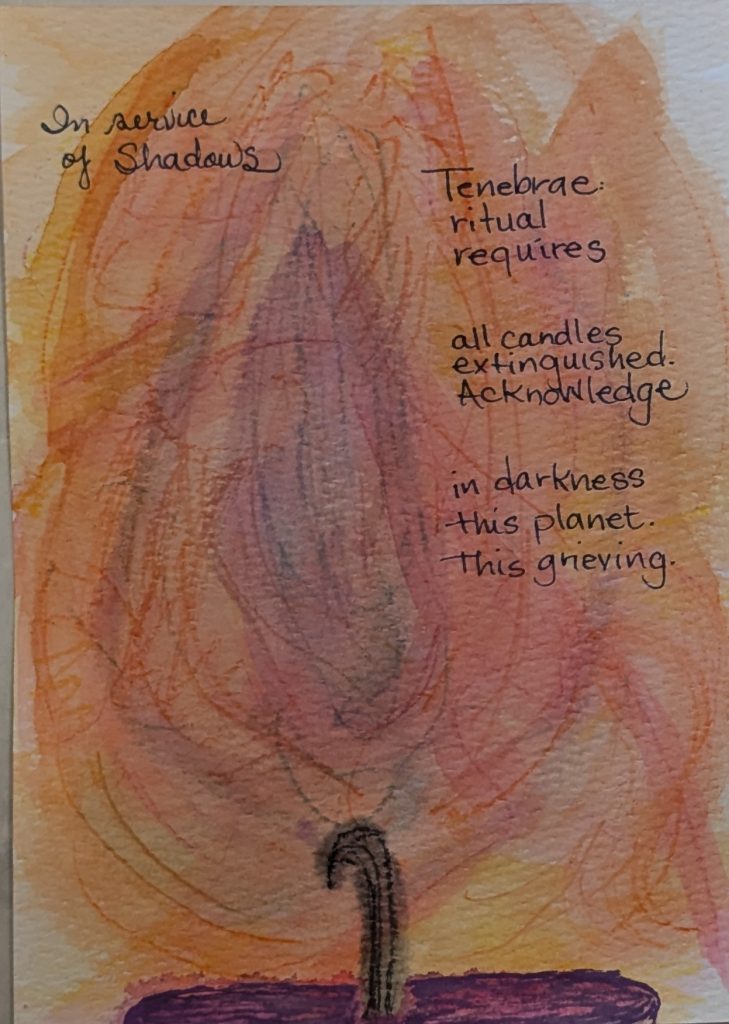
In Service of Shadows

Tenebrae:
ritual
requires

all candles
extinguished.
Acknowledge

in darkness
this planet,
this grieving.

I’m continually fascinated by how some people – communities or individuals – can make space for grief … and how some others relentless insistence on ‘this’ being some Part Of The Plan or Lesson. Sometimes awful things like pandemics, fascists, genocide, and war happen. Who wouldn’t weep? Who hasn’t?

(It also occurred to me after the drawing was done that it might have made more sense to draw the candle in grayscale, since tenebrae means shadows… but, oh well.)

Poetry Friday is hosted today at Radio, Rhythm & Rhyme. Thanks, Matt!

{npm ’26 • 2}

mandé

mandatum
“Commandment”
in Latin.

A brick word –
Unyielding.
Requiring

Adherence,
Demanding
Charity.

Not having been raised with liturgy, I am the girl who’s always wondering, “Wait, what’s this about?” Our ensemble was asked to sing for “Maundy” Thursday. Could say MUCH MORE on the history of the medieval/traditional connection between the day and charitable behavior, but… won’t.

I hadn’t envisioned using crayons for this project, but boy are they faster. Additionally, they (and just scribbling on any old piece of paper, including old planners) help me remember the imperfection I’m meant to embrace within this practice — quick art and poetry made of and in the moment. I literally am requiring myself to let go of the rules for just a tic, scribble and post, the end. Meanwhile, this article on how art makes people healthier gently nudges me to keep going.


{pf: poetry peeps offer up the ovillejo}

Welcome to another Poetry Friday Adventure!


Poetry Peeps! You’re invited to our poetry challenge for the month of MARCH.

Here’s the scoop: we’re writing ekphrastic poems, which might pair beautifully with your plans for National Poetry Month (I’m attempting poetry comics). Ekphrasis is a Greek word which means “description,” and you’re invited to choose your own image from anywhere – personal pictures or otherwise. Are you in? Good! You’ll have the month to craft your creation and share it April 24th in a blog post and/or on social media with the tag #PoetryPals. We hope you’ll play along!


From Process…

Greeting, Poetry Friends! If this form was a challenge to you – well, I can’t exactly say ‘mea culpa,’ but I will own that this month, this form is one I chose…possibly unwisely, since, once again, I based my choice on cleverness and appearance… Or, in other words, because, it looked easy. I mean, it had Rules! A clear Rhyme Scheme. There was Meter and Boundaries! Except for that bit about the quatrain written in trochaic tetrameter, it was even straightforward. What could possibly go wrong?

Well… the first issue was my assumptions. Spanish is a romance language, so surely this form, first popularized in Spain, was going to be a lyrical, dance-y walk in the park, no? Er… no.

The second issue was time – and just how much this form insisted on consuming… in terms of how long I spent thinking about trochaic tetrameter and remembering what that was.😂 It’s been a minute since grad school, and I can’t honestly say when last I spelunked into the cavernous depths of poetic meter. Perhaps as an undergraduate…? In any event, a quick search reminded me – of Blake’s Tyger, of the fairies and the witches speeches in Shakespeare’s Scottish play and in “A Midsummer’s Night Dream,” and of the hard syllabic pulse of Hiawatha, which Longfellow likely meant to mimic Native American drums. The skip-stumble “falling” cadence of tetrameter in lieu of the more regular pentameter might have been second nature in 16th century Spanish, which is the original language of the ovillejo, but it was afterthought enough that I decided against attempting to use it consistently, feeling that the redondilla refrain at the end was difficult enough. The final line of the quatrain wherein previous lines are recycled came with difficulty, and the Poetry Sisters discovered during the group write that if one did not give any thought to it ahead of time, it would All Go Very Badly. We all agreed on the wisdom of beginning the poems there…

…To Poetry

…so, I did. The first time. But, I admit that I’m contrary enough to have tried just writing the poem straight out – surely that’s what Cervantes did? Writing the poem straight out required a lot more piecing things together and fussing, and revising, revising, revising – but both poems had some dissonance, written from front or back. This poem was 9/10ths revision – and I’m grateful to like pieces of both, but this was not the unqualified win that I assumed. Which, given assumptions? Is my own fault. 😂

In the spirit of applying maximum rules in order to achieve some measure of success, I tried a theme-focus first. Twilight – whether civil, nautical, or astronomical – is one of those fascinating liminal periods that lend themselves well to poetry. Since our Poetry Friday hostess is already celebrating her book of the same name, I tried to lean in as much as I could to that changeable transitoriness. The other Poetry Sisters went other directions, of course. Sara’s poem leaned into answering a question. Mary Lee joined in on theme. Laura’s fierce poem is here, while Liz’s exploration is here, and Tricia’s offering is here. You’ll find Karen’s poem here, and Denise’s poem is here. Michelle K’s poem is right here, and Margaret’s ovillejo is here. Linda B’s poema is here, and Carol V’s ovillejo offering is here – and Carol L joins us here. It’s so nice to see so many participating! More Poetry Peeps may offer their own ovillejos throughout the weekend, so do pop by for the full roundup.

The next poem I tried to come to with fewer expectations. It obviously needed to be… the opposite of liminal. I wanted it to be unsubtle, blatant. High noon, no shade. I also decided to pry my grip off of the rules for this one. In spite of this, the second poem still has elements of twilight (which happens twice a day, despite many of us only acknowledging the evening one) and took a ton of revision and probably more time than I would normally give a poem that is meant to just be a challenge. …I’m still not fond of the dissonance the form created, so stubbornly, I kept polishing. Eventually I discovered that enjambment is actually a saving grace of this form, and I was able to move away from trying to make a workable rhyme scheme towards focusing on a smoother poetic arc and making more meaning. This is where I quit:

“NIGHT SONG”
for Marci Flinchum Atkins

Light slips its leash and starts to slide –
Eventide.
In slate and *mauve, dusk’s shadow grows.
Afterglow
Veils twilight, takes its light inside,
Beautified.

Day breathed its last, and night replied
A lingering note. As warm light drained,
Cool starlight rose up in refrain:
Eventide. After glows, beautified.

(Mauve here is pronounced the way I learned it – in French, so its long /o/ matches ‘stove.’ And, no, I don’t know why it matters.)

☀️MERIDIAN
Near solid, nourishing seeds, slow,
sun seeps, then glows.
Light tips. Sparks, shaken out and stirred –
The living, served.
No shade, just brightness unconfined
in “Sunshine.”

A subtle scent – soil, blade, and vine,
The warming earth and air duet
at Equinox. Its minuet
Sweeps and grows, and serves up sunshine.


Despite the second image not matching the poem (pictures of noon are …somewhat boring), this has been a fun project. An excuse to dig into snapshots from the past – that picture of Keflavik is one of my favorites – an excuse to try a new form – a good time, even when it doesn’t go as I envisioned – and an excuse to do poetry in community with my peeps and the Sisters. I’m looking forward to taking this viewpoint of the harmony between words and images into my NPM project next month. And however you plan on moving through April – in anticipation of renewal and hope, through a steady, measured practice of daily poetry, or in an exuberant exploration of simply sipping poetry from all corners, I wish you warming winds and calm skies, elegant elucidation and resonant rhymes. Happy National Poetry Month to come! Remember, you are well-loved.

©2015, David T. Macknet


{final pf of ’25: a poetry peeps wish of light, hope & peace}

Welcome to Poetry Friday!

Poetry Peeps! We did it! A very long year, but it’s nearly done, done, done. Thank you for being with us this year as we wrote poetry in conversation with each other and with the world. We don’t know yet what’s ahead thematically, but we’ll let you know the 2026 deets after January 4th when the Poetry Sisters put their heads together and figure out the next twelve month’s themes and challenges. Stay tuned!


Friends, I would have been writing this to you from other shores, except better sense intervened and kept us close to home this year. I’ll be happy to see friends abroad in June, but until then, I’m glad for the rain, and settling in to gratefully be a bit quiet and cozy at home.


As our overarching theme this month remains writing in conversation, and the words or ideas of ‘light,’ ‘hope,’ and ‘peace’ I thought I’d be fairly challenged with getting the words to fall together organically. I mean, granted – the December holidays, from Bodhi Day to Yalda, to Solstice to Hanukkah to Christmas are all about hope and light in one way or another, and light in the darkest part of the year is inevitably hopeful. But, peace… seems to be in a bit of short supply around any holiday that requires special foods and observances. I couldn’t figure out how to get peace as a concept to fit in organically…

From Process…

…until I started looking at these concepts from the opposite direction.

I started writing a Solstice poems a few years ago and shared a few. It’s an easy theme – the shortest day, the longest night, and facing forward to the idea that this is it, it’s Winter… but this is also the shortest day, and all days hereafter will be longer, even if by a minute, hallelujah, Amen. I even heard a brief mention of Solstice in the Advent homily as the reader said gleefully, “More light to come!” And we all cheered… but I found myself thinking, “…or, maybe we could just sit a minute with the cold and dark?” Admittedly, I was in a thinky mood and often homilies make my mind wander, but I realized that Christian religions, at least, seem only to do this ‘sit with the dark’ thing briefly, if at all. Some of us are weird about shadows and much prefer the sun and the shiny. Which, fair enough, but our insistence on only sunshine is imbalanced. We need the night, the moonlight , and the end of day. Plants don’t only need sunlight. Life doesn’t only exist by daylight. We can’t fast-forward the parts of living we don’t like, and dark exists for a reason… even if it makes us uncomfortable. Maybe especially then.

All times and seasons are part of our cycle, the turn of the wheel of days. Wherever we may be in one part of our pattern, we always know there’s more to come… The longer I live, the more I realize there’s no point in hating where we are. As my mother always said, “This, too, shall pass…”

…To Poetry

No matter how often I realize this, it always seems like… a new thought. Or, at least a thought I return to this again and again in poetry. I’ll choose to see it as a meditation instead of mere repetition. 😀

I paged through some of my poem forms because seasons – and recurring thoughts – tend to lend themselves to poems with repetitious forms. I started with a rondeau redoublé, but ended up with a villanelle (because end of year = lazy. I’ll return to the rondeau redoublé soon), a familiar friend. I leaned in to my love of alliteration as well – repeating thoughts deserve repeating sounds, after all – and just let myself ramble along until I came up with something. I’ll admit I’d forgotten how carefully one must choose the first line of the initial idea… I always start with that couplet of statements that feel solid enough to draw a poem out of, but boy, you’re really stuck with that first end word. Still, this came together quickly, and then lent itself to fiddling with for another day as the idea coalesced. This is the beauty of such a strict form – you only have so much wiggle room, so you have to make what you’ve come up with count. It’s not done, but I’m comfortable leaving it along for now.

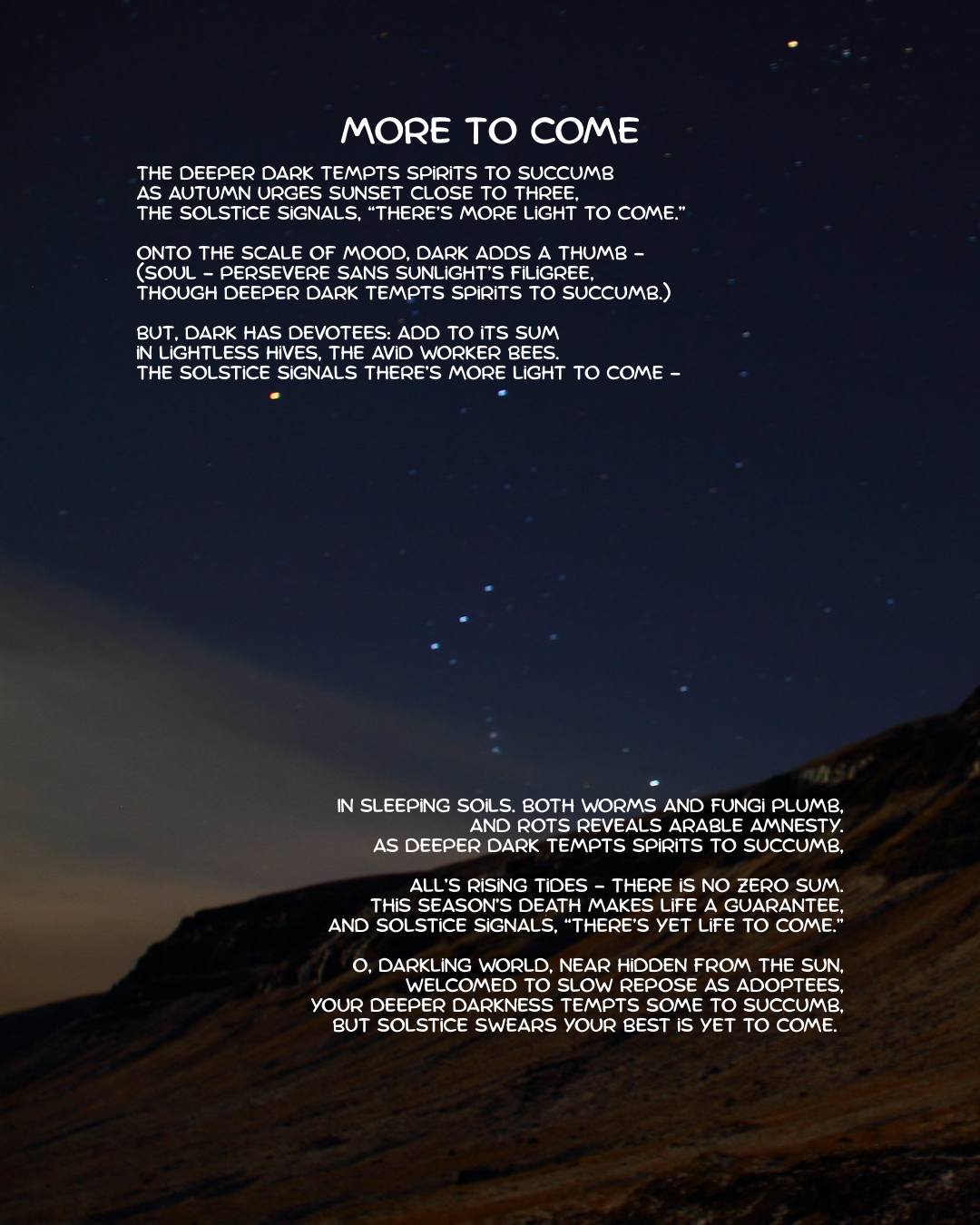
More To Come

The deeper dark tempts spirits to succumb
As autumn urges sunset close to three,
The solstice signals, “There’s more light to come.”

Onto the scale of Mood, dark adds a thumb –
(Soul, persevere sans sunlight’s filigree
Though deeper dark tempts spirits to succumb.)

But, dark has devotees: add to its sum
in lightless hives, the avid worker bees.
The solstice signals there’s more light to come –

In sleeping soils. Both worms and fungi plumb,
And rots reveals arable amnesty.
As deeper dark tempts spirits to succumb,

All’s rising tides – there is no zero sum.
This season’s death makes life a guarantee,
And solstice signals, “There’s yet life to come.”

O, darkling world, near hidden from the sun,
Welcomed to slow repose as adoptees,
Your deeper darkness tempts some to succumb,
But solstice swears your best is yet to come.

This image was taken by Tech Boy in 2010, and it remains my favorite night sky photograph of his, clearly showing the December night sky in Iceland, where we were tooling around at some unearthly hour in zero-degree weather, chasing the aurora. We didn’t see it that night, but the Orion nebulae was a most excellent consolation.

I hope you are enjoying this most wonderful Boxing Day, are ready for Kwanzaa, and had a wondrous Chrismukkah. If you’d like to peruse more poetry, the Peeps have got you. Sara’s poem is here. Laura’s poem is here. Mary Lee’s poem is here. Liz’s poem is right here. Michelle K’s post is here. Molly’s post coincidentally joins the list here. The usual suspects may filter in throughout the weekend, so don’t forget to check back for the full round up. (NB: I’m having blog issues and there will be some updates going on, so if your commenting is more difficult than usual, apologies, and feel free to drop me a thought on my contract form or an email.)

The end of the month, the end of a year, and a recurring thought – all three things added together are a solid refrain of time keeps flowing, and we’ll keep going. How we do so is entirely up to us. We’ll continue to love and live in the light, but as the dark folds around us this season, I hope we can sit with it deliberately, explore its hidden corners and let it speak to us what stories we may need to be told. And as always, in sunlight or under the glow of the moon, you are ever so well-loved.


{come for the poetry friday roundup! stay for the peeps wrestling the raccontino!}

Welcome to Poetry Friday!

Poetry Peeps! You’re invited to our challenge for the month of July! Here’s the scoop: We’ll going to write brief poems called Sedokas. A Sedoka is an unrhymed poem made up of two three-line katauta with a 5/7/7, 5/7/7 syllable count. Since a Sedoka has only six lines, you can totally do this! Of course, we’re continuing our theme of being ‘in conversation,’ next month as well (and since Mary Lee has invited us to join her at A(nother) Year of Reading for protest Poetry on Independence Day next Friday, this might be a great short form to use for that!). Are you in? You’ll have a month to craft your creation(s), then share your offering on July 25th in a post and/or on social media with the tag #PoetryPals. We hope all of you will join the fun!


Whew – just like that, summer has come in, and wow is it trying to redefine the definition of “heat” in much of the United States. To those of you prostrated before your AC and fans, we see you. Normally it’s California sweltering with no mercy, but so far this year we’ve had a really slow beginning to the more vicious heat – which leads us to believe we’ll be in steaming puddles by August, but let’s kick that can of sweat down the road, shall we?

Meanwhile, THIS is the place for Poetry Friday links!

Click, Friend, And Enter


Can I take a moment to revisit my Poetry Peeps invitation for last month and snicker? I wrote, “We’ll going to write a couple of couplets and make a Raccontino. Never heard of the form? No worries. If you can count to two, you can play with this delightful form.” Can anyone tell I’d forgotten that I’d struggled with writing a Raccontino before? The Poetry Sisters did, in fact, attempt them before. In 2015 I bleated, “This raccontino stuff is BLOODY DIFFICULT.” …Heh. So much for the ‘delightful form,’ huh? And yet: while it’s definitely complicated, this time around, it hasn’t been that bad.

From Process…

In Italian, a raccontino is a narrator or storyteller, so it stands to reason that the Raccontino form tells a story. From the title, which some poets compose as part of or an entire sentence, to the couplets, to the end words of the odd-numbered lines, each element tells a small story that braids together into a whole. I came back to this frequently.

When we gathered for our drafting session, the Poetry Sisters recalled our previous processes. Last time I tried this, I tried writing the odd-numbered end line phrase first, the even-line rhyme scheme second, and the title/rest of the poem after that. That worked for most people, except I could only think of long quotes/sentences for my end-line story, so ended up with ten thousand couplets. (I started over a lot, and whined a lot more.) We got a giggle remembering how last time Sara jiggered the end lines only after writing the poem – yet somehow made that chaos work into a beautiful, heartfelt piece. Those who can throw down with chaos do, I guess!?

…to Poetry

This time around, I started with a handful of end-line quotations to use, but some of them were a little too close to the bone, and I abandoned the very first poem I wrote mid-word. What is it about poetry that sometimes leads it to be …well, too true? Anyway, I turned to my back-up phrases and hoped they were a bit more generic. The title of the first one I got through was based on something my little sister said, and the rest is realism based on a comment about ability/mobility and arthritis from another poet in our circle. I liked how they came together.

Because a Raccontino calls for only one rhyming application, as I wrote that second poem, I found myself struggling with the meter. I could write a …decent enough collection of words within the boundaries of the rules, but I spent a lot of time cherry-picking and fussing, trying to find a flow. I gave it up as “good enough” when somehow, a third poem just… suggested itself. I came up with it because I went back to reread my 2015 post and words in conversation with the concept of “it’s a jungle out there,” arrived from the title of my first poem. (And, hand to God, as my friend L says, I didn’t even realize that the first part of the end-line words, “Undeclared, this war rages on, grab hands, stay close” were written in reference to the 2015 undeclared war against ISIS in Iran and Syria until I was writing this right now. Plus ça change, plus c’est la même chose, non? God save us from ourselves.) Because it’s a jungle out there, we need to live with honest hearts and true, and keep each other close… still holding hands before we jump, which I unthinkingly reechoed from the past. Just for fun, I’ll share both finished poems, but the last is definitely today’s winner for me.

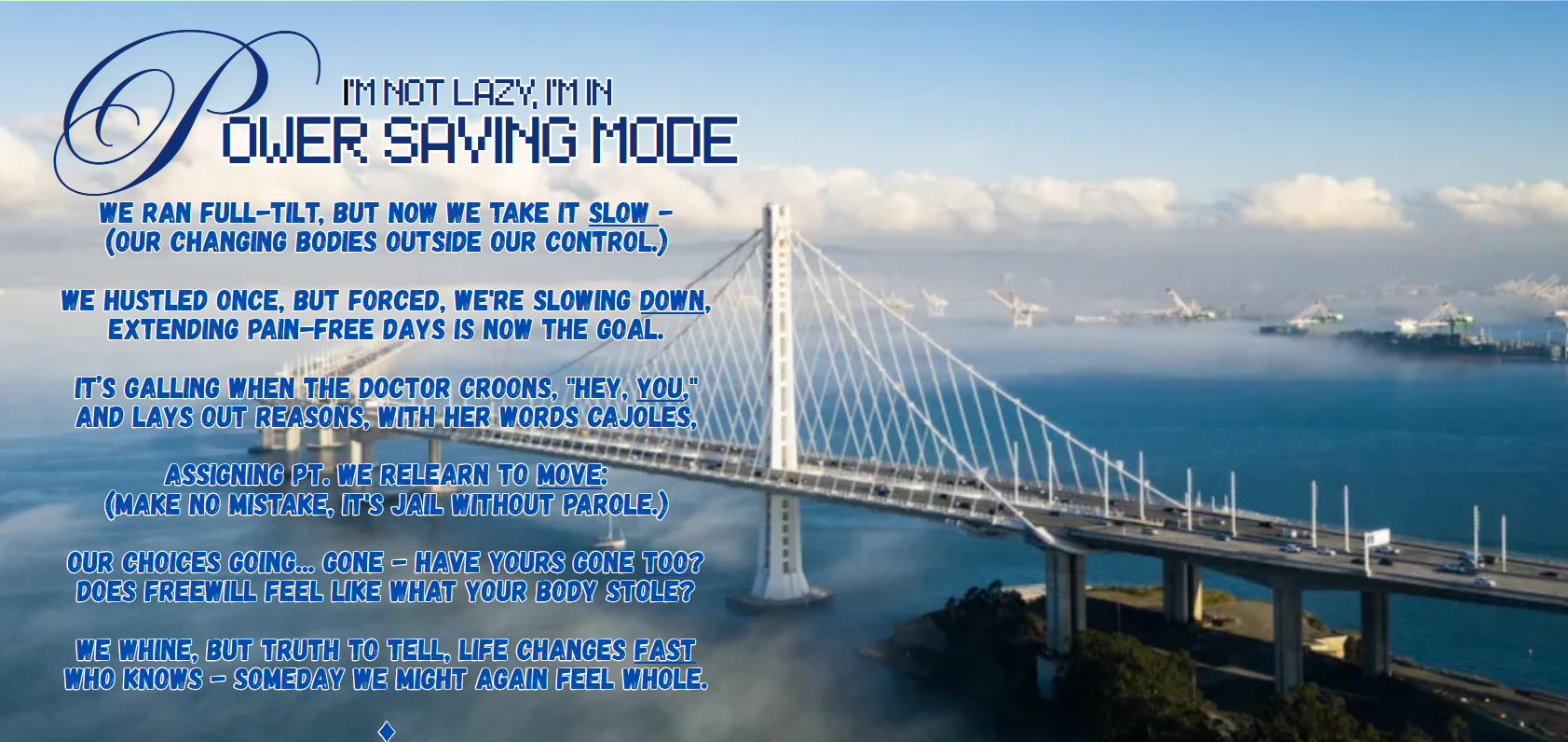
I’m Not Lazy, I’m In Power Saving Mode

We ran full-tilt, but now we take it SLOW –
(Our changing bodies outside our control.)

We hustled once, but forced, we’re slowing DOWN,
Extending Pain-Free days is now the goal.

It’s galling when the doctor croons, “Hey, YOU,”
And lays out reasons, with her words cajoles,

Assigning PT. We relearn to MOVE:
(Make no mistake, pain’s jail without parole.)

Our choices going… gone – Have yours gone TOO?
Does freewill feel like what your body stole?

We whine, but truth to tell, life changes FAST
Who knows – someday we might again feel whole.

This chronic pain crap may leave you downcast.
But keep the faith: Life’s mysteries are vast.

You’ll notice I’ve included a little envoi as if this were a sonnet. I don’t know – somehow today it felt like envoi were necessary? Additionally, the image is of the Bay Bridge in SF – not the well-known and fancily painted Golden Gate, but the plain old Bay Bridge which carries much of the common daily commuter traffic – not the 59th Street Bridge, but probably as pedestrian for people just getting to work or cycling across one bit of water to get somewhere else. Maybe the drivers are not yet feeling groovy, but having the potential for it…I like that link to joy in the ordinary.

Other Raccontino wrestlers are perhaps feeling pretty groovy or reveling in the ordinary as they share their forays into this form. I got a tiny preview Sunday and know that Tricia’s efficiently composed poem is here. Sara probably chose more chaos here, Mary Lee – always prepared – is here. Laura’s short and to the point is here, and we can’t wait to see what Liz has done. Karen rose to the challenge and wrestled her Raccontino here. Michelle K’s poem has punch, and we have a newcomer – let’s welcome Diane and her Raccontino to the Peep Squad. Margaret’s poem is here, and Carol V’s lovely poetry-filled post is here. More Poetry Peeps might swing by with their Raccontinos (Raccontini?) and I’ll round ’em up here by the end of the weekend.

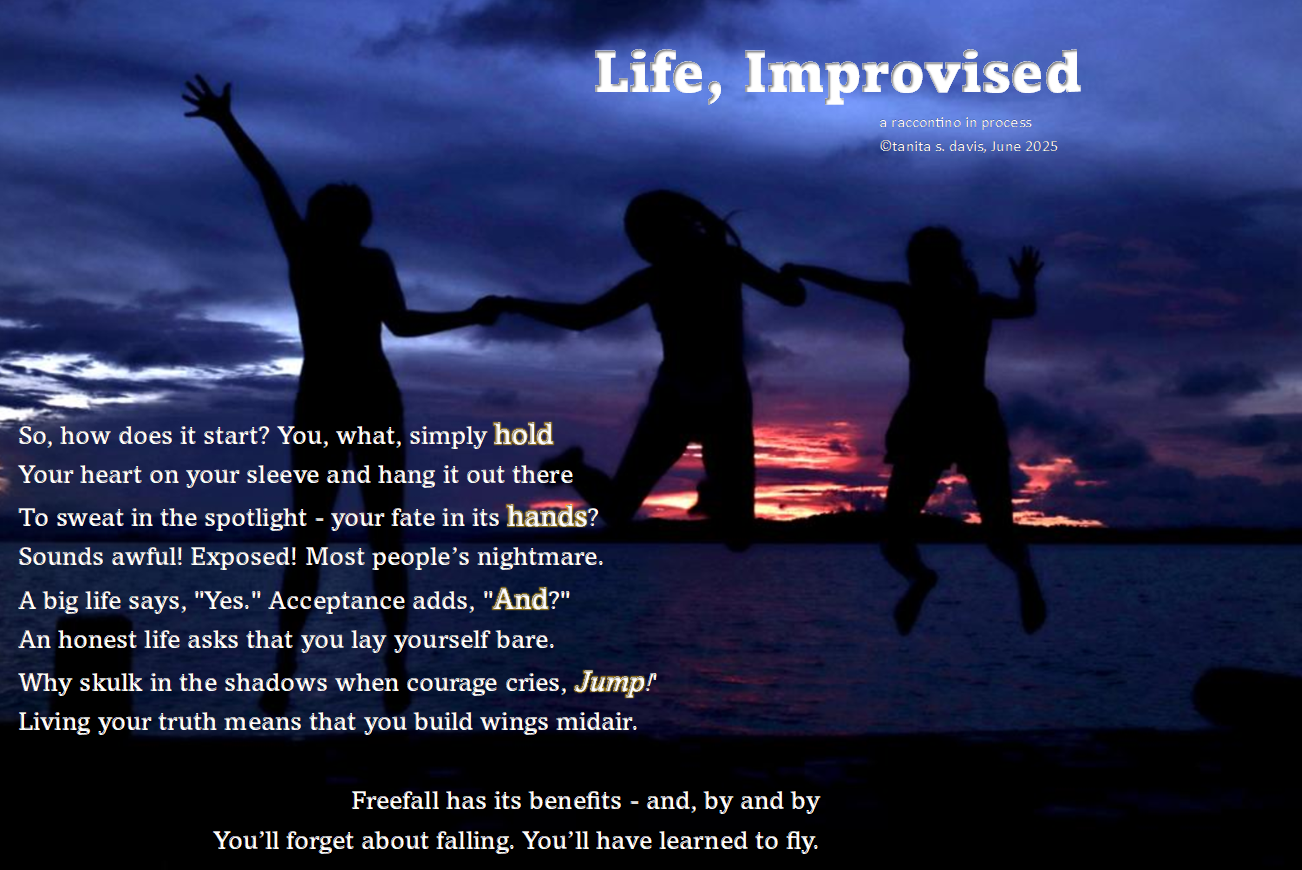
Life, Improvised

So, how does it start? You, what, simply hold
Your heart on your sleeve and hang it out there
To sweat in the spotlight – your fate in its hands?
Sounds awful! Exposed! Most people’s nightmare.
A big life says, “Yes.” Acceptance adds, “And?”
An honest life asks that you lay yourself bare.
Why skulk in the shadows when courage cries, Jump!’
Living your truth means that you build wings midair.

Freefall has its benefits — and by and by
You’ll forget about falling. You’ll have learned to fly.


My nephew graduated from high school nine days ago, and turned eighteen seven days ago, so the imagery of jumping into life – nervous, but holding hands – improvising, and learning to fly is definitely on my mind. The younger set remind us we all need a little help to get aloft – our neighbors, our chosen family and friends, and the community we need to keep close, now more than ever as the clouds close in. Elf’s fledgling flight might be a ragged one, with a bit of frantic flapping and barely missing crashing into windows at first, but if he falls, I’m counting on the rest of us to raise him up and run until he finds the wind again – into whatever extraordinary life is allotted to him. Whatever your age, may your circle do the same for you. May we never discount the power of community.

Look for the interconnected stories you’re telling, or have been told, and see where your narrative intersects. Remember that Yes. and And? are invitations to acceptance and connection. Know how well you are loved – and may it fuel you to love in return.

Happy weekend. Be well and do good.

{poetry friday: acknowledging hard things in poetry}

This is definitely not under the banner of my #winterlight offerings, because it’s not particularly encouraging, but rather… thinky. I’m grateful for the friends who have dragged me into poetry practice, and for my Deeper Dive poetry group, whose exercises help me to look differently at the poetry I read.

This week, my group read several mentor poems which touched on grief or despair, and using repetition, direct address and present tense voice lead the poem towards a commonality of experience, allowing the reader to both feel and release their own similar emotions. Yesterday I wrote a draft of a poem describing the rise and fall of Allensworth, CA, the first township in my home state to be founded, financed, and governed by African-Americans – the “Buffalo soldiers,” of the Civil War. I have been fiddling with the idea of writing historical fiction set in this town – or writing fantastical fiction about magical happenings in this town. All of this is still in the very bubbling-stew-of-imagination stages.

Today I’m attempting to look objectively at another poem from the Harlem Renaissance using the same tools as we identified yesterday. If this has a lot of the tone of an English paper, that’s because I think I fall back on the strategies that worked for me in my upper level English courses. Additionally, writing things down is sometimes a way that I further process and remember them. So, aren’t you glad to be here to crib my notes for the test on Monday? Enjoy! 😂

If We Must Die

by Claude McKay

If we must die, let it not be like hogs
Hunted and penned in an inglorious spot,
While round us bark the mad and hungry dogs,
Making their mock at our accursèd lot.
If we must die, O let us nobly die,
So that our precious blood may not be shed
In vain; then even the monsters we defy
Shall be constrained to honor us though dead!

(Do read the rest at The Poetry Foundation.)

Born Festus Claudius McKay in Sunny Ville, Jamaica in 1889, Claude McKay loved English literature and studied and wrote poetry as a young man – about his feelings, about the world around him, and about the things he observed. Logically, we know McKay observed a great deal of racism – both in his home nation, and during his lifetime in the United States. The themes of both his poetry and novels reflect this. The poem, “If We Must Die” is one of his best known, and most celebrated, not just among the Black community, but more on that later. The feel of the poem is, despite its formal tone, in some ways very American – very macho. “Mejor morir a pie que vivir en rodillas,” right? Better to die on your feet than to live on your knees. (This quotation attributed to Emiliano Zapata, 1877-1919, and quoted by FDR in 1941 when receiving an honorary doctorate from Oxford University – apparently meant to be encouragement to a war-stressed Britain.)

Many times, poems which deal in difficult topics use the natural world as a foil, pointing to the continuous cycles of nature as a contrast to the brevity of the human cycle. While McKay does mention hogs and dogs, he mentions them in a disturbing similarity to human beings – Black people chased down, cornered, and executed like hogs, white people like baying hounds, harrying them and running them down. While it at first seemed to me a departure from his animal metaphor when he urges the subject of the poem to make the ‘monsters’ pay for every drop of blood shed, I thought about how dangerous hogs are to come across in the woods. Even if you’re not hunting them, you don’t want to run afoul of them – they’re aggressive, and they’ll come after you if they’re even startled. Like the 1546 proverb said, “Even a worm will turn.” Even the meekest and most docile of the animal kingdom can be pushed too far, and the Black man McKay describes with such polished, formal language is apparently a man pushed outside of his natural bent for civility and calm – or, at least his language seems to imply that’s man’s natural bent, anyway.

That high-toned language and …the poem’s precise shine in general seems deliberate. The poem is a Shakespearean sonnet, with all of the structure this rule-bound form allows – and with all of the history and travel that the sonnet implies, from thirteenth century Italy to 1500’s England to the more recent pen of a Jamaican-born Black man. With this history and through this distance, McKay speaks to a certain kind of reader – to men, ostensibly, as the poem cries out to “O, Kinsmen!” at one point, and readers are encouraged to die “like men.” Those kinsmen could be American men, or McKay’s fellow Afro-Caribbean immigrants. Today I learned that there is an urban myth that Winston Churchhill (!!!! NB: there is no record of it, so this is wholly mythical and sourced from people’s memories at the time) read this poem aloud on the radio during the siege of London in 1940. Because this sonnet lacks specific identifying markers – the “We” who must die are called “kinsmen” and “men” and their oppressors simply “monsters” – the clarion call of standing with one’s back to the wall and fighting to the death, couched in the scholarly lines of a very European poetic form makes it allegedly relatable even to the Prime Minister of England. Who knows – maybe the poem is intended to speak to long-ago Italians and Englishmen as well. McKay’s direct address invokes whatever present moment the reader finds themselves in, which is often claustrophobically close in the ‘painful topic’ poem genre, and gives the reader a sense of tempus fugit – of a time that is fleeing, and so right this minute you must listen to the poet, and hear his wisdom, which may not be available beyond this epoch. I imagine the narrator running, ghostlike, along with a person fleeing a lynching, urging him to not just run but to consider stopping and making a last stand instead, to make the monsters pay. Even with these sterling words and high tone, though, it’s hard to imagine someone running for their life being very open to the whole thing.

The long-ranging discussion of violence and non-violence, of “By Any Means Necessary” and passive protest is present in this poem, but wrapped in the idea of nobility and honor. Is it better to “nobly die” not like a slaughtered hog, but “fighting back?” Or will you still be just dead? McKay definitely seems to believe that an honorable death is the best death – but the jury’s still out.

Thank you for coming to my English Lit discussion.

EDITED TO ADD: Can you believe that Susan @Chicken Spaghetti is also celebrating the poetry of Claude McKay today??? What are the chances?

{pf: p7 deconstruct construction}

Welcome to another Poetry Friday Poetry Peeps Adventure!

Poetry Peeps! You’re invited to our challenge for the month of November! Here’s the scoop: We’re taking a line or theme plucked from Jane Hirschfield’s TWO VERSIONS, a poem that appears in her collection The Asking: New and Selected Poems (scroll to the second page to see the poem). Are you in? Good! You have a month to craft your creation and share it on November 29th in a post and/or on social media with the tag #PoetryPals.


We laughed, when we met to talk about this poem… It sounded so easy. Just… build or take something apart. Deconstruct or construct something. Do it with detail. How hard could that be?

WHY DID THIS FEEL SO HARD????

Might have had something to do with the very busy month which included a multiplicity of medical appointments and running around with paperwork for various things, and finally getting around to voting (whoo!)? With all the noise, my poetic brain just didn’t seem to be beating in sync with me this month.

From Process…

The biggest issue I had with this wasn’t finding things to build and unbuild… I just felt like my attempts lacked any kind of poetic merit. Detail felt like the enemy of whimsy or beauty. I felt… mechanical, as I delved deeply into things. So, I tried to look at the natural world. I wrote whimsically of How To Build A Cluster (of Spiders). I wrote about ballooning – always a topic that inspires whimsical interpretation (because do I really know what it’s like to stick my bum in the air and trust my full body weight to the wind? No… I do not, and I never will). I attempted to write about building an attic extension, as I participated in that when I was in high school. I mudded drywall. I have built a dairy in Mexico, I smoothed cement stalls for the cows…

And somehow, none of that lent itself to poetry. It wasn’t the assignment, though. It was definitely ME. Maybe October just hasn’t been a poetical month?? Whatever my issue, I knew I was running out of time.

Fortunately, I wasn’t the only one who struggled – but my Poetry Sisters certainly pulled it together faster than I did! Liz’s post is here, and Mary Lee’s is here. Laura’s poem is here, and Tricia’s is here. Michelle K’s poem is here, Karen’s poem is here, Cousin Heidi’s maybe-her-rabbit is here. More Poetry Peeps may check in throughout the weekend, so stay tuned here for the full roundup, and thank you kindly, Carol V, for sharing her instructional trinet with us, and for rounding us up so beautifully this month!

…To Poetry

By last night, I knew I wasn’t going to be able to pull anything together in a timely manner, so I started looking at some of my previously abandoned attempts in an attempt to see what prompted me to quit writing on them. I know that poetic “feeling” is often in the eye/ear of the beholder, and hoped that I might be able to recapture something that went missing in subsequent lines. I… cannot honestly tell if I succeeded. Having begun and abandoned poetry about literal building projects, I began a rewrite in the metaphorical. Previously this had seemed like far too broad of an enterprise – how do you deconstruct an idea or a belief? It turned out that maybe you do the same things you do for a literal building – you get permits, and you begin demolition. What you do next is …up to you.

Construction/Deconstruction

to Everything there is a Season
and Now is the Time:
…but first, Permits.
The self demands Surety:
Do you know what you’re doing?

Once you cut the cables – Lights out –
You’re on your own, and –
Now is the Time to
Break up, break free, break through.
Your brain you’ve battered
Alone too long – take action.
Do you know what you’re doing?

Jackhammer your world into
Manageable pieces,
And haul the detritus away.
Because, Now is the Time
When order’s upended,
When baseboards are splintered,
Walls stripped down to studs…
Now your seeing’s believing –
Do you know what you’re doing?

Demolition debris cleared
reveals plain stone. Persistence:
And, Now is your Time
despite chaos and mess.
…a Life is built on nothing less.

If the answer to the question “Do you know what you’re doing?” continues to be “Um, no…” – in life, as well as in poetry, sometimes the answer is just… keep going. And once you’ve gotten down to your foundation, see where it needs shoring up, do the work, and rebuild. Honestly, a life – an idea – a dream – really is built on nothing less. We build by putting on brick atop another, pressing them in place, and going on to the next brick. And that is also how we persist – and succeed. In the words of Octavia Butler, So be it, see to it. You are the builder – so build it.

Happy Weekend, friends.