{constant reader reads: not only anne}

Dear TBR,

When nine-year-old me first stumbled on a 1930’s edition of ANNE OF GREEN GABLES in a pile of discarded books, I was mainly interested in its thickness, and the fact that it would mean several hours during which I could escape the airless and stifling eternity that was summer vacation. The book itself was mysterious – cloth-bound and hardbacked, covered only in a woven white and green baize and lacking a dust cover, so the title only appeared faintly on the spine. Who was Anne? Where was Green Gables? Later I would be intrigued by the internal landscape of a very weird girl, and her wide vocabulary of unknown words which I nonetheless employed with confident inaccuracy – turning heads with my increasingly foreign pronunciations and effusive expressions, becoming more and more the “white girl” I was often told I spoke like. I can’t really blame Anne for my complete weirdness as a child – but I can say that I welcomed the knowledge that someone else was an entirely square peg in a round hole like me. As a white, Canadian, Victorian possessed of prejudices and a touchy pride that I didn’t have, we weren’t twins, but we were definitely kindred spirits. I read that book over and over and over that summer and for many years, annually – because Anne’s emotional interior, if not her skin tone, time period, or even her concerns – was all me.

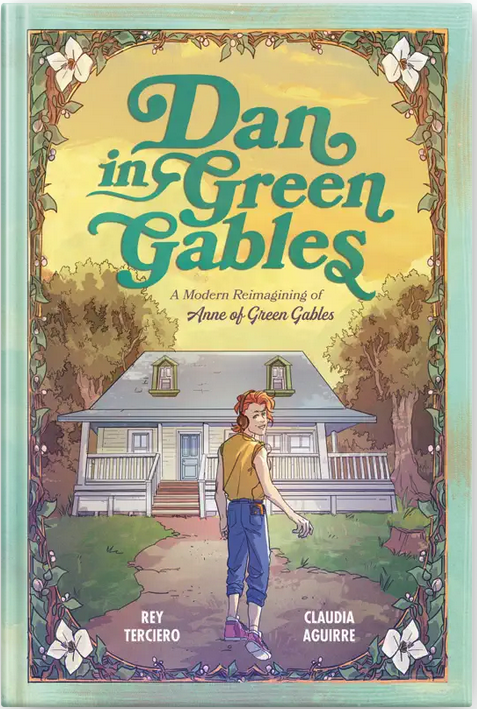
Anne Shirley, though first of her name, was not alone. There have been multiplicities of Annes, from the Japanese spin-offs of the 70’s to the more recent adult adaptations – Anne in Philly or whatnot. They’ve all been female, though… until Rey Terciero most recent graphic novel. DAN IN GREEN GABLES. Did the world need another Anne? Not necessarily – but though the emotions of the book are true enough to have made a space for many, they didn’t make a space for everyone… perhaps the author felt there needed to be a specific place for LGBTQ readers. In Terciero’s version, Dan isn’t orphaned – at least in his own mind. His Matthew and Marilla are, instead of geriatric siblings, grandparents – his. And rather than having only one kindred spirit, Dan’s world extends and expands to include two – in different ways – and numerous lighter bonds of relationships which nevertheless create the web which suspends him above the lava of his own emotions at times. Since Anne’s story is familiar I won’t go into the details, nor is this meant to be a beat-for-beat comparison between the original and Terciero’s newer work. The details differ, but the heart is the same.

When Dan’s mother takes him, after years of it largely being the two of them against the world, to a little house in the Great Smoky Mountains, he doesn’t know where they’re going – or why. He only knows his mother is in a ‘mood.’ It’s a shock when they roll up to the home of his paternal grandparents. Conservative farm folk, they live quietly and mostly contentedly within their church community, so a couple of itinerant city-dwellers who sometimes sleep in the back of their truck is quite a disruption. A further disruption occurs when Dan’s mother immediately argues bitterly and vociferously with his grandfather – and then slips out in the middle of the night, leaving her teen-aged son behind with essential strangers. Though he’d met his grandparents as a small child, Dan doesn’t remember them – at all. His mother has never talked about them, or even his father very much. He knows nothing – and as an expressive gay teen is as welcome as an ulcer to his tightly wound, judgmental and homophobic grandfather. While his Mawmaw is ready with armloads of unconditional love, it’s apparent that even she can be made uncomfortable by Dan’s flamboyant appearance and wounded by his touchy temper which occasionally lashes viciously from the depths of his fear and grief at being abandoned. Dan’s wounds, questions, doubts, and determination are very Anne, and would have resonated with nine-year-old me, even though neither our skin color, nationality, gender, nor concerns are the same.

Dan, overall, is Anne – crushed by disappointment and mockery, hiding deeper heartbreak, salty and snarky, flying off the handle and jumping to conclusions, elated and ebullient, hopeful and hilarious – all that made Anne-with-an-e relatable makes Dan the same. As in the original book, religion is a cornerstone element of Dan’s story, as his grandparents are church cornerstones, and his deacon grandfather is deeply concerned with how they appear as a family to their church community. Some readers may be uncomfortable at the characterization of some Christians – accurate, though rather damning – but others will feel relieved to find the words for what they may have thought, questioned, hoped for, or affirmed in the depiction of others in faith.

Resilient, inclusive, quick to anger, quick to forgive, willing to examine his own behavior and to see the world through another’s point of view, Dan has all of the genuine, personable human elements that gave Anne such well-loved main character energy. Definitely imperfect and thin-skinned – he is learning to be a person in this book, as well as learning to be someone cared for, instead of a caretaker – Dan’s road is full of missteps. He is just as exasperating as Anne was when she first came to Avonlea – and like Anne, Dan grows and changes. To my mind, he becomes even stronger in this single volume than Anne learned to become in two. People who fear that this version of Anne of Green Gables is merely a faded imprint of a saccharine-sweet character who goes on to Do Good will be relieved. People who love beautifully drawn graphic novels will be delighted – in these images Dan is colorful, expressive, and beautiful, and Avonlea is the perfect time capsule of a Appalachian farm town. I came to this book surprised by how well I liked it, and wistful that it was a graphic novel that doesn’t go on forever. This gave me the experience of coming to Anne of Green Gables for the first time, all over again.

I’ve carried my nine year old self and my first encounter with Anne Shirley with me for the whole of my life – I imagine that Dan in Green Gables will become a strong and portable fragment of someone’s heart – and hope – for a lifetime as well.


Fresh onto the TBR:

  • Darksight Dare, Lois McMasters Bujold
  • The Saltwater Curse, Avina St. Graves
  • Behind Frenemy Lines, Zen Cho


Until the next book, 📖

Still A Constant Reader

{constant reader reads: HEAs & HFAs}

HEA. HFN. The fairy tale staple of “happily ever after” is a rather limited construct in kidlit novels, as one has to ask, what does “ever after” mean when you’re thirteen or sixteen or even eighteen? Does a YA or MG novel really support a forever sort of bliss? Probably not – but in my continuing quest to read All The Tween Love Stories, and so support my editor’s goal of me actually writing one, I occasionally ask the question…


WE COULD BE MAGIC, Melissa Meyer and Joelle Murray

Tabitha, like many other girls in her universe or ours, grew up on a steady diet of “princess” – in books, games, and movies via a franchise called Somerland created by a fictional author named Winda Somers. From a very early age, Tabi knew the movies word-for-word, had her own understanding of the villains and heroines, and believed with all her pure heart that love conquered everything… thus her parents’ divorce crushed her little heart. She didn’t understand and couldn’t accept the end of everything she’d understood, so in an attempt to help heal her broken heart, her father takes her on a Daddy-and-Me trip to Somerland… where she finds her next goal: she’s going to return to Somerland as a princess in her own right someday. Fast forward to high school, and Tabi’s finally old enough to make her case to the interviewers, telling the story of how her broken heart was mended as a small child, asking her favorite prince and princess pair to please love each other forever – unlike her own parents. She gets the job, and is overwhelmingly excited to turn up for orientation, eager and bubbly and still a believer in the magic of the stories of princesses and villains and heroes that shaped her heart when she was young. But right away, it’s clear that there are actors… and then there’s The Story. For some kids, taking part in The Story is just a summer job, not a chance to be the magic that helps some child get through a rough moment in childhood. And as it turns out, The Story is not even Tabi’s job – she gets relegated to the nacho stand, completely unready for all the dance steps, all the work, all the sweating in character costumes that is part of the work they do to make magic. After working long enough to land an audition, Tabi realizes she was unprepared for reality, and needs to do a lot more work to make her dream happen. Somerland isn’t a walk in the park for the workers – and not all of the people who are inhabiting the princess costumes at the park aren’t like she’d expected. Not everyone is bubbling over with the joy of just being there – and some of them are wondering if Tabi, curvy and short – has a place there when the royalty they’re all trying out for are svelte and slim and tall. But what keeps Tabi from feeling completely discouraged is her new friend, James, who believes in her, and the magic that brought her there. And, as James shows Tabi the real park, and encourages her to trust in her own magic, she solidifies her belief that royalty comes in all shapes, hues, and sizes, and that we are the magic in The Story – always.

Yes, Your Serpentine Excellency, Kate Stradling

Joanna Marlow is… humiliated. The man who she was dating with has turned out to be a thief – and a gambler. He’s stolen her heirloom glowstone brooch, and so now she’s following him to the gambling house where he’s going to use it as an entry stake, in hopes of nipping in and stealing back her heirloom without having to have an ugly confrontation – where he’d be sure to try and lie his way out of things. Joanna is not a fond of chaos, of discomfort, and most of all, not a fan of confrontation. Courting has turned out to be – for the last time – humiliating and uncomfortable. She’s done. She’s resigning herself to spinsterhood and her cats. Unfortunately, there’s a complication – Joanna’s nearly caught and skips into what she thinks is an empty room in the gaming house – which instead houses a dragon. Who decides to follow her home.

Joanna neither wants nor needs a dragon. Additionally, this is a talking dragon, who somehow finds her house halfway across town and just lets itself into her living room, which has wards and blessings on all the doors and windows. Since Joanna lives on Marlow Hill with her entire, nosy, bossy family – who are all far too interested in maintaining the boundaries of their closed neighborhood – she knows he has to go. Magical beings are all conscripted into military service or the church in this kingdom, and skips have historically been conscripted by the crown to be assassins. Joanna’s family is protective of her – the only one of them to serve the church for five years – and they keep their neighborhood tightly regulated for a reason – to keep chaos and danger away from them, their elderly, and their children. Unfortunately, a dragon brings its own chaos – first in the form of the master of the gaming house from which he came, next from a series of gullible young heiresses who believe he’s a soothsayer and pay dearly for his “advice,” and finally from a high-powered mage carrying a deadly spell from one of the magical mob Families in the kingdom to take “her” dragon back. Joanna’s life… which was meant to be that of a quiet spinster working her courier job and taking care of her cats – has taken a decided turn for the chaotic… and that chaos seems to go through all the magical Families in the kingdom, and perhaps right on up into the King’s court. Nothing that Joanna thought is as it seems – herself, her family, and least of all, the dragon…

The Last Hope School For Magical Delinquents, Nicki Pau Preto

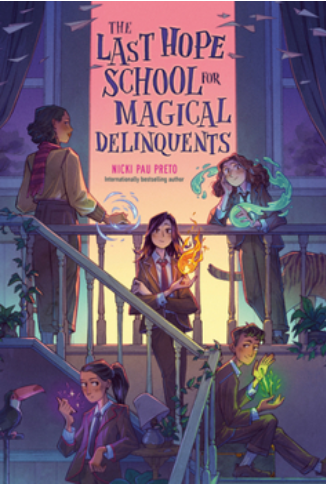
Lavina Lucas – Vin, to herself, since she has no real friends – has spent the last several years being a magical disaster. Somehow, no matter which school for budding magicians she’s sent to, everything goes wrong there. It’s never what she wants, but it’s always what she gets. Smoke. Explosions. Floods. Broken furniture. Broken bones. Disasters, major or minor, sooner or later find her hauled to the principal’s office, and then before the school board. With grim faces, she’s told that she’s an aberration – a danger to others – and absolutely not allowed to stay a moment longer. When Vin’s latest expulsion finds on the steps of The Last Hope school, Vin is… resigned. She is the magical delinquent they’ve named her, and there’s no hope – this placement isn’t going to go well either. Soon the kids will be gossiping about her and trying to bully her like they always do, and soon her magic will explode out of her, destroy glass and pipes and benches and desks and —

Somehow, though, The Last Hope is different. First, the Headmistress is… kind of amazing. She listens, and Vin is slowly beginning to believe that she might be an adult who actually tries to understand her. Vin is assigned fellow students to help her get settled. Gilly, Theo, and his sister, Araminta, are …nice to her. Oddly nice. Sure, there are still some hiccoughs – chaos seems to follow Vin regardless of her wishes – but with her new friends, things get settled, reversed, and …solved. Life becomes bearable – then more than bearable. Attending school with friends is a fragile treasure that Vin wants desperately to protect, so when she discovers that the school is facing a true threat from the so-called Free Mages, she throws herself at the threat bodily. When you’ve found a place to call home, it’s life or death to protect it. (This is the first of three books, so I’m being a LOT more vague with the plot, so as to avoid spoilers.)

Three vastly different magical books, but a similar unifying theme – happily ever after arrived at through having a place to belong, owning one’s literal or metaphorical magic and being allowed to simply be. This the type of happiness of which most tweens and teens – and people of any age – can dream. What I think is the best part, though, is that each of these books, in their own way, model how to create a HEA for someone else. #goals


Fresh onto the TBR:

  • Darksight Dare, Lois McMasters Bujold
  • The Saltwater Curse, Avina St. Graves
  • Camp Frenemy, Liz Montague


Until the next book, 📖

Still A Constant Reader

{npm ’26 • 30 – & Fin}


This morning, Liz said she’s already like a mother who has forgotten the trouble and travail of childbirth, already halfway to missing the daily hour (or in my case, sometimes two or more) of this month’s practice of poetry. And I’m with her – taking a deliberate space of time to do anything on purpose – to no purpose – is near impossible, and my brain and my body already crave the unfocused-focus of deliberately creating poetry with art supplies and open eyes. Despite beginning this on Easter Weekend – not traditionally a “quiet” time if you’re a church chorister – this practice gave me a little quiet – a little arbitrary time wherein I could loftily recuse myself from the world, citing Art. Mind, I write books, but somehow my brain can make that – with its entreaties and appeasement, with its pushes and pulls from readers and revisions and editors and such – much more mundane. That’s just “work,” that is attached to Filthy Lucre, despite the fact that it is, in my heart of hearts, still quite magical to create worlds and escape into them. But poetry – especially since I only have two anthology credits to my name thus – is still somehow …far Different.

Hah. Whatever I have to tell myself, I guess.

It would be a simple matter to extend this Artful Practice a bit – to try to at least get a little sketching and coloring in, but to be honest, it’s hard to justify. It’s time-consuming. It’s resource-consuming. And it pokes the voices in my head that remind me that there’s always something I should be doing – who am I to be skivving off of paying work or not Helping Others or Doing Good with my scant moments on this Earth? The idea that we are not enough on our own to make art or enjoy it is… destructive. And, unfortunately, how I was raised.

The self who I was would be astounded – shouldn’t All be known by now? Wasn’t adulthood meant to Answer All Questions? Who would have though that officially in Middle Age now I would still be so uncertain? But I am uncertain enough to make art, uncertain enough to learn and unlearn, and uncertain enough to still question and change. So as frustrating and difficult as it is to be myself sometimes – and ye squirrelly squids and monsters it is not simple – I guess the uncertainty and discomfort is…necessary. Vital for my personal…formation or whatnot. So, I’ll take it. I’ll keep this self, O Mighty Pen.

That’s what the month of observation has been to me – space for self-examining, deliberately censoring the world without as much as possible. All month long I’ve considered what I can see, peering through windows, looking out of in-groups and into spaces where I am not myself a member. It’s odd how closely aligned middle age is with adolescence; the same observable dance of declaration and denial, of conviction and conjecture. Amidst the swirl of alliance and estrangement, the same echoing queries of “Where do I belong in all of this?” remain. The answers resist simplicity as they always do, while the same conclusion comes – I simply am. I don’t know if that answer shapes who I became as a writer, or only writers can give it, but on the edge of the dance floor, I simply exist – and watch. Looking for how the gears mesh, and where the locomotion takes us.

Blank Page

A heart is
a vacant
city lot,

a pristine
prepped canvas:
potential.

who we are –
what blooms here –
our choosing.


Thanks for being along for the ride. If you’re aiming to catch up with everyone’s National Poetry Month projects for this month like I am, don’t forget that Jama-j has kindly kept a running roundup of everyone’s efforts. Happy Thursday, friends, see you next time – and remember you are so, so loved.

{constant reader reads: eccentricities and enchantment}

Dear TBR

Sarah Beth Durst’s The Spellshop came out in 2024, and like tons of people, I loved it immediately. We’re old Durst stans here, and have been reading and reviewing her books since she first started writing them, but this one was for adults, so we expected …something different? We were excited to find that, writing for adults or teens, her books are always the same – full of eccentricity and enchantment. In this case, the eccentricity is at first the main event – the main character, Kiela, has a talking spider plant (as one does). After the fall of her government, Kiela has has fled her job at The Great Library – taking as many books as she can cram into her boat as the city is engulfed in flames behind her. With nowhere else to turn and zero ideas, difficult, prickly Kiela goes home – and “home” – a weird place full of weird people she never thought she’d have to go back to. But, while the saying goes that you can’t go home again, it turns out that you can – because not only does going away change you, sometimes with your new eyes, you can see that home often changes, too. This book was the low stakes, low angst book that a difficult 2024 needed, and I was surprised when I saw that she’d written a companion book. What, I wondered, could still be left to say about that tiny, perfect microcosm of a book? As it turns out, nothing. And yet –

THE ENCHANTED GREENHOUSE: Caz, the sentient spider plant has an origin story which is only mentioned briefly. Terlu, his maker, was not a magician, but a librarian – and thus was turned into a statue for her crime of unauthorized magic use. The second novel in the duology begins with her trial where the reader discovers her crime stemmed from sheer loneliness, and the reader gets a sense of how horrible her sentence will be for her – she only ever made a talking plant to have someone to talk to… Six years after being entombed, Terlu experiences a sudden awakening in a wholly new place, one filled with snow, but nearly empty of people, save one. Best of all, this empty place is nearly overrun with… greenhouses. Ten thousand of them, or nearly so. Who would have sent her – in statue form, no less – to a deserted island filled with greenhouses? What is she supposed to do there? And, how safe is she? Will the magicians run her down and drag her back to the endless slow silence of being a statue? And, whatever happened to Caz?

This may seem like a book where nothing happens – and in a manner of speaking, this is true. Terlu sleeps and wakes, she eats – a lot, because she’s missed a lot of meals being an enchanted statue, and food is amazing – and she …worries. She tries to help keep up the greenhouses. She tries to be… useful. But there’s only so much you can do if you’re afraid of doing anything wrong for fear of …everything. This journey depicted here is small – Terlu moves from being a frightened, shamed unauthorized magician to being a determined person who makes choices not out of desperation, but with a clear mind. It’s a book about second chances – mainly giving yourself one. And it is cozy and kind and lovely, and a slow read with descriptions of beautiful plants, beautiful food, and the beautiful sense of belonging.

THE FARAWAY INN opens with the same sense of sweetness, though with a considerably tarter and more modern angle. Calisa is sixteen and going into her senior year, and very, very, very unhappy with her erstwhile exboyfriend, who she caught literally with his hands…where they ought not be. In a bid to get herself some distance from the disaster, Calisa heads away from New York to the wilds of Vermont for the summer, and for her Great Aunt Zee’s house. She’s not been there since she was quite small, and barely remembers it. It’s certainly not the floral extravaganza she recalls – it looks rundown and really awful, and to make matters worse, her Auntie Zee tells her she can stay exactly one night, and go home. As it turns out, Calisa wasn’t exactly invited, her mother and her aunt are in the middle of something that’s gone on for years, and Calisa is now the unfortunate recipient of a lot of unresolved feelings.

The thing is, the place clearly needs her help. And, Calisa really needs to not go home back into the orbit of the cheating, lying exboyfriend. In a blatant attempt to make herself useful enough to stay, Calisa begins to clean and organize and bustle – and discover that not everything at the rundown old inn is straightforward as it seemed… The guests are more than a little strange, and there are things no one will explain. As it turns out, nothing about the Faraway Inn is at all as Calisa believed…

Like many fantasy books, the age of the main character doesn’t matter as much as it would in many YA novels. Within the realm of the Hero(ine)’s Quest, the call to adventure simply… comes. Calisa arrives at the end of this book well beyond where most high school seniors would be, with her mind on a future that is already a bow-wrapped Happily Ever After. It’s a lovely, effortless, escapist read in the best of all ways. I appreciate that the author puts in an afterword about the idea of escapism, and what a gift it is – a deep breath before the plunge. If you can get your hands on either of these books, do – the respite is lovely.


Fresh onto the TBR:

  • The Testimony of Mute Things, Lois McMasters Bujold
  • The Saltwater Curse, Avina St. Graves
  • A Blacksmith’s Guide to Dragon Rearing, Julia Huni


Until the next book, 📖

Still A Constant Reader

{npm ’26 • 29}


the appearing

nothing more
magical:
appearing,

cutting through
all the noise,
a seeding

whimsically
reminding
You Are Here.

“I took a deep breath and listened to the old brag of my heart. I am, I am, I am.” – Sylvia Plath

I don’t like to show the images I draw from – I really am dreadful at depicting reality – but the frilly little seedlings near the foot of this Italian fever dream of a fountain shepherdess or whatever (the thing has a giant crack in the base, so it’s doubly ridiculous) – are everything good.

Every single year, I find something to observe which gets me shaking my head all over again. Observing the seedlings this morning in two hour increments has been WILD. I am literally watching them grow, millimeters higher every time I look. I may get nothing else done today but looking. How little I care.

{npm ’26 • 28}

If you haven’t yet had the opportunity to read the final lines of the Progressive Poem, the official version wraps up today. Some days I had my doubts with how we’d finish, as this one meandered through a poetic landscape named for poets and inhabited by books – and feathered words – and imbued with the presence of Earth which added (perhaps) real birds. What was so clearly felt was how much we all wanted to put into it. I’m grateful for the deft pens that kept us on the map and out of the weeds. The books – the birds – the trip? – has been brought safely home. It’s been a ride – as always, a testament to community, and the ability of wildly different poetic personalities to nevertheless produce something lovely.

Meanwhile, it’s been a ride around here, too. Today I have another double tricube – a Delian cube? A rhombic dodecahedron? – but we’re nearly finished with the month, so I have to toss the rules at least once or twice… Also, please ignore the words in the drawing for the typed ones, as the typed version is accurate.

chapel

sun yellow
a pint-sized
cathedral

mute, witness
commonplace
sacraments:

recitals,
spelling bees,
services.

one hundred-
and fifty-
two years

neighborhood
cornerstone,
welcoming

one more crowd –
a grand night
for singing.

I occasionally get to sing in the Boy’s recitals if they need a soprano to sing as part of someone’s opera chorus or backup singer – it’s a hoot, and requires a bit of scrambling to learn pieces sometimes. This year, all of the voice students are singing It’s A Grand Night for Singing from Rodger’s and Hammerstein’s 1945 musical, State Fair, and it’s such a delightful rollicking piece of music. The little yellow chapel, bright and acoustically live, perfectly lends itself to the gloriously Technicolor gratuitousness of it all.

{npm ’26 • 27}


turtles under ice

my bubble:
encircling
exclusive

occupies
existence
excluding

anyone
else awake
unnoticed

(This poem was in part inpired by Turtle Under Ice, by del Juleah Rosario, review to follow soonish)

I like that tricubes as a form can occasionally be read in more than one way. If we add a comma after ‘existence,’ a period after ‘excluding,’ and a question mark after ‘unnoticed,’ the poem reads one way. If a period comes after ‘else,’ it reads another way. (I am also deeply annoyed to have used exclusive and excluding in the same poem. These are the fruits of quick drafting – and finally, after NPM is nearly over, I’ve gotten the poem part down to about fifteen minutes…) I also think of the person who allegedly brought a weapon into a dangerous place this weekend – their manifesto, if genuine and unstaged, saddens me. How tragic that anyone suffering this current moment would think they suffer it alone. How fragile we are, locked in separate darkness, in our bubbles. Is anyone else awake?

{npm ’26 • poetry friday progressive poem line}

You are HERE! Welcome to today’s stop on the The Land of Poetry tour!

For a bit of history: The Progressive Poem began with Irene Latham, who hosted it from 2012-2019. Those archives of the poem can be found HERE! Margaret Simon took over in 2020, and those archives are HERE.

The rules state:

  • The poem moves from blog to blog, with each poet/blogger adding a line.
  • Topically, the poem is intended for children.
  • Each poet/blogger must copy the previous line exactly as written, unless permission from that poet has been given.
  • After presenting the poem to date, the poet/blogger may add their own line, offering an introduction if they wish.

There’s no rule that the poem rhymes, but this year, there’s a definite rhyme scheme that we’ve worked hard to continue, and a very Earth forward sentiment with all this burgeoning life metaphorically embodying the poetic elements. It’s been wild, but I really love where we’re heading, and… okay, I’m stalling. So now, without further ado…


Map by Tabatha Yeatts-Lonske, with progressively more creative additions by a multitude of poets.

The Land of Poetry

On my first trip to the Land of Poetry,
I saw anthologies of every color, tall as buildings.
A world of words, wonder on wings, waiting just for me!
Birding for words shimmering, flecked in golden gilding.

Binoculars ready, I toured boulevards and side streets,
exploring vibrant verses, verses so honest and tender.
feathery lyrics, bright flitting avian athletes
soaring ‘cross pages in rhythmic splendor.

In the Land of Poetry, I am the conductor,
seeking oodles of poems that tug at my heart,
a musical medley of sound and structure,
An open mic in Frost Forest! Wonder who’ll take part?

There’s a pause in the program; no one takes the stage
the trees quiver, the audience looks up. Raven lands,
singing Earth’s message of the sage.
“Poetry in motion will be forevermore, from forests to sands.”

“Scatter,” she croaked. “Beyond Wilde Pond, to each and every beach.”
Meek Dove mustered courage and sang, “Instill humanity with compassion and peace.
Let Thackeray’s middle name, from this thicket, hearts reach!”
Her gentle coo-ooo-ooos reverberate, soft as fleece.

Words dart, dimple—Do I dare warble what’s in my soul?
I’ve inhaled inspiration…yes, I’ll risk my refrain.
I fly to the mic, chanting “Tadpole, mole and oriole!
Come all living beings from water, land, air; come high and low terrains!

Come, living your poems, hearts open, ablaze,

…and now, over to you, Sharon! Please feel free to add a closing quotation if you feel the Poet spirit has finished her statement with my line, but otherwise… Enjoy!


The 2026 Progressive Poem Poets Include:

April 1 Tabatha Yeatts at The Opposite of Indifference
April 2 Cathy Stenquist at A Little Bit of This and That
April 3 Patricia Franz at Reverie
April 4 Donna Smith at Mainely Write
April 5 Janice Scully at Salt City Verse
April 6 Denise Krebs at Dare to Care
April 7 Ruth Hersey at There is no such thing as a God-forsaken town
April 8 Rose Cappelli at Imagine the Possibilities
April 9 Margaret Simon at Reflections on the Teche
April 10 Janet Clare Fagel at Reflections on the Teche
April 11 Diane Davis at Starting Again in Poetry
April 12 Linda Baie at Teacher Dance
April 13 Linda Mitchell at Another Word Edgewise
April 14 Jone MacCulloch at Jone Rush MacCulloch
April 15 Joyce Uglow at Storied Ink
April 16 Carol Varsalona at Beyond Literacy Link
April 17 Robyn Hood Black at Life on the Deckle Edge
April 18 Michele Kogan at More Art for All
April 19 Kim Johnson at Common Threads
April 20 Buffy Silverman
April 21 Irene Latham at Live Your Poem
April 22 Karen Edmisten
April 23 Heidi Mordhorst at my juicy little universe
April 24 Mary Lee Hahn at A(nother) Year of Reading
April 25 Tanita Davis at {fiction, instead of lies}
April 26 Sharon Roy at Pedaling Poet​
April 27 Tracey Kiff-Judson at Tangles and Tails
April 28-30 wrap-up by Tabatha Yeatts at The Opposite of Indifference