Blog

{pf: poetry peeps summon a haiku sonnet}

Welcome to another Poetry Friday Adventure!

Poetry Peeps! You’re invited to join our September poetry challenge!

Here’s the scoop: this month our delightful challenge comes from Colby Sharp’s book THE CREATIVITY PROJECT on page 257: “It was all my fault.” Peeps will be writing a poem that uses either this exact phrase, the idea of fault mentally, physically, or spiritually, things being your fault, somebody or anybody else’s fault, or nobody’s at all – this phrase is really a jumping off point for you to create a poem that speaks to you. Are you in? Good! Be ready to share September 25th in a blog post and/or on social media with the tag #PoetryPals. See you then!


Dear ones, this will be a short post. I am six thousand words from hitting my word count, writing flat out to hit an early September deadline (and itching to begin the all-important pare-down-and-polish stage of revision), so am so grateful that our prompt this month was relatively simple. Of course, relatively is an important word here. A haiku or a sonnet are their own delight, and the two together give one the opportunity to write a string of haiku with an envoi. I was prepared to lock in topically with a bright effulgence of natural wonder. I had thoughts. I had plans! Of course, as always happens, a throwaway comment derailed me entirely.

As I am dead serious about deadlines, I had to phone a former student to decline an invite to her mother’s birthday party (It’s a Zumba party. Can you think of another fête so delightfully original? Ice water, Latin music, and a built-in end point: et voila, perfection.) My autoimmune disorders parcel out even more limited spoons under stress, so I must prioritize. “We really need to reschedule,” my friend said. “It goes by too fast – we need to make time.” Remember I said she was a former student? I subbed seventh grade science while she blushed tomato red through reading aloud about the mating cycles of grasshoppers. It is bittersweet to hear someone in her thirties say that life is going too fast – and yet, like all of us, she knows. She’s lost family members and friends.

“Gather ye rosebuds,” my English major hindbrain lectured. As thoughts often do, that one seeped into the haiku I constructed. I am generally obsessed with season changes and autumn is low-hanging fruit for rhapsody, but I was firmly set on NOT doing that this time, and …well, here we are. Next time, friends. Next time.

Peeps who understood the assignment better include Tricia, whose post is here. Sara’s post is here. Liz’s post is here. Mary Lee’s post is here. You’ll find Laura’s poem here. Karen E’s is here, and Margaret still life poem is here. Linda Mitchell’s poem is here. More Peeps may pop in throughout the weekend to post their haiku-nets, so check back for the full round-up, and I’ll post ’em as I find ’em. Poetry Friday meanwhile is graciously hosted this week by Mona Voelkel – thank you for accompanying us on a joyride this week, Mona.

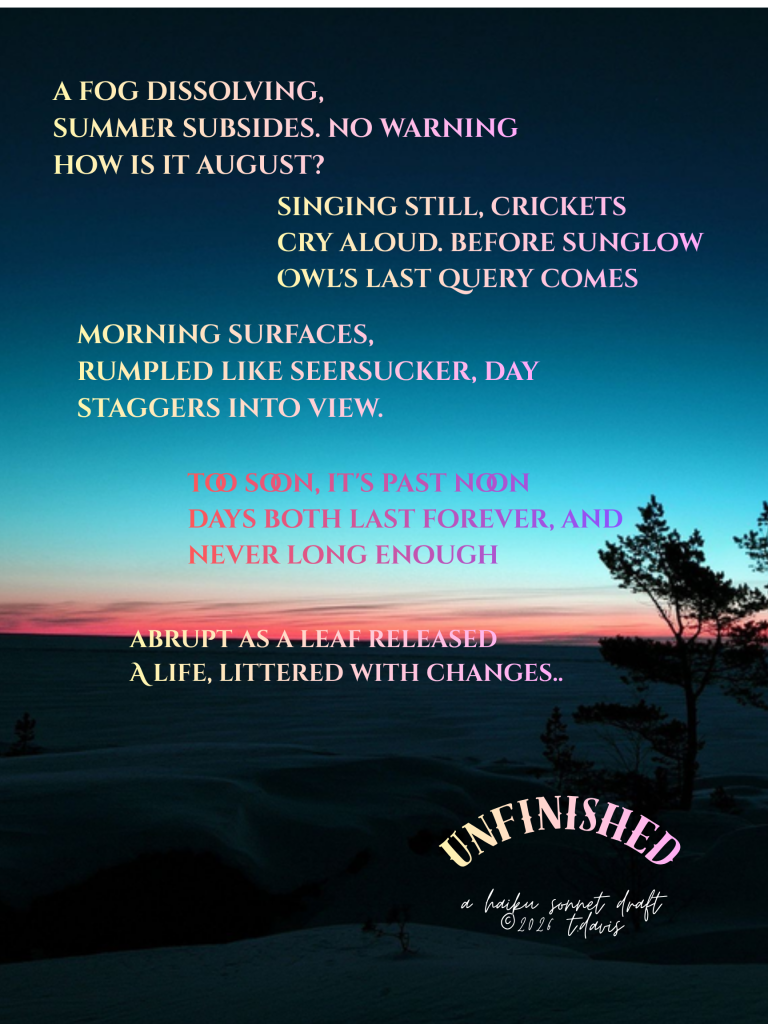
Unfinished

UNFINISHED

a fog dissolving,
summer subsides. no warning
how is it august?

singing still, crickets
cry aloud. before sunglow
Owl’s last query comes

morning surfaces,
rumpled like seersucker, day
staggers into view

too soon. it’s past noon
days both last forever, and
never long enough

abrupt as a leaf released
a life, littered in changes

I’m back to it, beloveds. Those going back into the classroom or the library, I see you. Those dealing with insane schedules, too many responsibilities and things bearing down on you – boy do I see you. Even if nothing feels as it should, and you’re being required to pull a rabbit out of a hat that only holds guinea pigs, know that you can relax in your weirdness, your mistakes, and your random coping mechanisms because you are just fine and enough and perfect as the light of a clear blue morning. Before you know it, you’ll have done the thing!🎩 As always, you are so, so loved.

{pf: poetry peeps reprise Padraig’s pantoum}

Welcome to another Poetry Friday Adventure!

Poetry Peeps! You’re invited to join our August poetry challenge!

Here’s the scoop: this month, we’re doing haiku…sonnets. If your response is a baffled “What?” no worries. Basically four 3-line haiku plus a couplet of either 5 or 7 syllables equals the traditional 14 lines you’ll find in a sonnet. If you haven’t written a sonnet, or “little song” in a minute, Folger has a Shakespearean guide, while the Poetry Foundation has the deets on other forms. Are you in? Good! Start today so you can be ready to share August 28th in a blog post and/or on social media with the tag #PoetryPals. See you then!


Our patron saint of poetry in potentia, Pádraig Ó Tuama, started Poetry Unbound listeners off this year with the materials with which to build a pantoum. Through his series of prompts, reflecting his own process upon waking at 3AM, we were meant to come away with enough lines to create the beginnings of this form, which uses simple statements repeated to build flow and certainty, and if one is lucky, a sense of emotion that sings like a lullaby. Of course that’s not what happened. When the Poetry Sisters gathered for our small Sunday salon, we discussed how closely we would stick to the rules – either the ones for pantoum or the prompts for this one in particular. The wiser of us came to the table with the word NOPE written all-caps and clutched firmly in our hands. Those smarter people proceeded to use the guidelines as a suggestion, which is perfectly within the scope of what St. Padraig suggested. As you may have guessed, I… was not one of those smarter people. And I wrote a poem which I absolutely hated. There were owls. Sighing wind. Poignancy. It was …a LOT, and it was so bad it made me laugh.

…I got something out of it at least? A good laugh isn’t nothing.

The eight prompts weren’t even the problem. The questions were all innocuous enough, and I answered every prompt and did what I was told… but did not make art. Which… honestly, I should have expected, since art isn’t all that much about rules, except in seeing where they don’t fit and leaving them on the floor.

As we left our digital salon, discussing with amusement our responses to our own work (there was a lot of “Meh” going on), Mary Lee made a comment on how Padraig centers the idea of wakefulness in connection with insomniac sleeplessness at 3AM – but who says our poem has to take place in the now? Who says that our waking from sleep only happens at night? Her throwaway thought gave me the space to release the reflex to follow all the rules so closely that there wasn’t room for me to move in my own poem. I was able to write again – still answering prompts, but the answers are either incomplete, or go so far into the question that they come out on the other side, in another province. I rearranged my responses and threw some of them completely under the bus. I answered a question that I’m not sure I was asking. And… it works for now.

The title and maybe the mood links to last week’s poem – Progressions. Migrations. Moving through changes, going places in different times in our lives, becoming different selves… I spent a lot of time as a child being awake in the car full of sleeping siblings on the long nights my parents drove us between where we lived and where we had lived; the lives we’d had, and a life in a place we now lived and weren’t sure of just yet. We did a lot of back-and-forth the first few years before we settled and stayed… It must have been hard for my parents to move us into suburbia from a city. They did it for their kids to have safety, but they left a lot of familiarity and friends and, frankly, probably adventure behind. Meanwhile, all we kids knew was that it meant a lot of time in the car.

Migrations

Limned by the headlight beams alone
the engine growls and grumbles. Sighs
as radios play quiet tones,
while stretched, time splits and multiplies.

The engine growls and rattles. Sighs
‘cross cattle guards while gravel groans,
time stretches, splits and multiplies
and absence yawns and megaphones.

Cross cattle guards, the gravel groans.
“Are we there yet?” preoccupies.
And absence yawns and megaphones
a past the present nullifies.

“Are we there yet?” Preoccupied,
miles stitch on miles. A road is sewn
while past and present notify:
some roads we only take alone.

Other Poetry Peeps have taken their own roads through to this pantoum. Mary Lee’s poem is here. Laura’s poem is here, and Tricia’s post is here. Liz’s poem slides in here. Summer is still having its way, and Sara is waving to us gently from a rainy green land, with plans to join us another day. Meanwhile, Michelle K’s is here. Patricia Franz’s poem is here. Denise’s pantoum is here, and Margaret’s poem is here. So happy to see so many Peeps joining the fun. More Peeps may pop in throughout the weekend to post their pantoum-ing, so check back for the full round-up, and I’ll post ’em as I find ’em. Meanwhile, Poetry Friday today is ably hosted by the one and only Tabatha, who personifies the opposite of indifference. Don’t forget to get the details on her anthology! Thanks, Tab!


Whether you’re back in another stretch of heat or in the throes of endless rainstorms and humidity, look for signs that the season is shifting, the light is shortening, the colors are deepening; the times, they are a-changin’. In some ways, it feels like we’ve been in this moment – this summer, this year? – forever, but in other ways, we’ll look back at this as a multihued smear of time. As we wait for better days – or perhaps just different ones – keep breathing. Keep listening. Keep spending the coin of your energy in deliberate attention and presence. Keep bearing witness; keep watch, and may joy find you. Remember, you are so, so loved.

{happy poetry friday: your round-up is here}

Welcome, friends, to another Poetry Friday Adventure!


Poetry Peeps! July’s challenge is next week.

Here’s the scoop: we’re circling back to the beginning by revisiting Pádraig Ó Tuama’s Poetry Unbound challenge from way back in January. (Scroll to the very bottom of the post and find) His eight prompts can be used to produce eight lines with which you can create a Midyear Pantoum that gives you a sense for where you are now, and where you’re hopes will take the rest of your year. Are you in? Good! Write quickly and share July 31st in a blog post and/or on social media with the tag #PoetryPals. See you then!


Happy Fourth Friday of July! In case you’d not already started groaning theatrically, in exactly six months and a week, it will be New Year’s Eve. You’re welcome.

While any reports of my dearth have not at all been greatly exaggerated, this Friday snuck up faster than even I had anticipated. June 23 I signed with a new agent. June 25th I had an offer for two new books. July 7th, I signed the contract, aaaand… the first draft is due the first week of September, while copy editing is standing by for November 1st. So, I’m thrilled that this was already on the calendar, giving me an excuse to pop in, wave whilst reading some stunning poetry, and then drop back into the draft-revise-panic-and-repeat rabbit hole.

But while we’re all above ground, let’s add some poetry to this summer-bright moment. Thank you for being part of Poetry Friday today (if you’re early, the room opens at 5PM Pacific, 8PM Eastern)!

Drop A Link, All Ye Who Enter…

HERE!


I thought I’d write a quick poem today – quick in that I’ve been thinking about it long enough for the words to come swiftly, but don’t mistake this for wholly unplanned. Ever since we dabbled with the Ireland Triptych poems at the beginning of the month, I’ve not quite felt like I did her actual mentor poem justice, so this is my second attempt. Like others of the Poetry Sisters, this time I’m using the words “Freedom is…” and seeing where that takes me.

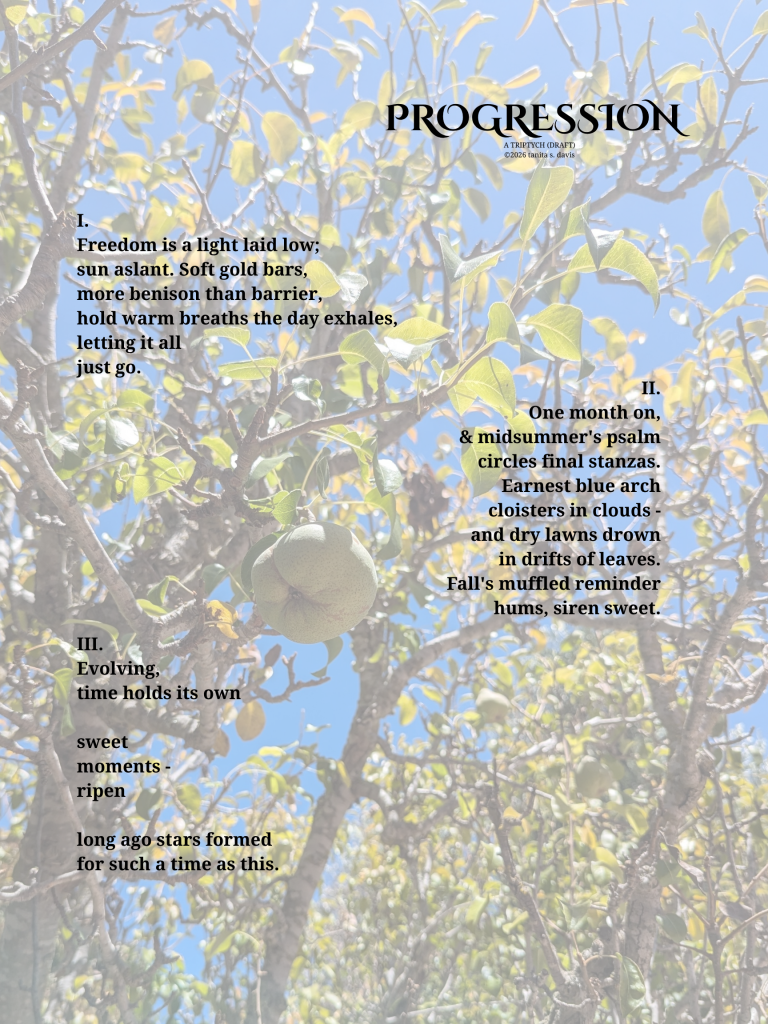
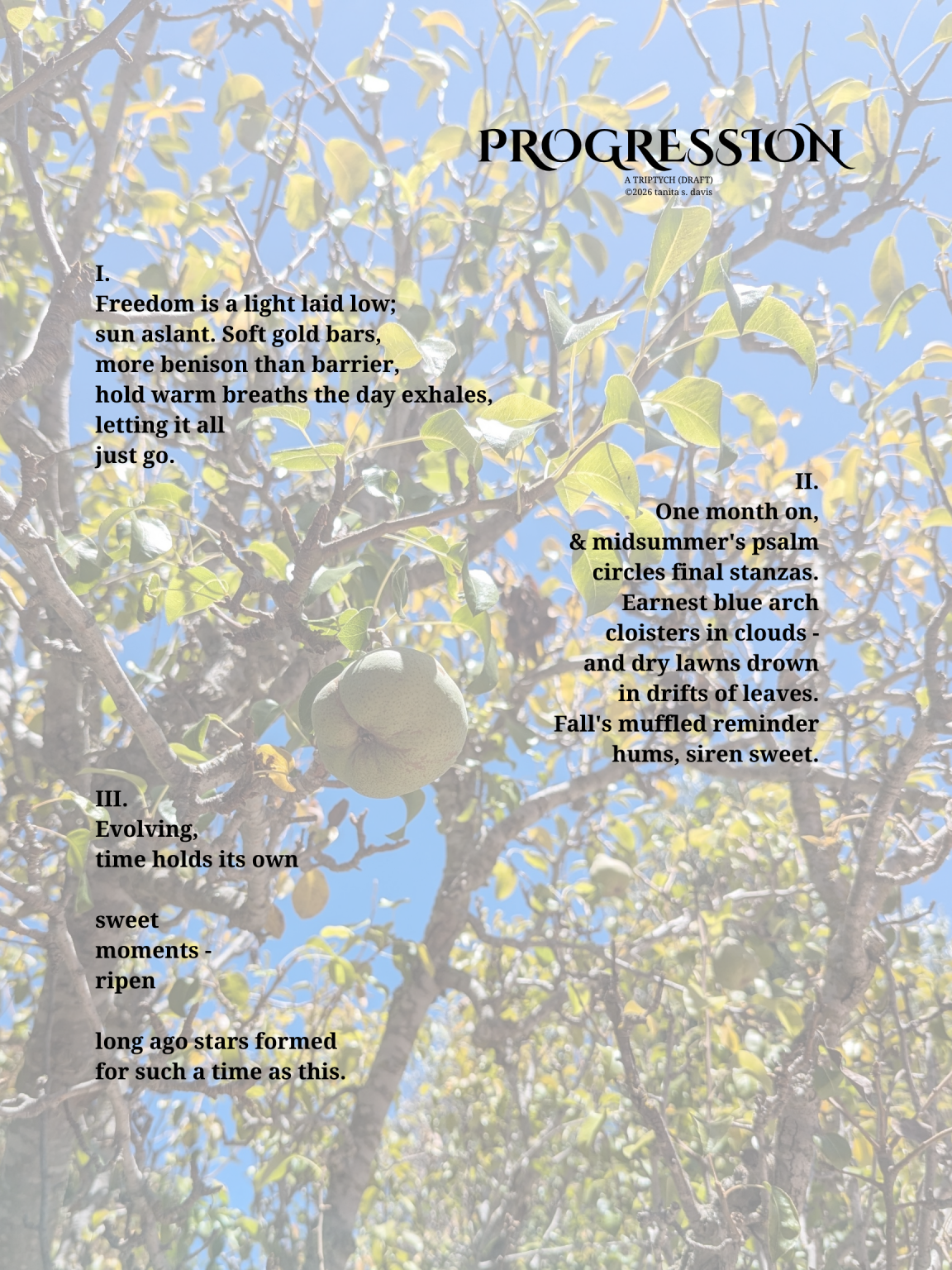
Progressions

I.
Freedom is a light laid low;
sun aslant. Soft gold bars,
more benison than barrier,
hold warm breaths the day exhales,
letting it all
just go.

II.
One month on,
& midsummer’s psalm
circles final stanzas.
Earnest blue arch
cloisters in clouds –
and dry lawns drown
in drifts of leaves.
Fall’s muffled reminder
hums, siren sweet.

III.
Evolving,
time holds its own:

sweet
moments –
ripen

long ago stars formed
for such a time as this.

-©2026, triptych draft


Thinkies:

  • Did you guys see the Doucette Roulette poetry form? The mind BOGGLES. 🤯
  • For those of us whose love language is sarcasm, what are we laughing at?
  • This left my heart on the floor. It matches my new contract: YA books 20k words shorter, MG vocab, and aimed at a generation of YA readers, some for whom information retrieval seems like someone else’s job…

The rabbit hole is calling, and I must go…

So until next time friends, water your plants, wear your sunscreen, and just 🐠 keep 🐡 swimming.🐟

🥰 Remember you are so, so loved.

P.S. – If you find yourself struggling with Inlinkz today, please leave your link in the comments. If you can’t make the comments work for you, use my contact form, which I’ll be watching for today. We’ll get this sorted!

{pf: the poetry peeps try out a triptych}

Welcome to another Poetry Friday Adventure!


Poetry Peeps! You’re invited to our poetry challenge for the month of JULY.

Here’s the scoop: we’re circling back to the beginning by revisiting Pádraig Ó Tuama’s Poetry Unbound challenge from way back in January. (After scrolling to the very bottom of the post), use the eight prompts he provides us to produce eight lines to organize into a Midyear Pantoum that gives you a sense for where you are now, and where you’re going with the rest of your year. Are you in? Good! You’ll have the month to craft your creation and share it July 31st in a blog post and/or on social media with the tag #PoetryPals. See you then!


Happy June, friends!

A few days after Solstice I was clearing off my art desk – finally – and found some sealed envelopes. New Year’s Cards… which I’d never sent. Honestly, that’s SO on brand for this year (and this month) that it made me laugh out loud (and apologies and felicitations to the people who are going to be receiving their New Year’s cards six months in – but hey, now we know we survived it, right? Right. Happy Halfway to January Again). I definitely needed to read Louise Ireland’s Louise Ireland’s August Triptych, a poem that depicts the exigencies of discarded urgency and celebrates the beauty in the ephemeral – all those things that don’t last, including blooms and buds, attention, and time.

From Process…

Because I’ve been reading this poem over and over again since Tabatha Yeatts introduced it to me, I can say that this was one of the easiest works to slip into as a mentor poem. Not because the poem has strong meter or rhyme that insists on drumming its way into me, but because the first line of that first stanza stops me cold again and again. Freedom is a fence gone slack. All I could think of when I read that was, “What could I escape, but don’t? What ‘fullness of time’ line item have I been auditing, waiting on paperwork and assurances which might never occur?”

Put that way, suddenly the topic shouldered its way into the forefront of my brain. I wrote this poem in a single sitting, in the short window of time we gave ourselves to write collaboratively with those of us able to meet on a Sunday afternoon. That rarely-to-never happens for me, and normally I’d take the time to fuss with and edit the poem. Not today.

Though some others of my Poetry Sisters did thorough editing and revision. Liz’s poem is here. Mary Lee’s poem is here. Michelle K’s triptych is here. You’ll find Poetry Friday hostess Tricia’s poem here. Diane Davis’s evocatively titled triptych is here. Other Poetry Peeps may taking on Louise Ireland’s beautiful poem may pop in throughout the weekend, so do check back for the round-up here.

…To Poetry

The poem that followed germinated in part because we sat down to have our poem chat on Father’s Day… a Father’s Day where I was home and not at my parents’ house, a Father’s Day where I didn’t even buy my Dad a card or a bottle of Dad’s Root Beer, because he didn’t want it.

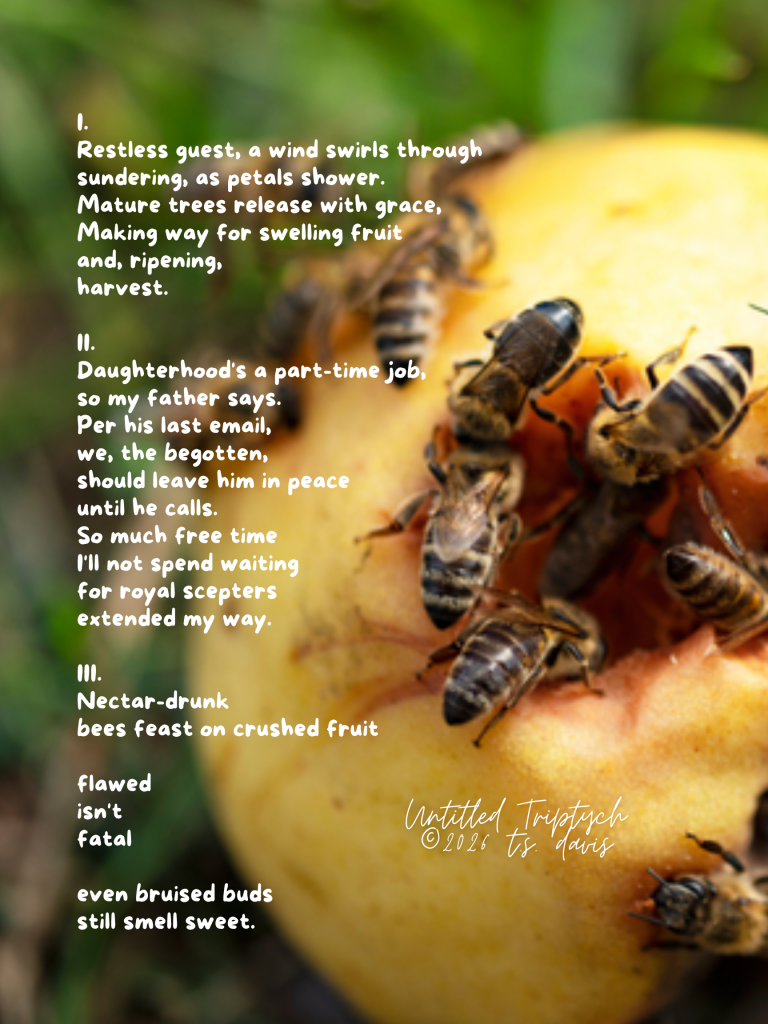
untitled triptych on louise ireland’s “august”

draft ©2026 ts davis

I.
Restless guest, a wind swirls through
sundering, as petals shower.
Mature trees release with grace,
Making way for swelling fruit
and, ripening,
harvest.

II.
Daughterhood’s a part-time job,
so my father says.
Per his last email,
we, the begotten,
should leave him in peace
until he calls.
So much free time
I’ll not spend waiting
for royal scepters
extended my way.

III.
Nectar-drunk
bees feast on crushed fruit

flawed
isn’t
fatal

even bruised buds
still smell sweet.

Well. It is what it is. The grass withers, the flowers fades, but what is timeless – the rhythms of change and choice – last forever. Seedtime and harvest. Sunrise and sunset. And, when we choose it, love that is the foundation of the world.

So until next time friends, pull your weeds, replant your borders, and leave a little water out for the honeybees. They’ll find the fruit on their own. And because it is always worth saying so that I hear it myself – remember you are so, so loved.

Happy Weekend🌻

{pf: the poetry peeps peruse potluck}

Welcome to another Poetry Friday Adventure!


Poetry Peeps! You’re invited to our poetry challenge for the month of JUNE.

Here’s the scoop: we’re greeting the opening act of summer with a triptych. Tabatha Yeatts-Lonske introduced West Coast poet and essayist Louise Ireland’s three-act August Triptych to me a long while back, and commented that she would use it as a mentor text someday. While I don’t know if Tab ever got there (probably yes), our someday is our today! Louise Ireland wrote from the trailing edge of summer’s wane, while we’ll compose our own triptych on the theme of diving into to the waxing of the season – in whatever way moves us. Are you in? Good! You’ll have the month to craft your creation and share it June 26th in a blog post and/or on social media with the tag #PoetryPals. See you then.


From Process…

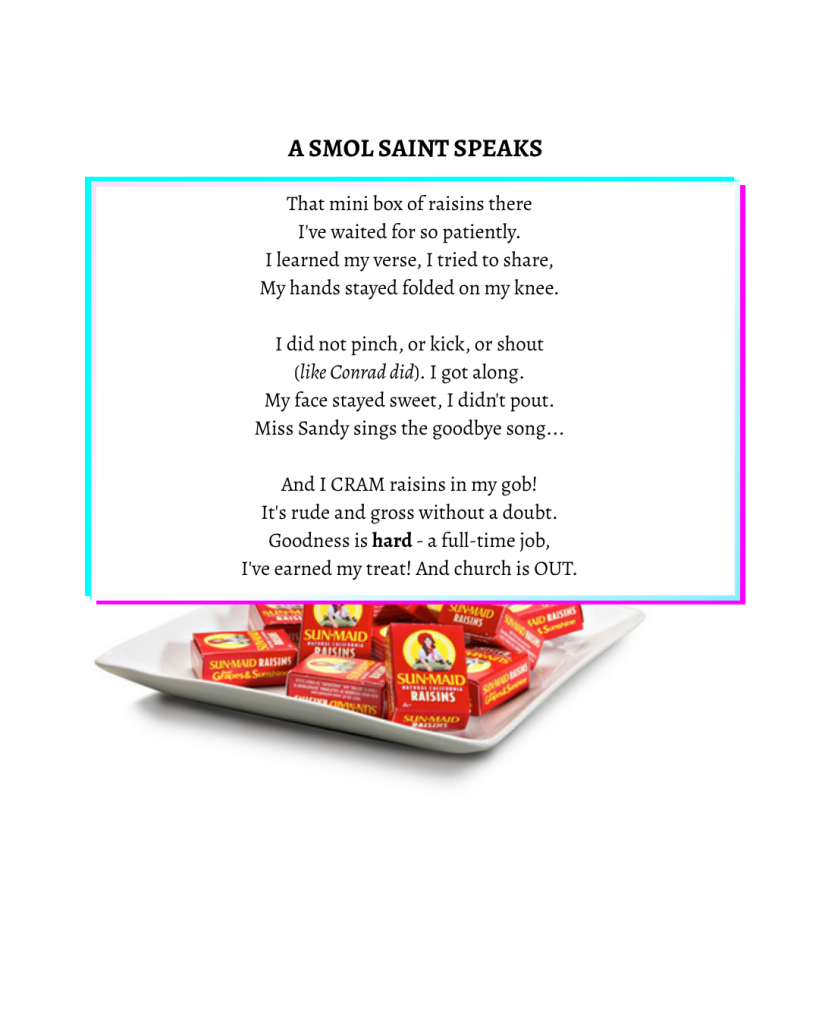
Welcome to the potluck! For me, potlucks are ever and always church-y, bringing to mind the people and things which helped shape my primary foundations for ethics and behavior, for good or for ill. One of those church people was a four-foot-nothing Scottish woman of indeterminate age with a bubble of brown curls, spiky faux lashes, pearled pink nail polish, a tiny lisp, and a huge heart. Sandy McMahon helped out in the 4-5 year old children’s ministry department, keeping us mannerly and handing us our papers after class was over. She also kept her hard-sided purse full of treats. And, every week at potluck, she brought a molded salad – always red Jello, sometimes with fruit cocktail, sometimes with pineapple rings and sophisticated piped mayonnaise. It was her go-to offering.

Alas, I am unfond of the squidge of Jello. I loathe the cloy of mayonnaise. Then there was the ginger ale and the fruit cocktail with the (peeled!!!!) grapes in… And let’s not even go into the Cool Whip. 🤢 On good days there were mandarins. On okay days, my serving did not include one grape. On the very worst days, there were strawberries, cooked to slimy limpness by hot Jello. That texture sets my teeth on edge even in memory. But I ate everything my mother put on my plate – including that jello salad – Every. Single. Week. For one, food was to be eaten, not looked at, played with, poked at, pouted over: eaten; thus sayeth the Mother. For another thing, after potluck, Miss Sandy gave out teensy boxes of raisins to all the five-and-under crowd in the clean plate club (a dried fruit digestif, I guess). So we feral little heathens ate up, then swarmed her, hands out, all demand and barely leashed impatience. We slammed those raisins down, then walked around blowing into the boxes, making high-pitched whistling squeaks and annoying everyone. Good times.

…To Poetry

But, come to the table! Your fellow Peeps are gathering, and the Poetry Sisters are opening bags and coolers – Laura dropped by to bless the table with a blossoms before whisking away. Cousin Mary Lee – today’s Poetry Friday hostess (Thank you, Mary Lee!) – brought a gorgeous bowl of beans. As always, Sara’s chips go with everything. Tricia’s brought her Mom’s dish to share, and Liz brought hers on a vintage plate. Cathy Stenquist brought fruit salad…plus, and Michelle K. brought a golden shovel-full of goodies, and Denise brought a basket. For the whole Poetry Friday roundup, don’t forget to circle back to Mary Lee’s post, where there’s even sides and postprandial activities! More Peeps bearing delish dishes and good gossip may show up throughout the weekend, so don’t forget to check back to see more potluck poetry links here.


Obviously, Miss Sandy deserves a poem. Which I will write. Someday. Until then, there is potluck food poetry. One rhymed randomly, the other ridiculous-but-ruly, because Padraig asked for pantoums this week, and that form was on my mind. In the random poem I took great pleasure in seeing in my mind’s eye the picture of me, age two, at church – patent leather shoes and red cabled tights, sitting primly, legs crossed… and then imagining the sticky, shouting, feral wee beastie I know lived insides – within every child (and every human, if we’re being fair). I amused myself with both poems – sometimes it’s just plain fun to write about something tiny pet peeves that are less than very minor blips in terms of the universe. Jello. Potluck. Behaving. All things which can easily be endured.

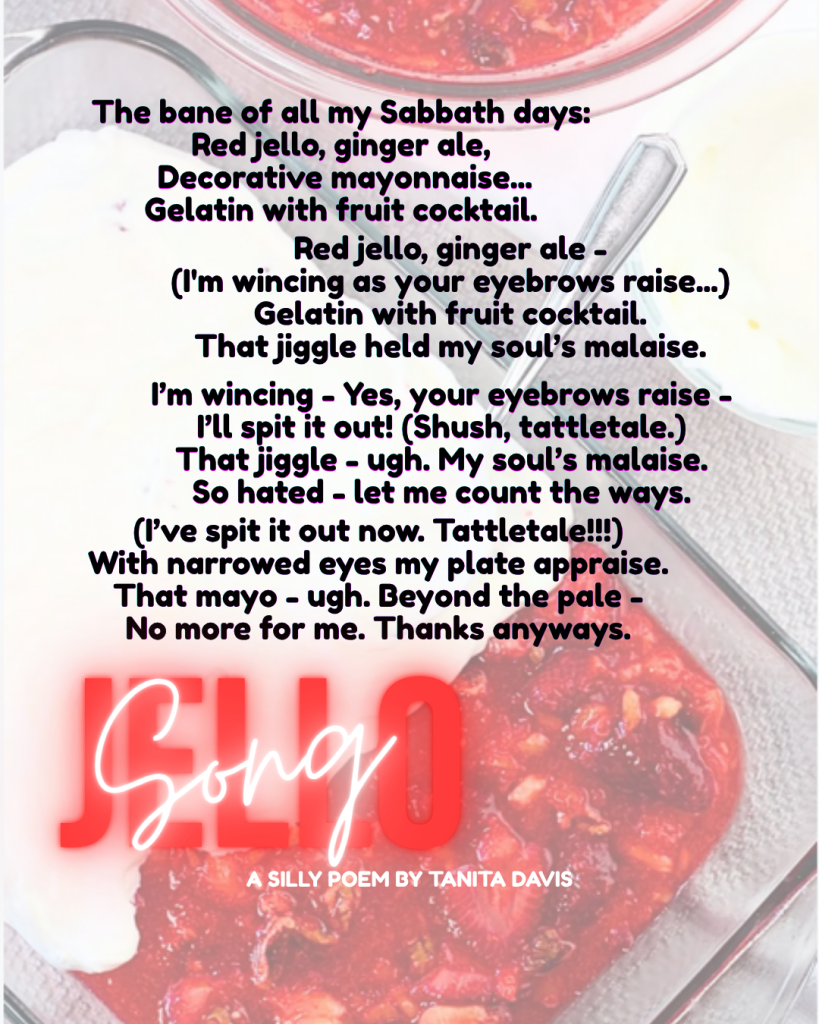
Jello Song

~ A Very Silly Poem Draft ~
The bane of all my Sabbath days:
Red jello, ginger ale,
Decorative mayonnaise…
Gelatin with fruit cocktail.

Red jello, ginger ale –
(I’m wincing as your eyebrows raise…)
Gelatin with fruit cocktail.
That jiggle held my soul’s malaise.

I’m wincing – Yes, your eyebrows raise –
I’ll spit it out! (Shush, tattletale.)
That jiggle – ugh. My soul’s malaise.
So hated – let me count the ways.

(I’ve spit it out now. Tattletale!!!)
With narrowed eyes my plate appraise.
That mayo – ugh. Beyond the pale –
No more for me. Thanks anyways.

And of course, the raisins have to have their moment:

A Smol Saint Speaks

That mini box of raisins there
I’ve waited for so patiently.
I learned my verse, I tried to share,
My hands stayed folded on my knee.

I did not pinch, or kick, or shout
(like Conrad did). I got along.
My face stayed sweet, I didn’t pout.
Miss Sandy sings the goodbye song…

And I CRAM raisins in my gob!
It’s rude and gross without a doubt.
Goodness is hard – a full-time job,
I’ve earned my treat! And church is OUT.


As I grew, Miss Sandy stayed around, though busy with a new crop of Very Smols to look after, so in the natural manner of things, I forgot her a bit. Though somehow, in a church with 600 to 800 members on the books and two services, she was still paying attention to her former charges. When I turned twelve, she presented me with a beautifully tissue-wrapped satiny peignoir from the 60’s – probably one of hers. It was the swankiest, fanciest sugary pink nylon and lace confection of a babydoll nightgown to ever be beloved by a young girl’s heart, and I simply SWOOPED around the house in that thing like I was on Dynasty. I LOVED that thing, and I cannot imagine what prompted her to gift me with that – except somehow she saw beyond the awkward sullenness and general geekery to someone whose secret longing was for pretty things. Looking back as an adult, this is even more amazing – what a brave thing to do, for a snotty tween who might have been awful to her. What a way to celebrate a growing-up moment with someone who wasn’t sure she/it was anything to celebrate (jury’s still out). May we all have a Miss Sandy in our lives when we need one – a person for whom we will eat dubiously textured things because she sees us and loves us. And, if we don’t HAVE a Miss Sandy, the Universe extends an invitation: Be One. Be the Miss Sandy you want to see in the world.

Until next time friends, remember you are so, so loved.

Happy Weekend🌷

{constant reader reads: not only anne}

Dear TBR,

When nine-year-old me first stumbled on a 1930’s edition of ANNE OF GREEN GABLES in a pile of discarded books, I was mainly interested in its thickness, and the fact that it would mean several hours during which I could escape the airless and stifling eternity that was summer vacation. The book itself was mysterious – cloth-bound and hardbacked, covered only in a woven white and green baize and lacking a dust cover, so the title only appeared faintly on the spine. Who was Anne? Where was Green Gables? Later I would be intrigued by the internal landscape of a very weird girl, and her wide vocabulary of unknown words which I nonetheless employed with confident inaccuracy – turning heads with my increasingly foreign pronunciations and effusive expressions, becoming more and more the “white girl” I was often told I spoke like. I can’t really blame Anne for my complete weirdness as a child – but I can say that I welcomed the knowledge that someone else was an entirely square peg in a round hole like me. As a white, Canadian, Victorian possessed of prejudices and a touchy pride that I didn’t have, we weren’t twins, but we were definitely kindred spirits. I read that book over and over and over that summer and for many years, annually – because Anne’s emotional interior, if not her skin tone, time period, or even her concerns – was all me.

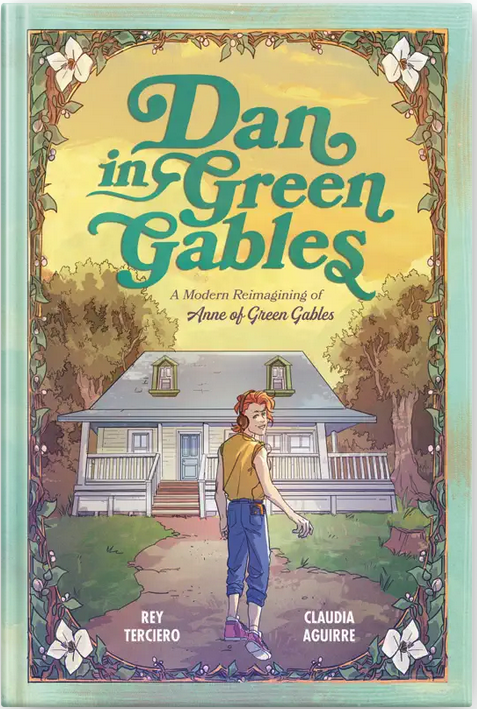
Anne Shirley, though first of her name, was not alone. There have been multiplicities of Annes, from the Japanese spin-offs of the 70’s to the more recent adult adaptations – Anne in Philly or whatnot. They’ve all been female, though… until Rey Terciero most recent graphic novel. DAN IN GREEN GABLES. Did the world need another Anne? Not necessarily – but though the emotions of the book are true enough to have made a space for many, they didn’t make a space for everyone… perhaps the author felt there needed to be a specific place for LGBTQ readers. In Terciero’s version, Dan isn’t orphaned – at least in his own mind. His Matthew and Marilla are, instead of geriatric siblings, grandparents – his. And rather than having only one kindred spirit, Dan’s world extends and expands to include two – in different ways – and numerous lighter bonds of relationships which nevertheless create the web which suspends him above the lava of his own emotions at times. Since Anne’s story is familiar I won’t go into the details, nor is this meant to be a beat-for-beat comparison between the original and Terciero’s newer work. The details differ, but the heart is the same.

When Dan’s mother takes him, after years of it largely being the two of them against the world, to a little house in the Great Smoky Mountains, he doesn’t know where they’re going – or why. He only knows his mother is in a ‘mood.’ It’s a shock when they roll up to the home of his paternal grandparents. Conservative farm folk, they live quietly and mostly contentedly within their church community, so a couple of itinerant city-dwellers who sometimes sleep in the back of their truck is quite a disruption. A further disruption occurs when Dan’s mother immediately argues bitterly and vociferously with his grandfather – and then slips out in the middle of the night, leaving her teen-aged son behind with essential strangers. Though he’d met his grandparents as a small child, Dan doesn’t remember them – at all. His mother has never talked about them, or even his father very much. He knows nothing – and as an expressive gay teen is as welcome as an ulcer to his tightly wound, judgmental and homophobic grandfather. While his Mawmaw is ready with armloads of unconditional love, it’s apparent that even she can be made uncomfortable by Dan’s flamboyant appearance and wounded by his touchy temper which occasionally lashes viciously from the depths of his fear and grief at being abandoned. Dan’s wounds, questions, doubts, and determination are very Anne, and would have resonated with nine-year-old me, even though neither our skin color, nationality, gender, nor concerns are the same.

Dan, overall, is Anne – crushed by disappointment and mockery, hiding deeper heartbreak, salty and snarky, flying off the handle and jumping to conclusions, elated and ebullient, hopeful and hilarious – all that made Anne-with-an-e relatable makes Dan the same. As in the original book, religion is a cornerstone element of Dan’s story, as his grandparents are church cornerstones, and his deacon grandfather is deeply concerned with how they appear as a family to their church community. Some readers may be uncomfortable at the characterization of some Christians – accurate, though rather damning – but others will feel relieved to find the words for what they may have thought, questioned, hoped for, or affirmed in the depiction of others in faith.

Resilient, inclusive, quick to anger, quick to forgive, willing to examine his own behavior and to see the world through another’s point of view, Dan has all of the genuine, personable human elements that gave Anne such well-loved main character energy. Definitely imperfect and thin-skinned – he is learning to be a person in this book, as well as learning to be someone cared for, instead of a caretaker – Dan’s road is full of missteps. He is just as exasperating as Anne was when she first came to Avonlea – and like Anne, Dan grows and changes. To my mind, he becomes even stronger in this single volume than Anne learned to become in two. People who fear that this version of Anne of Green Gables is merely a faded imprint of a saccharine-sweet character who goes on to Do Good will be relieved. People who love beautifully drawn graphic novels will be delighted – in these images Dan is colorful, expressive, and beautiful, and Avonlea is the perfect time capsule of a Appalachian farm town. I came to this book surprised by how well I liked it, and wistful that it was a graphic novel that doesn’t go on forever. This gave me the experience of coming to Anne of Green Gables for the first time, all over again.

I’ve carried my nine year old self and my first encounter with Anne Shirley with me for the whole of my life – I imagine that Dan in Green Gables will become a strong and portable fragment of someone’s heart – and hope – for a lifetime as well.


Fresh onto the TBR:

  • Darksight Dare, Lois McMasters Bujold
  • The Saltwater Curse, Avina St. Graves
  • Behind Frenemy Lines, Zen Cho


Until the next book, 📖

Still A Constant Reader

{constant reader reads: HEAs & HFAs}

HEA. HFN. The fairy tale staple of “happily ever after” is a rather limited construct in kidlit novels, as one has to ask, what does “ever after” mean when you’re thirteen or sixteen or even eighteen? Does a YA or MG novel really support a forever sort of bliss? Probably not – but in my continuing quest to read All The Tween Love Stories, and so support my editor’s goal of me actually writing one, I occasionally ask the question…


WE COULD BE MAGIC, Melissa Meyer and Joelle Murray

Tabitha, like many other girls in her universe or ours, grew up on a steady diet of “princess” – in books, games, and movies via a franchise called Somerland created by a fictional author named Winda Somers. From a very early age, Tabi knew the movies word-for-word, had her own understanding of the villains and heroines, and believed with all her pure heart that love conquered everything… thus her parents’ divorce crushed her little heart. She didn’t understand and couldn’t accept the end of everything she’d understood, so in an attempt to help heal her broken heart, her father takes her on a Daddy-and-Me trip to Somerland… where she finds her next goal: she’s going to return to Somerland as a princess in her own right someday. Fast forward to high school, and Tabi’s finally old enough to make her case to the interviewers, telling the story of how her broken heart was mended as a small child, asking her favorite prince and princess pair to please love each other forever – unlike her own parents. She gets the job, and is overwhelmingly excited to turn up for orientation, eager and bubbly and still a believer in the magic of the stories of princesses and villains and heroes that shaped her heart when she was young. But right away, it’s clear that there are actors… and then there’s The Story. For some kids, taking part in The Story is just a summer job, not a chance to be the magic that helps some child get through a rough moment in childhood. And as it turns out, The Story is not even Tabi’s job – she gets relegated to the nacho stand, completely unready for all the dance steps, all the work, all the sweating in character costumes that is part of the work they do to make magic. After working long enough to land an audition, Tabi realizes she was unprepared for reality, and needs to do a lot more work to make her dream happen. Somerland isn’t a walk in the park for the workers – and not all of the people who are inhabiting the princess costumes at the park aren’t like she’d expected. Not everyone is bubbling over with the joy of just being there – and some of them are wondering if Tabi, curvy and short – has a place there when the royalty they’re all trying out for are svelte and slim and tall. But what keeps Tabi from feeling completely discouraged is her new friend, James, who believes in her, and the magic that brought her there. And, as James shows Tabi the real park, and encourages her to trust in her own magic, she solidifies her belief that royalty comes in all shapes, hues, and sizes, and that we are the magic in The Story – always.

Yes, Your Serpentine Excellency, Kate Stradling

Joanna Marlow is… humiliated. The man who she was dating with has turned out to be a thief – and a gambler. He’s stolen her heirloom glowstone brooch, and so now she’s following him to the gambling house where he’s going to use it as an entry stake, in hopes of nipping in and stealing back her heirloom without having to have an ugly confrontation – where he’d be sure to try and lie his way out of things. Joanna is not a fond of chaos, of discomfort, and most of all, not a fan of confrontation. Courting has turned out to be – for the last time – humiliating and uncomfortable. She’s done. She’s resigning herself to spinsterhood and her cats. Unfortunately, there’s a complication – Joanna’s nearly caught and skips into what she thinks is an empty room in the gaming house – which instead houses a dragon. Who decides to follow her home.

Joanna neither wants nor needs a dragon. Additionally, this is a talking dragon, who somehow finds her house halfway across town and just lets itself into her living room, which has wards and blessings on all the doors and windows. Since Joanna lives on Marlow Hill with her entire, nosy, bossy family – who are all far too interested in maintaining the boundaries of their closed neighborhood – she knows he has to go. Magical beings are all conscripted into military service or the church in this kingdom, and skips have historically been conscripted by the crown to be assassins. Joanna’s family is protective of her – the only one of them to serve the church for five years – and they keep their neighborhood tightly regulated for a reason – to keep chaos and danger away from them, their elderly, and their children. Unfortunately, a dragon brings its own chaos – first in the form of the master of the gaming house from which he came, next from a series of gullible young heiresses who believe he’s a soothsayer and pay dearly for his “advice,” and finally from a high-powered mage carrying a deadly spell from one of the magical mob Families in the kingdom to take “her” dragon back. Joanna’s life… which was meant to be that of a quiet spinster working her courier job and taking care of her cats – has taken a decided turn for the chaotic… and that chaos seems to go through all the magical Families in the kingdom, and perhaps right on up into the King’s court. Nothing that Joanna thought is as it seems – herself, her family, and least of all, the dragon…

The Last Hope School For Magical Delinquents, Nicki Pau Preto
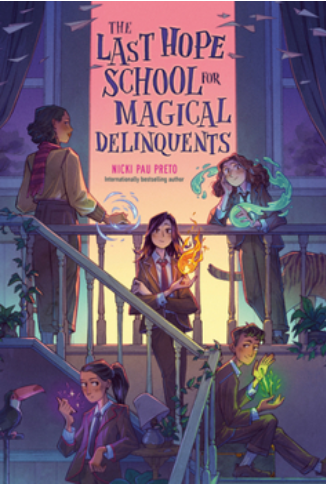
Lavina Lucas – Vin, to herself, since she has no real friends – has spent the last several years being a magical disaster. Somehow, no matter which school for budding magicians she’s sent to, everything goes wrong there. It’s never what she wants, but it’s always what she gets. Smoke. Explosions. Floods. Broken furniture. Broken bones. Disasters, major or minor, sooner or later find her hauled to the principal’s office, and then before the school board. With grim faces, she’s told that she’s an aberration – a danger to others – and absolutely not allowed to stay a moment longer. When Vin’s latest expulsion finds on the steps of The Last Hope school, Vin is… resigned. She is the magical delinquent they’ve named her, and there’s no hope – this placement isn’t going to go well either. Soon the kids will be gossiping about her and trying to bully her like they always do, and soon her magic will explode out of her, destroy glass and pipes and benches and desks and —

Somehow, though, The Last Hope is different. First, the Headmistress is… kind of amazing. She listens, and Vin is slowly beginning to believe that she might be an adult who actually tries to understand her. Vin is assigned fellow students to help her get settled. Gilly, Theo, and his sister, Araminta, are …nice to her. Oddly nice. Sure, there are still some hiccoughs – chaos seems to follow Vin regardless of her wishes – but with her new friends, things get settled, reversed, and …solved. Life becomes bearable – then more than bearable. Attending school with friends is a fragile treasure that Vin wants desperately to protect, so when she discovers that the school is facing a true threat from the so-called Free Mages, she throws herself at the threat bodily. When you’ve found a place to call home, it’s life or death to protect it. (This is the first of three books, so I’m being a LOT more vague with the plot, so as to avoid spoilers.)

Three vastly different magical books, but a similar unifying theme – happily ever after arrived at through having a place to belong, owning one’s literal or metaphorical magic and being allowed to simply be. This the type of happiness of which most tweens and teens – and people of any age – can dream. What I think is the best part, though, is that each of these books, in their own way, model how to create a HEA for someone else. #goals


Fresh onto the TBR:

  • Darksight Dare, Lois McMasters Bujold
  • The Saltwater Curse, Avina St. Graves
  • Camp Frenemy, Liz Montague


Until the next book, 📖

Still A Constant Reader

{npm ’26 • 30 – & Fin}


This morning, Liz said she’s already like a mother who has forgotten the trouble and travail of childbirth, already halfway to missing the daily hour (or in my case, sometimes two or more) of this month’s practice of poetry. And I’m with her – taking a deliberate space of time to do anything on purpose – to no purpose – is near impossible, and my brain and my body already crave the unfocused-focus of deliberately creating poetry with art supplies and open eyes. Despite beginning this on Easter Weekend – not traditionally a “quiet” time if you’re a church chorister – this practice gave me a little quiet – a little arbitrary time wherein I could loftily recuse myself from the world, citing Art. Mind, I write books, but somehow my brain can make that – with its entreaties and appeasement, with its pushes and pulls from readers and revisions and editors and such – much more mundane. That’s just “work,” that is attached to Filthy Lucre, despite the fact that it is, in my heart of hearts, still quite magical to create worlds and escape into them. But poetry – especially since I only have two anthology credits to my name thus – is still somehow …far Different.

Hah. Whatever I have to tell myself, I guess.

It would be a simple matter to extend this Artful Practice a bit – to try to at least get a little sketching and coloring in, but to be honest, it’s hard to justify. It’s time-consuming. It’s resource-consuming. And it pokes the voices in my head that remind me that there’s always something I should be doing – who am I to be skivving off of paying work or not Helping Others or Doing Good with my scant moments on this Earth? The idea that we are not enough on our own to make art or enjoy it is… destructive. And, unfortunately, how I was raised.

The self who I was would be astounded – shouldn’t All be known by now? Wasn’t adulthood meant to Answer All Questions? Who would have though that officially in Middle Age now I would still be so uncertain? But I am uncertain enough to make art, uncertain enough to learn and unlearn, and uncertain enough to still question and change. So as frustrating and difficult as it is to be myself sometimes – and ye squirrelly squids and monsters it is not simple – I guess the uncertainty and discomfort is…necessary. Vital for my personal…formation or whatnot. So, I’ll take it. I’ll keep this self, O Mighty Pen.

That’s what the month of observation has been to me – space for self-examining, deliberately censoring the world without as much as possible. All month long I’ve considered what I can see, peering through windows, looking out of in-groups and into spaces where I am not myself a member. It’s odd how closely aligned middle age is with adolescence; the same observable dance of declaration and denial, of conviction and conjecture. Amidst the swirl of alliance and estrangement, the same echoing queries of “Where do I belong in all of this?” remain. The answers resist simplicity as they always do, while the same conclusion comes – I simply am. I don’t know if that answer shapes who I became as a writer, or only writers can give it, but on the edge of the dance floor, I simply exist – and watch. Looking for how the gears mesh, and where the locomotion takes us.

Blank Page

A heart is
a vacant
city lot,

a pristine
prepped canvas:
potential.

who we are –
what blooms here –
our choosing.


Thanks for being along for the ride. If you’re aiming to catch up with everyone’s National Poetry Month projects for this month like I am, don’t forget that Jama-j has kindly kept a running roundup of everyone’s efforts. Happy Thursday, friends, see you next time – and remember you are so, so loved.

{constant reader reads: eccentricities and enchantment}

Dear TBR

Sarah Beth Durst’s The Spellshop came out in 2024, and like tons of people, I loved it immediately. We’re old Durst stans here, and have been reading and reviewing her books since she first started writing them, but this one was for adults, so we expected …something different? We were excited to find that, writing for adults or teens, her books are always the same – full of eccentricity and enchantment. In this case, the eccentricity is at first the main event – the main character, Kiela, has a talking spider plant (as one does). After the fall of her government, Kiela has has fled her job at The Great Library – taking as many books as she can cram into her boat as the city is engulfed in flames behind her. With nowhere else to turn and zero ideas, difficult, prickly Kiela goes home – and “home” – a weird place full of weird people she never thought she’d have to go back to. But, while the saying goes that you can’t go home again, it turns out that you can – because not only does going away change you, sometimes with your new eyes, you can see that home often changes, too. This book was the low stakes, low angst book that a difficult 2024 needed, and I was surprised when I saw that she’d written a companion book. What, I wondered, could still be left to say about that tiny, perfect microcosm of a book? As it turns out, nothing. And yet –

THE ENCHANTED GREENHOUSE: Caz, the sentient spider plant has an origin story which is only mentioned briefly. Terlu, his maker, was not a magician, but a librarian – and thus was turned into a statue for her crime of unauthorized magic use. The second novel in the duology begins with her trial where the reader discovers her crime stemmed from sheer loneliness, and the reader gets a sense of how horrible her sentence will be for her – she only ever made a talking plant to have someone to talk to… Six years after being entombed, Terlu experiences a sudden awakening in a wholly new place, one filled with snow, but nearly empty of people, save one. Best of all, this empty place is nearly overrun with… greenhouses. Ten thousand of them, or nearly so. Who would have sent her – in statue form, no less – to a deserted island filled with greenhouses? What is she supposed to do there? And, how safe is she? Will the magicians run her down and drag her back to the endless slow silence of being a statue? And, whatever happened to Caz?

This may seem like a book where nothing happens – and in a manner of speaking, this is true. Terlu sleeps and wakes, she eats – a lot, because she’s missed a lot of meals being an enchanted statue, and food is amazing – and she …worries. She tries to help keep up the greenhouses. She tries to be… useful. But there’s only so much you can do if you’re afraid of doing anything wrong for fear of …everything. This journey depicted here is small – Terlu moves from being a frightened, shamed unauthorized magician to being a determined person who makes choices not out of desperation, but with a clear mind. It’s a book about second chances – mainly giving yourself one. And it is cozy and kind and lovely, and a slow read with descriptions of beautiful plants, beautiful food, and the beautiful sense of belonging.

THE FARAWAY INN opens with the same sense of sweetness, though with a considerably tarter and more modern angle. Calisa is sixteen and going into her senior year, and very, very, very unhappy with her erstwhile exboyfriend, who she caught literally with his hands…where they ought not be. In a bid to get herself some distance from the disaster, Calisa heads away from New York to the wilds of Vermont for the summer, and for her Great Aunt Zee’s house. She’s not been there since she was quite small, and barely remembers it. It’s certainly not the floral extravaganza she recalls – it looks rundown and really awful, and to make matters worse, her Auntie Zee tells her she can stay exactly one night, and go home. As it turns out, Calisa wasn’t exactly invited, her mother and her aunt are in the middle of something that’s gone on for years, and Calisa is now the unfortunate recipient of a lot of unresolved feelings.

The thing is, the place clearly needs her help. And, Calisa really needs to not go home back into the orbit of the cheating, lying exboyfriend. In a blatant attempt to make herself useful enough to stay, Calisa begins to clean and organize and bustle – and discover that not everything at the rundown old inn is straightforward as it seemed… The guests are more than a little strange, and there are things no one will explain. As it turns out, nothing about the Faraway Inn is at all as Calisa believed…

Like many fantasy books, the age of the main character doesn’t matter as much as it would in many YA novels. Within the realm of the Hero(ine)’s Quest, the call to adventure simply… comes. Calisa arrives at the end of this book well beyond where most high school seniors would be, with her mind on a future that is already a bow-wrapped Happily Ever After. It’s a lovely, effortless, escapist read in the best of all ways. I appreciate that the author puts in an afterword about the idea of escapism, and what a gift it is – a deep breath before the plunge. If you can get your hands on either of these books, do – the respite is lovely.


Fresh onto the TBR:

  • The Testimony of Mute Things, Lois McMasters Bujold
  • The Saltwater Curse, Avina St. Graves
  • A Blacksmith’s Guide to Dragon Rearing, Julia Huni


Until the next book, 📖

Still A Constant Reader

{npm ’26 • 29}


the appearing

nothing more
magical:
appearing,

cutting through
all the noise,
a seeding

whimsically
reminding
You Are Here.

“I took a deep breath and listened to the old brag of my heart. I am, I am, I am.” – Sylvia Plath

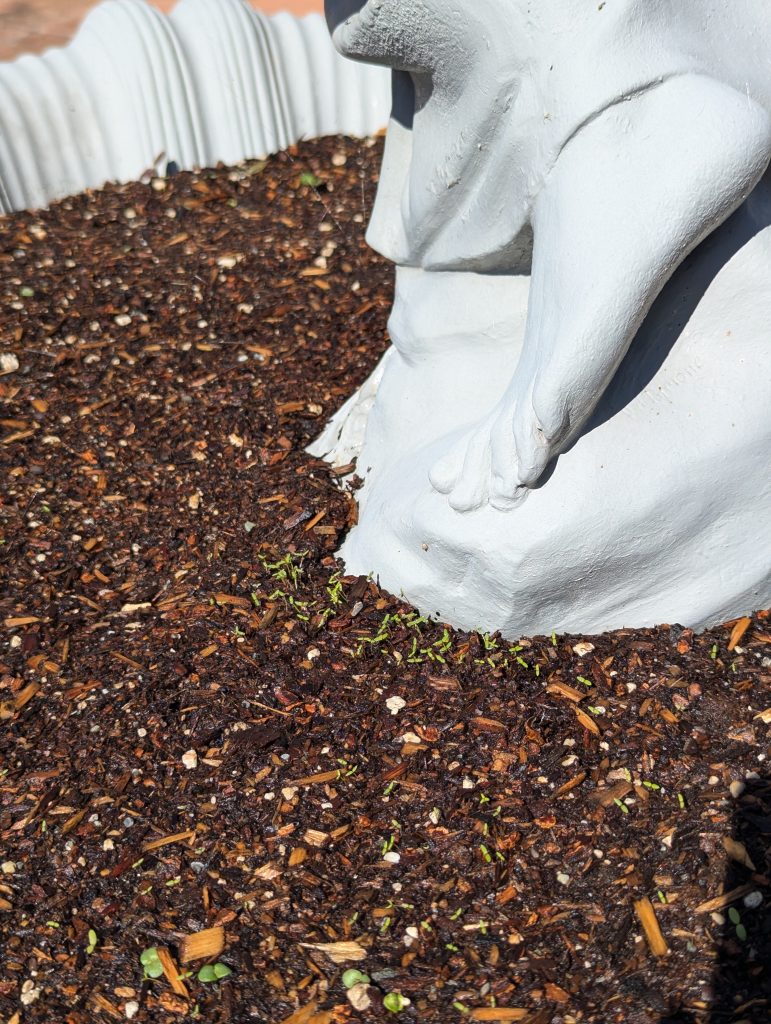
I don’t like to show the images I draw from – I really am dreadful at depicting reality – but the frilly little seedlings near the foot of this Italian fever dream of a fountain shepherdess or whatever (the thing has a giant crack in the base, so it’s doubly ridiculous) – are everything good.

Every single year, I find something to observe which gets me shaking my head all over again. Observing the seedlings this morning in two hour increments has been WILD. I am literally watching them grow, millimeters higher every time I look. I may get nothing else done today but looking. How little I care.