{pf: poetry peeps summon a haiku sonnet}

Welcome to another Poetry Friday Adventure!

Poetry Peeps! You’re invited to join our September poetry challenge!

Here’s the scoop: this month our delightful challenge comes from Colby Sharp’s book THE CREATIVITY PROJECT on page 257: “It was all my fault.” Peeps will be writing a poem that uses either this exact phrase, the idea of fault mentally, physically, or spiritually, things being your fault, somebody or anybody else’s fault, or nobody’s at all – this phrase is really a jumping off point for you to create a poem that speaks to you. Are you in? Good! Be ready to share September 25th in a blog post and/or on social media with the tag #PoetryPals. See you then!


Dear ones, this will be a short post. I am six thousand words from hitting my word count, writing flat out to hit an early September deadline (and itching to begin the all-important pare-down-and-polish stage of revision), so am so grateful that our prompt this month was relatively simple. Of course, relatively is an important word here. A haiku or a sonnet are their own delight, and the two together give one the opportunity to write a string of haiku with an envoi. I was prepared to lock in topically with a bright effulgence of natural wonder. I had thoughts. I had plans! Of course, as always happens, a throwaway comment derailed me entirely.

As I am dead serious about deadlines, I had to phone a former student to decline an invite to her mother’s birthday party (It’s a Zumba party. Can you think of another fête so delightfully original? Ice water, Latin music, and a built-in end point: et voila, perfection.) My autoimmune disorders parcel out even more limited spoons under stress, so I must prioritize. “We really need to reschedule,” my friend said. “It goes by too fast – we need to make time.” Remember I said she was a former student? I subbed seventh grade science while she blushed tomato red through reading aloud about the mating cycles of grasshoppers. It is bittersweet to hear someone in her thirties say that life is going too fast – and yet, like all of us, she knows. She’s lost family members and friends.

“Gather ye rosebuds,” my English major hindbrain lectured. As thoughts often do, that one seeped into the haiku I constructed. I am generally obsessed with season changes and autumn is low-hanging fruit for rhapsody, but I was firmly set on NOT doing that this time, and …well, here we are. Next time, friends. Next time.

Peeps who understood the assignment better include Tricia, whose post is here. Sara’s post is here. Liz’s post is here. Mary Lee’s post is here. You’ll find Laura’s poem here. Karen E’s is here, and Margaret still life poem is here. Linda Mitchell’s poem is here. More Peeps may pop in throughout the weekend to post their haiku-nets, so check back for the full round-up, and I’ll post ’em as I find ’em. Poetry Friday meanwhile is graciously hosted this week by Mona Voelkel – thank you for accompanying us on a joyride this week, Mona.

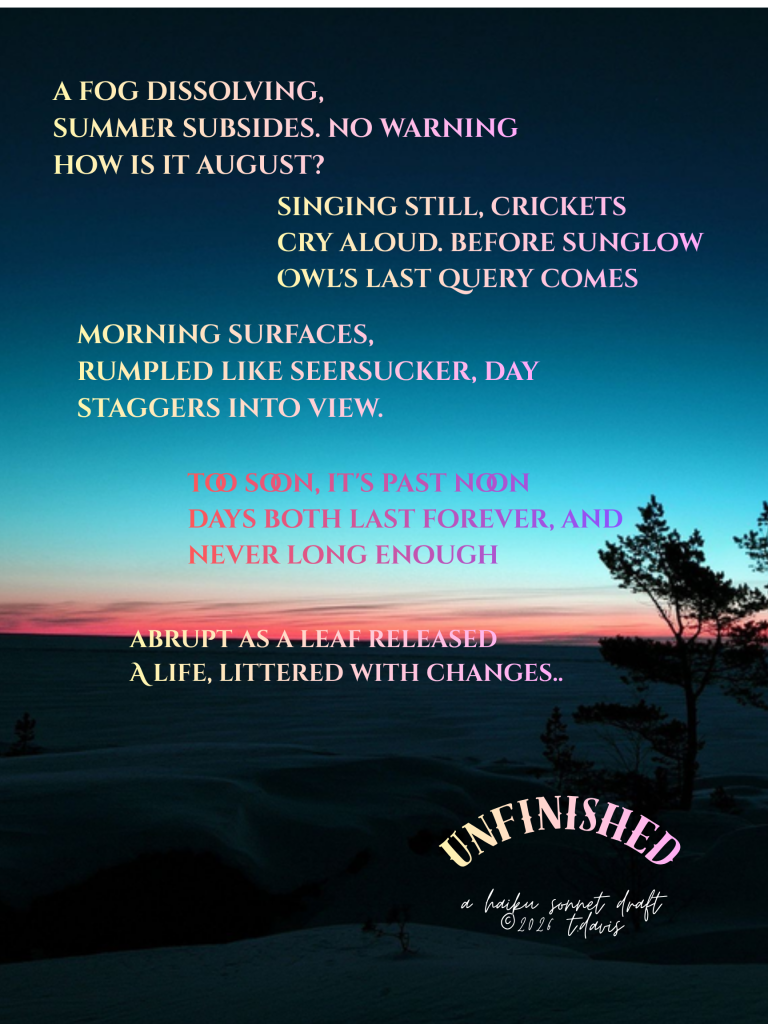
Unfinished

UNFINISHED

a fog dissolving,
summer subsides. no warning
how is it august?

singing still, crickets
cry aloud. before sunglow
Owl’s last query comes

morning surfaces,
rumpled like seersucker, day
staggers into view

too soon. it’s past noon
days both last forever, and
never long enough

abrupt as a leaf released
a life, littered in changes

I’m back to it, beloveds. Those going back into the classroom or the library, I see you. Those dealing with insane schedules, too many responsibilities and things bearing down on you – boy do I see you. Even if nothing feels as it should, and you’re being required to pull a rabbit out of a hat that only holds guinea pigs, know that you can relax in your weirdness, your mistakes, and your random coping mechanisms because you are just fine and enough and perfect as the light of a clear blue morning. Before you know it, you’ll have done the thing!🎩 As always, you are so, so loved.

{pf: poetry peeps reprise Padraig’s pantoum}

Welcome to another Poetry Friday Adventure!

Poetry Peeps! You’re invited to join our August poetry challenge!

Here’s the scoop: this month, we’re doing haiku…sonnets. If your response is a baffled “What?” no worries. Basically four 3-line haiku plus a couplet of either 5 or 7 syllables equals the traditional 14 lines you’ll find in a sonnet. If you haven’t written a sonnet, or “little song” in a minute, Folger has a Shakespearean guide, while the Poetry Foundation has the deets on other forms. Are you in? Good! Start today so you can be ready to share August 28th in a blog post and/or on social media with the tag #PoetryPals. See you then!


Our patron saint of poetry in potentia, Pádraig Ó Tuama, started Poetry Unbound listeners off this year with the materials with which to build a pantoum. Through his series of prompts, reflecting his own process upon waking at 3AM, we were meant to come away with enough lines to create the beginnings of this form, which uses simple statements repeated to build flow and certainty, and if one is lucky, a sense of emotion that sings like a lullaby. Of course that’s not what happened. When the Poetry Sisters gathered for our small Sunday salon, we discussed how closely we would stick to the rules – either the ones for pantoum or the prompts for this one in particular. The wiser of us came to the table with the word NOPE written all-caps and clutched firmly in our hands. Those smarter people proceeded to use the guidelines as a suggestion, which is perfectly within the scope of what St. Padraig suggested. As you may have guessed, I… was not one of those smarter people. And I wrote a poem which I absolutely hated. There were owls. Sighing wind. Poignancy. It was …a LOT, and it was so bad it made me laugh.

…I got something out of it at least? A good laugh isn’t nothing.

The eight prompts weren’t even the problem. The questions were all innocuous enough, and I answered every prompt and did what I was told… but did not make art. Which… honestly, I should have expected, since art isn’t all that much about rules, except in seeing where they don’t fit and leaving them on the floor.

As we left our digital salon, discussing with amusement our responses to our own work (there was a lot of “Meh” going on), Mary Lee made a comment on how Padraig centers the idea of wakefulness in connection with insomniac sleeplessness at 3AM – but who says our poem has to take place in the now? Who says that our waking from sleep only happens at night? Her throwaway thought gave me the space to release the reflex to follow all the rules so closely that there wasn’t room for me to move in my own poem. I was able to write again – still answering prompts, but the answers are either incomplete, or go so far into the question that they come out on the other side, in another province. I rearranged my responses and threw some of them completely under the bus. I answered a question that I’m not sure I was asking. And… it works for now.

The title and maybe the mood links to last week’s poem – Progressions. Migrations. Moving through changes, going places in different times in our lives, becoming different selves… I spent a lot of time as a child being awake in the car full of sleeping siblings on the long nights my parents drove us between where we lived and where we had lived; the lives we’d had, and a life in a place we now lived and weren’t sure of just yet. We did a lot of back-and-forth the first few years before we settled and stayed… It must have been hard for my parents to move us into suburbia from a city. They did it for their kids to have safety, but they left a lot of familiarity and friends and, frankly, probably adventure behind. Meanwhile, all we kids knew was that it meant a lot of time in the car.

Migrations

Limned by the headlight beams alone
the engine growls and grumbles. Sighs
as radios play quiet tones,
while stretched, time splits and multiplies.

The engine growls and rattles. Sighs
‘cross cattle guards while gravel groans,
time stretches, splits and multiplies
and absence yawns and megaphones.

Cross cattle guards, the gravel groans.
“Are we there yet?” preoccupies.
And absence yawns and megaphones
a past the present nullifies.

“Are we there yet?” Preoccupied,
miles stitch on miles. A road is sewn
while past and present notify:
some roads we only take alone.

Other Poetry Peeps have taken their own roads through to this pantoum. Mary Lee’s poem is here. Laura’s poem is here, and Tricia’s post is here. Liz’s poem slides in here. Summer is still having its way, and Sara is waving to us gently from a rainy green land, with plans to join us another day. Meanwhile, Michelle K’s is here. Patricia Franz’s poem is here. Denise’s pantoum is here, and Margaret’s poem is here. So happy to see so many Peeps joining the fun. More Peeps may pop in throughout the weekend to post their pantoum-ing, so check back for the full round-up, and I’ll post ’em as I find ’em. Meanwhile, Poetry Friday today is ably hosted by the one and only Tabatha, who personifies the opposite of indifference. Don’t forget to get the details on her anthology! Thanks, Tab!


Whether you’re back in another stretch of heat or in the throes of endless rainstorms and humidity, look for signs that the season is shifting, the light is shortening, the colors are deepening; the times, they are a-changin’. In some ways, it feels like we’ve been in this moment – this summer, this year? – forever, but in other ways, we’ll look back at this as a multihued smear of time. As we wait for better days – or perhaps just different ones – keep breathing. Keep listening. Keep spending the coin of your energy in deliberate attention and presence. Keep bearing witness; keep watch, and may joy find you. Remember, you are so, so loved.

{pf: the poetry peeps try out a triptych}

Welcome to another Poetry Friday Adventure!


Poetry Peeps! You’re invited to our poetry challenge for the month of JULY.

Here’s the scoop: we’re circling back to the beginning by revisiting Pádraig Ó Tuama’s Poetry Unbound challenge from way back in January. (After scrolling to the very bottom of the post), use the eight prompts he provides us to produce eight lines to organize into a Midyear Pantoum that gives you a sense for where you are now, and where you’re going with the rest of your year. Are you in? Good! You’ll have the month to craft your creation and share it July 31st in a blog post and/or on social media with the tag #PoetryPals. See you then!


Happy June, friends!

A few days after Solstice I was clearing off my art desk – finally – and found some sealed envelopes. New Year’s Cards… which I’d never sent. Honestly, that’s SO on brand for this year (and this month) that it made me laugh out loud (and apologies and felicitations to the people who are going to be receiving their New Year’s cards six months in – but hey, now we know we survived it, right? Right. Happy Halfway to January Again). I definitely needed to read Louise Ireland’s Louise Ireland’s August Triptych, a poem that depicts the exigencies of discarded urgency and celebrates the beauty in the ephemeral – all those things that don’t last, including blooms and buds, attention, and time.

From Process…

Because I’ve been reading this poem over and over again since Tabatha Yeatts introduced it to me, I can say that this was one of the easiest works to slip into as a mentor poem. Not because the poem has strong meter or rhyme that insists on drumming its way into me, but because the first line of that first stanza stops me cold again and again. Freedom is a fence gone slack. All I could think of when I read that was, “What could I escape, but don’t? What ‘fullness of time’ line item have I been auditing, waiting on paperwork and assurances which might never occur?”

Put that way, suddenly the topic shouldered its way into the forefront of my brain. I wrote this poem in a single sitting, in the short window of time we gave ourselves to write collaboratively with those of us able to meet on a Sunday afternoon. That rarely-to-never happens for me, and normally I’d take the time to fuss with and edit the poem. Not today.

Though some others of my Poetry Sisters did thorough editing and revision. Liz’s poem is here. Mary Lee’s poem is here. Michelle K’s triptych is here. You’ll find Poetry Friday hostess Tricia’s poem here. Diane Davis’s evocatively titled triptych is here. Other Poetry Peeps may taking on Louise Ireland’s beautiful poem may pop in throughout the weekend, so do check back for the round-up here.

…To Poetry

The poem that followed germinated in part because we sat down to have our poem chat on Father’s Day… a Father’s Day where I was home and not at my parents’ house, a Father’s Day where I didn’t even buy my Dad a card or a bottle of Dad’s Root Beer, because he didn’t want it.

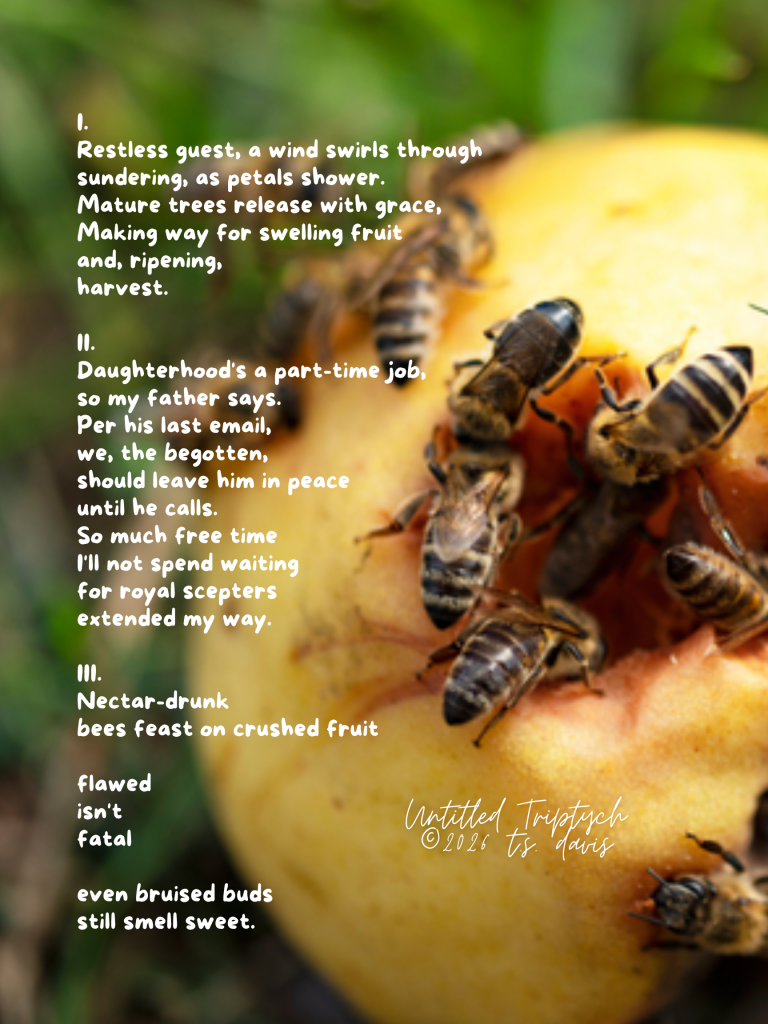
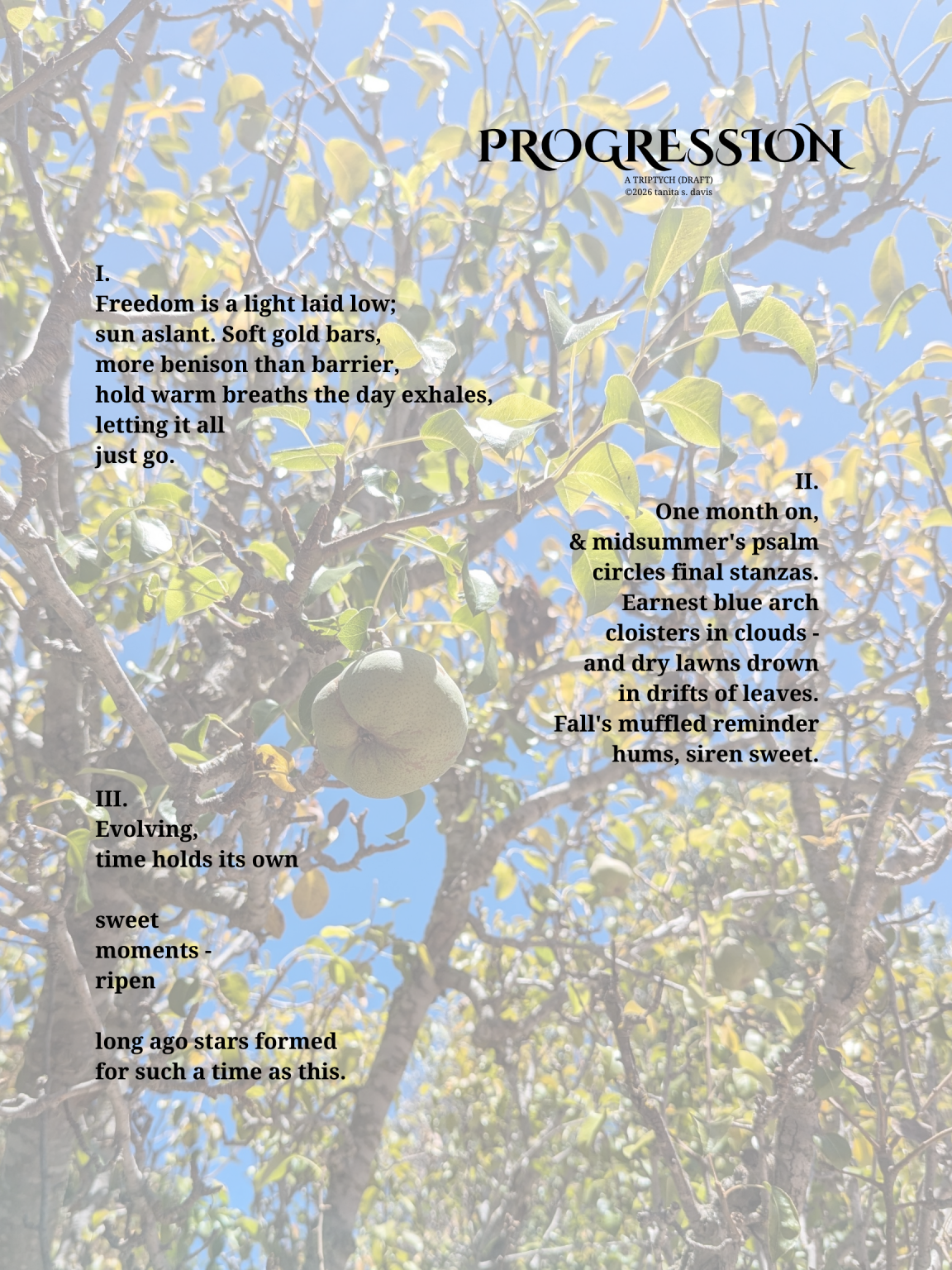
untitled triptych on louise ireland’s “august”

draft ©2026 ts davis

I.
Restless guest, a wind swirls through
sundering, as petals shower.
Mature trees release with grace,
Making way for swelling fruit
and, ripening,
harvest.

II.
Daughterhood’s a part-time job,
so my father says.
Per his last email,
we, the begotten,
should leave him in peace
until he calls.
So much free time
I’ll not spend waiting
for royal scepters
extended my way.

III.
Nectar-drunk
bees feast on crushed fruit

flawed
isn’t
fatal

even bruised buds
still smell sweet.

Well. It is what it is. The grass withers, the flowers fades, but what is timeless – the rhythms of change and choice – last forever. Seedtime and harvest. Sunrise and sunset. And, when we choose it, love that is the foundation of the world.

So until next time friends, pull your weeds, replant your borders, and leave a little water out for the honeybees. They’ll find the fruit on their own. And because it is always worth saying so that I hear it myself – remember you are so, so loved.

Happy Weekend🌻

{pf: the poetry peeps peruse potluck}

Welcome to another Poetry Friday Adventure!


Poetry Peeps! You’re invited to our poetry challenge for the month of JUNE.

Here’s the scoop: we’re greeting the opening act of summer with a triptych. Tabatha Yeatts-Lonske introduced West Coast poet and essayist Louise Ireland’s three-act August Triptych to me a long while back, and commented that she would use it as a mentor text someday. While I don’t know if Tab ever got there (probably yes), our someday is our today! Louise Ireland wrote from the trailing edge of summer’s wane, while we’ll compose our own triptych on the theme of diving into to the waxing of the season – in whatever way moves us. Are you in? Good! You’ll have the month to craft your creation and share it June 26th in a blog post and/or on social media with the tag #PoetryPals. See you then.


From Process…

Welcome to the potluck! For me, potlucks are ever and always church-y, bringing to mind the people and things which helped shape my primary foundations for ethics and behavior, for good or for ill. One of those church people was a four-foot-nothing Scottish woman of indeterminate age with a bubble of brown curls, spiky faux lashes, pearled pink nail polish, a tiny lisp, and a huge heart. Sandy McMahon helped out in the 4-5 year old children’s ministry department, keeping us mannerly and handing us our papers after class was over. She also kept her hard-sided purse full of treats. And, every week at potluck, she brought a molded salad – always red Jello, sometimes with fruit cocktail, sometimes with pineapple rings and sophisticated piped mayonnaise. It was her go-to offering.

Alas, I am unfond of the squidge of Jello. I loathe the cloy of mayonnaise. Then there was the ginger ale and the fruit cocktail with the (peeled!!!!) grapes in… And let’s not even go into the Cool Whip. 🤢 On good days there were mandarins. On okay days, my serving did not include one grape. On the very worst days, there were strawberries, cooked to slimy limpness by hot Jello. That texture sets my teeth on edge even in memory. But I ate everything my mother put on my plate – including that jello salad – Every. Single. Week. For one, food was to be eaten, not looked at, played with, poked at, pouted over: eaten; thus sayeth the Mother. For another thing, after potluck, Miss Sandy gave out teensy boxes of raisins to all the five-and-under crowd in the clean plate club (a dried fruit digestif, I guess). So we feral little heathens ate up, then swarmed her, hands out, all demand and barely leashed impatience. We slammed those raisins down, then walked around blowing into the boxes, making high-pitched whistling squeaks and annoying everyone. Good times.

…To Poetry

But, come to the table! Your fellow Peeps are gathering, and the Poetry Sisters are opening bags and coolers – Laura dropped by to bless the table with a blossoms before whisking away. Cousin Mary Lee – today’s Poetry Friday hostess (Thank you, Mary Lee!) – brought a gorgeous bowl of beans. As always, Sara’s chips go with everything. Tricia’s brought her Mom’s dish to share, and Liz brought hers on a vintage plate. Cathy Stenquist brought fruit salad…plus, and Michelle K. brought a golden shovel-full of goodies, and Denise brought a basket. For the whole Poetry Friday roundup, don’t forget to circle back to Mary Lee’s post, where there’s even sides and postprandial activities! More Peeps bearing delish dishes and good gossip may show up throughout the weekend, so don’t forget to check back to see more potluck poetry links here.


Obviously, Miss Sandy deserves a poem. Which I will write. Someday. Until then, there is potluck food poetry. One rhymed randomly, the other ridiculous-but-ruly, because Padraig asked for pantoums this week, and that form was on my mind. In the random poem I took great pleasure in seeing in my mind’s eye the picture of me, age two, at church – patent leather shoes and red cabled tights, sitting primly, legs crossed… and then imagining the sticky, shouting, feral wee beastie I know lived insides – within every child (and every human, if we’re being fair). I amused myself with both poems – sometimes it’s just plain fun to write about something tiny pet peeves that are less than very minor blips in terms of the universe. Jello. Potluck. Behaving. All things which can easily be endured.

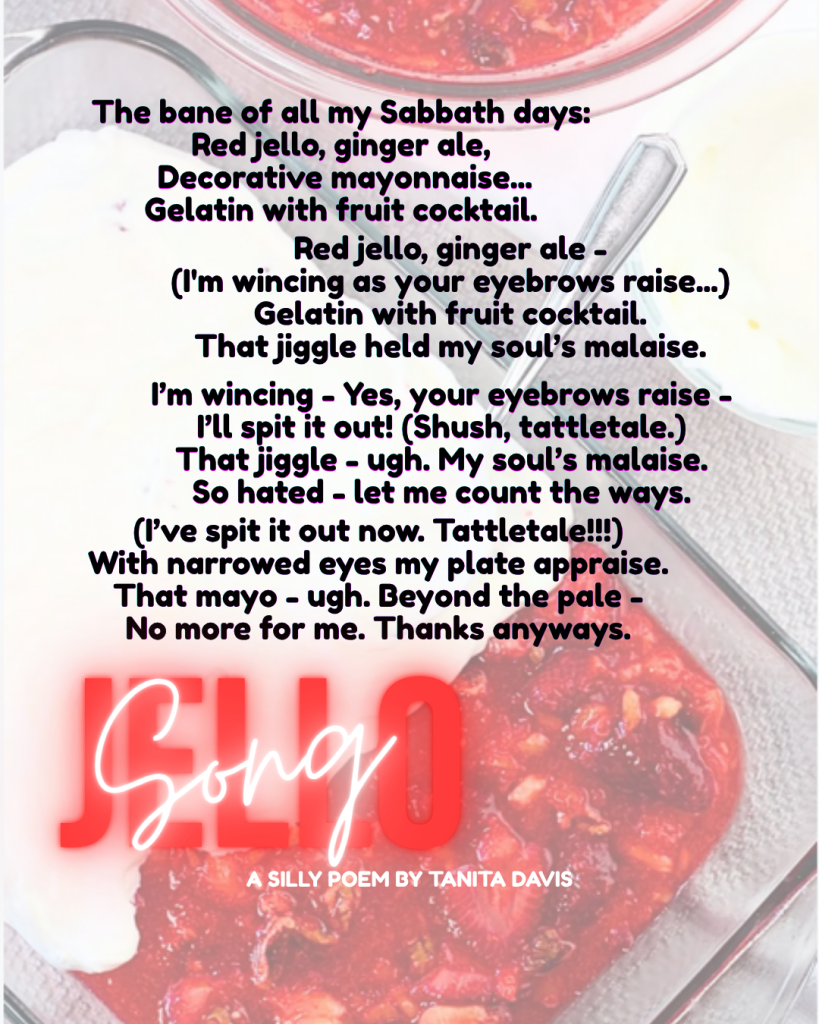
Jello Song

~ A Very Silly Poem Draft ~
The bane of all my Sabbath days:
Red jello, ginger ale,
Decorative mayonnaise…
Gelatin with fruit cocktail.

Red jello, ginger ale –
(I’m wincing as your eyebrows raise…)
Gelatin with fruit cocktail.
That jiggle held my soul’s malaise.

I’m wincing – Yes, your eyebrows raise –
I’ll spit it out! (Shush, tattletale.)
That jiggle – ugh. My soul’s malaise.
So hated – let me count the ways.

(I’ve spit it out now. Tattletale!!!)
With narrowed eyes my plate appraise.
That mayo – ugh. Beyond the pale –
No more for me. Thanks anyways.

And of course, the raisins have to have their moment:

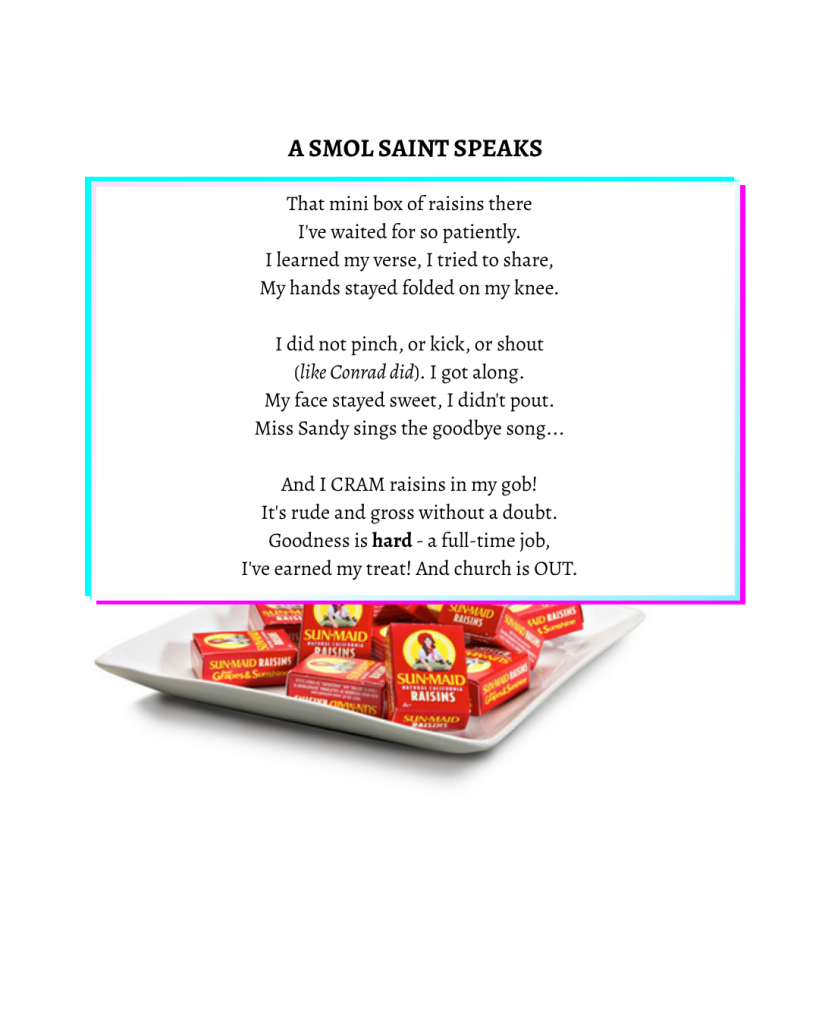
A Smol Saint Speaks

That mini box of raisins there
I’ve waited for so patiently.
I learned my verse, I tried to share,
My hands stayed folded on my knee.

I did not pinch, or kick, or shout
(like Conrad did). I got along.
My face stayed sweet, I didn’t pout.
Miss Sandy sings the goodbye song…

And I CRAM raisins in my gob!
It’s rude and gross without a doubt.
Goodness is hard – a full-time job,
I’ve earned my treat! And church is OUT.


As I grew, Miss Sandy stayed around, though busy with a new crop of Very Smols to look after, so in the natural manner of things, I forgot her a bit. Though somehow, in a church with 600 to 800 members on the books and two services, she was still paying attention to her former charges. When I turned twelve, she presented me with a beautifully tissue-wrapped satiny peignoir from the 60’s – probably one of hers. It was the swankiest, fanciest sugary pink nylon and lace confection of a babydoll nightgown to ever be beloved by a young girl’s heart, and I simply SWOOPED around the house in that thing like I was on Dynasty. I LOVED that thing, and I cannot imagine what prompted her to gift me with that – except somehow she saw beyond the awkward sullenness and general geekery to someone whose secret longing was for pretty things. Looking back as an adult, this is even more amazing – what a brave thing to do, for a snotty tween who might have been awful to her. What a way to celebrate a growing-up moment with someone who wasn’t sure she/it was anything to celebrate (jury’s still out). May we all have a Miss Sandy in our lives when we need one – a person for whom we will eat dubiously textured things because she sees us and loves us. And, if we don’t HAVE a Miss Sandy, the Universe extends an invitation: Be One. Be the Miss Sandy you want to see in the world.

Until next time friends, remember you are so, so loved.

Happy Weekend🌷

{pf: npm ’26 • poetry peeps engage the ekphrastic}

Welcome to another Poetry Friday Adventure!


Poetry Peeps! You’re invited to our poetry challenge for the month of MAY.

Here’s the scoop: we’re having a Poetry Potluck. In the spirit of sharing a plate of poetry together, we invite you to grab a form you like, season it to your taste, and share it with us and all of your Poetry Peeps – it’s a good time for all of us to remember what we’ve learned, and to celebrate. Are you in? Good! You’ll have the month to craft your creation and share it May 29th in a blog post and/or on social media with the tag #PoetryPals. We hope you’ll bring a dish!


From Process…

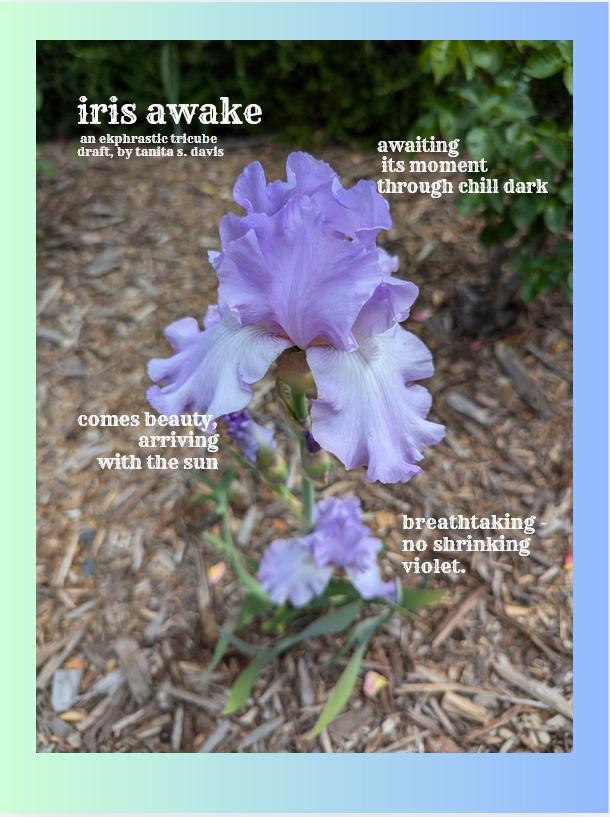
Happy National Poetry Month, Poetry Friends! Ekphrastic poetry is one of my favorite, favorite forms, simply because I am an avid photographer, using my phone far more often for its photo capabilities than its ability to connect me to anyone else. I have been mildly obsessed with Springtime in the garden of this house, as come May we’ll have been here for one year, and we’re still in the “discovery” phase. Did we know we had daffodils? Nope, not until they started showing up. Ditto for the hyacinths. Now I’ve found my new best love – bearded irises. I’m entranced.

…to Poetry

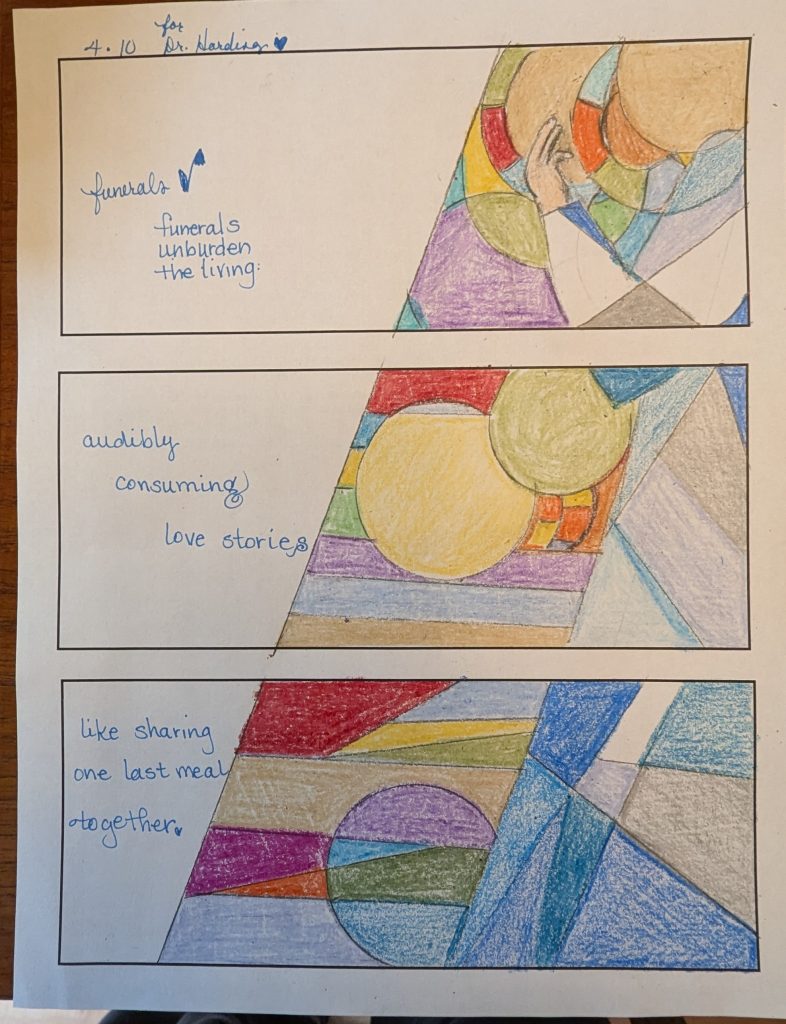
Today the Poetry Seven are also poem-ing in honor of a birthday! My NPM project is daily tricubes along with Very Bad Drawings (TM), but in the spirit of wanting to bring a gift to my friend, I’ll spare our birthday girl my artwork and share a recent garden snap instead. Happy Birthday to Sara Lewis Holmes, who is a bright spark, shining undiminished even in darkness – living aglow not “in spite of” but living into her Because. Farsee-er, questioner, somesuch-er, friend – may you continue to live all the days of your life. Love you, Sara.

iris awake

awaiting
its moment
through chill dark

comes beauty,
arriving
with the sun

breathtaking –
no shrinking
violet.

My Poetry Sisters are much more on top of things this month, engaging the ekphrastic in their own ways. Liz’s poem is here. Laura’s poem is here, Cousin Mary Lee’s is here, and Sara’s poem is here. Tricia’s poem is here, and Karen’s poem is here. Michelle K’s poem is here. Carol V’s poem is a puff of dandelion here, and Jill’s poem is here – welcome Jill! Margaret’s cypress poem is here. More Peeps may show up throughout the weekend, so don’t forget to check back to see their links rounded up here.

Our lovely hostess this Poetry Friday is Irene – and Emily Dickinson – so don’t miss stopping by for more poetry, and thank-you, Irene, for hosting.


In the chaos of life bursting into being, change insisting on its way, and finally a little sun, some things remain the same – unchanged despite our desire or efforts. Some things have also remained the same in spite of us – which is a bit of joy in the tangle. I hope this season reminds you to look for what is unfolding beautifully along with what is unfolding chaotically. Take deep breaths, and walk with measured steps. Life is change – and chaos – but I hope that today especially that you can be a calm in your own storm. Remember that you are well-loved.

{npm ’26 • 3}


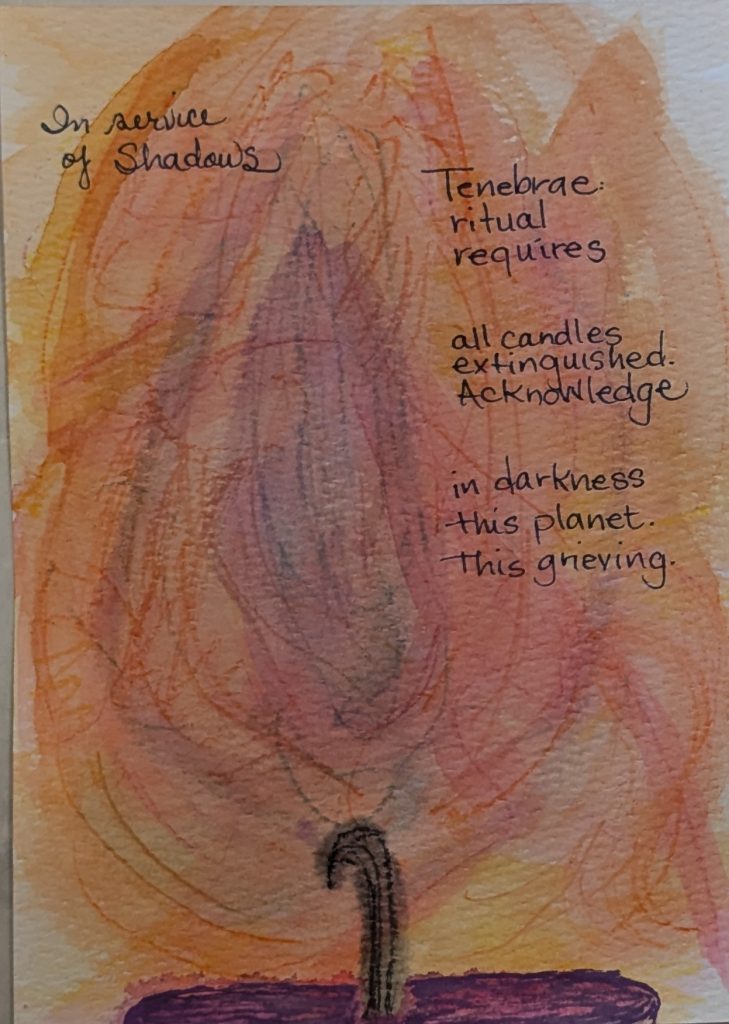
In Service of Shadows

Tenebrae:
ritual
requires

all candles
extinguished.
Acknowledge

in darkness
this planet,
this grieving.

I’m continually fascinated by how some people – communities or individuals – can make space for grief … and how some others relentless insistence on ‘this’ being some Part Of The Plan or Lesson. Sometimes awful things like pandemics, fascists, genocide, and war happen. Who wouldn’t weep? Who hasn’t?

(It also occurred to me after the drawing was done that it might have made more sense to draw the candle in grayscale, since tenebrae means shadows… but, oh well.)

Poetry Friday is hosted today at Radio, Rhythm & Rhyme. Thanks, Matt!

{pf: poetry peeps offer up the ovillejo}

Welcome to another Poetry Friday Adventure!


Poetry Peeps! You’re invited to our poetry challenge for the month of MARCH.

Here’s the scoop: we’re writing ekphrastic poems, which might pair beautifully with your plans for National Poetry Month (I’m attempting poetry comics). Ekphrasis is a Greek word which means “description,” and you’re invited to choose your own image from anywhere – personal pictures or otherwise. Are you in? Good! You’ll have the month to craft your creation and share it April 24th in a blog post and/or on social media with the tag #PoetryPals. We hope you’ll play along!


From Process…

Greeting, Poetry Friends! If this form was a challenge to you – well, I can’t exactly say ‘mea culpa,’ but I will own that this month, this form is one I chose…possibly unwisely, since, once again, I based my choice on cleverness and appearance… Or, in other words, because, it looked easy. I mean, it had Rules! A clear Rhyme Scheme. There was Meter and Boundaries! Except for that bit about the quatrain written in trochaic tetrameter, it was even straightforward. What could possibly go wrong?

Well… the first issue was my assumptions. Spanish is a romance language, so surely this form, first popularized in Spain, was going to be a lyrical, dance-y walk in the park, no? Er… no.

The second issue was time – and just how much this form insisted on consuming… in terms of how long I spent thinking about trochaic tetrameter and remembering what that was.😂 It’s been a minute since grad school, and I can’t honestly say when last I spelunked into the cavernous depths of poetic meter. Perhaps as an undergraduate…? In any event, a quick search reminded me – of Blake’s Tyger, of the fairies and the witches speeches in Shakespeare’s Scottish play and in “A Midsummer’s Night Dream,” and of the hard syllabic pulse of Hiawatha, which Longfellow likely meant to mimic Native American drums. The skip-stumble “falling” cadence of tetrameter in lieu of the more regular pentameter might have been second nature in 16th century Spanish, which is the original language of the ovillejo, but it was afterthought enough that I decided against attempting to use it consistently, feeling that the redondilla refrain at the end was difficult enough. The final line of the quatrain wherein previous lines are recycled came with difficulty, and the Poetry Sisters discovered during the group write that if one did not give any thought to it ahead of time, it would All Go Very Badly. We all agreed on the wisdom of beginning the poems there…

…To Poetry

…so, I did. The first time. But, I admit that I’m contrary enough to have tried just writing the poem straight out – surely that’s what Cervantes did? Writing the poem straight out required a lot more piecing things together and fussing, and revising, revising, revising – but both poems had some dissonance, written from front or back. This poem was 9/10ths revision – and I’m grateful to like pieces of both, but this was not the unqualified win that I assumed. Which, given assumptions? Is my own fault. 😂

In the spirit of applying maximum rules in order to achieve some measure of success, I tried a theme-focus first. Twilight – whether civil, nautical, or astronomical – is one of those fascinating liminal periods that lend themselves well to poetry. Since our Poetry Friday hostess is already celebrating her book of the same name, I tried to lean in as much as I could to that changeable transitoriness. The other Poetry Sisters went other directions, of course. Sara’s poem leaned into answering a question. Mary Lee joined in on theme. Laura’s fierce poem is here, while Liz’s exploration is here, and Tricia’s offering is here. You’ll find Karen’s poem here, and Denise’s poem is here. Michelle K’s poem is right here, and Margaret’s ovillejo is here. Linda B’s poema is here, and Carol V’s ovillejo offering is here – and Carol L joins us here. It’s so nice to see so many participating! More Poetry Peeps may offer their own ovillejos throughout the weekend, so do pop by for the full roundup.

The next poem I tried to come to with fewer expectations. It obviously needed to be… the opposite of liminal. I wanted it to be unsubtle, blatant. High noon, no shade. I also decided to pry my grip off of the rules for this one. In spite of this, the second poem still has elements of twilight (which happens twice a day, despite many of us only acknowledging the evening one) and took a ton of revision and probably more time than I would normally give a poem that is meant to just be a challenge. …I’m still not fond of the dissonance the form created, so stubbornly, I kept polishing. Eventually I discovered that enjambment is actually a saving grace of this form, and I was able to move away from trying to make a workable rhyme scheme towards focusing on a smoother poetic arc and making more meaning. This is where I quit:

“NIGHT SONG”
for Marci Flinchum Atkins

Light slips its leash and starts to slide –
Eventide.
In slate and *mauve, dusk’s shadow grows.
Afterglow
Veils twilight, takes its light inside,
Beautified.

Day breathed its last, and night replied
A lingering note. As warm light drained,
Cool starlight rose up in refrain:
Eventide. After glows, beautified.

(Mauve here is pronounced the way I learned it – in French, so its long /o/ matches ‘stove.’ And, no, I don’t know why it matters.)

☀️MERIDIAN
Near solid, nourishing seeds, slow,
sun seeps, then glows.
Light tips. Sparks, shaken out and stirred –
The living, served.
No shade, just brightness unconfined
in “Sunshine.”

A subtle scent – soil, blade, and vine,
The warming earth and air duet
at Equinox. Its minuet
Sweeps and grows, and serves up sunshine.


Despite the second image not matching the poem (pictures of noon are …somewhat boring), this has been a fun project. An excuse to dig into snapshots from the past – that picture of Keflavik is one of my favorites – an excuse to try a new form – a good time, even when it doesn’t go as I envisioned – and an excuse to do poetry in community with my peeps and the Sisters. I’m looking forward to taking this viewpoint of the harmony between words and images into my NPM project next month. And however you plan on moving through April – in anticipation of renewal and hope, through a steady, measured practice of daily poetry, or in an exuberant exploration of simply sipping poetry from all corners, I wish you warming winds and calm skies, elegant elucidation and resonant rhymes. Happy National Poetry Month to come! Remember, you are well-loved.

©2015, David T. Macknet


{poetry friday: comfort in community}

You’ve Arrived! Welcome to Poetry Friday!

Poetry Peeps! You’re invited to the Poetry Sisters’ challenge for the month of MARCH.

Here’s the scoop: we’re writing tight little bundles of poetry called Ovillejos! That’s exactly what the word means – a bundle of yarn. This Spanish form bundles together ten lines, made up of 3 rhyming couplets interspersed with three verrrry short lines, and a quatrain. The last line is a “redondilla,” a “little round” that collects all three of the short lines and casts off the poem, as it were. The Ovillejo plays with repetition in a way that will allow some cleverness and wordplay. I’m excited to dig into a new-to-me poetic form, first popularized sometime between the late fifteen hundreds by Miguel de Cervantes (he lived between 1547-1616 so it’s been a minute – may as well make it popular again) – and might even throw in a Spanish word or two, just to challenge myself. Are you in? Good! Take this week to craft your creation and share it March 27th in a post and/or on social media with the tag #PoetryPals. This form looks like fun, so we hope you’ll us!


This is THE PLACE! for poetry links!

Click here to enter


The events of January, 2026 were the crucible from which formed the Hennepin Avenue United Methodist Church’s Singing Resistance, a Minneapolis-based, grassroots movement using song to protest the illegal federal agent activity in that state and throughout the nation. Time after time in our nation’s history, protest singing has been a tool for organizers, as a form of embodied protest – from “Yankee Doodle,” sung in protest against British imperialism in the 1700’s to “The Battle Hymn of the Republic,” sung by marching suffragists and labor organizers, to “We Shall Overcome” sung through the years by protestors for civil rights in the early 1900’s to “No nos moverán” sung by Dolores Huertas and the UFW movement, and more. Every major sea change in American politics and society has come with a soundtrack of people singing together.

However, in the past several decades group singing has waned outside of religious circles. Even in some religious spaces, singing has largely become a competitive reality TV type of thing where “the best” is elevated and ‘the rest’ are meant to sit in properly awed silence. In today’s atmosphere, the commonly sung American folk song had all but vanished. Dorian Lynskey, author of “33 Revolutions Per Minute: A History of Protest Songs,” theorized in an interview that American individualism in music also has its role in this musical shift. Older songs used the word “we.” “We shall overcome.” “We shall not be moved.” Or, “All we are saying is give peace a chance.” He observed that the spirit of “we” as found in community and cooperation is largely absent in modern pop music.

…but now as the old protest songs are being taught to new voices, and as new troubadours arrive, necessary change is coming with them. Now we’re reaching across aisles, across cultures and preferences, trying to anchor ourselves, our country, and each other.

A song heard at almost every singing protest, many of you are already familiar with Heidi Wilson’s “Hold On.” The words are simple, the tune adapting easily to harmony, and it has reverberated – from the U.S. to Cornwall to Wales and Ireland to Australia and beyond. A new generation of singers is carrying this song with them, and like a stone dropped into a pond, its message of quiet, almost prayerful endurance is rippling outward.

And when you learn from writer and composer Heidi Wilson the impetus behind the song she wrote in 2020 (thank you, Liz, for sharing this), you’ll understand what a gift it truly is. In the words of the Spiritual-turned Southern-ism (or vice versa), “Trouble don’t last forever.” Or, from the Christian Bible in the book of Psalms, “Weeping may endure for a night, but joy comes in the morning.” So, while everything looks rough, feels rough, is indisputably rough – hold on.

Hold On

Hold on, hold on

My dear ones, here comes the dawn

Heidi Wilson,
Plainfield, VT 2020
(Sheet music free at the link above, but please compensate and support the musician as you can.)

A song is simply a poem set to music, and this one is a direct, unrhymed lullaby that grounds us in persistence and courage. It’s a seed to pull us through the last, dark days of winter, a promise of renewal and green sprouts, baby goats and, someday, an end to this moment. This is a song that calls us to community. I am challenging myself to find other song-poems like this – and I hope you do so, too. And as you do, hold on, dear ones. Hold on to who you are, what you know to be right, and how you live – with open hands, helping your neighbor and community, and uplifting sanity and kindness. Hold on – to each other, too, to community, and to creating the world we want with our hands linked. And in doing so may we each in our own ways hold up our arms to carry the dawn as it comes.

Happy Friday, friends; you are so well-loved.

{pf: the peeps shine a light on Arthur Sze}

Welcome to another year of Poetry Peeps Adventures!

Poetry Peeps! You’re invited to our poetry challenge for the month of MARCH.

Here’s the scoop: we’re writing tight little bundles of poetry called Ovillejos! That’s exactly what the word means – a bundle of yarn. This Spanish form bundles together ten lines, made up of 3 rhyming couplets interspersed with three verrrry short lines, and a quatrain. The last line is a “redondilla,” a “little round” that collects all three of the short lines and casts off the poem, as it were. The Ovillejo plays with repetition in a way that will allow some cleverness and wordplay. I’m excited to dig into a new-to-me poetic form, first popularized sometime between the late fifteen hundreds by Miguel de Cervantes (he lived between 1547-1616 so it’s been a minute – may as well make it popular again) – and might even throw in a Spanish word or two, just to challenge myself. Are you in? Good! You’ll have the month to craft your creation and share it March 27th in a post and/or on social media with the tag #PoetryPals. This form looks like fun, so we hope you’ll us!


From Process…

“That’s one of the things poetry does,” Sze says. “We’re not writing in competition—we’re all trying to create poems, and they’re all shining light on each other.”

Thanks to Poetry Sister, Sara, who listened to a podcast and urged us towards this man, it has been our honor this month to learn a bit more about our newly appointed poet laureate, Arthur Sze. We all admitted to feeling a little awkward that we knew NOTHING about him. While the work of Tracy K. Smith, Joy Harjo, and Ada Limon, our previous three laureates, were already known to us, I know I came to Mr. Sze’s poetry only knowing that he is a translator whose early focus was translating classical Chinese poetry. Mr. Sze’s previous scholarship shows in his attention to words, his ability to both dial in and step back while retaining an immense focus on his subject, and his facility with using simple words to paint emotionally lush, immersive pictures. I really enjoyed reading his work. Finding a mentor poem of his wasn’t difficult – rather, narrowing his body of work down to just ONE was the issue.

Though this month was full of topics which easily lend themselves to poetry, I found that I didn’t quite know where to begin with Arthur Sze in conversation with any of these. It’s not that he doesn’t write about daily life in the world, but it’s more that he hyper-focuses on tiny bits of it that really wrest the ordinary from the daily. Subjects which reappear in his poetry come largely from the natural world – various leaves, lakes, celestial bodies – but he also has a fascination with hands. He repeatedly mentions X-rays. His poetry is stillness that moves, movement made meaning – impact and explosion, sting and spin – and always, grasping at understanding the internal through the lens of the external. Eventually I limited myself to the first few poems of his that I’d read and decided to try two forms – one, creating a Golden Shovel from an especially toothsome line, or two, trying to recreate relief and resignation using an ordinary life moment turned to metaphor and given substance as he so often does.

…To Poetry

The first mentor poem I chose was about smoke. Living in the Western U.S., this was an easy choice; having had the experience of being downwind of fires in Canada or Alaska or Washington State – or even further north in my own state. The repetition of the first line and the phrase ‘days of smoke’ reflects the multiplicity of days we’ve endured this, and the final stanza resigns itself to knowing that we can’t slide back the moves on time’s Rubik’s Cube from yesterday – today requires a new solution.
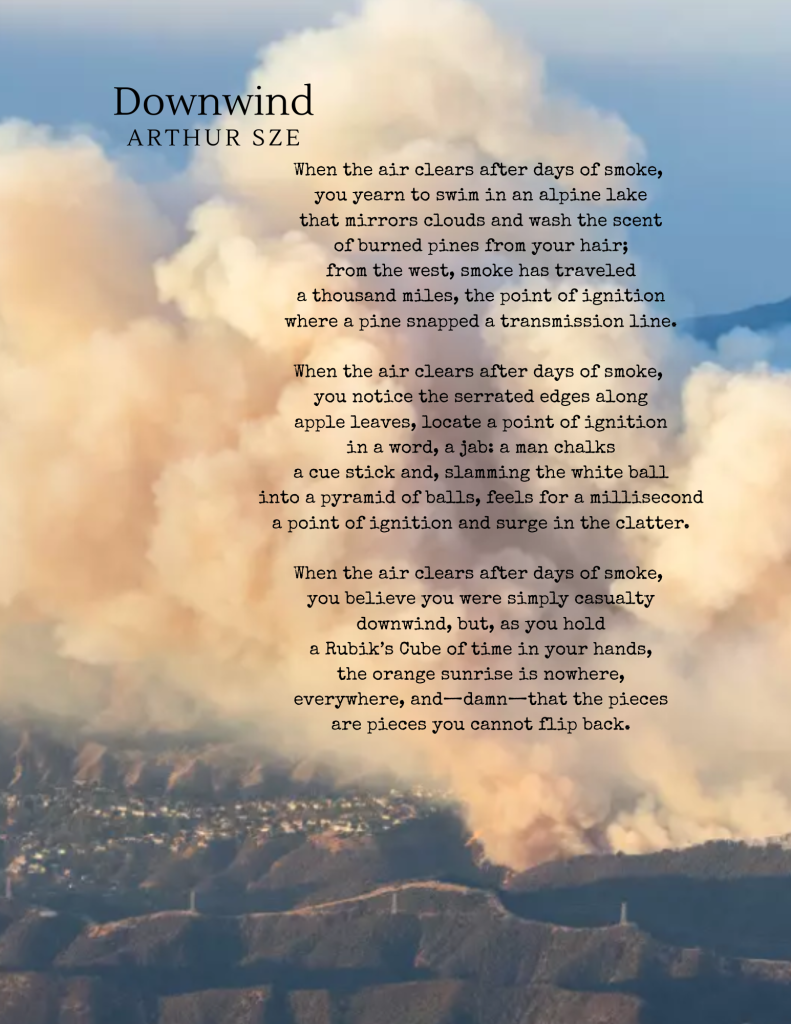
Downwind

from Into the Hush by Arthur Sze,
Copper Canyon Press, 2025; *Winner of the 2025 Bollingen Prize for American Poetry for Lifetime Achievement*

When the air clears after days of smoke,
you yearn to swim in an alpine lake
that mirrors clouds and wash the scent
of burned pines from your hair;
from the west, smoke has traveled
a thousand miles, the point of ignition
where a pine snapped a transmission line.

When the air clears after days of smoke,
you notice the serrated edges along
apple leaves, locate a point of ignition
in a word, a jab: a man chalks
a cue stick and, slamming the white ball
into a pyramid of balls, feels for a millisecond
a point of ignition and surge in the clatter.

When the air clears after days of smoke,
you believe you were simply casualty
downwind, but, as you hold
a Rubik’s Cube of time in your hands,
the orange sunrise is nowhere,
everywhere, and—damn—that the pieces
are pieces you cannot flip back.

To find my own place with this poem, using Arthur Sze’s style as my mentor, I needed to use his deliberate, expansive phrasing, leaving room for my immediate meaning, and other weights of meanings a reader would bring to the piece. Each stanza needed to tell a story, complete within itself, of a moment or action. …And I needed to avoid rhyme like my life depended on it. (Guess which one of those was really trying.😖) In a nod to his translations, I threw in a couple of undemanding-to-non-speakers Spanish words.

At present, I find fire and its environmental impacts too grief-inducing, so I tried for a lighter direction. I chose a positive moment – small and internal – and then tried to use a less heavy hand in describing regret and resignation.
Updraft

When the sky clears after days of clouds,
you yearn down steep staircases
once known but long left unexplored
as whetted, curiosity bustles back up again –
And pausing, with winter no less present,
el clima’s daughter gestures to her brother.
el niño y la niña’s salsa spins scour the floor.

When the sky clears after days of clouds,
you notice that viridian is Gaia’s favorite shade,
followed familiarly by fern, or maybe sage.
exclamations of dun birds – sparrows? – are lime limned,
though faintly heard by the slow-sap forest;
evergreen rising, a point of departure,
draping the hills, a softening, moss-fuzzed mantilla.

When the sky clears after days of clouds,
you believe you feel potentiality’s
updraft, but as the acetic
wind curdles the clouds, vernal promises
of equinox diminish –
while hollow bellied thunder growls,
a ‘not yet’ that can’t be unheard.

I liked the word ‘updraft’ because, like ‘downwind,’ it is a minor thing that speaks to something huge. An updraft is a small, rapid, upward current of air, caused by wind rising from warmed ground, or forced over topography – and it’s the engine behind clouds, moisture formation, hail, and thunderstorms. It gently sends regrets as I think of spring, and plunges us back into yet another tormenta.

My final poem I wasn’t going to share, but I really found far too many neat turns of phrase in Sze’s work NOT to mess with my Shovel idea. “Winter Wishes” borrows from the poem, “X-Ray,” the first line of which reads In my mind, a lilac begins to leaf. I went again with a lighthearted approach, sticking to my theme of kind of not complaining about rain (nobody with any sense who lives in a drought-prone place does that), but merely suggesting that I’m really ready to start (very sloooowly) digging out the hillside for my garden if we could have a few days pause early next month? Yes, Dr. Nimbus, thank you.
Winter Wishes

on the store front, signs smile, “welcome In,”
while bagged soils, stacked, find my
fingers fidgeting. It’s TIME – past time, to my mind
though mind over matter can’t leave the land less a
lake. yesterday the first lilac
hyacinths raised bowed heads. Crowing, “Now it begins!”
I scrambled to the garden center, anxious to
find the finest fertilizer to fortify my be-leaf.

My Poetry Sisters are scintillating on the poetry of Arthur Sze from wildly different directions this month. Liz’s poem is here. Laura’s poem is here, Cousin Mary Lee’s is here, and Sara’s poem is here. Tricia’s poem is here, and Susan’s poem is here. Michelle K’s poem is here. More Peeps may show up throughout the weekend, so don’t forget to check back to see their links rounded up here.

Our lovely hostess this Poetry Friday is Ms. Margaret, at Reflections on the Teche, so don’t miss stopping by for more poetry! Thanks for hosting.


Book Giveaway! You have 31 days to win copies of BERRY PARKER DOESN’T CATCH CRUSHES. A book club, school library, or home school group is eligible to receive ten copies, which was published by Harper Collins in September of 2025, and is all about a young woman growing up and learning that love is not pie, and that sharing it out doesn’t require it to diminish. It’s a book about love and growing into change and compromise, through the lens of middle school. If you’re a book club host, or know a teacher or librarian who could use a boost this very long winter, don’t hesitate to sign up. Continental U.S. only, please, with apologies and acknowledgment of the murky tariff situation – may it clear soon.


We’re finally seeing the calendar and astronomical end of winter in a few weeks, though meteorological winter has yet to give way. In month two of this year, it seems we are already we’re in the stutter stop of weeks that extend years long, followed by days that just blink past. This was somehow the shortest Olympics, EVER, and yet, it’s been another endless month of this national moment. It’s so strange how time both shrinks and stretches, warps and morphs, all inchworms and seven-league boots. I longed as a child to be the magical ages of both seventeen and thirty-six (?? no idea), and then – life leapfrogged a decade and some, and now neither of those is even visible in my rear view anymore. Psychologists suggest that the more information the brain processes, the slower time seems to move, and as we age, much less seems like new information. When we’re kids, time moves like those deposit cans they used to send along through pneumatic tubes at the bank; a whoosh and the packet of our days is delivered elsewhere – grades and birthdays brought forward in a flash.

While we’re being both stretched and stationary, remember – b r e a t h e. On this ride, may you stop and look, cramming your moments with new faces, new textures, and new experiences, expanding the river of what you think you know down through its tiniest tributaries. May your brains have to slow down so that you can step deliberately into new understanding – giving depth and new dimension to knowledge you thought you’d already learned. And as you suck down cold, fresh mouthfuls of this spring to come, may you remember that no one will experience the new season just like you – so celebrate your original self because you are so well-loved.