{constant reader’s reads: a procrastination smörgåsbord}

Dear TBR,

The book world is such a fun place, and people in their fandoms are crazy in a good way. Going out into that world sometimes is a good reminder of why we write, of who our readers are, and how awesome this whole job can be.

Of course, stories like Maggie Tokuda-Hall’s remind us of how NOT awesome it can be, but it’s usually publishers/politicians and not readers who are responsible for that…!

It’s been a good reading month, though busy; work is moving right along at a good clip. Hopefully I’ll eventually noodle through things in a timely fashion, but until then I’m procrastinating reading like mad.

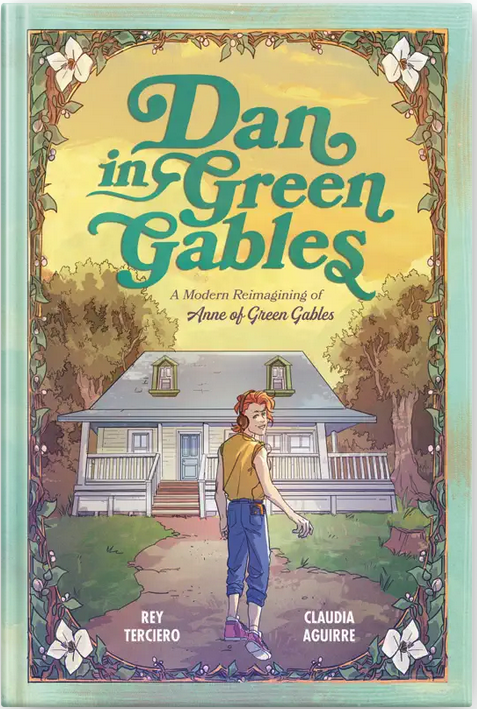
THE RENAISSANCE OF GWEN HATHAWAY: RenFaire novels are a particular love for me; Jen DeLuca’s WELL MET series is a particular favorite of mine (and I’m hoping someday Grinnell Russian Lit professor Kelly Herold will someday finish her portal RenFaire novel which includes time travel and a lovely villain). I love Renaissance Faires more in theory than in practice, however, because they never feel like a place for people of color, celebrating, as they are, a mostly made-up history of a time which didn’t feature people of color. This novel does, however, have a Black girl in it as a love interest – AND there is size and queer representation, as Gwen is a fat heroine being wooed by Arthur, a thin and somewhat nerdy boy with two Dads. I love Arthur. I want to hug him and squeeze him and call him George. He made me cry by being awesome. Gwen is dealing with her first Renaissance Faire after her mother’s death, and is trying to take her place as the jewelry maker for the family’s stall. Her father, who, like her, is mostly non-communicative and not apt to try anything new, are really struggling, and the story of how they struggle through this year anniversary of the death of the bright and beating heart of their family is worth reading.

LUCY CLARK WILL NOT APOLOGIZE: Lucy Clark’s parents are absolutely insane. They are… self-help gurus, and nutters who – okay, only *I* think they’re nutters, but I’m not a huge fan of people who treat self-help like a new religion. ANYWAY. It’s mostly Lucy’s Dad who is very popular on the self-help circuit, and Lucy is basically neglected, sent to an absolutely hideous boarding school, and then when she gets into trouble, not only is her best friend withdrawn from the school, she is suspended and sent to one of her Dad’s protegees, who is supposed to be a positive influence on her. That person is supposed to find Lucy something to do that will turn her onto a new path. That new path comes in the form of being a companion to an elderly woman named Edith.

Rather than the awful-piled-on-awful task that Lucy fears, Edith turns out to be AMAZING, with an amazing best friend, fun and quirky inhabitants of the New York converted mansion in which they live, but there’s one small snag: Edith is convinced someone is trying to kill her. Convinced. Eventually, Lucy begins to believe that something is …up. But, who is trying to scare an old lady? And why?

This is a meandering mystery with a lot about being enough, about having self-esteem, about not apologizing for surviving and standing up for yourself. The boarding school and teacher are SERIOUSLY OTT awful, Lucy, though sixteen, is almost written as a middle grade student, her emotional inner life seems to be so simplified, and the denizens of Edith’s house seem to come straight out of a Ransom Riggs novel – they’re all so quirky as to not seem real. But, it’s a fun, slightly Gothic mystery nonetheless.

NIC BLAKE AND THE REMARKABLES: I couldn’t really review this novel until I’d had my moment interviewing the author — and while I made a point of not discussing spoilers then, I *really* want to avoid them now. Nic Blake is homeschooled, Black, and Gifted. REALLY Gifted — in a way that’s like magic, only stronger. (As the author says “Wands are evil in this book… take that the way you will.”) Nic’s family has an ancestral gift which manifests as power to do things. The people – her enslaved ancestors – could fly. They flew away from slavery and lived in a place called Uhura, which in Swahili means “freedom.” Nic doesn’t know much about the details, though. She’s never been to Uhura. She lives with her Dad, and the two of them move a lot. Most of the people they know are Unremarkables; ordinary humans without the Gift. The reason for that, and the reason her next-door neighbor can tell her new puppy is a Hellhound is part of a lot of other secrets and surprises are found as they put their all into doing something that feels impossible for a couple of kids — saving Nic’s father from a fate worse than jail.

Way back in the day, the Wizard With the Scar books were praised for hooking the reader with myriad New Things Per Page. The author has all of that going on, plus multi-layered bits of Black history, emotional resonance and themes of self-esteem, being “enough,” and using your God-given gifts, even if you aren’t particularly remarkable. This is going to be a very, very popular fantasy series.

WHISTLEBLOWER: I have a *lot* of mixed feelings about this indie book. I have a lot of mixed feelings about being a whistleblower, too, I guess. Sometimes knowing that Something Should Be Done about a thing, and actually setting out to do it are two very different things. In this New Adult novel, college student Laurel feels somewhat invisible and unmoored at her college. She’s made it onto the paper — but she’s basically coasting through life, showing up late, hung-over, or both, to almost everywhere. It’s …fun? But “fun” for a college junior is wearing a bit thin. It’s almost a relief to Laurel to get the story she’s pitched to the paper rejected — it’s the kind of story she figures the paper won’t really run with, because it’s based on hearsay, because she stayed out too late partying and couldn’t come up with anything stronger. She’s disgusted with herself for not taking herself seriously enough to do her best — but then, her story gets scooped by a stronger, sharper writer — and in a twist, that other girl gives her credit for the idea. Their editor decides that they both should investigate to uncover whether or not what they suspect is true. As it turns out, Something Rotten is happening at the college with the football coach, the man whose finger is on the pulse of so many futures. Laurel just wants to help the people he’s hurting, but the golden boy quarter back of the football team is baffled, hurt and infuriated. He swears the coach isn’t who Laurel thinks he is. Laurel swears otherwise. They set out to prove each other wrong – and of course catch feelings along the way. Suddenly it’s turned out that Laurel is a whistleblower — and she’s not sure that’s what she ever intended to be.

This story was a little scary to read, as I think the world is actually uglier than the way the author portrayed it and I worry when people downplay things. Young women get death threats these days from looking at someone wrong — I think the author deliberately brushed lightly over quite a few things which I felt were more serious. I also felt like Laurel drank way too much — and that’s my Old Lady coming out, I’m sure, but she didn’t seem safe enough to kick back and not have all her senses about her. The jocks and sycophants surrounding her were some nasty people and I kind of wish the author would have taken things more seriously — BUT, this was meant to be somewhat light and not erring on the side of too message-y. Did I like it? I’m not sure yet – a very mixed bag, but also interesting and thought-provoking.

Fresh onto the TBR:

  • Enter the Body, by Joy McCullough
  • Both Feet in the Grave, Jeanine Frost
  • The Secret Service of Tea and Treason, by India Holton
  • In Memoriam, by Alice Winn


Until the next book, 📖

Still A Constant Reader

{npm ’26 • 21}


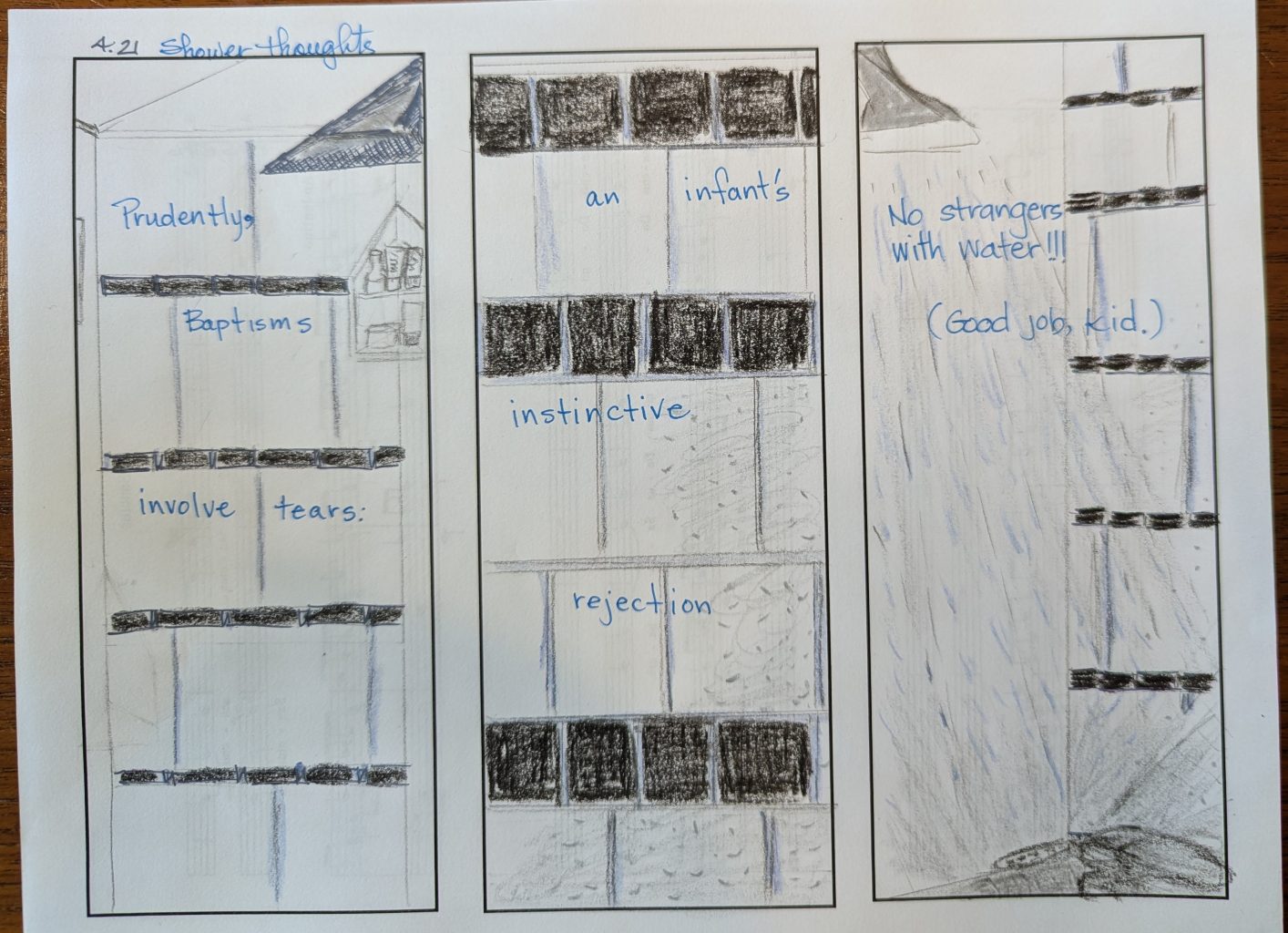
This morning in the bathroom, I realized that both the showers are glassed in, thus constituting “windows,” thus technically coming under my wholly arbitrary ‘windows’ poetry rule… And now you’ll be tormented with my “shower thoughts” for the rest of the month, you’re welcome.

So, I don’t know if it’s a Spring thing or if there’s some other denom-specific significant thing I’m missing, but the Presbyterians are having baby baptisms frequently these days. And each time a baby objects to the whole… thing, the parents look like they want to sink through the floor. And I just want to call down from the choir loft and say, “HEY! Tell them they’re doing great!” Because honestly? If a random smiley man said some stuff to me I didn’t understand and then caressed my nearly bald head with water which is probably at best tepid? You’d better believe I’d let him know my thoughts on the matter. Loudly.

(TANGENT: does anyone remember the water gun christenings and Easter …Holy Water spritzing of 2020? The babies were perhaps even more offended then [or just confused]). Mind you, I’m wholly and deliberately missing the point, but dang it, babies should react negatively at the wildly strange interaction that is infant baptism. It’s an important survival reflex. The kids are all right.

Early Displays of Common Sense

Prudently,
baptisms
involve tears.

An infant’s
instinctive
rejection:

NO STRANGERS
WITH WATER!!!

(Good job, kid.)

{constant reader’s reads: cultural connections}

Dear TBR:

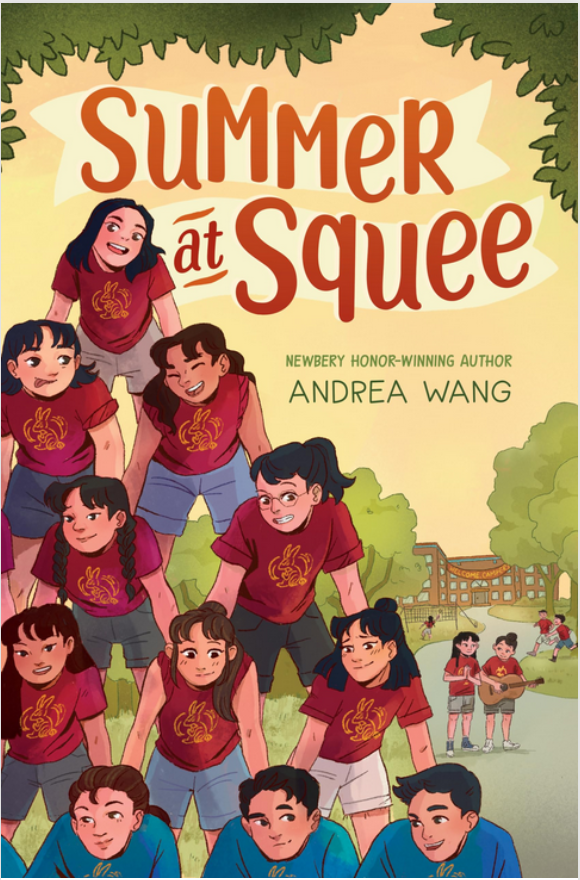
The Read Harder Challenge that Book Riot does every year hasn’t been something I’ve felt too much need to participate in, because it was originally started to expand people’s reading horizons, and… I like mine where they are? Meaning, I do make a point of trying to read a leeeetle nonfic, quite a few books by writers of other ethnicities and cultures, including queer and disabled cultures, and a couple of books in translation per year. That said, this book snuck up on me. It’s …brilliant. And? I wish that there had been – or were – Squee Camps for all kids in a racial minority with a 90’s hyphenated identity (I say this acknowledging that some people reject the labels of “Whatever-American” and just say Black or whatnot). I worked at a summer camp for six years, and served on its board for a few years, so I’m all about summer camp books, but this one is a step above! If I’d read it in junior high, I would have wanted to be Chinese-American, just to include myself in the sense of belonging that the characters in this book eventually find.

Phoenny Fang isn’t ready for her last summer at Chinese cultural camp. The Summertime Chinese Culture, Wellness, and Enrichment Experience – “SQUEE” to those in the know – ages out its campers in the eighth grade, and so, this summer is IT – it’s going to be the BEST summer of Phee’s life, and she’s here for the special camp things – the crafts, the games, and the bonding. With her squad of ten close friends, she expects to have the Best Time, Ever. Of course, being that this is real life, nothing goes as planned. For one thing, Phee and friends are NOT in the same dorm. She’s rooming with her best friend, fortunately, but some of the rest of the girls she’s been hallmates with since forever are on aren’t close by. Second, there are two new girls in her the group, and it’s clear that they’re hostile. They hate camp, they hate cultural Chinese stuff, and they seem to hate Phee especially. EVERYTHING Phee does is wrong – including Mandarin words in conversation. Asking questions about their Chinese names. Even smiling at one of the new counselors in training – who has also been smiling at Phee, which makes her feel…feelings. Phee is spiraling. Not being with her friends, not getting her first choice in activities, and dodging weird feelings and hostile new girls is making what should be fun hard. Squee has always been a haven that Phee as looked forward to every year. Why are these new girls even at SQUEE if they hate Chinese culture so much? Why is everything coming apart?

Phee’s plate seems overfull already when the SQUEE socials are attacked by anti-Asian trolls. Suddenly there are new safety rules, a craft making holders for security whistles, and a renewed sense that the real world is intruding. All Phee wanted was to have the best camp experience ever, to end her time as a SQUEE camper on a high note, just like the previous summer. But, when it becomes clear that she’s trying to hang on to something that will never happen again, that she’s trying to keep Squee exactly the same as it always was – even when the new girls’ experiences make it clear that it needs to evolve and expand – Phoenny realizes that in order to have a memorable final summer at SQUEE like she wants, things have got to change.

One of the things I love about this book is that it is honest and speaks genuinely about the experience of being a hyphenated American. Phoenny is unhappy about the changes that have come to the camp, but one of them is Hall Meetings, where the campers give Snaps, Squawks and S’Ups each evening to kind of discuss their day. Snaps are compliments – and everyone is required to share those, Squawks are complaints, and S’Ups are questions they have for their counselors. As it turns out, these Hall Meetings are where the author put some of the most baldly honest interactions between the characters. Some might argue that the conversations between the characters aren’t quite realistic, and that no tween is that honest or articulate, but I would argue that this being a work of fiction for middle grade/junior high kids, that honesty is important. Here the characters discuss their feelings about being at a cultural camp when they’re Chinese kids adopted by white parents, they discuss cultural heritage trips, which are a real life joint effort by the government of China and the U.S. to encourage Chinese-born Americans to return to visit, and they discuss the pitfalls of speaking Cantonese or Mandarin well, or not at all. They discuss feeling like a “bad Asian” because of the perception of their white peers — or of their Chinese relatives at times — that they don’t know enough, aren’t acting Chinese enough, and aren’t good enough as they are. Most hyphenated-Americans I know would cherish these types of conversations if they allowed themselves to be honest enough to have them. This book would work best, to my mind, for OLDER MG readers. I would LOVE to read this book with a book club or a social studies/literature class – the discussion prompts here are worth gold.

Acknowledging that there are hundreds of new books from various children’s lit publishers every year, I was nonetheless annoyed that I had missed this one. Where are its accolades and fans? This is just as important a book as many other books coming out in March 2024 which have gotten ALA props. Still, this won has a ⭐️ Kirkus, was featured on The TODAY SHOW: Read with Jenna Jr. 2024 Summer Reading List, is a 2025 Charlotte Huck Honor Book for Outstanding Fiction for Children, a Junior Library Guild Gold Standard Selection, and was honored as a Horn Book 2024 Summer Reading: Middle School selection. So, okay. I am now officially less annoyed. Respect to Andrea Wang, and here’s to more excellent books like this one.

Fresh onto the TBR:

  • Somebody’s Daughter, Ashley Ford
  • The Friend Zone Experiment, Zen Cho
  • The Tribulations of Ross Young, Supernat PA, A.J. Sherwood

We are more than our outsides, more than looks that tags us with a label and put us in a box. Here’s to books to help us remember we all have worthy insides. Stay reading!


Until the next book, 📖

Still A Constant Reader
{constant reader’s reading: title ix contenders}

Dear TBR

Though I wanted to be, your girl is NOT a ball-and-bat-and-sweats-and-spike girlie. I played football in junior high because I was fast and aggressive and very, very angry so bashing my body into boys without getting a felony count seemed like a good idea, until I was yanked unceremoniously off the team by my father. It was fine, really – while I did my best, sports are one place where my spatial disability makes me trip a lot, run left when I should run right, be clueless about yardage and — yeah. Football plays make as much sense to me as knitting patterns, so it wasn’t going to have lasted long anyway.

But I WANTED to be a sporty girl. And reading these two books about the team solidarity and body-mind connection that sports require are giving pure Title IX.

IT’S ALL OR NOTHING, VALE,, by Andrea Beatriz Arango

Vale – or Valentina Marí Camacho – is a Puerto Rican girl from Virginia who has been competitively fencing for years and years and years. Fed on a steady diet of “pain is just weakness leaving the body,” “winner’s don’t quit,” and told so long that “it’s all or nothing,” Vale has honed herself to be determined, 100% serious effort. She’s never been good at anything, really, unlike her brother, but she’s good enough at fencing to have been tagged to go to the junior Olympics. As an athlete, she’s at the top of her game and fiercely proud of it. But an accident on the back of her father’s motorcycle breaks her leg in multiple places and suddenly Vale is out of competition for four long months.

Her return – which is where the book begins – is not the glorious sprint she envisioned, but a pained limp. Her parents argue constantly about whether or not she should sit down, use her cane, do yoga, or try whatever random internet-sourced cure that Vale’s mother has found. Her Papí, meanwhile, believes nothing but that she is fine, and that she will be back to 100% if she just puts in the time. Her mother her to be hyperfragile and her father believing she’s indestructible has more to do with them than with Vale, but she’s unable to see that, because the family cannot themselves articulate their own feelings – or fears. Vale returns to her fencing group unsure if “disabled” is a bad word, hearing whispers of dolor chronico, and terrified but unable to share it. And to her shock, the forceful, graceful effort that fencing requires seems no longer available to her, even with Vale giving it 150%. And to make everything exponentially worse, Cuban Myrka Mareero – a gorgeous, pink-haired newcomer, has not only taken Vale’s spot, she’s also got her attention in a way that Vale isn’t sure she’s ready to deal with. At ALL.

SO much to love in this book – from the stunning cover to the liberal use of Spanish, which challenged me but left carefully placed context clues for if I couldn’t remember a vocabulary word. I don’t think I’ve ever read a MG story about chronic pain, injury, and perfectionism that hit me in the same way, and the fact that the novel doesn’t end with a conclusion “and then Vale decided X, and she lived happily ever after” is one of its major strengths. The novel is merely a moment in a long process which is just beginning – a truth so important which we need more novels which center. Healing and survival are always-in-progress things.

OUT OF OUR LEAGUE,, edited by Dahlia Adler & Jennifer Iacopelli

Reading an ensemble book like an anthology is usually an uneven experience for me – some stories I love so hard that I could squeeze them, and other stories rate little more than a “Meh” or a baffled question as to how they were included. This anthology of sixteen short stories about female athletes held far more winners than expected, and is HANDS DOWN the best sports anthology I’ve ever read. I can’t talk about all of story, I’ll highlight a few I especially enjoyed:

“Safe at Home” by Jennifer Iacopelli opened the book strongly with a story of sisters pitted against each other in the under18 amateur baseball championship. Even going viral for footage of her stealing home – making her older sister, Meredith, drop the ball as she bashed into her – wasn’t the major victory Molly Hancock expected it to be. She’s always felt less-than her brilliant, accomplished older sister, and making the winning run for her team is quickly overshadowed, first by her getting into her university of choice, then next by the whispers of sports commentators. Male sports commentators. She dropped the ball to give her sister the win. Isn’t that sweet? Of all the things Molly expected to be wondering about, that was never a question.

“Sidelined” by Maggie Hall pits friends Ollie and Lexie against each other on the basketball court and for Oliver, on the football field. In just a few short weeks, their winning combination will be dissolved – while they go to colleges on opposing sides of the map. Lexie is settling – but she doesn’t want to acknowledge it. She’s been offered a basketball scholarship, and thought it’s not really her game – she’s her high school star, and they offered, and she’s an athlete, right? Leaving her dearest friend and her brother behind shouldn’t make a difference, if she gets to come out ahead and compete, right? …Right?

“Power Ten in Two” by Leah Henderson was utterly delightful – Emersyn knows all there is to know about her sport, and she’s been playing against high school students since she was a seventh grader. She’s a senior headed for a Division 1 soccer team in college, and a true believer in her coach’s mantra of Outplay. Outwork. Outlast. Outshine. Nothing matters more than winning… but when Emersyn but when she gets dumped in with a jayvee crew team for two weeks, she knows less than the newbies. How could her coach do this to her? Why is she in the WORST boat? And, what the heck is a ‘power ten?’ Emersyn has to learn – and quickly – what she’s with the rowing team to learn – but fortunately for her, it isn’t to win against impossible odds.

Volley Girl, by Dahlia Adler made me smile because every summer camp, whether its a sports camp or not, has some similarities. Camp Ilan is coming to a close for Azi, and all the memories she’s made with her girls, all the horrible volleyball coaching she’s endured, every fight she’s broken up, every hour spent perfecting her serve – pretty soon none of that is going to matter to anyone in the larger world. It’s hard to embrace the idea that winning isn’t not only not everything, that sometimes it’s not anything – and that there’s more to life, but Azi is going to try…

Fresh onto the TBR:

  • Sea Legs, Jules Bakes
  • On the Hippie Trail, Rich Steves
  • I Got Abducted By Aliens And Now I’m Trapped In A Rom-Com, by Kimberly Lemming

Even if some of us weren’t meant to be sports stars, we can all look up and find our own guiding stars – which in these books were literally playing for love of the game – and for love of self, which turns out to be an unbeatable combination. Stay reading!

📚 Still A Constant Reader

{npm kidlit progressive poem}

It’s time! The lovely progressive poem has “progressed” for twenty days, and now it’s my turn! Here’s the panoply of poets playing this year:

April 1 Linda Mitchell at A Word Edgewise
April 2 Tricia at The Miss Rumphius Effect
April 3 Robyn at Life on the Deckle Edge
April 4 Donna Smith at Mainely Write
April 5 Denise at https://mrsdkrebs.edublogs.org/
April 6 Buffy at http://www.buffysilverman.com/blog
April 7 Jone at https://www.jonerushmacculloch.com/
April 8 Janice Scully at Salt City Verse
April 9 Tabatha at https://tabathayeatts.blogspot.com/
April 10 Marcie at Marcie Flinchum Atkins
April 11 Rose at Imagine the Possibilities | Rose’s Blog
April 12 Fran Haley at Lit Bits and Pieces
April 13 Cathy Stenquist
April 14 Janet Fagel at Mainly Write
April 15 Carol Varsalona at Beyond LiteracyLink
April 16 Amy Ludwig VanDerwater at The Poem Farm
April 17 Kim Johnson at Common Threads
April 18 Margaret at Reflections on the Teche
April 19 Ramona at Pleasures from the Page
April 20 Mary Lee at A(nother) Year of Reading
April 21 Tanita at {fiction instead of lies}
April 22 *Patricia Franz
April 23 *Ruth at There’s No Such Thing as a Godforsaken Town
April 24 Linda Kulp Trout at http://lindakulptrout.blogspot.com
April 25 Heidi Mordhorst at My Juicy Little Universe
April 26 Michelle Kogan at: https://moreart4all.wordpress.com/
April 27 Linda Baie at Teacher Dance
April 28 Pamela Ross at Words in Flight
April 29 Diane Davis at Starting Again in Poetry
April 30 April Halprin Wayland at Teaching Authors

(EDITED TO ADD – tomorrow’s line will be found at Rose’s blog, and the poem will go forward from there. Please skip Patricia for now. Thank you!)

For those of you new to the process: this NPM children’s poetry celebration was originally begun by Irene Latham, and the mantle taken up by Margaret Simon, who wrangled this year’s distracted poets into a cohesive whole. Linda M. started us off with a gloriously open April window…

From Process…to Poetry (Line)

April thus far has been a particularly scattered month for me, but reading poetry has been particularly grounding, especially seeing this poem grow in creation. In this April garden, nothing yet has come to grief. It is full of the actions of joy. As I breathed the “gift of the lilacs,” and imagined myself painting and breathing and dabbling and gamboling, I thought about what we verb-y activities we haven’t yet done in this poem – eaten, spoken, shouted, screamed/squealed, or slept (we’re playing in this garden alone, which is its own kind of delightful). I also meditated on the scents on my back porch just now of an evening – orange blossoms from my dwarf citrus tree. It almost feels like we opened that April window into a glorious morning, and now… taking my cue from the thanks at the “day’s end,” and “long-ago springs,” as well as Cousin Mary Lee’s flowering shrubs, I decided to forget about eating (I couldn’t figure out how to fit it in 😂) and drink in a sense of peace and rest. That’s what this April garden has given to me this month. Since we’ve stayed in four lines per stanza, I’ll add an ellipse and begin a new one…and then it’s over to you, Patricia Rose!

Open an April window
let sunlight paint the air
stippling every dogwood
dappling daffodils with flair

Race to the garden
where woodpeckers drum
as hummingbirds thrum
in the blossoming Sweetgum

Sing as you set up the easels
dabble in the paints
echo the colors of lilac and phlox
commune without constraints

Breathe deeply the gifts of lilacs
rejoice in earth’s sweet offerings
feel renewed-give thanks at day’s end
remember long-ago springs

Bask in a royal spring meadow
romp like a golden-doodle pup!
startle the sleeping grasshoppers
delight in each flowering shrub…

Drinking in orange-blossom twilight

{pf: poetry peeps find ‘A Word’}

Welcome to Poetry Friday!

Poetry Peeps! You’re invited to our challenge for the month of March! Here’s the scoop: We’re writing back to four Lucille Clifton poems, in her notes to clark kent series: “if i should;” “further note to clark;” “final note to clark;” and “note passed to superman.” We’ll be ‘in conversation’ with Ms. Lucille’s poems – talking to them, talking back to them, or talking about them, whether that’s all of them, or any of them, either in form or in substance. Once you’re sure how that’ll look for you, you’ve got a month to craft your creation(s), then share your offering on March 28th in a post and/or on social media with the tag #PoetryPals. We hope you’ll join the fun!


“…And that’s what your holy men discuss, is it?” asked Granny Weatherwax.

“Not usually. There is a very interesting debate raging at the moment on the nature of sin, for example,” said Oats.

“And what do they think? Against it, are they?”

“It’s not as simple as that. It’s not a black and white issue. There are so many shades of gray.”

“Nope.”

“Pardon?”

“There’s no grays, only white that’s got grubby. I’m surprised you don’t know that. And sin, young man, is when you treat people like things. Including yourself. That’s what sin is.”

“It’s a lot more complicated than that–”

“No. It ain’t. When people say things are a lot more complicated than that, they means they’re getting worried that they won’t like the truth. People as things, that’s where it starts.”

“Oh, I’m sure there are worse crimes–”

“But they starts with thinking about people as things.”

–from CARPE JUGULUM, by Terry Pratchett.

People, and things. Things, and people…

Sometimes the subjects we find in conversation with each other are mirror images, and sometimes they’re complete contrasts.

From Process…

Some of you know that for reasons of faith my parents didn’t allow me to read fiction in junior high and high school. No fiction, much less fantasy fiction with a witch – Granny Weatherwax – and an Omnian priest (a made-up sect that goes hard with the door-to-door solicitation) and… vampires, as were featured in Terry Pratchett’s Carpe Jugulum. And though my parents wanted me to be a celebrant of truth as defined by the term “non-fiction,” there’s …just a whole lot of truth in the previous fictional passage, too, isn’t there? The intersection of People Treated Like Things and Injustice is the corner whereon most of the problems begin. Pick out any deeply unfortunate moment in history – the Doctrine of Discovery, the advent of chattel slavery in the Americas in 1619, the forced migration of The Trail of Tears, The Triangle Shirtwaist Factory Fire, Executive Order 9066 – ? All of those things come down to people treated as things. Own-able. Moveable. Modifiable. Disposable.

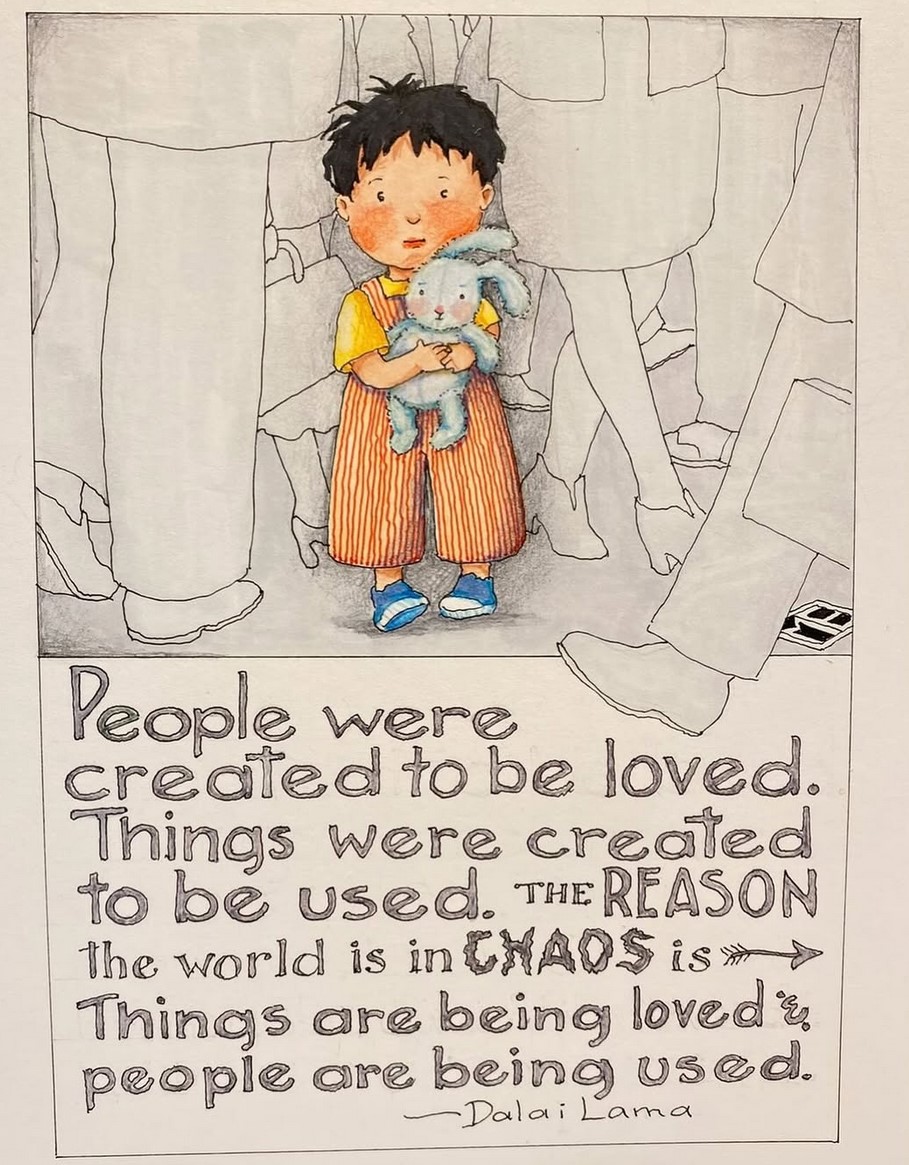
Today’s thoughts are in conversation with Granny Weatherwax’s profound statement (as brought to us by a renown British author who started out as a journalist) and with the Dalai Lama’s (a spiritual leader of great renown who started out as a mostly regular Buddhist priest). I could not believe how similar the statements between these very disparate people were when I found them on a Mary Engelbreit print which the artist shared on Instagram on February 21st of this year. (That one needs to be a print, no?) Two roads diverge on this highway, and they are People and Things. Two vastly different entities, two vastly different purposes, but human society confuses them so frequently. One made to be loved, and the other made to be used. How difficult for some to keep that straight.

…to Poetry

Though I missed the poetry meet-up this month (boo!) I felt like I already had a good feel for this kind of poem, which I’m leaning towards playing with some more to kind of unpack the current news of the day as I process it with its abundant catch words. This time, it was an obvious choice to write several poems as well, or at least two, because my brain has kept circling around the linked but contrasting noun categories of People and Things. But, after running across the Dalai Lama’s statement on my socials, two new words elbowed their way to the front – Loved and Used.


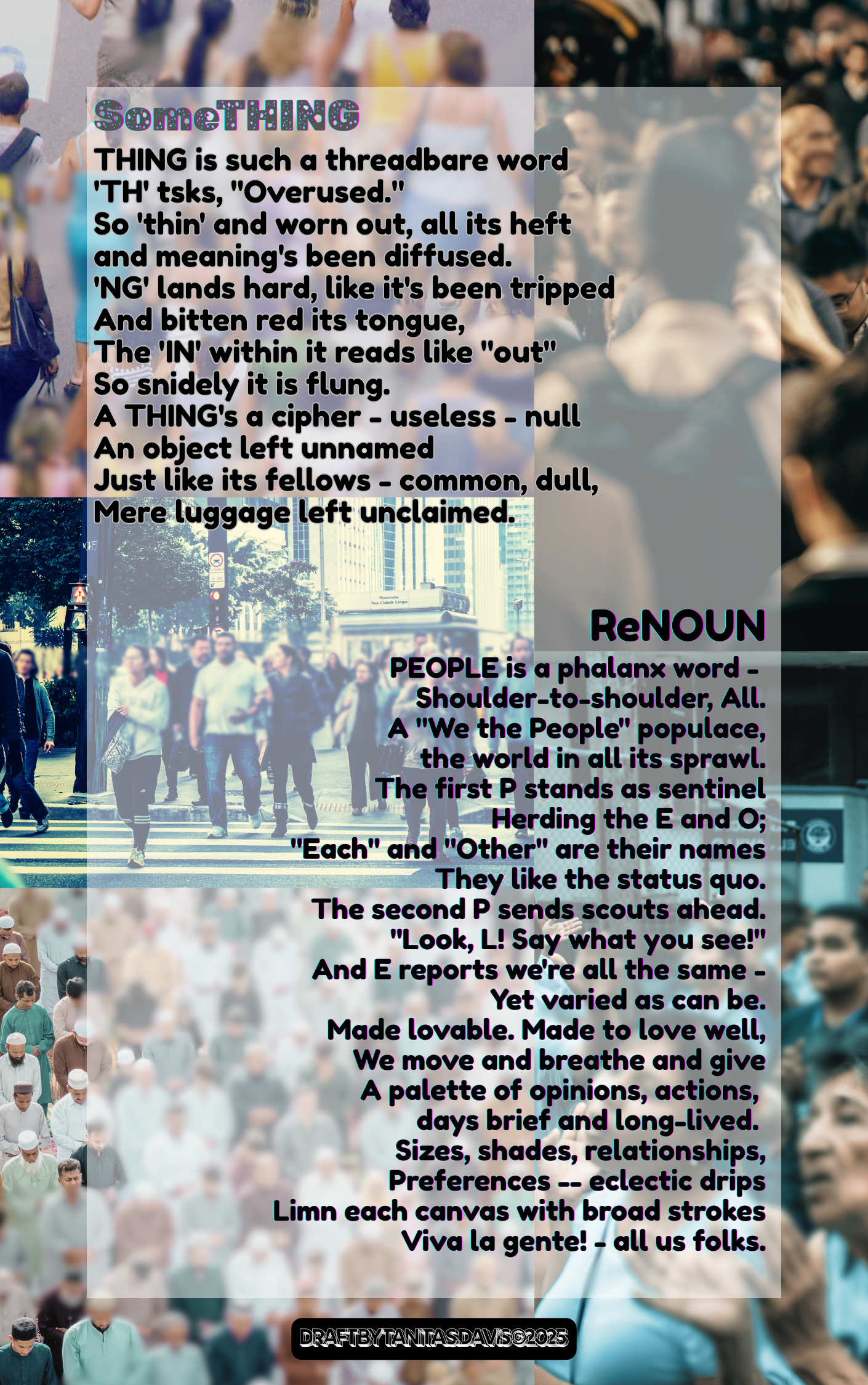
someTHING

THING is such a threadbare word
‘TH’ tsks, “Overused.”
So ‘thin’ and worn out, all its heft
and meaning’s been diffused.
‘NG’ lands hard, like it’s been tripped
And bitten red its tongue,
The ‘IN’ within it reads like “out”
So cruelly it is flung.
A THING’s a cipher – useless – null
An object left unnamed…
Just like its fellows – common, dull,
Mere luggage left unclaimed.

reNOUN

PEOPLE is a phalanx word – shoulder-to-shoulder, All.
The “We the People” populace,
The world in all its sprawl.
The first P stands as sentinel
Herding the E and O;
“Each” and “Other” are their names
They like the status quo.
The second P sends scouts ahead.
“Look, L! Say what you see!”
And E reports we’re all the same –
Yet varied as can be.
Made lovable. Made to love well,
We move and breathe and give
A palette of opinions, actions,
days brief and long-lived.
Sizes, shades, relationships,
Preferences — eclectic drips
Limn each canvas with broad strokes
Viva la gente! – all us folks.

This form lends itself to some real creativity for me, in terms of just letting my brain go and feeling my way into a word’s deeper meaning through what it remind me of, its internal sounds, the shapes of its letters, and whatnot. I like that “______is a Word” invites both wordplay and a thoughtful liberation like few other forms – I don’t have to make these poems rhyme. I don’t have to observe meter or number of lines, or anything else if I don’t want to. I just need to examine the word from all facets and let the word speak to ME – as didactically or as simplistically or as complexly and cleverly as I may. So, this was delightful – and I hope you find these word meditations delightful – useful, and illuminating – as well.

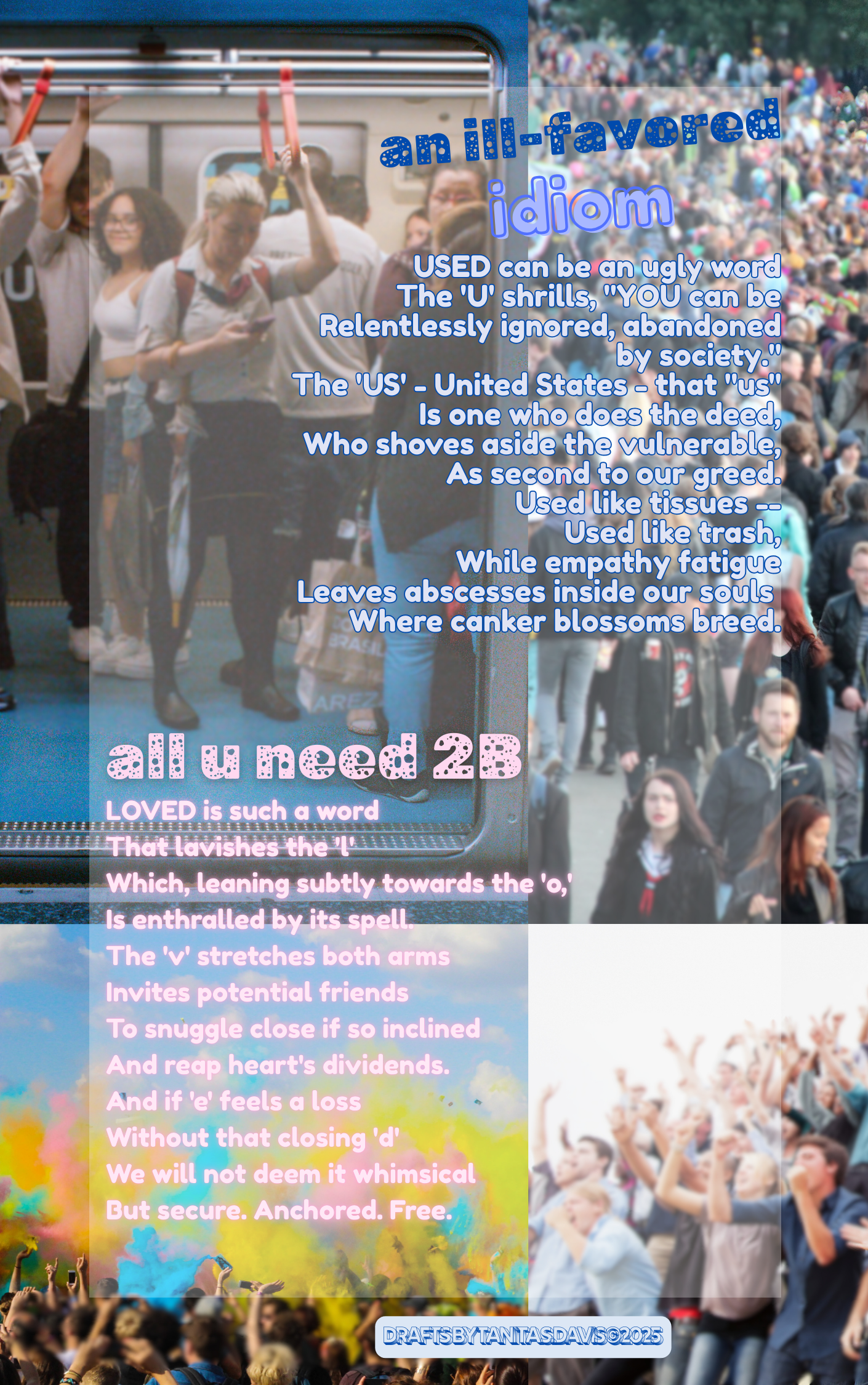
an ill-favored idiom

USED can be an ugly word
The ‘U’ shrills, “YOU can be
Relentlessly ignored, abandoned
By society.”
The ‘US’ – United States – that “us”
Is one who does the deed,
Who shoves aside the vulnerable,
As second to our greed.
Used like tissues —
Used like trash,
While empathy fatigue
Leaves abscesses inside our souls
Where canker blossoms breed.

all u need 2B

LOVED is such a word
That lavishes the ‘l’
Which, leaning subtly towards the ‘o,’
Is enthralled by its spell.
The ‘v’ stretches both arms
Invites potential friends
To snuggle close if so inclined
And reap heart’s dividends.
And if ‘e’ feels a loss
Without that closing ‘d’
We will not deem it whimsical
But secure. Anchored. Free.

There are quite a few other folks who dipped a toe in to the “_______is a Word” challenge this month. Laura’s post is here, and you’ll find Sara’s poem here. Liz’s poem is here. Mary Lee’s post is here, and Tricia’s poem is here. Linda B’s poem is here, and Rose joins us here. Michelle K’s poem is here. Jan from Bookseed has joined the fun, while Susan’s poem is here. More Peeps may be popping up during the weekend, so don’t forget to come back for the full roundup. Meanwhile, Poetry Friday is hosted this week by the delightful Denise Krebs, so don’t miss popping over for more poetry celebrations at Mrs. D. Krebs’ EduBlog! Thanks, Denise!

One of the MOST fun things about this style of poem is writing them with a thesaurus to hand. I often think of a word… and then look it up, and use the fifth or sixth synonym of it, so that I can sharpen my meaning – or even obscure or enlarge it. For instance, phalanx is a great word with multiple meanings, one of which was originally …log – a shoulder-to-shoulder line formation used in ancient Greek military battles. I LOVE that the plural of phalanx is phalanges… the names of the bones of the fingers or toes. People are each other’s foundation to stand on, or as Gwendolyn Brooks said it, “we are each other’s business, we are each other’s magnitude and bond.” We are each other’s hands to hold or extend in help and support – so to keep our battalion together. I appreciate the dichotomy of that – our little battalion standing with our shields linked, being both tethered and tied in, yet completely independent. Isn’t that the confidence that being loved gives to us?

I suspect Esme Weatherwax would think that nice little man in the saffron robe and wire-rimmed glasses was good people, and invite him over to sit a spell and listen to her bees. And I suspect His Holiness the Dalai Lama would get a kick out of reading about the kingdom of Lancre in the Ramtops where the strong-willed Granny Weatherwax catches babies, raises bees, and practices “headology,” which is a lot of philosophy mixed with a generous serving of stubbornness and a heavy sprinkle of common sense. The topics we find in conversation with each other sometimes aren’t that far apart after all… As more and more people are treated as things and things are cherished as people ought to be, we’ll figure out how to flip that particular script. Until then… perhaps we’ll keep this conversation simmering on the back burner – and let people who need to know, know that they are, as always, well-loved. Happy Weekend.

all poems ©2025, tanita s. davis

{#winterlight}

It’s not a surprise that the sweep of changes and minor disasters have collected a bit of detritus in the corners of our psyches. It’s hard to imagine sweeping our mental houses clean to begin a new year with so much… stuff weighing us down. A few years ago, a few of us got together to do a haiku project in November, but as always, I wasn’t ready to begin when everyone else was, wasn’t able to put my gratitude shoes on and walk that route.

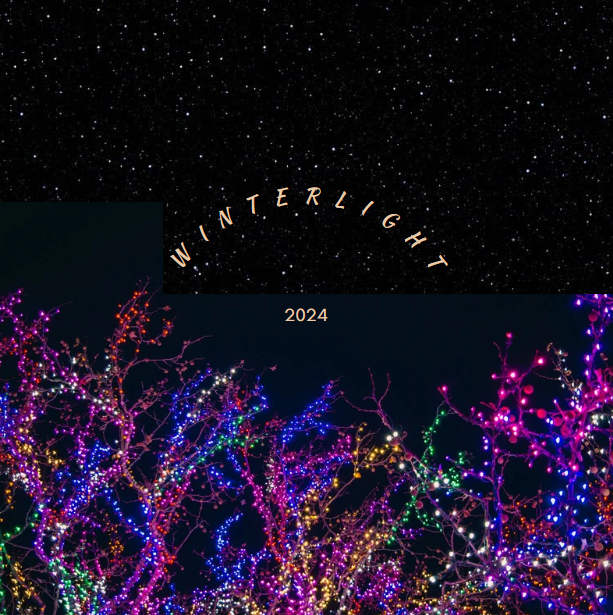
TBH, I still can’t say I’m ready. Not that I’m not grateful for things, but there’s still so much swirling through the gray corridors of my brain. So, I rely on my usual exercise of seeing. I can look. I can say what I see. And, what I see is winter light. The graying, fading, fast darkening world will bring its usual insights – or perhaps none at all, and we will sit with the shifting of the season and be present. Either way – I’m here, and so are you, perhaps. I don’t promise a daily visit, but we are here, and so is the winter light. This poem reminds me of driving around hoping to see the aurora in 28 degree weather in Iceland one year. We never did see it, but the vast silence of waiting under the limitless sky was a profound experience.


community in darkness

after a false dawn
we are awake, and waiting,
breaths the only life.

{npm24: progressive poem!}


Aaaah! It’s been exciting to watch this poem take shape. This is my first year, and as I watched the couplets collect at first I thought, “OH NO, I should have picked a MUCH earlier date to contribute!” There were intimidatingly beautiful phrases! (…the tender, heavy, harsh of home – *alliterative swoon*) And so many details as the poem took on a narrative shape. I felt like I was too late to do anything “good.”

Well, that was silly. This day, this moment in the life of these young immigrants… this time is perfect. Cousin, thanks for giving me a strong springboard from which to jump into playing with you all. The mastery of the Muse to those poets providing our conclusion, including:

April 24 Molly Hogan at Nix the Comfort Zone
April 25 Joanne Emery at Word Dancer
April 26 Karin Fisher-Golton at Still in Awe
April 27 Donna Smith at Mainly Write
April 28 Dave at Leap of Dave
April 29 Robyn Hood Black at Life on the Deckle Edge
April 30 Michelle Kogan at More Art for All


And now for our featured presentation…

Cradled in stars, our planet sleeps,
clinging to tender dreams of peace
sister moon watches from afar,
singing lunar lullabies of hope.

almost dawn, I walk with others,
keeping close, my little brother.
hand in hand, we carry courage
escaping closer to the border

My feet are lightning;
My heart is thunder.
Our pace draws us closer
to a new land of wonder.

I bristle against rough brush—
poppies ahead brighten the browns.
Morning light won’t stay away—
hearts jump at every sound.

I hum my own little song
like ripples in a stream
Humming Mami’s lullaby
reminds me I have her letter

My fingers linger on well-worn creases,
shielding an address, a name, a promise–
Sister Moon will find always us
surrounding us with beams of kindness

But last night as we rested in the dusty field,
worries crept in about matters back home.
I huddled close to my brother. Tears revealed
the no-choice need to escape. I feel grown.

Leaving all I’ve ever known
the tender, heavy, harsh of home.
On to maybes, on to dreams,
on to whispers we hope could be.

But I don’t want to whisper! I squeeze Manu’s hand.
“¡Más cerca ahora!” Our feet pound the sand.
We race, we pant, we lean on each other
I open my canteen and drink gratefully

Thirst is slaked, but I know we’ll need
more than water to achieve our dreams.
Nights pass slowly, but days call for speed
through the highs and the lows, we live with extremes

We enter a village the one from Mami’s letter,
We find the steeple; food, kindly people, and shelter.
We made it, Manu! Mami would be so proud!
I choke back a sob, then stand tall for the crowd.

A slapping of sandals… I wake to the sound
of “¡GOL!” Manu’s playing! The fútbol rebounds.

{the cracked kettle: puzzled}

Admittedly, this is a weird story, but the picture prompt eluded me. And yes, it’s late, but I blame the concert(s) in the last seventy-two hours, the coughing, the ground-glass-in-the-vocal-chords sensations, and the four hours of sleep I had last night. Things should get better very soon, because as soon as I post this? It’s back to bed.

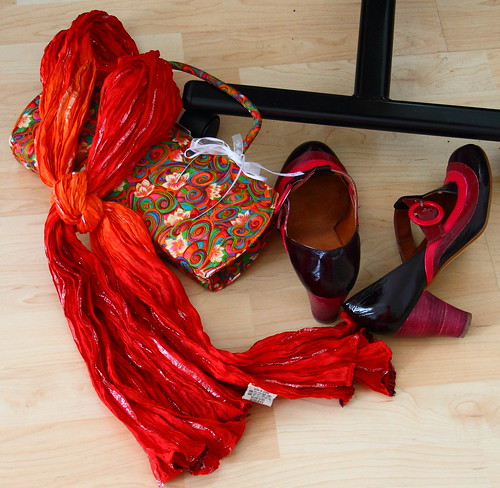
Creative Commons prompt this week courtesy of Flickr user Asja.


puzzled.

© 2012 T.S. Davis

It would be, by the doctor’s reckoning, another week and four days before she got that parasite out of her, but Gillian wasn’t really up to waiting that long.

“Are you sure he said the first of the year?” Gran asked, giving a worried look to the slump of Gillian’s spine. Her own back was ramrod straight, her shoulders flung back with muscular strength.

“That’s what he said,” Gillian replied, leaning her shoulder against the door jamb, wincing at a warning muscle twinge on the back of her neck. “He’s scheduled the surgery for the first Tuesday of the year.”

“It’ll be good to see what you’ve got.” Gran’s eyes crinkles at her brief smile. “Every Hoffsteader has had their challenges, but they’ve seen them through. You get to grips with that chap, and you’ll be on your way.”

“Well, I’ve been thinking. I’d feel better if I could be on my way now…” Gillian began.

Gran’s smile vanished. For a moment, it seemed that there was another head behind her own, peering out from behind the column of her neck. “Gillian. We’ve talked about this – ”

“It’s just so big,” Gillian gnawed her lip anxiously, flinching from the shadow behind her mother’s mother. “It’s huge, Gran. I’ve got to know. How can we be prepared if we don’t know?”

“You’re never given more than you can handle,” Gran said primly, lips stitched into a thin line of censure. “You’re a Hoffsteader, Gillian. A Hoffsteader puts her back into it, and she can accomplish anything.” Gran straightened, chin high, and once again resolved into the tough old lady Gillian had grown up with – a solitary soldier who bore her burden, and never mumbled.

“I know, Gran,” Gillian sighed. She did know – nobody, in all the history of her family, had ever been unable to handle anything thrown at them – any curveball, any hitch, any little difficulty. Bad grades, mortgage bubbles, world wars, influenza pandemics – the family was filled with hardcore survivors who took the problems of the world on their backs and slogged onward. Just look at Gran – she was seventy-eight, and she’d held up her own burden, plus take on her daughter’s child.

Gillian wasn’t sure she measured up to the history. She was a gamer – fond of puzzles and wordplay and hours of being a Seventh Level Elf with mage powers in her online gaming world. Reality was more trouble than it was worth, most days. Who wanted the back-breaking, life-sapping responsibilities of the whole world? Who’d voted the Hoffsteaders into being such stalwarts, anyway? Gillian had never had to put her back to anything. Brute strength was for those who had it – Gillian preferred subterfuge. What else was a sharp brain good for, if not for protecting you from breaking a sweat?

“If you’d ever take things seriously, you’d be just fine,” Gran rapped her misshapen knuckle against the tabletop. “You’re a Hoffsteader, and Hoffsteaders stand strong. Carrying this burden might just be the making of you.”

Or, it might just make her crazy, Gillian decided, but she kept her mouth shut.

The weeks passed, bearing the holidays closer. In return for her moment of doubt, Gran supervised Gillian’s time, leaving her not much for her games – except for the stupid Sudoku from the paper – or even for sleep. Her back was a constant ache. If nothing else, the elder Hoffsteader was grimly satisfied that Gillian didn’t quibble, even over extra errands. It was taking Gran’s beast, Scherzo, to the beast-mender that reminded Gillian that she had other options.

Only a moment of subterfuge – excusing herself to the single bathroom in the back, unlatching a few cages filled with an old paranoia, its razor-edged wings flicking irritably, a pair of abject failures and three hyperactive grouchies – all she’d needed. For good measure, Gillian set a cold and sleepy terror she found on the floor to lend what mayhem it could. She’d sat quietly through the exam until distant screams creased the minder’s face. He’d given her Scherzo’s leash. “Would you excuse me for just – ”

The X-ray machine was old, which was to her advantage. She lined up her spine against the plate, held her breath, and pushed the button. She heard the door rattle and leaned away from the screen, holding closed the door.

object #3: bones

“Just a sec – I’ve got to -this beast!” she exclaimed, and held her breath again as elsewhere someone screamed. The beastmender swore, the rattle ceased, and raised voices echoed down the hallway.

Gillian bent awkwardly, hands pressed against the door, pushed the button again. On the screen behind her, a ghostly image took shape.

The bulge on her spine – the traditional monkey on her back – was only partially visible, its thumbs arched at an awkward distance. Her heart thumped once, hard, then Gillian grinned in relief. It seemed she would be another in a long line of successful Hoffsteaders, even as a fly-by-night, silly girl who frittered away her time with games.

The monkey was already locked into a Chinese finger trap.


May the things which hold you be ever so easily defeated.