{“I feel today like maybe I could get paid for writing someday. Just maybe.”}


Going through old files is a huge part of being a writer – I hoard even slips of paper with words on them, so I have to take a firm hand with my paper gremlin tendencies and pare down both physical and digital files frequently. On the other hand, it’s a well-known idea that writers HAVE to save things, because one never knows if one’s dud lines or story seeds or bits of fragmented ephemera are going to suddenly sprout buds and leaves and turn into the rootstock for your next award-winning series. It’s a push-pull as always, and requires a mental vigilance that I don’t always exercise. Honestly, like most of us, I err on the side of saving everything.

Fortunately(?) Google is there to harp at you about running out of file space at convenient intervals, so I have been rooting through my digital files. I stumbled across some forgotten journal entries that I wrote during grad school, and laughed out loud at this one from 2003, when I’d first had the nascent draft idea which eventually became MARE’S WAR.

(Am also giggling because this is basically one long run-on sentence and heralded my em-dash abuse epoch so CLEARLY.)

My first workshop with (REDACTED) — September 24 — The workshop was one of the best I’ve had since first semester — workshop with (REDACTED) was basically pretty useless, because internally I accused him constantly of only caring about the bottom line, how things would sell, and we’re just not there yet, but I liked this one. This is an entirely new piece of writing — about a woman dying, and the hospice nurse sitting by her, and flashbacks to her childhood, young adulthood, flashbacks from her children about incidents growing up — it’s much more complex, and much more experimentally crafted, yet much less deeply felt in some ways — the other piece was semi-biographical, and I want so much for my friend who died not to be forgotten that I was heavy-handed and totally muffing it. I feel like writing this piece has maybe finally tapped into something real with me, something new, and it’s an adventure I’m on, and I’m much more sanguine about who goes with me, because I don’t know where the hell we’re going. It’s that “Road Trip!!!” mentality, you know? Everybody just jump in the flippin’ car and let’s floor it. I didn’t care what they thought/said, and that helped so much.

I am also just beaming that I got notice from (REDACTED) — I had been laughing at everyone hero worshiping on him in a big way and totally trying to play it off as banality and indifference — but he wrote — on a short paper I wrote for his novel craft course — “There is grace and fluidity to your writing, even here, that makes it easy to enjoy.”

And the gods ascended!!!

Shame on me. But I’m a praise slattern. I would do anything for a kind word. Just another postscript from my happy, happy childhood… I feel today like maybe I could get paid for writing someday. Just maybe.

It’s a good feeling.

Art by Simini Blocker. Check out her amazing prints.

{pf: poetry peeps find ‘A Word’}

Welcome to Poetry Friday!
Poetry Peeps! You’re invited to our challenge for the month of March! Here’s the scoop: We’re writing back to four Lucille Clifton poems, in her notes to clark kent series: “if i should;” “further note to clark;” “final note to clark;” and “note passed to superman.” We’ll be ‘in conversation’ with Ms. Lucille’s poems – talking to them, talking back to them, or talking about them, whether that’s all of them, or any of them, either in form or in substance. Once you’re sure how that’ll look for you, you’ve got a month to craft your creation(s), then share your offering on March 28th in a post and/or on social media with the tag #PoetryPals. We hope you’ll join the fun!


“…And that’s what your holy men discuss, is it?” asked Granny Weatherwax.

“Not usually. There is a very interesting debate raging at the moment on the nature of sin, for example,” said Oats.

“And what do they think? Against it, are they?”

“It’s not as simple as that. It’s not a black and white issue. There are so many shades of gray.”

“Nope.”

“Pardon?”

“There’s no grays, only white that’s got grubby. I’m surprised you don’t know that. And sin, young man, is when you treat people like things. Including yourself. That’s what sin is.”

“It’s a lot more complicated than that–”

“No. It ain’t. When people say things are a lot more complicated than that, they means they’re getting worried that they won’t like the truth. People as things, that’s where it starts.”

“Oh, I’m sure there are worse crimes–”

“But they starts with thinking about people as things.”

–from CARPE JUGULUM, by Terry Pratchett.

People, and things. Things, and people…

Sometimes the subjects we find in conversation with each other are mirror images, and sometimes they’re complete contrasts.

From Process…

Some of you know that for reasons of faith my parents didn’t allow me to read fiction in junior high and high school. No fiction, much less fantasy fiction with a witch – Granny Weatherwax – and an Omnian priest (a made-up sect that goes hard with the door-to-door solicitation) and… vampires, as were featured in Terry Pratchett’s Carpe Jugulum. And though my parents wanted me to be a celebrant of truth as defined by the term “non-fiction,” there’s …just a whole lot of truth in the previous fictional passage, too, isn’t there? The intersection of People Treated Like Things and Injustice is the corner whereon most of the problems begin. Pick out any deeply unfortunate moment in history – the Doctrine of Discovery, the advent of chattel slavery in the Americas in 1619, the forced migration of The Trail of Tears, The Triangle Shirtwaist Factory Fire, Executive Order 9066 – ? All of those things come down to people treated as things. Own-able. Moveable. Modifiable. Disposable.
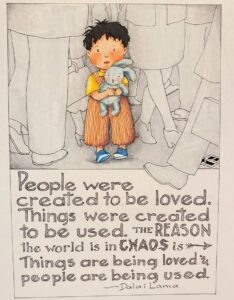
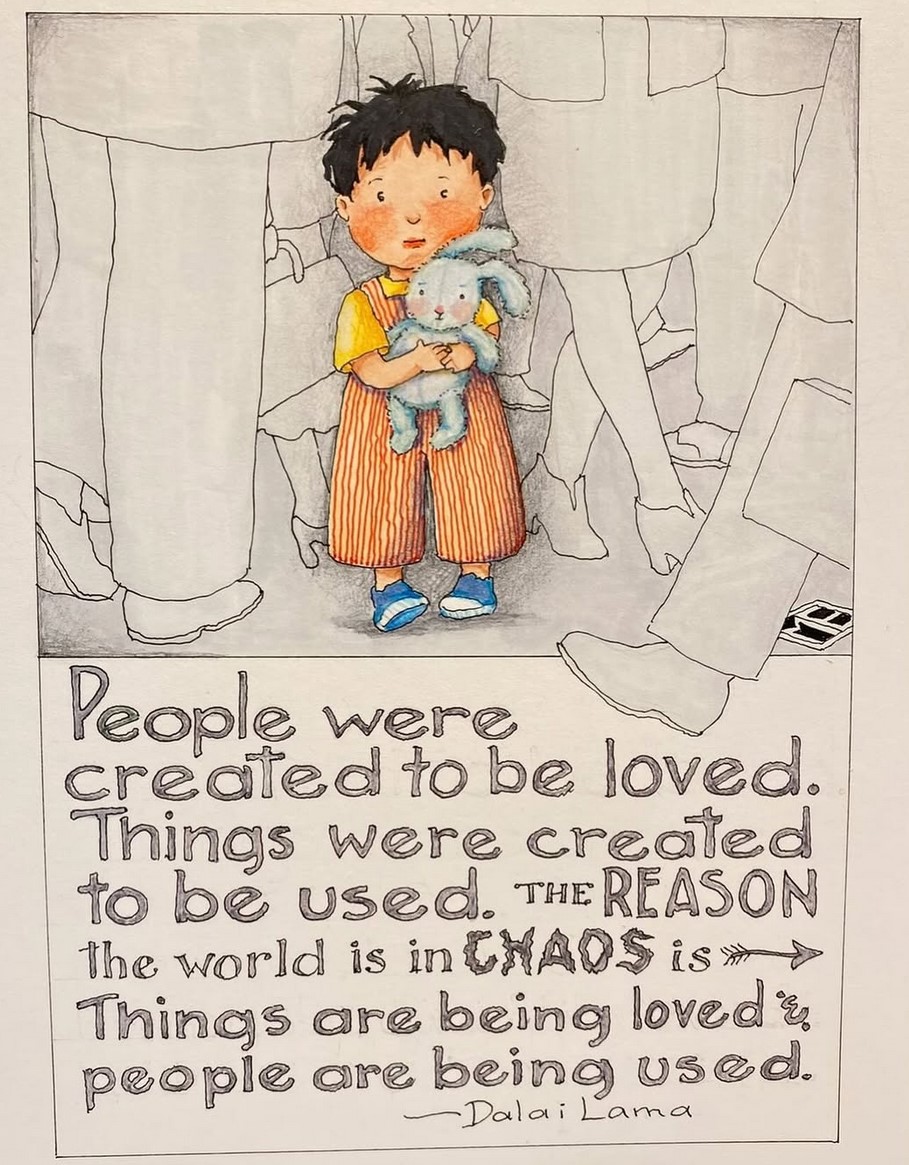
Today’s thoughts are in conversation with Granny Weatherwax’s profound statement (as brought to us by a renown British author who started out as a journalist) and with the Dalai Lama’s (a spiritual leader of great renown who started out as a mostly regular Buddhist priest). I could not believe how similar the statements between these very disparate people were when I found them on a Mary Engelbreit print which the artist shared on Instagram on February 21st of this year. (That one needs to be a print, no?) Two roads diverge on this highway, and they are People and Things. Two vastly different entities, two vastly different purposes, but human society confuses them so frequently. One made to be loved, and the other made to be used. How difficult for some to keep that straight.

…to Poetry

Though I missed the poetry meet-up this month (boo!) I felt like I already had a good feel for this kind of poem, which I’m leaning towards playing with some more to kind of unpack the current news of the day as I process it with its abundant catch words. This time, it was an obvious choice to write several poems as well, or at least two, because my brain has kept circling around the linked but contrasting noun categories of People and Things. But, after running across the Dalai Lama’s statement on my socials, two new words elbowed their way to the front – Loved and Used.


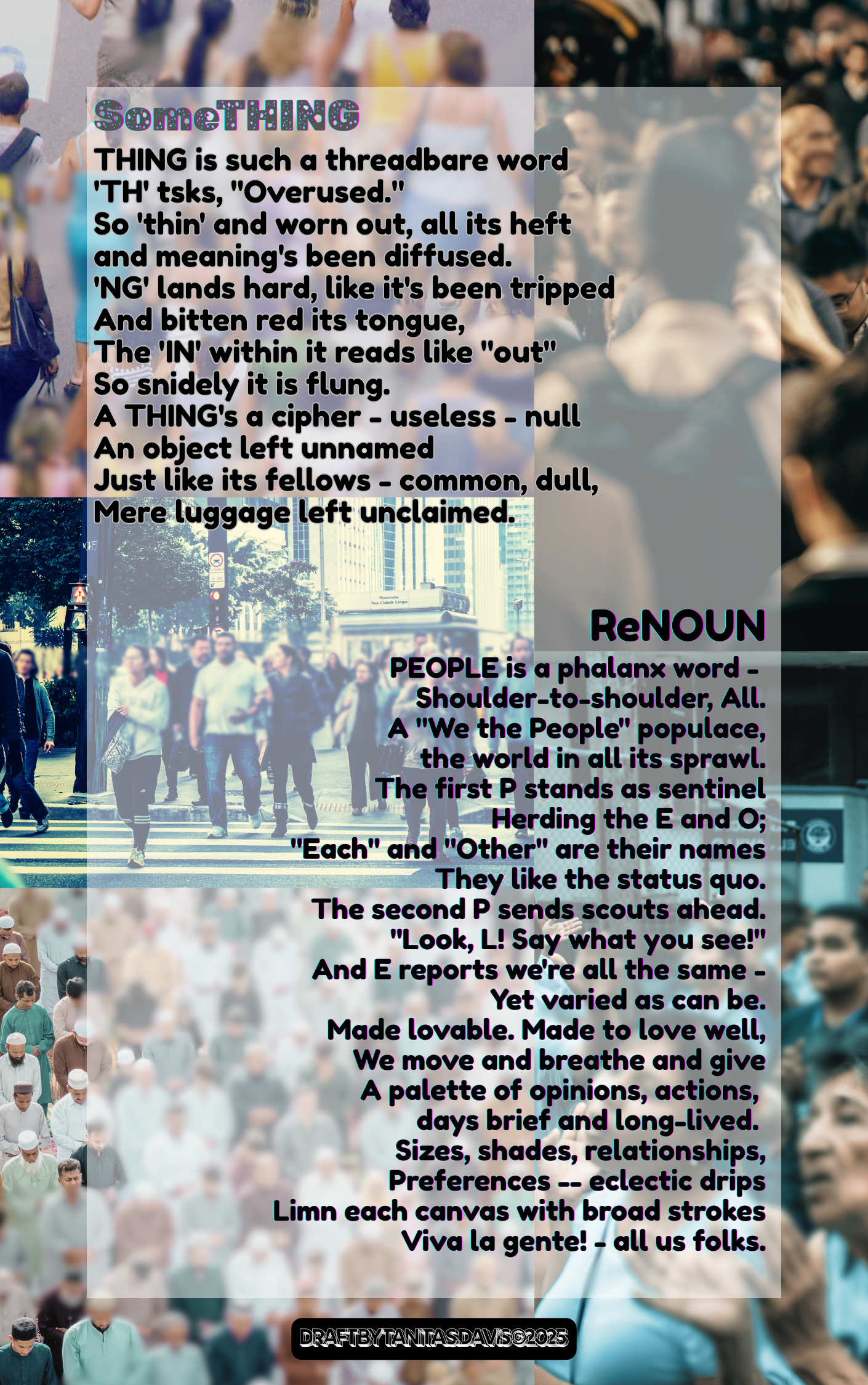
someTHING

THING is such a threadbare word
‘TH’ tsks, “Overused.”
So ‘thin’ and worn out, all its heft
and meaning’s been diffused.
‘NG’ lands hard, like it’s been tripped
And bitten red its tongue,
The ‘IN’ within it reads like “out”
So cruelly it is flung.
A THING’s a cipher – useless – null
An object left unnamed…
Just like its fellows – common, dull,
Mere luggage left unclaimed.

reNOUN

PEOPLE is a phalanx word – shoulder-to-shoulder, All.
The “We the People” populace,
The world in all its sprawl.
The first P stands as sentinel
Herding the E and O;
“Each” and “Other” are their names
They like the status quo.
The second P sends scouts ahead.
“Look, L! Say what you see!”
And E reports we’re all the same –
Yet varied as can be.
Made lovable. Made to love well,
We move and breathe and give
A palette of opinions, actions,
days brief and long-lived.
Sizes, shades, relationships,
Preferences — eclectic drips
Limn each canvas with broad strokes
Viva la gente! – all us folks.

This form lends itself to some real creativity for me, in terms of just letting my brain go and feeling my way into a word’s deeper meaning through what it remind me of, its internal sounds, the shapes of its letters, and whatnot. I like that “______is a Word” invites both wordplay and a thoughtful liberation like few other forms – I don’t have to make these poems rhyme. I don’t have to observe meter or number of lines, or anything else if I don’t want to. I just need to examine the word from all facets and let the word speak to ME – as didactically or as simplistically or as complexly and cleverly as I may. So, this was delightful – and I hope you find these word meditations delightful – useful, and illuminating – as well.

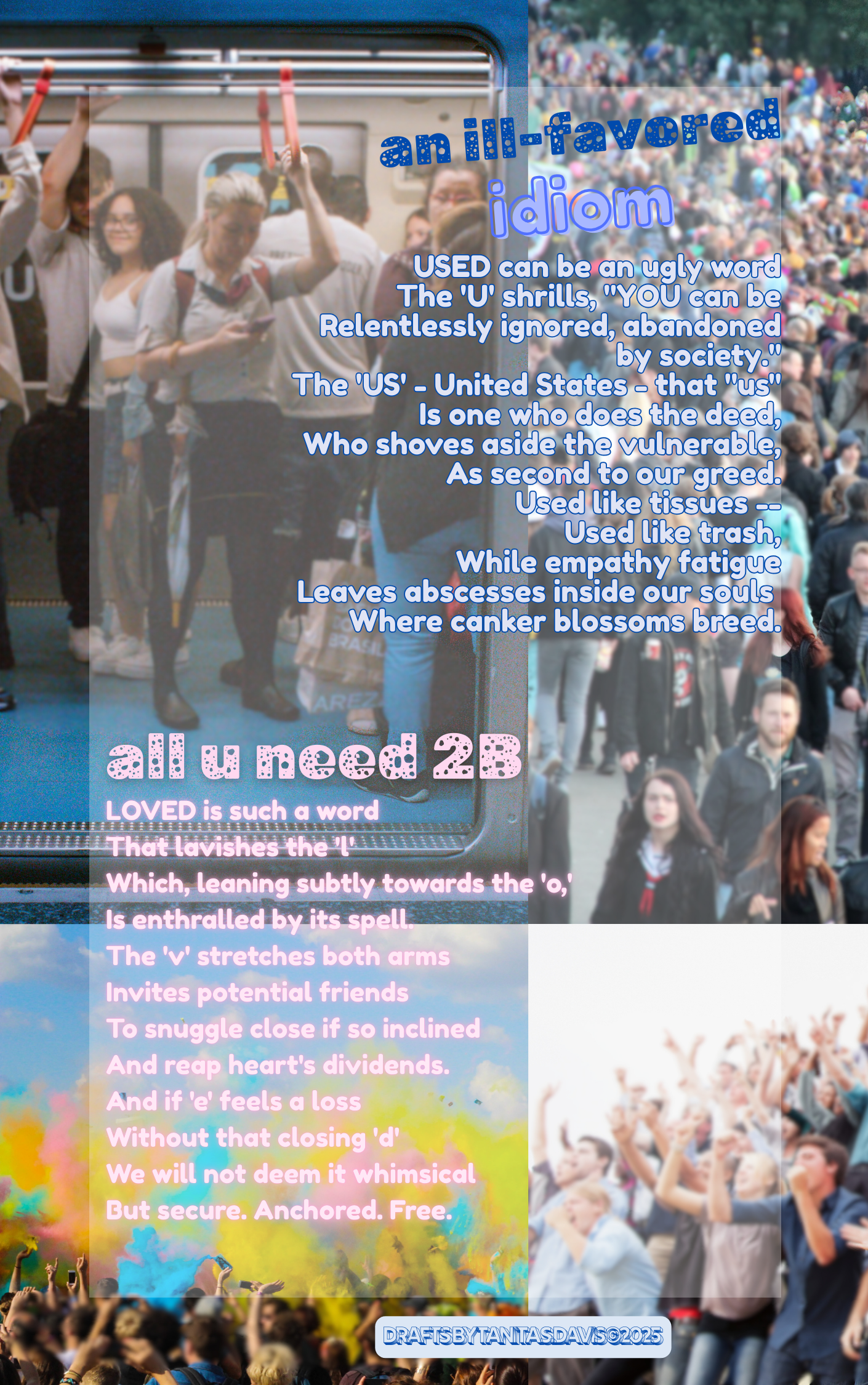
an ill-favored idiom

USED can be an ugly word
The ‘U’ shrills, “YOU can be
Relentlessly ignored, abandoned
By society.”
The ‘US’ – United States – that “us”
Is one who does the deed,
Who shoves aside the vulnerable,
As second to our greed.
Used like tissues —
Used like trash,
While empathy fatigue
Leaves abscesses inside our souls
Where canker blossoms breed.

all u need 2B

LOVED is such a word
That lavishes the ‘l’
Which, leaning subtly towards the ‘o,’
Is enthralled by its spell.
The ‘v’ stretches both arms
Invites potential friends
To snuggle close if so inclined
And reap heart’s dividends.
And if ‘e’ feels a loss
Without that closing ‘d’
We will not deem it whimsical
But secure. Anchored. Free.

There are quite a few other folks who dipped a toe in to the “_______is a Word” challenge this month. Laura’s post is here, and you’ll find Sara’s poem here. Liz’s poem is here. Mary Lee’s post is here, and Tricia’s poem is here. Linda B’s poem is here, and Rose joins us here. Michelle K’s poem is here. Jan from Bookseed has joined the fun, while Susan’s poem is here. More Peeps may be popping up during the weekend, so don’t forget to come back for the full roundup. Meanwhile, Poetry Friday is hosted this week by the delightful Denise Krebs, so don’t miss popping over for more poetry celebrations at Mrs. D. Krebs’ EduBlog! Thanks, Denise!

One of the MOST fun things about this style of poem is writing them with a thesaurus to hand. I often think of a word… and then look it up, and use the fifth or sixth synonym of it, so that I can sharpen my meaning – or even obscure or enlarge it. For instance, phalanx is a great word with multiple meanings, one of which was originally …log – a shoulder-to-shoulder line formation used in ancient Greek military battles. I LOVE that the plural of phalanx is phalanges… the names of the bones of the fingers or toes. People are each other’s foundation to stand on, or as Gwendolyn Brooks said it, “we are each other’s business, we are each other’s magnitude and bond.” We are each other’s hands to hold or extend in help and support – so to keep our battalion together. I appreciate the dichotomy of that – our little battalion standing with our shields linked, being both tethered and tied in, yet completely independent. Isn’t that the confidence that being loved gives to us?

I suspect Esme Weatherwax would think that nice little man in the saffron robe and wire-rimmed glasses was good people, and invite him over to sit a spell and listen to her bees. And I suspect His Holiness the Dalai Lama would get a kick out of reading about the kingdom of Lancre in the Ramtops where the strong-willed Granny Weatherwax catches babies, raises bees, and practices “headology,” which is a lot of philosophy mixed with a generous serving of stubbornness and a heavy sprinkle of common sense. The topics we find in conversation with each other sometimes aren’t that far apart after all… As more and more people are treated as things and things are cherished as people ought to be, we’ll figure out how to flip that particular script. Until then… perhaps we’ll keep this conversation simmering on the back burner – and let people who need to know, know that they are, as always, well-loved. Happy Weekend.

all poems ©2025, tanita s. davis
{poetry friday: acknowledging hard things in poetry}

This is definitely not under the banner of my #winterlight offerings, because it’s not particularly encouraging, but rather… thinky. I’m grateful for the friends who have dragged me into poetry practice, and for my Deeper Dive poetry group, whose exercises help me to look differently at the poetry I read.

This week, my group read several mentor poems which touched on grief or despair, and using repetition, direct address and present tense voice lead the poem towards a commonality of experience, allowing the reader to both feel and release their own similar emotions. Yesterday I wrote a draft of a poem describing the rise and fall of Allensworth, CA, the first township in my home state to be founded, financed, and governed by African-Americans – the “Buffalo soldiers,” of the Civil War. I have been fiddling with the idea of writing historical fiction set in this town – or writing fantastical fiction about magical happenings in this town. All of this is still in the very bubbling-stew-of-imagination stages.

Today I’m attempting to look objectively at another poem from the Harlem Renaissance using the same tools as we identified yesterday. If this has a lot of the tone of an English paper, that’s because I think I fall back on the strategies that worked for me in my upper level English courses. Additionally, writing things down is sometimes a way that I further process and remember them. So, aren’t you glad to be here to crib my notes for the test on Monday? Enjoy! 😂

If We Must Die

by Claude McKay

If we must die, let it not be like hogs
Hunted and penned in an inglorious spot,
While round us bark the mad and hungry dogs,
Making their mock at our accursèd lot.
If we must die, O let us nobly die,
So that our precious blood may not be shed
In vain; then even the monsters we defy
Shall be constrained to honor us though dead!

(Do read the rest at The Poetry Foundation.)

Born Festus Claudius McKay in Sunny Ville, Jamaica in 1889, Claude McKay loved English literature and studied and wrote poetry as a young man – about his feelings, about the world around him, and about the things he observed. Logically, we know McKay observed a great deal of racism – both in his home nation, and during his lifetime in the United States. The themes of both his poetry and novels reflect this. The poem, “If We Must Die” is one of his best known, and most celebrated, not just among the Black community, but more on that later. The feel of the poem is, despite its formal tone, in some ways very American – very macho. “Mejor morir a pie que vivir en rodillas,” right? Better to die on your feet than to live on your knees. (This quotation attributed to Emiliano Zapata, 1877-1919, and quoted by FDR in 1941 when receiving an honorary doctorate from Oxford University – apparently meant to be encouragement to a war-stressed Britain.)

Many times, poems which deal in difficult topics use the natural world as a foil, pointing to the continuous cycles of nature as a contrast to the brevity of the human cycle. While McKay does mention hogs and dogs, he mentions them in a disturbing similarity to human beings – Black people chased down, cornered, and executed like hogs, white people like baying hounds, harrying them and running them down. While it at first seemed to me a departure from his animal metaphor when he urges the subject of the poem to make the ‘monsters’ pay for every drop of blood shed, I thought about how dangerous hogs are to come across in the woods. Even if you’re not hunting them, you don’t want to run afoul of them – they’re aggressive, and they’ll come after you if they’re even startled. Like the 1546 proverb said, “Even a worm will turn.” Even the meekest and most docile of the animal kingdom can be pushed too far, and the Black man McKay describes with such polished, formal language is apparently a man pushed outside of his natural bent for civility and calm – or, at least his language seems to imply that’s man’s natural bent, anyway.

That high-toned language and …the poem’s precise shine in general seems deliberate. The poem is a Shakespearean sonnet, with all of the structure this rule-bound form allows – and with all of the history and travel that the sonnet implies, from thirteenth century Italy to 1500’s England to the more recent pen of a Jamaican-born Black man. With this history and through this distance, McKay speaks to a certain kind of reader – to men, ostensibly, as the poem cries out to “O, Kinsmen!” at one point, and readers are encouraged to die “like men.” Those kinsmen could be American men, or McKay’s fellow Afro-Caribbean immigrants. Today I learned that there is an urban myth that Winston Churchhill (!!!! NB: there is no record of it, so this is wholly mythical and sourced from people’s memories at the time) read this poem aloud on the radio during the siege of London in 1940. Because this sonnet lacks specific identifying markers – the “We” who must die are called “kinsmen” and “men” and their oppressors simply “monsters” – the clarion call of standing with one’s back to the wall and fighting to the death, couched in the scholarly lines of a very European poetic form makes it allegedly relatable even to the Prime Minister of England. Who knows – maybe the poem is intended to speak to long-ago Italians and Englishmen as well. McKay’s direct address invokes whatever present moment the reader finds themselves in, which is often claustrophobically close in the ‘painful topic’ poem genre, and gives the reader a sense of tempus fugit – of a time that is fleeing, and so right this minute you must listen to the poet, and hear his wisdom, which may not be available beyond this epoch. I imagine the narrator running, ghostlike, along with a person fleeing a lynching, urging him to not just run but to consider stopping and making a last stand instead, to make the monsters pay. Even with these sterling words and high tone, though, it’s hard to imagine someone running for their life being very open to the whole thing.

The long-ranging discussion of violence and non-violence, of “By Any Means Necessary” and passive protest is present in this poem, but wrapped in the idea of nobility and honor. Is it better to “nobly die” not like a slaughtered hog, but “fighting back?” Or will you still be just dead? McKay definitely seems to believe that an honorable death is the best death – but the jury’s still out.

Thank you for coming to my English Lit discussion.

EDITED TO ADD: Can you believe that Susan @Chicken Spaghetti is also celebrating the poetry of Claude McKay today??? What are the chances?

{THE CYBILS: it’s happening!}

Friends, it’s been a helluva summer. My fatigue has kicked my backside, but I STILL turned in a book – on time, thankyouverymuch – and now for my reward is taking part in the second round judging for the CYBILS Award. Every time I think I don’t have time, I find that it is just one of my singular joys to be a part of the crew. I am SO happy to be back. I try and hold back, as a Board member, because I participated seven years in a row, and it’s always nice to have Other People get a chance, but when I’m needed I am OVERJOYED to be there. And look: we have new badges this year!!!!

And here’s the POETRY badges:

I’m a 2nd Round Poetry Judge, and I couldn’t be prouder. I feel quasi-qualified this time, too, since I have a poem being published in 2026 in an anthology from Lerner! Woot! But, even if I didn’t have that, I know that my only qualification needs to be that I love poetry, and I’m willing to speak about my opinion, and listen to the opinions of others. Together we’ll celebrate what we love the best – and that’s the joy of the CYBILS.

Friends – especially poetry, nonfiction, and speculative fiction friends – when you have a chance to nominate books, DO IT. Being a part of this singularly nerdy award which started all the way in 2006 is proof positive that we – average ordinary librarians, teacher, and readers – can make our voices heard about the work we love to read. Join the fun, please!

{how is it the end of may, and other queries}

We do not grow absolutely, chronologically. We grow sometimes in one dimension, and not in another; unevenly. We grow partially. We are relative. We are mature in one realm, childish in another. The past, present, and future mingle and pull us backward, forward, or fix us in the present. We are made up of layers, cells, constellations.

~ Anais Nin

So ends the merry, merry month of May, which brought to my circle, weather extremes, dishwashers blowing up, Achilles’s tendon surgery, mental health break, court dates, new, difficult medications, sudden sibling deaths, broken-into cars, suicide, lost jobs, lost illustrators, and plenty of book rejections, as always. May presented my larger circle the writer’s strike, persistent book censorship, a disappointing buy-in on the part of the industry (especially side-eying you, Scholastic) who want to appear in virtuous support of diversity and inclusivity, but who in truth bow to the loudest shareholder monies, and corporations moving hesitantly towards ethical behavior without ever embracing or wholeheartedly championing it. And further out from that, nationally, globally, May has continued to reveal to us ugly social divisions, war and its proxies, the high incidences of violence globally against immigrants, violence against trans persons, Asian, and Black communities in the US that goes on, and on, and on, a rising shriek in our collective ears. I’m thinking we’ve somehow cosmically agreed to delay the “merry” from this month until another day.

And yet, May has also been what it always is, a season of growth, a season of renewal, and a season of change. Yesterday I found the first morning glory blossom, peeking shyly from beneath a broad leaf. The hollyhocks are hip high and the dahlias buds grow fatter every day. The chard and lettuce are tiny, tender shoots, the walking onions stand tall in lines, and all the hard squashes and watermelon have more than six leaves. The last of the corn goes in this week, and the potatoes, ahead of a fall harvest. And there are tomato flowers.

In this grim place, there is still life affirmed. Even in an endless night, there are stars.

This month of shifting tides finds me once again reevaluating issues of religion/faith/denomination, re-examining my abilities to write, and contemplating my reasons for publishing. It is, in many ways, something I used to do more nebulously, a sort of anxious, “should I be quiet now? Do I any longer have anything to say?” angst that rattled in my mental background, but I feel it adds value to be deliberate in these thoughts, to let them come and be spoken aloud, instead of merely haunting me from shadowed corners. Who am I? What is my role? Why should I take up space? Each round of this kind of thinking moves me… some direction.

How about you? What questions are you asking, as the seasons blend and flowers move towards fruiting?

We learn things, through these revelatory moments in our lives. Trees age in circles, tides push us out, and draw us in again, moment by moment, step by step, always moving somewhere both familiar and new. I feel like I am moving both closer to my real self, and further out to sea. My closest relationships are becoming more genuine, and the ones which are …less, are fading. The refining continues to cycle things closer to the heart of the flame, and move what is mere dross further away. The Byrds echoed Ecclesiastes, “to everything there is a season.” All things will be revealed – finished and refined – in due time. So much of life and art is about our process, about waiting and being. About, in the wise words of the late Robin Smith, being here NOW. The seeds have been planted, the water is in place, and from this moment on, it’s about being present to take in each new unfolding, each new direction, each reset and rekindling of our purpose.

This is, admittedly, not my favorite part. I hate these treading water bits of life, this sense of standing in a boat while it’s being sloshed from stem to stern, while the tide is drawing in or running out, and we’re just trying to keep our balance. And yet – it’s been a month of unpacking some things, in between bouts of flailing about and wondering if I’m doing anything right at all. I sense an answer may be just around the corner…

…but, until then, we wait. We listen.

Here. Ready, though hesitant. Willing, though uneasy. Open to the next move.

{pf: Henri on the internet}

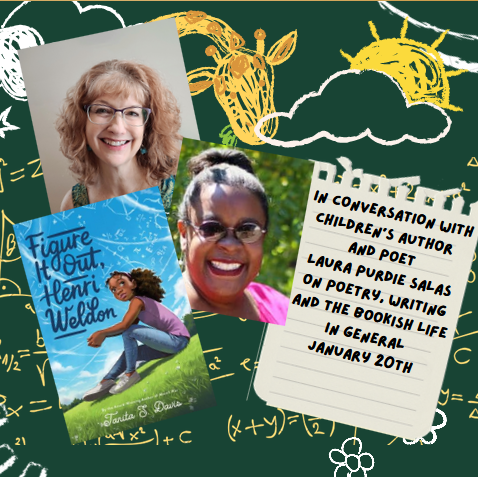
Happy Poetry Friday! I’m at Laura’s today, being interviewed about my latest middle grade book – wherein I have the students participate in Poetry Friday.

Poetry Friday is kind of a funny thing for me – because I never was quite sure how I got involved. I did a little bit of posting, and enjoyed writing the odd haiku, but when an actual published picture book poet approached me about being part of a poetry group, I was… shocked, to say the least. And it’s happened twice now! Do I yet consider myself a poet… Not…really? Even though I just wrote a novel that has original poetry of mine (in the voice of my middle grade character) all the way through it. Maybe it’s just that I don’t want to narrow anything down. I’m a writer. I’ll always be a writer. Sometimes, I just write poetry.

To that end, here’s a semi dansa:

So, How Are You…? and Other Question Pitfalls

We say “Good” and mean “Well…”
Polite insists on “fine:”
(If heartsick, give no sign
It’s in poor taste to dwell,
We say.) Good and mean? Well…
While no one’s all sunshine
It just seems asinine
To beam while we’re in hell.
We say “Good” and mean, “Well…”
Are we to “fibs” resigned,
So no one says we whine?
On this point I REBEL —
Say good, and mean it. Well?


Hope you’re happy and you know it this weekend. Or else if you’re grumpy, you don’t tell people you’re doing fine. Poetry Friday today is Marcie Atkins’ blog, where she is ironically featuring one of Laura’s books today too. Happy Weekend.

{#npm: 27 – place}

Anyone being plopped in the middle of Hogsmeade or Hobbiton would know where they were immediately. Charlie’s Chocolate Factory would likewise be recognizable, as a sense of place crackles from the pages of Roald Dahl’s book. Perhaps within ourselves there are places it feels we’ll always recognize …as home.

May we all find such places.

the “where” trivial
only the warm curled body
and the book, vital

{pushing back the finish line}

It’s been an EXHAUSTING month in the children’s lit field – really, in the literary industry in general. Between the current administration wanting to gut federal support for libraries, to the continued firestorm of authors naming industry insiders and other high profile movers and shakers as serial abusers, it’s been… hard to focus on actually writing. That’s been par for the course for the last year, of course, but lately it’s become harder to imagine this industry in two years, or five years time. With all of the turmoil finished, who will we be then? (Or, will we ever finish?)

It’s Women’s History Month, and across the internet, children’s lit folk have committed to 31 days of posts focused on “improving the climate for social and gender equality in the children’s and teens’ industry.” Children’s lit people have an open invitation to join in the conversation in various places, using the Twitter hashtag #kidlitwomen or to access all the #KidlitWomen posts this month on the FaceBook page https://www.facebook.com/kidlitwomen/

While I haven’t participated, I’ve quietly been reading industry professionals’ essays (and ironic poems) about the issues of being overlooked and undervalued, and how to address those issues. Through these writings, we observe where power and representation in terms of who receives professional acclaim, and who does not receive it, intersect. Edi Campbell has continued to do her good work in interpreting data to come up with a rough outline of the facts on diversity within the larger picture (which you’ll find here and more here.) As usual, she is spot-on, and timely.

I am collecting these links here as a place for me to come back to them – because I think they will, in time, be proof — that we’ve been talking about some of these inequities for ages. The numbers won’t lie when it comes to looking back and seeing if a change has been made. The revelatory Ripped Bodice Diversity Report for 2017 dropped in a PERFECTLY timed space with its message of “we have to do better, and we’re doing worse than last year.” Honestly, it’s hard to see where “better” is going to come from, when right now a lot of powerbrokers within the industry seem content with virtue signaling to make sure everyone knows they’re “committed” to being better… but these claims will have to be seen to be believed. Women struggle as a whole within the writing industry, and in the children’s lit world, it continues to be woman-heavy in staffing, but sustain a culture which awards and prioritizes men, as if the business savvy act of writing for children and teens – the largest industry IN publishing just now – is equal to giving birth and nurturing an infant to childhood with one’s own body. Not to mention how women of color are left with not even the few perquisites offered to women in the industry as a whole. And let’s not talk about disabled women, or queer women, or older women, or…

How do we move from desire to action? How do we get ourselves out of conversation and across the room to… act?

If we were writing this scene in a novel, what would happen next?

{“…after the watermelon thing.”}

I told you! I told Jackie she was going to win. And I said that if she won, I would tell all of you something I learned this summer, which is that Jackie Woodson is allergic to watermelon. Just let that sink in your mind.

And I said you have to put that in a book. And she said, you put that in a book. And I said I am only writing a book about a black girl who is allergic to watermelon if I get a blurb from you, Cornell West, Toni Morrison, and Barack Obama saying,”This guy’s okay. This guy’s fine.”

Yeah, remember that? 2014, the National Book Award, televised on C-SPAN and elsewhere. People are so heartened to see African Americans on the National Book Award finalist list. Poets and writers and people of letters are tuning in. In the children’s lit community, we’re thrilled that Jacqueline Woodson, one of our steady bright lights in YA literature, has won. She’s earned that BIG award, one which will thrust her outside the quieter waters of children’s lit, and… in that moment, the professional crowning pinnacle of her success thus far, the presenter makes …a watermelon joke.

“In a few short words, the audience and I were asked to take a step back from everything I’ve ever written, a step back from the power and meaning of the National Book Award, lest we forget, lest I forget, where I came from.” – Jacqueline Woodson, quoted in the New York Times.

He had an hundred million reasons why, later, he had remarked so disparagingly on the poets who were nominated, why he had told jokes and tried to wrest the attention of the crowd from the nominees onto his vast and hungry ego. But, it wasn’t personal; he cried no foul, she’s my friend! a thousand times, and yet, that moment, those sly, knowing words sliced thousands of us to ribbons, as the audience laughed, and a tall, serene woman had to stand – and yet again, endure. Endure. Endure, with her face at peace, as if the buffoonery of the man before her didn’t reach her.

I don’t support hate, and yet, in that moment, that dizzyingly visceral emotion shivered in my sight. Gut-punched, I wanted to both hiss and claw, scream and spit. As far as I was concerned, that man was finished, and I was done with him and all his works, forever. I never bought, reviewed, read, or talked of anything else he said or did. It made no difference to his life, I am sure, but it seemed right, to me, to simply use my internal Wite-Out and blot him from my notice for the rest of forever. I was fully over this “problematic” favorite.

It’s clear that I’m still sitting with our current moment in the children’s lit industry, trying to work through it, and thinking about the last time that so many voices came together to exclaim in disgust. It was for our Ms. Woodson, and rightly so. The commentary was sharp, and loud – and ultimately… was placated by the huge monetary donation Handler gave to We Need Diverse Books. And then, most of the voices were hushed, pressing their hands against the shoulders of those who still rose up, and their hands over the mouths of those still bitterly protesting. He apologized. He made it right. You can’t judge people on what they say.

But, yesterday, after Handler wandered flat-footedly into the pages of children’s lit history again, this time into the earnest signatories of the #ustoo pledge, wherein members of the children’s lit industry pledged to hold accountable conferences and gatherings, and not attend those which have no clear sexual harassment policy, people took him to task for his very clear participation IN the harassment. The very innuendo-laden jokes, in front of children and adults. The demeaning sexual talk. But — he apologized. He made it right. You can’t judge people on what they say.

It seems clear that you can, unless what you say is racist.

In my small and petty way, I blocked Daniel Handler from my sight years ago – but he’s still been doing things, writing, being invited places, feted within the industry, and I’m the doofus who didn’t realize that his “little faux pas” on Ms. Woodson’s big night had long been forgotten.

But, as Heidi so succinctly asked, didn’t we figure out this guy was trash after the watermelon thing? What are we doing still courting that kind of person to be a speaker and to visit classrooms? Why don’t we seem to take the humiliation, shame, and harm of racism as seriously as we’re all endeavoring to take the #metoo harassment thing?

In all seriousness – is a #metoo movement going to actually succeed if, once again, racism is instructed to take a seat at the back of the bus?

1897. “The day before the inauguration of the nation’s 28th president the Congressional Committee of NAWSA hosted a large parade on Pennsylvania Avenue in Washington, D.C. The idea behind this was to maximize onlookers who happened to be in town to attend the inauguration. Woodrow Wilson expected a crowd at the train station to greet him; however, very few people actually showed up to greet the president, the largest part of the crowd was his staff. The parade was led by the beautiful lawyer Inez Milholland Bouissevain upon a white horse. This image of her as a warrior atop a horse is what made her an iconic image in the fight for womens’ right to vote. This massive parade consisted of no less than nine bands. It also included four brigades on horseback and close to eight thousand marchers. The parade was cut into sections: working women, state delegates, male suffragists, and finally African-American women.

The point of the parade was “to march in the spirit of protest against the present political organization of society, from which women are excluded.”

Ida B. Wells-Barnett, the journalist who led an anti-lynching campaign in the late nineteenth century, organized the Alpha Suffrage Club among Black women in Chicago and brought members with her to participate in the 1913 suffrage parade in Washington, D.C. The organizers of the march asked that they walk at the end of the parade. She tried to get the White Illinois delegation to support her opposition of this segregation, but found few supporters. They either would march at the end or not at all. Ida refused to march, but as the parade progressed, Ida emerged from the crowd and joined the White Illinois delegation, marching between two White supporters. She refused to comply with the segregation.”

– Excerpts taken from One of Divided Sisters: Bridging the Gap Between Black and White Women by Midge Wilson & Kathy Russell, Anchor, 1996, and PBS.org.

I think I’ve been naive, and pretty quiet – but it’s clear the time for my naive assumptions is way over.

{december lights: it’s what we’re here for}

Many people find the idea of divinity, of a separate Entity in this universe, of spirit… frankly terrifying. I remember my parents talking about growing up watching people in the throes of religious…somethings, and despite growing up with that, feeling dismayed and betrayed by the adults around them, and eager to escape. As soon as they were of age, they both decamped for more comprehensible experiences, less ecstatic and chaotic, and confusing. I know some would be critical of them for that, but your faith isn’t supposed to scare you.

And yet:

There is something to be said for those in the light of Divinity, who act in pursuit of understanding, instead of relaxing in the presumption of its possession. There is something to be said for the Mystery, and the Enigma, and for uncertainty. We ought to be less comfortable in our beliefs than we are, always questioning our assumptions, always querying our conclusions, critically adjusting them, becoming comfortable in our doubts and in our uncertainties and yes, our fear. We aren’t here to settle complacently into one way of being, but to be led, turned, and moved…to where we ought to be.

We Have Come to Be Danced

We have come to be danced
not the pretty dance
not the pretty pretty, pick me, pick me dance
but the claw our way back into the belly
of the sacred, sensual animal dance
the unhinged, unplugged, cat is out of its box dance
the holding the precious moment in the palms
of our hands and feet dance

We have come to be danced
not the jiffy booby, shake your booty for him dance
but the wring the sadness from our skin dance
the blow the chip off our shoulder dance
the slap the apology from our posture dance

We have come to be danced
not the monkey see, monkey do dance
one, two dance like you
one two three, dance like me dance
but the grave robber, tomb stalker
tearing scabs & scars open dance
the rub the rhythm raw against our souls dance

WE have come to be danced
not the nice invisible, self conscious shuffle
but the matted hair flying, voodoo mama
shaman shakin’ ancient bones dance
the strip us from our casings, return our wings
sharpen our claws & tongues dance
the shed dead cells and slip into
the luminous skin of love dance

We have come to be danced
not the hold our breath and wallow in the shallow end of the floor dance
but the meeting of the trinity: the body, breath & beat dance
the shout hallelujah from the top of our thighs dance
the mother may I?
yes you may take 10 giant leaps dance
the Olly Olly Oxen Free Free Free dance
the everyone can come to our heaven dance

We have come to be danced
where the kingdom’s collide
in the cathedral of flesh
to burn back into the light
to unravel, to play, to fly, to pray
to root in skin sanctuary
We have come to be danced
WE HAVE COME

by Jewel Mathieson, ©2004

Treasure Island 35

A dance that slaps the apology from our postures. A dance that refuses a self-conscious shuffle. A dance to strip us from our casings, and return our wings. What if we were to truly let go of ourselves, and leave the steps to Divinity? Then, we wouldn’t just dance. We’d rise and shine – and possibly fly.

And wouldn’t that just ring in a new year?


Hat tip to Tricia for sending me this poem after hearing it in a yoga class the other day. I might have to rethink my aversion to yoga! Or, at least find one where they read you poetry while you’re holding your pose. What a fine thing, to ignore your discomfort and open your heart to “eat and drink the precious words,” as our Em might have put it.