{december lights: y fea sea la palabra}

“En un mundo donde la oscuridad y el silencio han amordazado la esperanza, que la musica sea la luz y fe sea la palabra. Para que vengan tiempos mejores, que suenen los tambores.” – Victor Manuelle

A loose translation: In a world where darkness and silence have muted hope, music is light and faith is the word. To bring better times, bring on the drums. I heard reference to this amazing quote on an episode of NPR’s Code Switch podcast in November, and it’s stayed with me. Even as I center light in this end-of-season celebration, it has been difficult to feel particularly joyous. More than ever before, the commercial nature of our celebrations has stuck in my craw, and the traditional insistence on larding all the cracks with manufactured joy in the face of some real doozies in terms of social injustice has been… difficult to swallow, to say the least. But, I do find that occasionally, music can drown it out, for a while, for long enough to recenter. In keeping an attitude that lifts one up and keeps one moving forward, turn up the volume. Faith is the word, so sound the drums, Sister Rosetta. On with the dance, Dirty Dozen Brass – and keep it moving. We have too much to do to mope. Arise & Shine.

{thanksfully 3.0 ♦ enamored with armor}

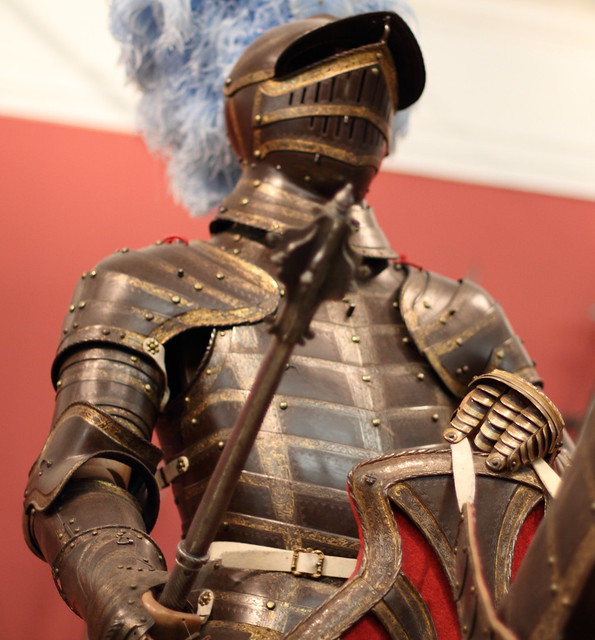
Kelvingrove Museum D 578

As authors, we sometimes struggle with how much we should protect our readers. Especially authors who write historical fiction, who write works with “historical” content which is problematic by today’s higher and broader understanding – how we present this information in fiction matters. I have read a LOT of discussion on the topic, and continue to read accounts this week about how others are trying to navigate these tricky places in their lives.

Today I’m grateful for the gatekeepers who try to protect the young, and I’m grateful for those gatekeepers who understand when to open the gates.


{thanksfully 3.0 ♦ sloppy firsts}

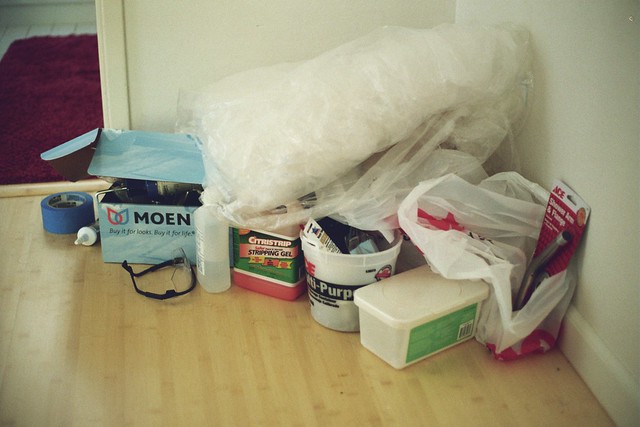
Upstairs Bathroom After 3

I don’t read reviews unless my editor gives them to me – I figure I have enough problems – so I generally only see her copy of what Kirkus has to say, and they are always decent, if not always particularly kind. (I am greatly blessed for this decency – I have seen them be outright vicious, and know my time will come.) This review was strong, but I am indicted for “clunky” dialogue, which makes me chuckle. I’m actually pretty proud of my dialogue skills – most days. But, some days they, and the rest of my narrative chops, are pretty crap. Clunky is a generous description; at times they’re outright sloppy. Trying to shrink-fit and meld pieces of a story together, some older, some brand new, is like taping up drywall, spackling holes, mudding, painting. It’s all remodeling the house.

I’m grateful today for the mercy of the first draft, for the awkwardness of the words splayed gracelessly on the screen, for the belief that I will sand and shove those unbeautiful clunkers into shape.

{gibney’s see no color is a good, hard book}

Sooo, I’m reading SEE NO COLOR, by Shannon Gibney, and I’ve already had to stop a couple of times and just… think.

This is a deeply personal book for me, because it’s about transracial adoptions – in this case, how a nonwhite person might feel in a white family. In my family, I worry a lot about my sister, who is Cambodian, in a black family. Not the same, no, and we certainly didn’t deal with her ethnic background the same way, either. She had supervised visits which as much family as we could find, frequently, when she was small, until she rebelled and said, “No.” We took her to Tet when she was small. We got her books from Lee & Low, story dolls, cut out pictures from magazines. Here is the country of your origin. This is where your birth mother lived until she was two or three. This is the fabric worn there, these are the foods, these are the faces… We took her culture, and served it up on a platter, garnished. And she was interested, as a wee tad, then, as she grew into tweendom, utterly indifferent. To our culture, too. Eventually, to family culture — family at all.

So, the familial juggernaut to acquaint our youngest with part of her cultural heritage ran into her teenhood and ran out of steam. Still, I find myself wondering what she, at nineteen now, feels about being a lone Asian face in a sea of dark brown. When she was small, she still chose a white avatar in any game we played – and then, those were usually the only options, black or white, and she was neither. How alienated have we made her?

And this book pokes me, and prods me, makes me uncomfortable all over again — as it should. What could we have done differently? What should we still do? I’m not even halfway through this, but I want to talk to my sister, and am having trouble waiting ’til her class is over. Read this book I text her. This is the mark of a successful novel; I want to press it into her hands.

{the audacity of a foreigner appropriating}

“He said my writing does not show him Africa. Keep in mind this American man has never visited any country in Africa. He said i was writing about Africans driving and listening to Sade in air-conditioned cars. He just couldn’t identify with such. He said it like i should apologize for ever portraying my people as some modern day normal Africans. It is as though if Africans are not killing each other or dying of a disease; then our stories are not valid. As a Nigerian, i have never witnessed war and i know what listening to Sade in an air-conditioned car while in crazy Lagos traffic feels like, yet an American who has never stepped foot in my continent tried explaining my country to me. He said, “i am sorry, this is just not believable….” and then as i tried to hold my anger, i understood the ‘burden’ of writing an African story.

The anger most African writers feel when others seem to know so damn much about our own motherland. The terrible idea that Africans are a certain way is disheartening. I remember how my friend in Lagos laughed as i told her about the American. She laughed loud at his foolishness and cursed him in Yoruba. You cannot tell me what an African city looks like, you cannot tell me what a Nigerian city looks like. You cannot tell me how to write about Africa only if it shows her people as helpless, only if it feeds into your stereotype. How can a foreigner tell us about our own land? They want to shake their head, read only about struggles and discuss it in their book clubs. The audacity of a foreigner to tell me how to write about my people.” – Ijeoma Umebinyuo

I ran across this quote courtesy of Ursula Vernon’s tumblr, and it resonated with me. One of the …twisty things about writing young adult fiction as an African American person is being told… that my story, the way I’m telling it, isn’t valid. I spend a lot of time in the quiet of my inner mind, trying to wrestle through the ambiguous feelings of “something is wrong here,” and to identify what is being implied or directly told to me, so that I can work through it. It doesn’t help that I am slow to react to things at times — slow to be able to pinpoint the root of a sad or negative feeling I might be having. I don’t always like words like “microaggression” because they’re kind of catchy and overused at the moment, but I understand the effect — a tiny wrongness that builds up and builds up and over time, you end up with a mirror that obscures a face instead of reflecting it, because the surface has been scratched with a thousand tiny cuts.

And, now that a person has identified this, found the root of their anger, what are they supposed to do about it?

That, I don’t know yet. What do we always do, when we’re misunderstood? Keep talking? Talk louder? Decide it doesn’t matter? Today, I couldn’t tell you.

{dear mr. handler}

November 20, 2014

Dear Mr. Handler:

I remember the last two National Book Award books I’ve read – the Gene Yang and the Sherman Alexie books both blew me away, so I know BROWN GIRL DREAMING must be STUPENDOUS. So soon after Ms. Woodson’s words during the We Need Diverse Books debacle, this award is a real triumph. I am SO pleased for Jacqueline Woodson! These are my thoughts today, while you’re beating yourself up at home, probably wishing to God that you had never seen a green-and-white striped melon, much less told an allergy joke, expressed lighthearted dismay about not being eligible for the CSK Award, or made light of racial profiling. Today you are possibly feeling a little like the Paula Deen of the kidlitosphere.

Dear Mr. Handler, thank you for acknowledging that you spoke with your mouth full of privilege, and with your eyes blinded by it. Thank you for understanding the extent to which you had erred, and thank you for your apology. I am writing to remind you that the best apologies on earth are non erbis sed operis; not words, but deeds. You made a solid and humble apology – acknowledging what you did, not blaming anyone else or excusing yourself. But, the very best apologies make restitution. Here’s what I’d like to suggest:

First, buy Ms. Woodson a case of high-end champagne or whatever non-alcoholic fancy bottled drink of her choosing. Raise a silent glass to her well-deserved award for sharing such a personal and touching story, and applaud again the National Book Foundation’s good taste in awarding her this honor.

Next, buy half a print run of BROWN GIRL DREAMING. Take it in your mittened hands, and walk it around frigid New York. Press it into the warm palms of school children in large suburban schools. Press it into the hands of middle-aged shoppers at the Mall. Press it into the hands of elderly people coming out of church. Fly to a different state. Repeat. Repeat. Repeat.

Finally, in silence, allow the furor to die. Don’t speak. Let your acknowledgement of your error be your last words to the Outrage Machine that is Twitter on this subject. By your silence, you can assist in directing the attention back to Jacqueline Woodson where it rightfully belongs. The social media world is a vicious critic, quick to indict, quick to a blood frenzy – and you may feel this sting for awhile, but lifting up someone else has always been the best way to mitigate the effects of negativity. Using your influence, your money and your time to boost this talented and lovely author is honestly the least – and the best – you can do.

And, know that this too shall pass.

Still a fan,

-tsd

EDITED TO ADD

As a postscript, I want to respond to the idea of “permission racism:”

I’d previously suggested that Mr. Handler put his head down, close his mouth up, and Do Better. Doing Better may eventually mean an explanation — but how about at a We Need Diverse Books event, and not on Twitter? Perhaps at a public event, in person, he can say why he thought his remarks were funny/edgy, and why he now knows that he’s wrong and what he’s going to do with his newfound understanding. That would be a powerful step in further opening the door on dialogue about race in publishing.

His fund matching to me isn’t giving him permission to be racist after the fact. A part of a good apology is to own what you did, and the final piece is to take steps to make restitution. He can’t restore the whole night – we don’t time travel yet, and he’s not hardly a god – but I think he’s doing so much more than many others would in his position. Which is maybe faint praise, but it’s what I’ve got. For me, this is about US as kidlitosphere people. I don’t want us to be vicious. I don’t want Daniel Handler to be the Paula Deen of the kidlitosphere… I really don’t. And I think we shouldn’t let the Outrage Machine of Twitter goad us into asking him to do unrealistic, ridiculous mea culpas through his whole life, and still act like there is NO forgiveness for him, at any point, at any date, EVER, because Racist! and Let’s Get Him! Here is a truth: EVERYONE has perceptions and biases and comprehensions that are less than ideal. I don’t at all like the concept that “everyone’s a little bit racist,” but I certainly will concede that everyone speaks poorly from privilege at times, from bias, from mistaken attempts at humor and relating that fall painfully flat, or edge toward disrespectful and stupid. We need to be as gracious to him as we would want others to be to ourselves. Seriously.

{an exchange on art}

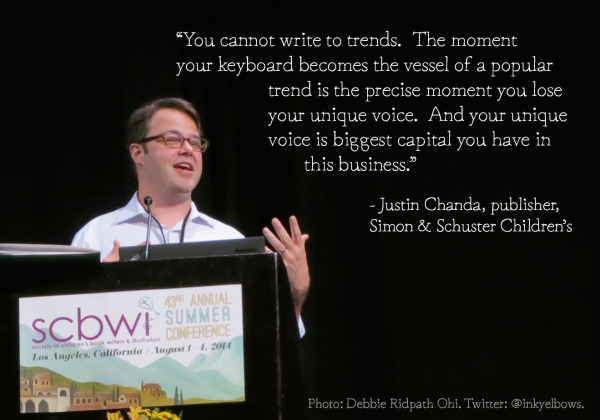
JustinChanda-podium-voice-v2flatweb

Photo credit: Debbie Ridpath Ohi, from her blog Inky Girl, ©2014

Today, I sent Debbie’s inspirational photograph to my writing group, and added the following words:

RESIST THE TRENDS. Resist the frigid breath of the publishing industry, breathing down your neck, trying to get you to focus on The Market and What Editors Want. WHO CARES. Write the best story you know how. Write you heart out, all over the page. Look into the convex lens of your imaginary audience and tell the true – the REAL true that makes you dig down and get personal and a little afraid and maybe weep a little. Write what you’re finding a glimmer of, but fear maybe others won’t understand. Write what scares you, what hurts you, what disgusts you, what seduces you.

…and THEN worry about the stupid industry.

As is often the case, the quotation shared started a dialogue with a friend. Her response (appropriately anonymized):

The problem is I did write the story that came to me, and now I’m worrying about the market, because my story won’t sell.

Not to be a naysayer and a downer, but I listened to Justin Chanda, and his speech was inspirational, BUT…

They (and by they, I mean editors and agents and publishers) say to not worry about the market and write your own story, and then in the next breath, they say, “We’re not taking ______, ________, _________, because those trends are over.” Fill in the blanks with your story idea(s).

They want the next big thing, but they also want the current hot trend. He’s right that we cannot predict the trends or write to them, but on the other hand, the trends exist and if you happen to have something that doesn’t match what they’re looking for–even if it’s well written–the answer will still be tough luck, Charlie.

I sat through that conference depressed and disheartened, despite Justin’s smiling face. Many of the agents there were closed to submissions, including conference goers. (I kept wondering, “Then why are you here?”) And all of them were pretty down on YA–especially speculative fiction. The ones who were taking submissions wanted realistic, please, something like John Green, only not a cancer book (aka trend over).

Right.

I walked away with the decision that I’m just going to write for me and not worry about publication or querying. No pressure. No what if. No fear if it’s good enough. No second-guessing the critiques I’ll receive and wondering what everyone won’t like, what I need to fix, etc. Just me and my own joy in making up a story.

…Right now, I just want to finish [my] manuscript and enjoy the ride.

Trying to experience the journey and not worry about the end…

I tried to choose my words carefully – because I know it’s easy for me to say “Oh, don’t give up! Don’t let the market rule you!” when I’ve already been published, and my friend hasn’t yet, but I believe so strongly that she will be that “yet” is the only word I can use. I replied:

And that is what I mean about not worrying about the trend.
I don’t at all belittle what was said at conference, what you heard, or what you found inspirational —
What I have a problem with is PERPETUATING. If we keep writing books that are what people want? We’re keeping the world – this dominant culture, youth worshiping, lucre-loving, hypocritically class conscious, culturally clueless, mean (girl/guy) enabling, tech obsessed – this disappointing, shallow world exactly the way it is.

Okay, so astronauts get to grow up and change the world. People expect that of the hard sciences – they’re researching, they’re making discoveries – right? People don’t expect that from art. We’re just… making pretty pictures. Scribbling words. It’s not like we’re curing cancer. We don’t change the world… or, so you’d think.

ART IS POWERFUL. The act of creation — the experience of seeing yourself reflected in a creation — we can’t possibly ignore that thrill. Art – and our place in it – has the potential to be transformative. We cannot possibly content ourselves with just regurgitating something made up by talking heads in publishing firms whose ego and paycheque is tied to perpetuating the status quo. Another-John-Green-But-Not-Cancer realistic fiction novel – my square backside; we can do better than that. We CAN do better than that. OUR stories are real – for a given value of “real” in fiction – not contrived and cobbled to meet some trend. YES, marketing and money rule supreme in the industry, but the industry doesn’t move without us. I truly believe that the best stories — and a disturbing number of outright craptacular ones and generic “meh” ones — will continue to be told.

You’re right: it’s not important to be THE best in the industry, especially because that is totally subjective. Being your best is what’s going to make creating your stories satisfying – it’s what’s going to make your words fly, and your story arc and your big-picture metaphors sing like the tapped edge of a crystal goblet – that tiny chime that says ‘real.’

Here’s to being the genuine article.

The conversation on literature and breaking into the market isn’t over, of course – this was just a piece of it. There’s a lot of hope, and a lot of despair in publishing; a lot of unrealized dreams and normalizing the status quo, but it’s still my hope that things will change. Here’s to that day.

{when i am crazed, i remember agatha}

WHY must I have Existential Crises at 10:45 on Sunday nights? We even had a long weekend this weekend, I had plenty of time to come unglued about the glacial speed at which my current revision is going — but no. When we needed to be safely asleep and storing up hours of rest against a busy week, I start fidgeting and sighing, and poor Tech Boy says, “So… should I just leave the light on?”

“No… it’s fine, we can go to bed. It’s just that…” Aaaand, we’re off.

My Tech Boy is no stranger to my cray-cray, but rather than rolling his eyes or tuning me out in favor of his book – which, not gonna lie, I might do to me – he actually listens to the words behind the hysteria. He listens until I wind down, and then says a few knowledgeable things which spark something. Somehow, within minutes, I am back on track after spewing invective and doubt all over the room. I grab my bedside pad of paper and pencil, and start scribbling notes. I nod. We discuss. And, finally, much later, I sleep, at last able to actually relax.

Much to my dismay, yes. There’s a moment like this EVERY. SINGLE. TIME.

But, then, this is par for the course:

“There is always, of course, that terrible three weeks, or a month, which you have to get through when you are trying to get started on a book. There is no agony like it. You sit in a room, biting pencils, looking at a typewriter, walking about, or casting yourself down on a sofa, feeling like you want to cry your head off. Then you go out and interrupt someone who is busy – Max usually, because he is so good-natured – and you say:

“‘It’s awful, Max, do you know, I have quite forgotten how to write – I simply can’t do it any more! I shall never write another book.’”

“‘Oh yes you will,’” Max would say consolingly. He used to say it with some anxiety at first: now his eyes stray back again to his work while he talks soothingly.

“‘But I know I won’t. I can’t think of an idea. I had an idea, but now it seems no good.’”

“‘You’ll just have to get through this phase. You’ve had all this before. You said it last year. You said it the year before.’”

“‘It’s different this time,’” I say, with positive assurance.

“But it wasn’t different, of course, it was just the same. You forget every time what you felt before when it comes again: such misery and despair, such inability to do anything that seems the least creative. And yet it seems that this particular phase of misery has got to be lived through. It is rather like putting the ferrets in to bring out what you want at the end of the rabbit burrow. Until there has been a lot of subterranean disturbance, until you have spent long hours of utter boredom, you can never feel normal. You can’t think of what you want to write, and if you pick up a book you find you are not reading it properly. If you try to do a crossword your mind isn’t on the clues; you are possessed by a feeling of paralyzed hopelessness.

“Then, for some unknown reason, an inner ‘starter’ gets you off at the post. You begin to function, you know then that ‘it’ is coming, the mist is clearing up. You know suddenly, with absolute certitude, just what A wants to say to B. You can walk out of the house, down the road, talking to yourself violently, repeating the conversation that Maud, say, is going to have with Aylwin, and exactly where they will be, just where the other man will be watching through the trees, and how the little dead pheasant on the ground makes Maud think of something she had forgotten, and so on and so on. And you come home bursting with pleasure; you haven’t done anything at all yet, but you are – triumphantly – there.”

An Autobiography: Agatha Christie, pp. 571-572)

To think that the woman who crafted Marple and Poirot writhed on the point of her pen makes me smile. That she nagged her husband with her crazy makes me laugh. Some of us have to make several false starts to begin our writing; others of us struggle with slump-y middles, and still others of us are in agonies at the end. All of us are, at some point, an absolute joy to live with. I can never say enough good things about my Tech Boy – when I am pulling out hair and clinging to the side of cliffs, he just starts talking me down.

I think I’ll keep him.

{the apple of the unblushing cheek}

A few weeks ago, Charlesbridge editor Yolanda Scott shared on the Children’s Book Council Diversity blog (CBC Diversity) about working with author Mitali Perkins on her 2010 novel, BAMBOO PEOPLE. At one point, she recalls advising Mitali that her Burmese-born character should blush, when he was embarrassed.

“Mitali gently informed me that the character’s brown skin just wouldn’t redden up like a white person’s would. I felt horrible, stammered something in reply, and let the floor under my desk open and swallow me up. My own cheeks flamed red in ironic retribution.”

It was REALLY brave of Yolanda Scott to share this moment with the world on a diversity website, #1. But, she’s not the only one who occasionally goofs or gaffes and makes gauche statements and social blunders on race and ethnicity. Writers do it too — and it’s sometimes hard to refresh tired body language stereotypes in writing, so good writers are always seeking new ways to get into the topic. Recently, I came across Body Language Success, a website that is all about teaching people tells and cues of body language… and analyzing the body language of public figures.

Can I tell you how much I LOVE this stuff? I have always been a reader of people — and having NAMES for some of the things I observe is just really, super, nerd-tingling-ly cool. (Okay. I’m fine now.) While this April Fool’s prank is my FAVORITE video on the site at the moment — watching people who CAN blush is high entertainment, let me tell you — I find a lot of really good stuff here that works well with writing.

A minor character in my novel just shouted over a loud noise — which had abruptly shut off mid-word. She’s not going to blush — even if she could, not everyone with fair skin even does that.

The girl mouthed something incomprehensible through the roar.

“What?” Zora leaned forward.

Raising her voice, the girl screeched, “I SAID, WHAT’S YOUR NAME?” The last word was unnecessarily loud, as the blower, which had sounded like a jet engine, cut off unexpectedly. “Sorry,” the girl said, ducking her head. She gave a weak smile. “I’m Kayla, and that’s Jasmine. Are you a freshman?”

Even without that hint of blush, I think embarrassment is pretty well clear, no? Hope so. Until then, I keep hoping for the perfect turn of body-language phrase…

{the fine points of getting it right, or “why aren’t you representing?”}

Dear Store,

So, yeah, yesterday I visited you, and cringed at the massive display of cases of Jamison’s and Guinness, and a countdown clock to St. Patrick’s Day, and now, I have a teeny rant: Thanks, Store, for subtly reinforcing the worn out, hoary stereotype that there’s nothing more to Irish culture than being a flat-out, pishing, green-wearing drunk. Nothing exists in a vacuum, Store, and even your displays helps shape the lens of how people see the world. Your reinforcing a tired old cliché does not serve anyone, and helps to obliterate the record of the myriad brilliant, incisive and influential Irish and Irish-American people that I know personally. Just so you know.

Also, please note I didn’t mention you by name, as you’ve probably not yet gotten my note about it, but next year, if you do it again? It’s ON.


As I’ve no doubt mentioned repeatedly on this blog, representation was one of the BIG Questions that came at me repeatedly in grad school: “Why aren’t you representing,” or, “why aren’t you representing more?” I will admit that for a long time, I wrote stories under the shorthand For some people, when you present a culture as the “norm,” it’s too subtle for them. They want you to exaggerate certain qualities and create a caricature more than a three-dimensional whole. People sometimes don’t even know they’re doing that, and end up exoticizing an entire culture. Everyone Mexican can make tortillas, wears a serape, and likes to nap with her sombrero tipped over her face during siestas; everyone Japanese is a geisha or a kung fu master, etc…

“The Kingdom in Huntress is influenced by Chinese and Japanese culture, but it is not China or Japan. It is a fictional fantasy world…” ~ Malinda Lo, author of ASH and HUNTRESS, in “On avoiding the exotic in HUNTRESS,” from her blog, 2 Sept. 2011.

What I’ve been asking myself is how to represent a culture in a fantasy world without exoticizing it, and turned to author and anthropologist Malinda Lo’s blog for help in thinking it through. Is it enough to set a book in a fictional version of North/Northeast Africa and southern Italy during a fictional Ottoman Empire? I don’t think so, not inherently. Is it exoticizing to take note of the actual clothes, foods, and religious and social mores from the real Ottoman Empire in its heyday, and use that in the book? No, especially if I can subtly include them without making them A Thing. So… what would make this exotic? Malinda speaks of her own work:

“What makes something exotic? It can certainly be philosophy or beliefs, but more often, I think exoticism resides in things you can actually see or hear. Clothing, food, music, architecture: these are the external markers of difference.” ~ M. Lo

So, taking note of that, these are among the things I will avoid: no despotic ruler clichés, no warmongering, fanatical religious Muslims. Further, there will be no untrustworthy, swarthy mafioso types, and while I can’t promise no short, or hirsute, or curly haired, or dark skinned or chauvinistic characters, these things won’t occur because a character is Sicilian. There will be no obsequious, effendi-panting slyly servile types, no Ali Baba and Aladdin, Sindbad or any one of Forty Thieves. No Oriental-ism, with swoopy calligraphy and poufy turban saber-wearing sultans, swathed in mysticism and curly-toed shoes, reclining on Persian carpets whilst being danced for by those sloe-eyed temptresses from the harem. Also, people will wear a color other than black, and not eat only spaghetti.

Honestly, I should think most of these egregious stereotypes would be easy to avoid… the point of adding cultural richness is to place the character right in the midst of the riches, not keep them self-conscious about it, and always commenting on the nubile chick tossing off veils in the corner as she dances, and the smoke of the hookah or whatnot (and really. Must I have a hookah? I think not).

Yeah, you’d THINK this stuff would be obvious… but too many people mess up with exoticism for me to believe that, so, we’ll see.

Writing thoughtfully,

-t