{poetry friday poem: after Donika Kelly}

Welcome to Poetry Friday!
Poetry Peeps! Just a reminder that our challenge for the month of November is composing ‘Eavesdropped & Overheard’ poems in tribute to our pal at the long-running Chicken Spaghetti blog, Susan Thomsen. I look forward to your post or on social media with the tag #PoetryPals on NOVEMBER 28th!


And speaking of Susan, today’s poetry prompt comes her, and a poem she shared a couple of weeks back, Donika Kelly’s Poem To Remind Myself of the Natural Order of Things. In it, the poet hearkens back to that thicc and wondrous baby hippo captured our hearts during lockdown, then turns her attention back to her own heart.

From Process…

Now, I wasn’t going to do this challenge. I am truly bad with memes — some of what other people find funny or cute comes off as either sad, weird, or mean to me, and hello, welcome to my sideways brain, I guess. But then, I read Susan’s poem, and all the poems of the others taking part in the challenge, and they were so good that I thought of one meme that hasn’t left me alone.

Yeah, so – remember the viral ‘Paws-In Test’ from about six months back? I …disliked that so much (once again: weird brain. NO SHADE whatsoever if you thought it was cute. It a fundamental way, it is cute, because: dogs). The ‘test’ was owners putting their hands in a stack and silently requesting their dog to take part in their weird human activity. And some of the dogs, you could see the gears turning as they looked from one of their human pack to the next, trying to figure out what the ask was… trying to make sure that they were doing whatever was being asked of them “right.” And egads, that seemed way too much like the social tests of life for me, and all of my oh, noooo anxiety kicked in, just looking at those sweet liquid eyes, staring at the humans being …baffling, and waiting for…something… ❗

…To Poetry

However, the point of the whole exercise is to find more in the ephemeral memes and ‘moments’ observed in the social media stratosphere, and I love that Donika begins with the word “observe” and leans in with just that – forcing us to look back and remember the delightful chonk that is Fiona, and how the posts from the zoo lightened up our hearts in a heavy time. Hadn’t love, the poet seems to realize, once done the same for her? And thus, I found my way into writing …some kind of poem. For once, it helped that I did this last minute, so forced myself to truly lean in to the mentor text: no rhyme, no wordplay, just… thoughts. (Or, vibes, no? I mean, if we’re talking memes, we are fully USING the lingo.)
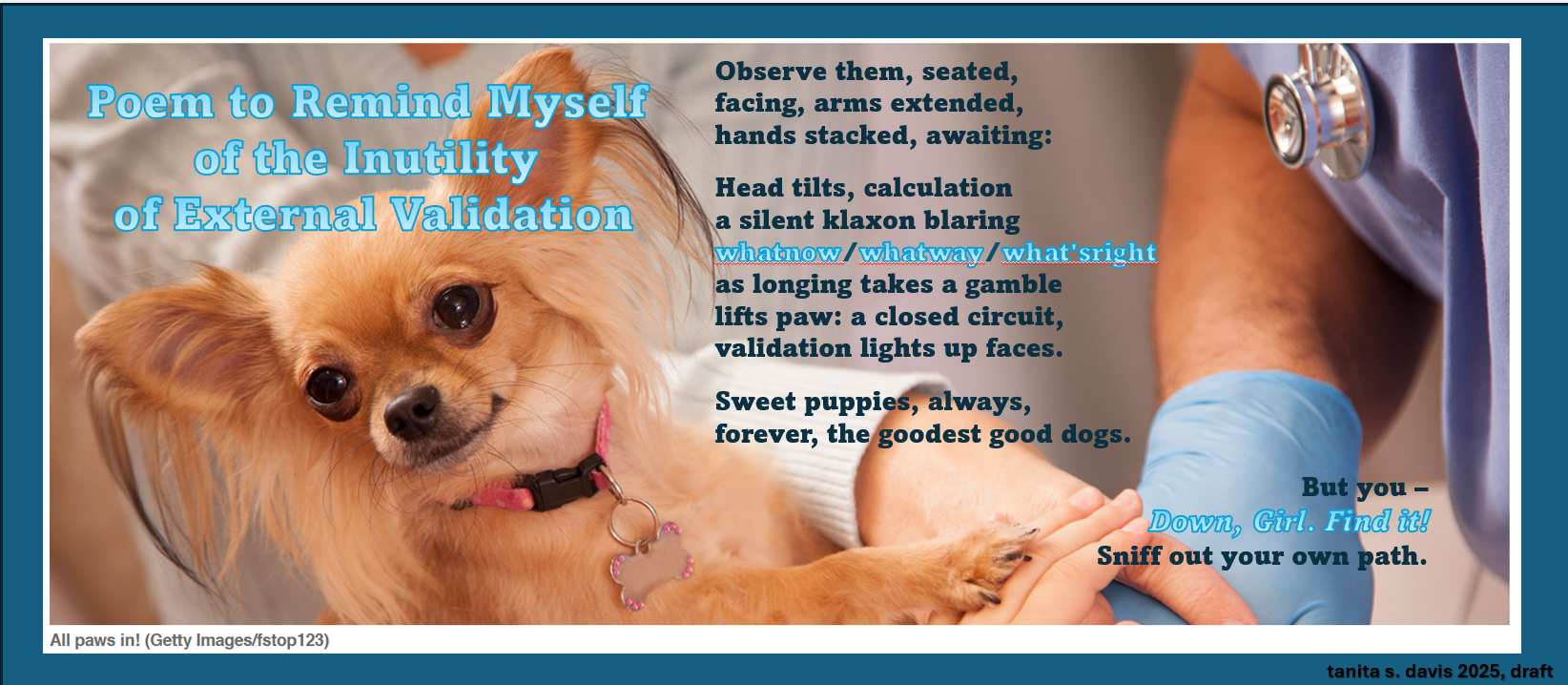
“A Poem to Reminds Myself of the Inutility of External Validation”

After Donika Kelly

Observe them, seated,
facing, arms extended,
hands stacked, awaiting:

Head tilts, calculation
a silent klaxon blaring
whatnow/whatway/what’sright
as longing takes a gamble
lifts paw: a closed circuit,
validation lights up faces.

Sweet puppies, always,
forever, the goodest good dogs.

But you –
Down, Girl. Find it!
Sniff out your OWN path.

tanita s. davis draft, 2025


It’s Carol who is hosting the Poetry Friday roundup today, so pop by for an apple from her orchard. Remember – there is no ‘right’ way to act. There is no ‘correct’ response. There is only you, and yours, and the choices you make to fulfill your needs. And, you. are. enough. of a majority to rule. Now, off to find your own way, you good being.

Happy Friday.


{socializing calling}

Finally Thursday! The weekend is calling!

And wouldn’t we like to answer with a nice lie-in, especially the week after the time change? But no – not this time. Socializing is on my horizon.

(Please click on the image to enlarge the actual images of calling cards I found online.) Despite the fact that some of the people I will be seeing I actually want to see, I still feel like it’s time to bring back the early 19th and 20th century social call. This, dear ones, did not take place on anything so gauche as a telephone, oh, no, this was a visit during visiting hours. One walked briskly through the neighborhood and one presented one’s calling card – as elegant a little piece of stationery as one could afford – to indicate that one was disposed to a moment of sociability, if the recipient had the time.

The recipient had the option of being at home or regrettably away, even if they were slouching in their peignoir eating chocolates or whatever people did instead people back then.

Okay, yes, laugh at me but I actually DO like people, within, you know, reason, and it might be nice to be more sociable if visits lasted, as they did back then, for a mere FIFTEEN MINUTES.

Think of it! Fifteen minutes. People went ALL the way to an acquaintance’s home, dressed to the nines, and…only stayed for a quarter of an hour. Honestly, I cannot imagine why there were wars back then – surely no one actually had to endure each other’s company long enough for any real dissent! (Hah.) And while the rules of socialization were labyrinthine and the Victorians were prisoners of the social dance as surely as they were the other trappings of the Beau Monde, it still seems like it would solve so many problems to have At Home days and fixed times when you were required to engage in socialization. I would have one day where I made lovely baked goods, sat down and read a book, and endured being interrupted all day, just to get it out of the way.

Once the telephone arrived, society veered in the direction of business cards for reasons I still don’t understand, and people now of course leave messages for each other on social media – to which my sporadic visits are something of a social obligation that I enact poorly as well. ::sigh:: As I gird up my social loins for the weekend, I think wistfully of Ye Olden Days when people (not of my class or race, but a girl can dream) could drop off a card and a gift to someone and perform a social nicety without actually ever going inside of anyone else’s house.

Honestly… making calls was the best, and calling cards were sometimes works of art. I don’t know why we don’t bring them back.

{poetry friday: acknowledging hard things in poetry}

This is definitely not under the banner of my #winterlight offerings, because it’s not particularly encouraging, but rather… thinky. I’m grateful for the friends who have dragged me into poetry practice, and for my Deeper Dive poetry group, whose exercises help me to look differently at the poetry I read.

This week, my group read several mentor poems which touched on grief or despair, and using repetition, direct address and present tense voice lead the poem towards a commonality of experience, allowing the reader to both feel and release their own similar emotions. Yesterday I wrote a draft of a poem describing the rise and fall of Allensworth, CA, the first township in my home state to be founded, financed, and governed by African-Americans – the “Buffalo soldiers,” of the Civil War. I have been fiddling with the idea of writing historical fiction set in this town – or writing fantastical fiction about magical happenings in this town. All of this is still in the very bubbling-stew-of-imagination stages.

Today I’m attempting to look objectively at another poem from the Harlem Renaissance using the same tools as we identified yesterday. If this has a lot of the tone of an English paper, that’s because I think I fall back on the strategies that worked for me in my upper level English courses. Additionally, writing things down is sometimes a way that I further process and remember them. So, aren’t you glad to be here to crib my notes for the test on Monday? Enjoy! 😂

If We Must Die

by Claude McKay

If we must die, let it not be like hogs
Hunted and penned in an inglorious spot,
While round us bark the mad and hungry dogs,
Making their mock at our accursèd lot.
If we must die, O let us nobly die,
So that our precious blood may not be shed
In vain; then even the monsters we defy
Shall be constrained to honor us though dead!

(Do read the rest at The Poetry Foundation.)

Born Festus Claudius McKay in Sunny Ville, Jamaica in 1889, Claude McKay loved English literature and studied and wrote poetry as a young man – about his feelings, about the world around him, and about the things he observed. Logically, we know McKay observed a great deal of racism – both in his home nation, and during his lifetime in the United States. The themes of both his poetry and novels reflect this. The poem, “If We Must Die” is one of his best known, and most celebrated, not just among the Black community, but more on that later. The feel of the poem is, despite its formal tone, in some ways very American – very macho. “Mejor morir a pie que vivir en rodillas,” right? Better to die on your feet than to live on your knees. (This quotation attributed to Emiliano Zapata, 1877-1919, and quoted by FDR in 1941 when receiving an honorary doctorate from Oxford University – apparently meant to be encouragement to a war-stressed Britain.)

Many times, poems which deal in difficult topics use the natural world as a foil, pointing to the continuous cycles of nature as a contrast to the brevity of the human cycle. While McKay does mention hogs and dogs, he mentions them in a disturbing similarity to human beings – Black people chased down, cornered, and executed like hogs, white people like baying hounds, harrying them and running them down. While it at first seemed to me a departure from his animal metaphor when he urges the subject of the poem to make the ‘monsters’ pay for every drop of blood shed, I thought about how dangerous hogs are to come across in the woods. Even if you’re not hunting them, you don’t want to run afoul of them – they’re aggressive, and they’ll come after you if they’re even startled. Like the 1546 proverb said, “Even a worm will turn.” Even the meekest and most docile of the animal kingdom can be pushed too far, and the Black man McKay describes with such polished, formal language is apparently a man pushed outside of his natural bent for civility and calm – or, at least his language seems to imply that’s man’s natural bent, anyway.

That high-toned language and …the poem’s precise shine in general seems deliberate. The poem is a Shakespearean sonnet, with all of the structure this rule-bound form allows – and with all of the history and travel that the sonnet implies, from thirteenth century Italy to 1500’s England to the more recent pen of a Jamaican-born Black man. With this history and through this distance, McKay speaks to a certain kind of reader – to men, ostensibly, as the poem cries out to “O, Kinsmen!” at one point, and readers are encouraged to die “like men.” Those kinsmen could be American men, or McKay’s fellow Afro-Caribbean immigrants. Today I learned that there is an urban myth that Winston Churchhill (!!!! NB: there is no record of it, so this is wholly mythical and sourced from people’s memories at the time) read this poem aloud on the radio during the siege of London in 1940. Because this sonnet lacks specific identifying markers – the “We” who must die are called “kinsmen” and “men” and their oppressors simply “monsters” – the clarion call of standing with one’s back to the wall and fighting to the death, couched in the scholarly lines of a very European poetic form makes it allegedly relatable even to the Prime Minister of England. Who knows – maybe the poem is intended to speak to long-ago Italians and Englishmen as well. McKay’s direct address invokes whatever present moment the reader finds themselves in, which is often claustrophobically close in the ‘painful topic’ poem genre, and gives the reader a sense of tempus fugit – of a time that is fleeing, and so right this minute you must listen to the poet, and hear his wisdom, which may not be available beyond this epoch. I imagine the narrator running, ghostlike, along with a person fleeing a lynching, urging him to not just run but to consider stopping and making a last stand instead, to make the monsters pay. Even with these sterling words and high tone, though, it’s hard to imagine someone running for their life being very open to the whole thing.

The long-ranging discussion of violence and non-violence, of “By Any Means Necessary” and passive protest is present in this poem, but wrapped in the idea of nobility and honor. Is it better to “nobly die” not like a slaughtered hog, but “fighting back?” Or will you still be just dead? McKay definitely seems to believe that an honorable death is the best death – but the jury’s still out.

Thank you for coming to my English Lit discussion.

EDITED TO ADD: Can you believe that Susan @Chicken Spaghetti is also celebrating the poetry of Claude McKay today??? What are the chances?

{poetry friday: believing}

Welcome to Poetry Friday!

Poetry Peeps! You’re invited to our challenge for the month of January! Here’s the scoop: we’re composing tan-ku, conversations between a haiku and a tanka, as created by Mariko Kitakubo & Deborah P. Kolodji. (This is a short-but-sweet challenge, given that we don’t have a full month to ponder it.) Are you in? Good! You have …two weeks to craft your creation and share it on January 31st in a post and/or on social media with the tag #PoetryPals. We hope you’ll join the fun!


One of my modest goals for 2025 is to share my poems a bit more often. Since I’ve been writing with the Poetry Sisters since 2007, I have amassed a ton of poems, some of which I even feel okay about, but they tend to languish in folders and never see the light of day. Rather than continue to emulate the Belle of Amehurst and have someone find all of this on my hard drive when I’m dead, I’m going to start sharing… they may be good, bad, or indifferent, but the point is that I did like them once, so… here goes.

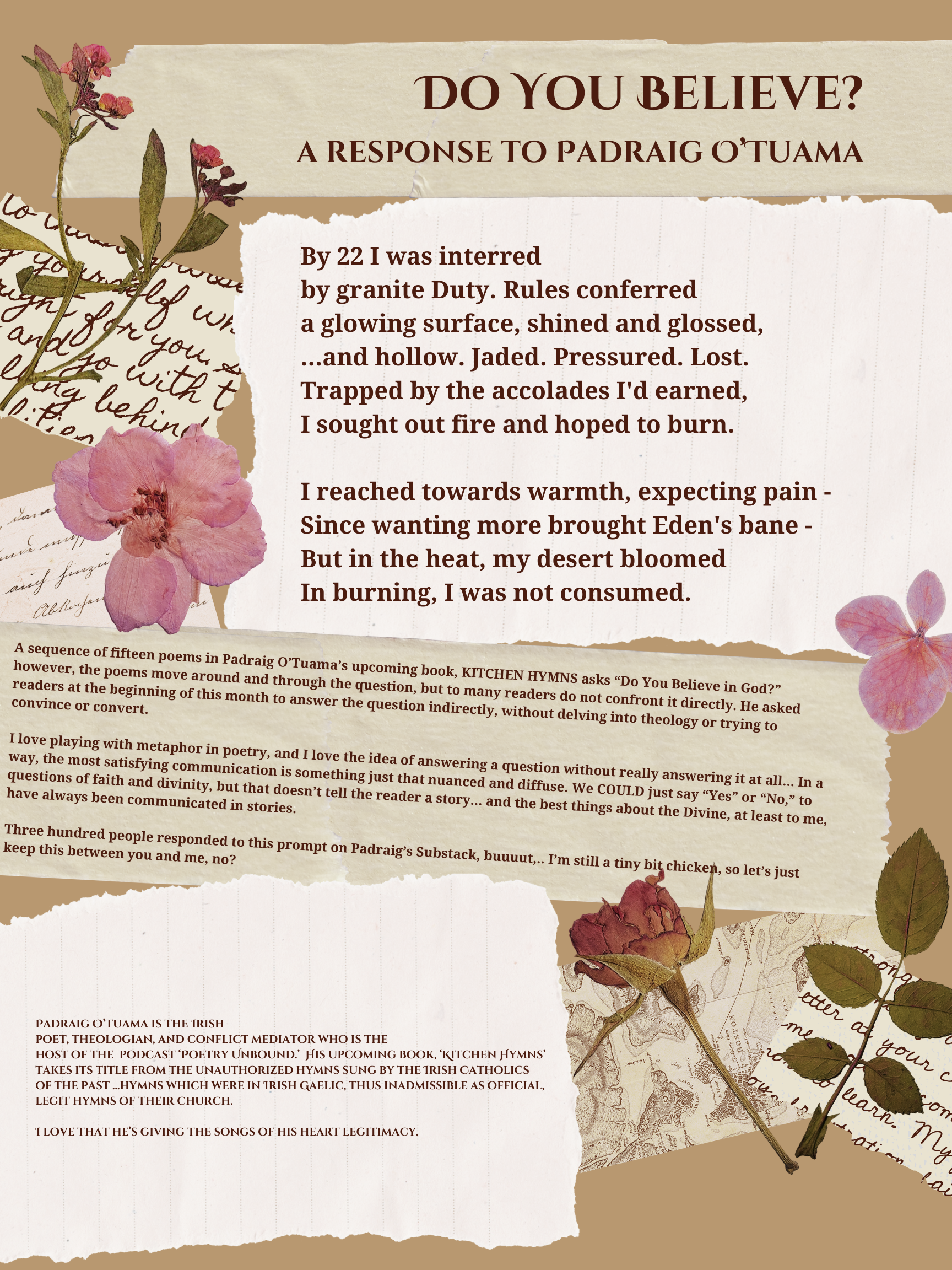
The following poem is less of a real answer to a poem, and more of an illustration, if not quite a parable. I think religious writings of any faith practice contain a lot of stories, because that’s the way to break concepts down into digestible bits for the average person… belief is a MASSIVE topic. We all believe something …sometimes. That old saw about atheists and foxholes come to mind – even if our belief is ephemeral and unthinking, sometimes it exists, and I think it’s part of life that deserves examination like the rest…


Poetry Friday is hosted by Tricia’s Smith Corona at The Miss Rumphius Effect. Thanks, Tricia.

Happy Weekend, friends.

{welcome to your poetry friday post!}

You are cordially invited to March…

In this hemisphere, March is the month of seeds, the month of being in the raw cold, pushing seeds into the clammy earth with cold fingers.

I haven’t yet gotten to the second part of that last sentence, the pushing in of the seeds with cold fingers. I’m still in the indoors stage, waiting for the raw cold to abate, trying to possess my soul in patience at each new frost warning. This is why half the dining room table is covered with seedlings, strawberry plants and lavender bushes straining toward the light. This is why both my lasagna pans are filled with mini pots of soil. This is not a month for company at my house; I have little packets of seeds and pots on most flat surfaces, and nowhere to put you that isn’t covered with proto-plants. I think I’m worse than usual this year, because it’s been such a cold, gray time. Not just winter, of course; winter is supposed to be cold and gray. I mean the cold grayness of book bans and disheartening political chicanery, of climate threats, and mass shootings, of war anniversaries. I have never needed the hope and anticipation of a garden more.

For moments like these, there’s Poetry Friday.

Join the Roundup here.


The Poetry Sisters have been riffing off of the word “transformation” as part of their poetic peregrinations this year. One of the synonyms for the word, evolution, has been quietly reverberating through my poetry practice. With my Deeper Dive group, I’ve been “diving” into some of the exercises in The Practice of Poetry, with the goal of keeping better track of how my poems change, and where I begin with them as opposed to where I end up. It’s been kind of intriguing to see some of them come together, and to feel like I am finally beginning to find my feet as a semi-sorta-kinda poet. (Don’t @ me – it’s a process.)

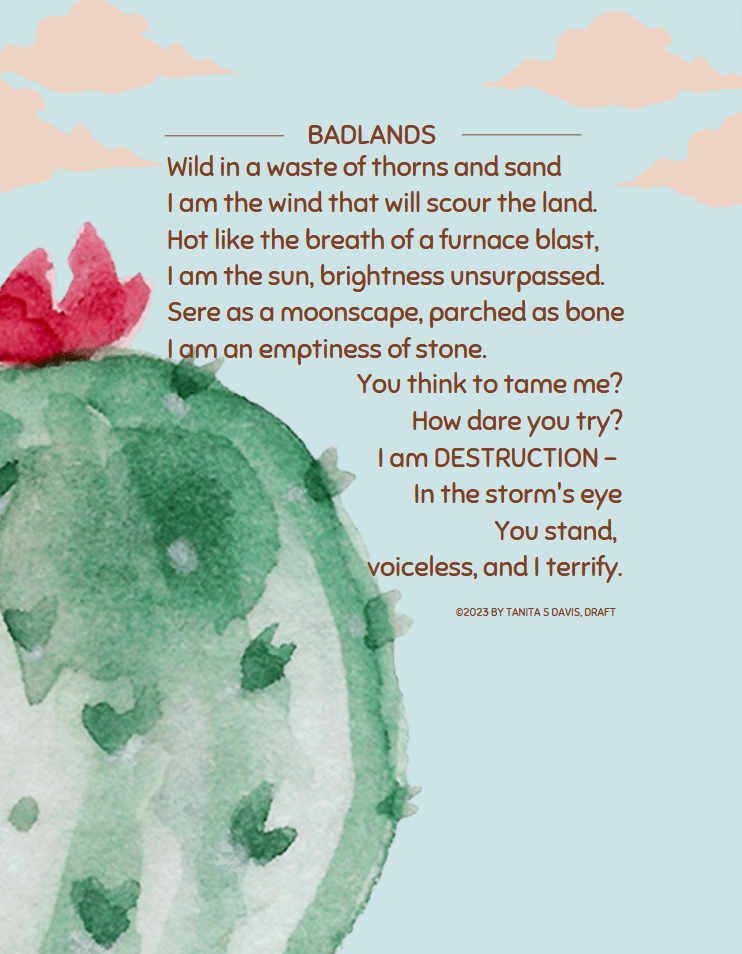
In doing an exercise to imaginatively embody inanimate objects, I tried to apply the idea of change. I tried to imagine what typically comes to mind when I think of this or that object – and then toss it, enabling me to think past my first reflexive thoughts. Most of my beginnings weren’t poems, they were lists – beginning with the word “I am.” Three objects later, I returned to look at my lists and try and figure out what lines, moved and rearranged, had some kind of theme to them. A few more switches and refinements, and I began to hear… something. Is it a poem yet? Maybe? All I know is, it’s a …start.

The key to having gotten this far is having… started. It sounds kind of obvious when stated so baldly, but it took me a while to figure that out. So many people want to “be a writer,” and state this desire with a fervid sort of earnestness… but writers learn that desire alone cannot be the endpoint. It’s desire and. Desire and work. Desire and beginnings, middles and endings. It’s desire and editing and rewriting. How do you get there from here? You…desire, and then you begin. Somehow in prose I knew that, but just hadn’t figured it out for poetry.

So, anyway, here you are – land cleared and furrow turned. Here you are with seeds in your back pocket, looking at this expanse of earth, wishing for a garden.

I’ve got great news for you – you can take the next step to whatever your goals are. Transformation is at your fingertips. Are you game?

A frequent saying of mine is that anything I write, I’m also writing to myself. As I have a meeting with my editor (triumphantly back from striking) in a few hours, I’ll be thinking of the transformations ahead – the beginnings and the work to be done. As I continue to noodle with various poems, as I look out at the gray world, I’ll be thinking of the transformations necessary. The seeds in my pocket. The call to… begin.

Good luck, all. Remember…


Poetry Peeps! A little reminder for our challenge in the month of March: We’re writing an etheree. This ten-line form begins with a single syllable, and each line expands by one syllable until the tenth line has ten. We’re continuing with our 2023 theme of transformation, but how you interpret that topically is up to you. You have a month to craft your creation and share it on March 31st in a post and/or on social media with the tag #PoetryPals.

{solstice & a breather}

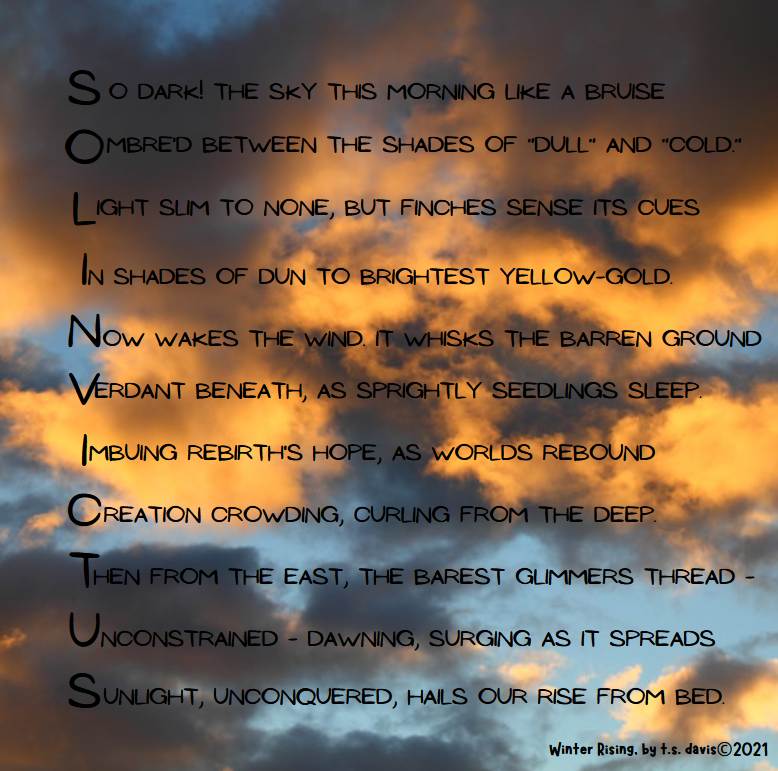
I’m sharing this poem I wrote for a holiday poetry swap last year for my second-cousin Heidi Mordhorst. I think of people who really struggle with the dark and the cold and send hugs and sunlight to them.

Winter Rising
So dark! the sky this morning like a bruise
Ombré’d between the shades of “dull” and “cold.”
Light slim to none, but finches sense its cues
In shades of dun to brightest yellow-gold.
Now wakes the wind. It whisks the barren ground
Verdant beneath, as sprightly seedlings sleep.
Imbuing rebirth’s hope, as worlds rebound –
Creation crowding, curling from the deep.
Then from the East, the barest glimmers thread –
Unconstrained – surging as it spreads
Sunlight, unconquered, hails our rise from bed.
©2021

I’m going to be offline and shutting down for a few days, and will be back when the hols are over. Until then, happy reading! And if you and yours are enjoying Hanukkah, Solstice, Christmas, or Kwaanza, all joy and celebration to you!

{pf: poetry peeps try to byr a thoddaid}

Poetry Peeps! You’re invited to our challenge in the month of July! Here’s the scoop: We’re each taking an empowering and inimitable line from Maya Angelou’s “And Still I Rise,” and from them creating acrostic poems. Each of those forty+ lines are available to poets to create something memorable – grounding, empowering and expansive – of their own. Are you in? Good! You’ve got a month to craft your creation(s), then share your offering with the rest of us on July 29th in a post and/or on social media with the tag #PoetryPals.


Well, first off, you pronounce it beer ah TOE-thy’d, which won’t really help you write one, but hey, The More You Know.🌠 Second, once you get into the byr a thoddaid form, they’re… complicated? But, not actually HARD. I’ve decided that byr a thoddaid are like …long division. You might run out of attention before you finish all the steps (shout-out to my former students), but it is nothing that you cannot handle (Insert authoritative teacher-voice.).

That being said, let’s acknowledge: this seemed like a LOT of steps.

Mistakes were made. Repeatedly.

My process, when dealing with an unfamiliar form, is usually to read a ton of examples. Are there a ton of examples online that I like? No. Would I need to read them in Welsh or something to find a bunch of great ones? Probably. Did I spend more time faffing about on Google than I ought to have? Definitely. I kept thinking I HAD it, when it turned out I was forgetting the near rhyme and just concentrating on the end rhyme. At one point, I rhymed everything to the first stanza, which …could be done, I guess, but wasn’t one of the options listed. I finally pulled off a tiny one, but like that long division, it took longer than I felt it should have:

The season spills a thousand scents,

As summer twilight, liquescent

Shimmers, igniting dreams undreamt. Such light

Sparkles through stars at night.

So, that felt… like a good start, but then I heard people were making two stanza poems from their stanzas, I felt I ought to step up a bit. Also, it was time to pull out the Canva and make-believe I knew what I was doing…

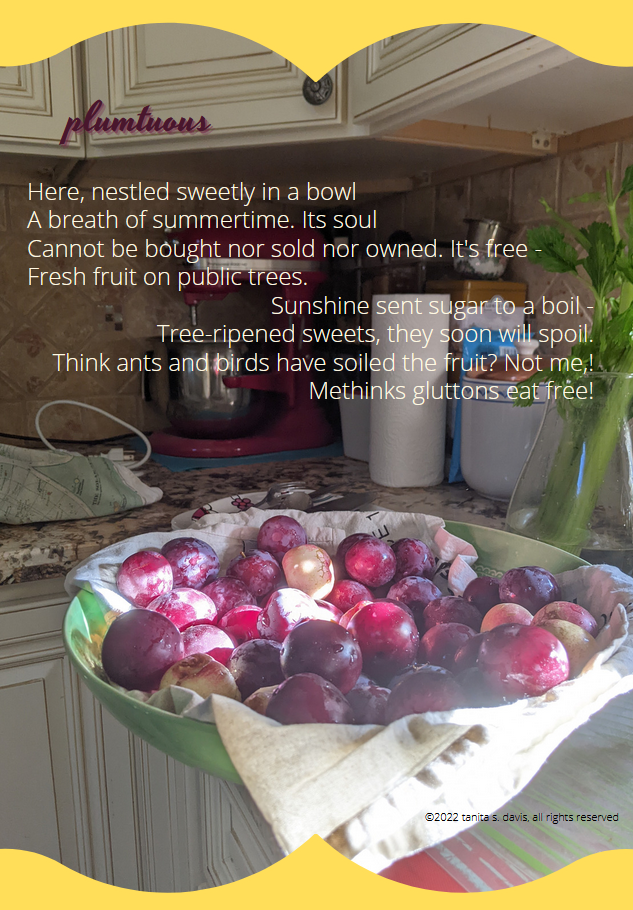
Full disclosure, these are from my backyard nectarine and plum trees, but one of the loveliest things about this area is the many, many sidewalk fruit trees, and of an evening, you will see families – small children, whole rafts of folks in the national clothing of their home countries – with boxes, bags, little red wagons and step-stools, all out to get stone fruit for jam, for eating out of hand, to dry it, and more. It’s …it makes me feel like SOMETHING is going right in the world. Friends, I will gladly take this one thing.

Want to see the attempts of the peeps who also assayed this adventure? Tricia’s is here. Sara’s is here. Laura got inspired here, and Liz’s link is here. Cousin Mary Lee’s is here. Michelle K.’s poem is here. More Poetry Peeps will be added as the weekend progresses, so check back later for the full round-up.

Meanwhile, Poetry Friday is hosted by Catherine, at Reading to the Core. Thanks, Catherine!


And here it is, the end of a week, when just days – or hours – or months ago, you never thought you’d get here. See how much you’ve done with what you’ve got? Remember — like long division, life is nothing that you cannot handle. Take that deep breath of summer sweet, and hold fast. Happy Weekend.

{gratitude: 11.1}


Does anyone else share my that end of year time crunching down on them? My angst, as deadlines loom (planned, unplanned, and now somehow EARLIER), and all the things I promised people gladly that I would do, I now am feeling like I’m slap-dashing and barely getting done. Going through my head are the words, “Ugh! I do not have time to post every day in the month of November.”

“Even though I want to, I do not have time to write a poem every day for the month of November.”

“Even though it’s traditional for this time of year, I do not have time for gratiti…”

…wait, really?! This has been a year in which I’ve received a great deal. I’d better have some time for a gratitude project!

I’ve tried to do a gratitude poetry exercise yearly in November, but I don’t always succeed. Additionally, this year, though, I come with limited time, and, (as usual?) a very dubious attitude. Every year, I end the month feeling truly grateful for my life, and I expect the same this year, (even though I have a deadline this month). Here’s to the transformation.

{so, poetry peeps, feeling Zen yet? or just tangled?!}

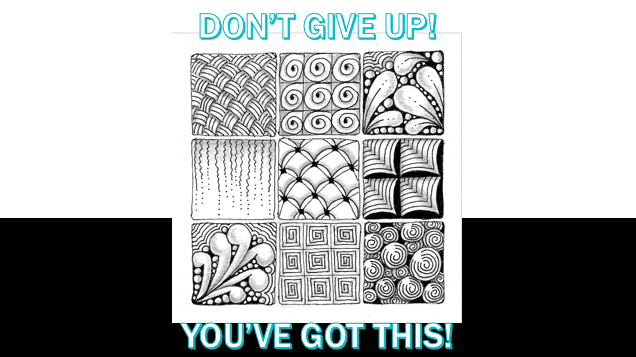
Okay, is it me, or has anyone else found the Zentangle form a bit… much?! Have you felt like your designs were too busy, too messy, too wordy, or just somehow subtly wrong? Don’t despair! We can make this work! Remember – it’s supposed to be fun. (I am telling MYSELF this, trust me.)

If you’re in need of a little design help, Strathmore has some great examples of patterns for the Zentangle. Can’t wait to see what you come up with Friday!