{socializing calling}

Finally Thursday! The weekend is calling!

And wouldn’t we like to answer with a nice lie-in, especially the week after the time change? But no – not this time. Socializing is on my horizon.

(Please click on the image to enlarge the actual images of calling cards I found online.) Despite the fact that some of the people I will be seeing I actually want to see, I still feel like it’s time to bring back the early 19th and 20th century social call. This, dear ones, did not take place on anything so gauche as a telephone, oh, no, this was a visit during visiting hours. One walked briskly through the neighborhood and one presented one’s calling card – as elegant a little piece of stationery as one could afford – to indicate that one was disposed to a moment of sociability, if the recipient had the time.

The recipient had the option of being at home or regrettably away, even if they were slouching in their peignoir eating chocolates or whatever people did instead people back then.

Okay, yes, laugh at me but I actually DO like people, within, you know, reason, and it might be nice to be more sociable if visits lasted, as they did back then, for a mere FIFTEEN MINUTES.

Think of it! Fifteen minutes. People went ALL the way to an acquaintance’s home, dressed to the nines, and…only stayed for a quarter of an hour. Honestly, I cannot imagine why there were wars back then – surely no one actually had to endure each other’s company long enough for any real dissent! (Hah.) And while the rules of socialization were labyrinthine and the Victorians were prisoners of the social dance as surely as they were the other trappings of the Beau Monde, it still seems like it would solve so many problems to have At Home days and fixed times when you were required to engage in socialization. I would have one day where I made lovely baked goods, sat down and read a book, and endured being interrupted all day, just to get it out of the way.

Once the telephone arrived, society veered in the direction of business cards for reasons I still don’t understand, and people now of course leave messages for each other on social media – to which my sporadic visits are something of a social obligation that I enact poorly as well. ::sigh:: As I gird up my social loins for the weekend, I think wistfully of Ye Olden Days when people (not of my class or race, but a girl can dream) could drop off a card and a gift to someone and perform a social nicety without actually ever going inside of anyone else’s house.

Honestly… making calls was the best, and calling cards were sometimes works of art. I don’t know why we don’t bring them back.

{pf: p7 hoping for a haibun}

Welcome to the last Poetry Friday Adventure for 2024!

Thank you so much for joining us for our 2024 Poetry Peeps Adventures. You have made our poetry year more fun and meaningful, and we thank you for taking part as we challenged and stretched our skill this year. Challenges for 2025 are forthcoming! Stay tuned for the announcement of the January challenge on January 15.


By the time you read this post, it will be well after Christmas, and on the way to the calendar (as opposed to Lunar) New Year. I hope that you have had a wonderful, restful, music-and-book filled time – with all the family and/or all the quiet you might desire. I hope that those of you who have lost friends and loved ones this year felt close to their memories and that those of you who have welcomed new family and loved ones enjoyed time with them. Happy Winter Holidays! Here’s to the invincible light that illuminates the darkness.


Did you know that the poet, Bashō, coined the word haibun? The form as it is today existed in Japan even before the seventeenth century when Bashō first brought it to the attention of the world. Mini lyric essays, sharing an array of sensory details, created a mood and highlighted a season through a poet’s observations, and then set the tone for haiku, which went even more deeply into the natural world. These aren’t really meant to be long poems, but to bring the reader deeper into the spirit of haiku, which Bashō felt was useful to create a sense of longing, empathy, or sadness. (Not a small order, that.)

From Process…

The Poetry Sisters were quiet busy this month as so many of us were, so we mostly worked on our poems alone. Liz and I got together for our live chat, and found that we hadn’t really thought ahead to what our topics might be. We talked about what we’d been doing, and both of us agreed that we might settle on writing about the Solstice, since it had been the day before. That seemed a reasonable topic. What surprised us was how, when we came together to discuss and read aloud our poem drafts, we had fallen into a synchronicity of thought. Not only had we used similar topical beginnings (though I’d crossed mine out), we ended on eerily similar final lines. How did we do that, after only speaking to each other for about twelve minutes before working solo for twenty minutes?? We determined that the Universe has been speaking – loudly. Somehow, poetry tuned us in to the right frequency.

…To Poetry

Here’s Liz’s poem – which I found to be stunning. And here’s the frequency wherein the rest of the Poetry Peeps came in – Laura’s poem is here. Mary Lee’s poem is here. Tricia’s poem is here. Jone’s poem is here. Michelle K – who is our Poetry Friday hostess today – adds both Hanukkah and a Haibun to the fun, at More Art 4 All. Thanks, Michelle! More Poetry Peeps may check in between now and New Year’s, so do check back for the full round-up.

While I was unaware of being particularly tuned-in to the Universe, I knew we had chosen the Haibun as a particularly short and low-rule poetic form that ALLEGEDLY would be easier to write. ALLEGEDLY. We think this every time we encounter a short form, and in all honesty, short forms are sometimes even harder to finagle. Haibun is a form which is meant to evoke mood and season, diminish the poet’s presence in the work, but avoid merely being a listing of what one sees in the natural world. It’s meant to make you FEEL something… All I could feel, however, was how dark it was, even though it was early afternoon. Some years more than others I struggle with the shades drawing down of the seasons – but this year, after November, especially, I have felt like the light has bled out of the world. Not to be overly dramatic – the world has been a dim and barren place before throughout history – but sometimes we’re wearier than other times. Sometimes, the grimness is a little harder to take. And I know I have so much to be thankful for! Because – among other things – every time the darkness comes, we’re reminded of the contrast of the light, are we not? If we never knew the shadow, we would never love the sun.

And with that, I realized that I had my whole prose bit, anyway.

The haiku – as I sat scribbling with a single candle lit – practically wrote itself.

AFTER NOVEMBER,
the autumn sky seems shoulder high, sheer rags of clouds stretched thin.
Like a breaker thrown, no matter that it’s 3PM, dark’s edge…falls. Sharp as a guillotine,
sudden as a cut-off scream. Darkness, and the moon is a pale coin for the ferryman,
as sky blue bleeds down black, and the longest night begins, burying the corpse of an endless year.

Scraped raw we stumble through the gloom, barking our shins, fumbling for a glimmer,
as a kind of heedless desperation steering our night-blind gaze. We strain towards… something.
Anything.
But, what if we’re looking in the wrong direction?
What if we are the dawn?

Light every candle
and breathing clouds of mist, rise
meet the dark singing


We have, some of us, settled into a trough. We are in a low place, as the light has ebbed, as the night is long, as the cold feels endless. Solutions, answers, and light seem in short supply. But – we can’t stay here. We won’t stay here. Every day, the light’s return comes closer. Every day, the dawning of the year comes nearer. Maybe we don’t have a plan yet. Maybe we feel – strongly – that we need one, but don’t know where to start. Even if we don’t move, we’ll come to the place where there’s another beginning. And another one. And another. I would rather meet the days ahead on my feet than be dragged into the stage lights, unprepared. I don’t know what I’m standing up to meet, but I’ll be on my feet – ready to move. And I know you will, too. So – take a breath. Tighten your shoelaces, and plant your feet. We’ve got things to do, and we’ve got this.

Happy New Year. You are well-loved.

{whither creativity}

Every year I find I’m knee-deep in spring or early summer, stuffed with farmer’s market produce and sunny days with no idea how or when I got there. I just look up, and boom – this is my life, squeezing to see if the plums are ripe, filling the bird feeder and their bath, watering, weeding (so. much. weeding), slicing up apples for the deep freeze or the dehydrator and doing The Garden Thing that takes up more of my brain every season. As water restrictions and an earlier and earlier growing season changes traditions, I’m attempting to actually notice things and be more present this time around. It, like everything else with me, is a work in progress.

In the last couple of years I’ve been REALLY privileged to have several projects sell, one after the other. I suddenly went from a pause of about two years between books to having books come out three autumns in a row. In a pandemic. And every book, I discover myself knee-deep in revision or writing in ways to expand and bright forward hidden theme, or listening to audio book artists to give my two cents to my editor, and look up and think – wait, how did I get here? Outside of Julianna Baggott’s seminar that I took with my writing group a few years ago (It’s called Efficient Creativity – and it was truly worth our time), I don’t look much at my process. I have Ideas, they become books, The End.

With a smaller world, fewer opportunities taken to just get out and observe humanity, and more time by myself, though, I’m noticing that my creativity has taken a hit. Not a huge one – but I’m conscious that with the increased monotony of my days that the Random Idea Generator has slowed. I’ve always enjoyed rainy, gray days as a time to cocoon in and dream, but the past two years seem to have provided a plethora of that, and this winter hasn’t been as fruitful as I’ve expected. I find myself floundering. Part of it is the inevitable Doing Anything fatigue with the autoimmune thing, but it’s also that I find myself dodging commitments and feeling enormous pressure when I have to do even small things. It’s funny because we all know we have ‘seasons of life’ blah-blah-blah, but I think I’m finally connecting the dots with the garden – if we don’t have seasons we fertilize, we have seasons where nothing grows.

So, it’s time for finding fertilizer.

It’s a strange place to be. I’m good at creating assignments for this sort of thing – poem idea generators or something – but for ways to generate creativity in general? I’m kind of stumped. I’m trying to make more time to color, daydream, look at clouds. I’m not convinced that won’t work, but it doesn’t seem it will work in a hurry. In the meantime, the trees are budding, and I’m trying to pay attention and be at home in this world. Right now, that has to be enough.

{fire season}

It’s been cold when I wake up for the last several nights, and we’ve had a brief rain – so this idea of autumn is not a fluke. “Fire season” is almost over.

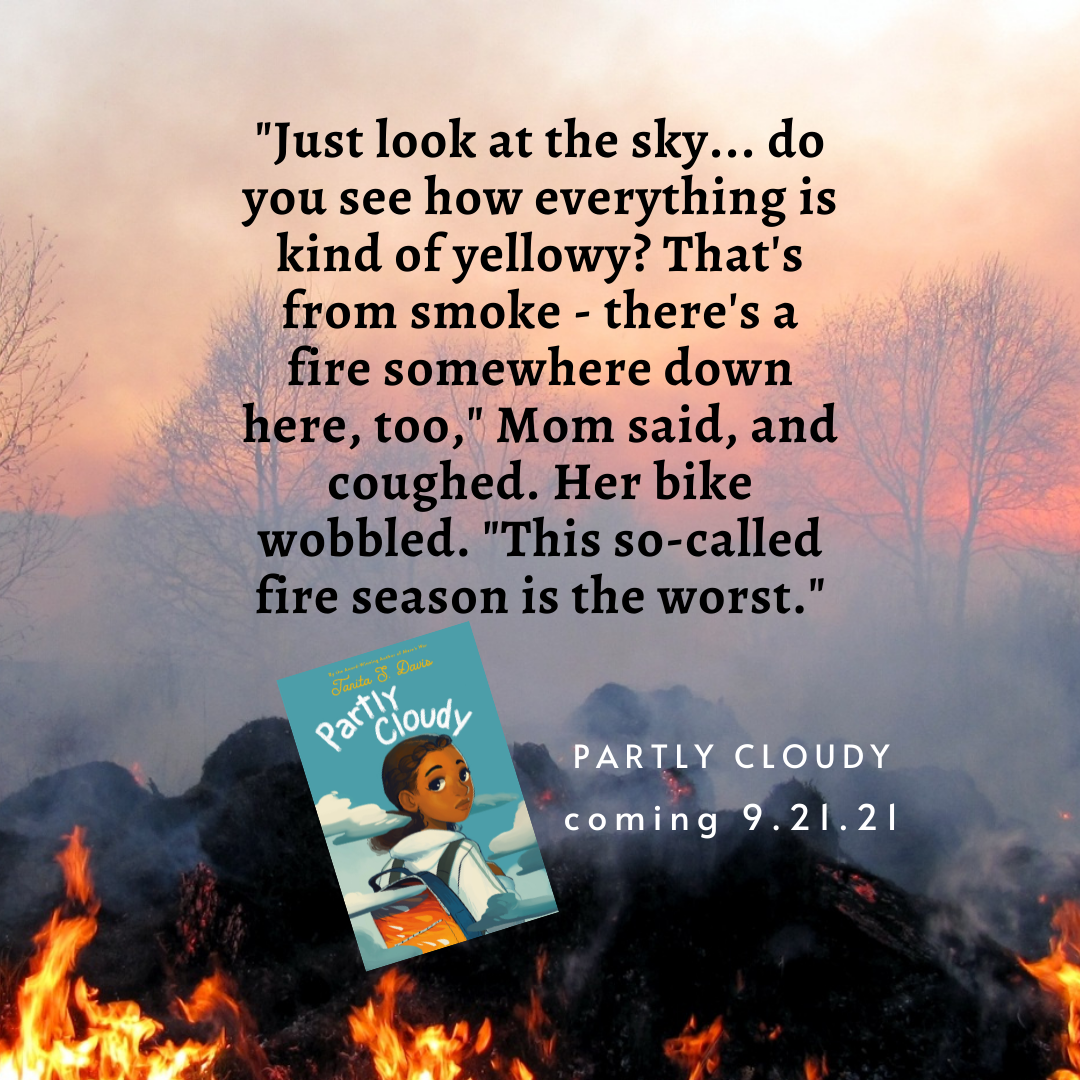
Like the mother in PARTLY CLOUDY, I used to hate the idea of a season for wildfires. Fire doesn’t seem like a natural part of the natural world – but it is. Fires, insects, and tree blights are part of a natural cycle of replenishment and growth in a forest. Lightning ignited wildfires used to simply burn, but now people go through a lot of effort to make sure that don’t … and without wildfires to scour the forest floor to thin out the deadfalls and competing vegetation, to encourage certain tree species seeds to fall and certain flowers to bloom, to break down and return certain nutrients to the soil, the forest isn’t as strong and healthy of an ecosystem as it needs to be.

Even knowing all of this, it’s hard not to hate the fires. The climate changes that create severe drought make them worse, and the fires are burning hotter and longer, creating a changed landscape and ecosystem as trees don’t have time to grow back before the next big blaze. On top of all the other changes we’re facing as a society, this comes with the additional trauma of people losing their homes. It isn’t within our natures not to fight for what is ours, and it’s going to take a lot to move past our ingrained responses to fire and loss. But every time this seems like a hopeless tangle, I remind myself that human beings are flexible and creative, and because we are also deeply stubborn creatures, we will figure out a way around this. We’ll relearn managing the forests and learn new ways of using water and our natural resources to everyone’s benefit. We will manage this. We don’t have any choice.

In the meantime, we welcome autumn – a chance to breathe and recover, and hopefully, to await the rain.

{a fable. a parable. or a true story.}

This is a 2017 post from my family blog. It seemed a fitting repost.

Oakland Museum of California 23

It was the Mozart solo she’d had her heart set on. A simple kyrie, appropriate for ten-year-olds, but the rising descant over the chorus made her feel unnameable things, and she wanted to sing it with all her heart.

In parochial schools in those days, there wasn’t much else to do but participate in the arts. There was no prom king or queen, no dances, no competitive sports. Instead, the boys took piano, and the girls played the flute – or, at least it seemed like everyone in her grade did. Twenty-some girls on flutes, and not a one of them with the courage to do something original, like learn the French horn. But, it was what it was – middle school in the 80’s.

The Kyrie was the first real classical music they’d ever done, so out of the mundane realm of kids’ songs they’d done before. Everyone was aware that they were in the presence of Grown-up Music, and acted accordingly. Desire to show themselves as grown up – and sing that descant – was intense. Her choir teacher knew she wanted that solo, knew she was a soprano who could consistently hit the right notes, but, weighing his choice by scales she could not read said, “Well, sweetie, we’ll give this solo to Sheley. We’ll save a nice, juicy Spiritual for you.”

But, she didn’t want the Spiritual. She wanted the Mozart.

♦ ♦ ♦

In college, she was to remember this moment when visiting home on a weekend to sing with an ensemble. The rehearsal was early – the music was lackluster, and the director was getting desperate as the singers’ yawns increased.

“Sing it more black,” the director urged her, finally finding both scapegoat and fix.

She stopped singing altogether, bewildered. “What? What does that even mean?”

“Well… you know,” the director gestured vaguely. “More black.”

She vanished behind a brittle smile. “You mean, with more of a swing? With more of a backbeat? With more syncopation? What?”

She kept her voice even, because she had learned it did no good to scream.

♦ ♦ ♦

Fast forward to a progressive party in San Francisco, where, armed with cameras, teams of teens and twentysomethings were on a scavenger hunt. One of the requirements was for participants to take a picture of themselves on or near a stage. Half the group pressed to simply go to Max’s Opera Cafe and take a group shot with a singing waiter. Another vocal male found a jazz bar on one of the piers, and insisted she go inside, take the mic, and ‘scat.’

“Scat?” she echoed, for a moment setting aside the breath-stealing idiocy and horror of making an unsolicited performance in a private club.

“Yeah, scat,” he said, “Like Ella Fitzgerald. You know…scat!”

This time, embarrassment came mingled with humiliation, as the entire group began to wheedle. “No, you guys. Really…no.”

♦ ♦ ♦

Fast forward even further, to singing with a quartet, in which the music director and the pastor – both white males – donned sunglasses and capered to the spiritual style hymn in the style of the Blues Brothers. Fleeing during a break, she called her sisters, asking them what to do, how to act. They stood and listened while she laughed, tears streaming, down a face so hot they evaporated. “But, why am I embarrassed?” she kept asking. “They’re behaving like jackasses, and I’m embarrassed? I feel like they’re making fun of me, and it’s humiliating, but why am I the one who is feeling …stupid?
Oakland Museum of California 118

The shame didn’t make sense, but by then she had learned that few things did, when microaggressions – casual racism – was added to the mix. Musically, it meant that people assumed she wanted – always – to sing gospel music, even though she did other music well. It meant that people assumed she could break into Janet Jackson improvised choreography, that she could imitate the vocal rhythms of Bobby McFerrin on a whim. It meant that instead of who was in front of them, someone whose eclectic tastes ran from the weird to the classical with many stops in between, all they saw was myriad aspects of what – The Other combined into a single person, on whom they could glue myriad of labels, none of which were hers.

It was exhausting.

♦ ♦ ♦

We fast forward one last time, but our time machine is about out of steam. Now see it has limped to a stop at chamber rehearsal, where a gleeful last-minute addition means another entry into the program, another song to be learned. “Oh, it’ll be quick,” the director encourages the panicky singers. “It’s just two parts, in Swahili. Uh, just read the pronunciation as is — I’m sure it’ll be fine.”

“It’ll be fine.” A startling phrase, after the lengthy lectures about pronouncing German as to not “sound like hillbillies.” Unexpected, after the long-winded arguments about “church Latin” vs. classical Latin pronunciations. Jarring, after the many long lectures about pronunciation of Hebrew consonants vs. Yiddish, of Argentinian Spanish vs. Mexican. Shocking, that an entire language is mischaracterized (the people are Swahili; the language, Kiswahili) and shrugged off as “nothing to worry about.” As the translation was cooed over, in ways the translations of European languages were not (“Ooh, how sweet!”), she found herself… conflicted.

The composer’s name was American, and a thorough search uncovered no African translator. Deeper research revealed that the composer’s translation didn’t match a word-for-word translation of Kiswahili words, that the tune was from a Nigerian harvest song. There was no citation as to where the words came from, no African educator or musician listed. She feared that they were singing an imaginary lullaby, with imaginary text, the rocking 6/4 tempo convenient but false. This was music selected by an intentional community made up of good people, people whose stated goals were to bring parity, inclusiveness, and justice to the world – yet they easily diminuitized the importance of a tribal people and its language as “cute,” but ultimately too insignificant to merit concern or further study.

Perhaps, as was implied, it wasn’t that important, in a world where wrongs of greater significance loomed large. Perhaps it was merely good enough for an American winter festival – not exactly religious, Christmas, not exactly non-religious, Solstice. Not exactly meaningless… and not exactly meaningful.

Or, perhaps it was as infuriating and confusing as everything else she had ever encountered.


Edited to Add: PS – you will be gratified to know that speaking up helped a little. The director phoned a friend in Kenya, determined that the text is “maybe Nigerian” and not at all Kiswahili, and promised to do due diligence to find out what he could, and add his findings – or lack of such – to the program notes. Intentional communities such as choirs and churches – and libraries, schools, and other places – must be intersectional in their inclusivity, thinking through the many ways we as people can belong to various communities, and doing our best to come to each of them with thoughtfulness, respect and appreciation, thinking not just of our individual needs, but how to serve a whole, which is the sum of its parts. As has become so readily apparent, it is tricky, but if we draw each other back to the road when we wander off, it can be done. It must be.

{#winterlight: no such thing as lost}

I’m so glad many of us enjoyed the very succinct and on-topic poem yesterday. I was glad I’d come across it. Amos Russel Wells is actually a new-to-me poet as well; he was a professor of Greek and geology at for the first part of his professional career, and ended it as editor of a religious magazine. He was also a fairly dedicated Sunday School teacher, and apparently loved children. His book, Rollicking Rhymes for Youngsters, first published in 1902, is where today’s poem comes from. You can see the Sunday School teacher/hymn writer in this verse.

“Lost” Opportunities

Many words are lightly tossed,
   Only cowards mind them,
Opportunities are “lost” –
   Rouse yourself, and find them!

Some are lost for aye and aye,
   But the most are hiding –
*Cars the switch has found are they
   Take them from the siding!*

Past is past, the chance is gone? –
   Up, and follow after!
Many a noble race is run
   Despite sneers and laughter.

Opportunities are “lost”?
   Aren’t there legs behind them?
Boldly run, nor count the cost,
   Speed until you find them!

*”Cars the switch has lost” refers to train cars that are shunted to a different track when the switch is thrown.


This is a sort of bracing hope that is really old-fashioned and brought to you by people who lived through wars and upheaval and didn’t have time for self-pity. No such thing as opportunities “lost,” to them… just a need to be up and doing. Here’s to that bracing, gingery, spit and vinegar.

{#winterlight: country of freedom}

I’ve run out of words.

Fortunately, there’s poetry.

Poetry Friday today is hosted by Sylvia Vardell at Poetry for Children. Thank you, Sylvia.

Country of Freedom

Country of freedom, be free in thy heart:
Free from the shackles of poisoning pride,
Free from the liar’s contemptible art,
Free from allurements that tempt thee aside,
Free from the crafty and treacherous guide,
Free from the ravening greed of the mart,
Free from the snares that in opulence hide, —
Country of freedom be free in thy heart.

— Amos Russel Wells (1863-1933)

{#winterlight: irony}

I found it just a bit ironic that I blogged yesterday about anger before I got on social media or read the paper, or heard anything about the attempted coup at the nation’s Capitol. After hearing nineteen million politicians blurt, “This isn’t who we are!” I feel like it’s a good day to resurrect a poem I wrote in 2017… after the first nineteen million times I heard politicians say this phrase, in defense of this indefensible presidency. Enjoy.

“…this is. And thou art. There is no safety. There is no end. The word must be heard in silence. There must be darkness to see the stars. The dance is always danced above the hollow place, above the terrible abyss.” – Ursula K. LeGuin, THE FARTHEST SHORE, Ch. 8

“you may experience feelings of momentary discomfort”

“This is not who we are,” good souls profess.
“This brief discomfort heralds changing views.”
The dream, America, is dispossessed.

And politicians wallow in the mess
Eyes rolling wild, while looking for their cues —
“This is not who we are.” Good souls profess

To understand the needs of the oppressed,
Who are not newly pressured, but eschew
The “dream America.” We, dispossessed.

“Just rhetoric and chatter,” pundits stress.
“A bigot’s dreams could never here come true.”
This IS. Not who we are? Good souls, profess!

Resist. Support, with dogged faithfulness
Those who, with courage march. We must push through
the dream and wake our country, in distress.

Distracted by your grieving? Reassess
Comfort you proffered those who are not you…
This. Is. Not. Who. We. Are. Good souls, protect
The dreamer, wakening, and dispossessed.