{#winterlight: rage epiphany }

I’ve blogged before about how many times girls are taught that anger is “being ugly,” thus setting anger as antithetical to being somehow properly attractive/womanly or whatnot. It’s always so bizarre when you don’t think you’ve been raised with any slant in particular, and then hear yourself prevaricating when someone asks you if you’re angry. “No, I’m not mad, I’m just upset. I’m a little vexed, yes. I’m frustrated. I’m aggravated.” Yeah. I’m also pretty torqued, ticked off, peeved, furious and properly raging as well – but it’s not nice to say so, apparently.

It’s always a little breath-taking to realize that you are mad about something when it’s deep-seated, private, almost even from yourself, and catches you off-guard. You stumble out of a conversation, panting like a marathon-runner, and wonder, bewildered, “Where did all this rage come from?”

I suspect the rage is a more common epiphany than one might think.

Dolomites D 039

Who Said It Was Simple

There are so many roots to the tree of anger
that sometimes the branches shatter
before they bear.

Sitting in Nedicks
the women rally before they march
discussing the problematic girls
they hire to make them free.
An almost white counterman passes
a waiting brother to serve them first
and the ladies neither notice nor reject
the slighter pleasures of their slavery.
But I who am bound by my mirror
as well as my bed
see causes in color
as well as sex

and sit here wondering
which me will survive
all these liberations.

– Audre Lourde


Real life is distracting, contradictory, full of issues of competing importance, and thoroughly messy. This messy, conflicting ball of emotions is also worth examination, if one is to live well.

Good luck with that.
{#winterlight: my morning light}

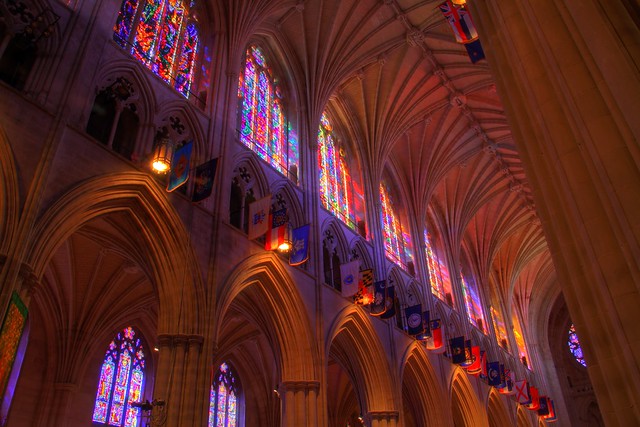
Washington D.C. 052 HDR

I love the National Cathedral, though I’ve only been there once. I’ve spent much more times in the cathedrals of Europe – and its small parish churches, and its village halls. I love old church architecture and interesting new twists on it. And it’s all equally, genuinely lovely first thing in the morning. That’s one of the best things – to be on a trip somewhere and to get up before the traffic snarls and the commuters are hurrying with their coffee, and just… look up. Look around. And see how the light changes things.

Morning

Why do we bother with the rest of the day,
the swale of the afternoon,
the sudden dip into evening,

then night with his notorious perfumes,
his many-pointed stars?

This is the best—
throwing off the light covers,
feet on the cold floor,
and buzzing around the house on espresso—

Read the rest here.

Good morning! May the light of the day put you in the proper mood to begin anew.

{#winterlight: shining on}

Last Thursday, I stood in a driveway – properly masked and distanced – with my mother and a couple of sisters, my brother, and nephews for the first time since March of last year. We all have different distancing protocols and needs, and it’s safest for us to be away from each other, or outside for fifteen or twenty minutes – but it was lovely to see them not on a screen. And it was still so hard not to hug… which is one of the other reasons we don’t meet often. Somehow, I ended up in a family of huggers.

I’d forgotten how fast boy-children grow, and was slightly horrified to see my youngest nephew the same height as his mother. I’d forgotten my mother’s penchant for wearing Ugg-adjacent boots, and laughed at the furry Muppet-style vibe she was giving. I’d forgotten how long my sister was growing out her hair – and that my youngest sister had stopped dyeing hers for a minute. It’s weird, what you forget when you’re not seeing each other every week. But, what we remember, of course, is obvious.

Sun-Down Shining

I forget these things –
   where a trail begins,
   where a trail ends.

I forget these things –
   white of dawn,
   and sun-going down.

I forget these things –
   hunger for piki,
   thirst for the springs ….

But I forget not you,
   O beloved,
   with the night.

– William Haskell Simpson

{#winterlight: poetry friday, early in the year}

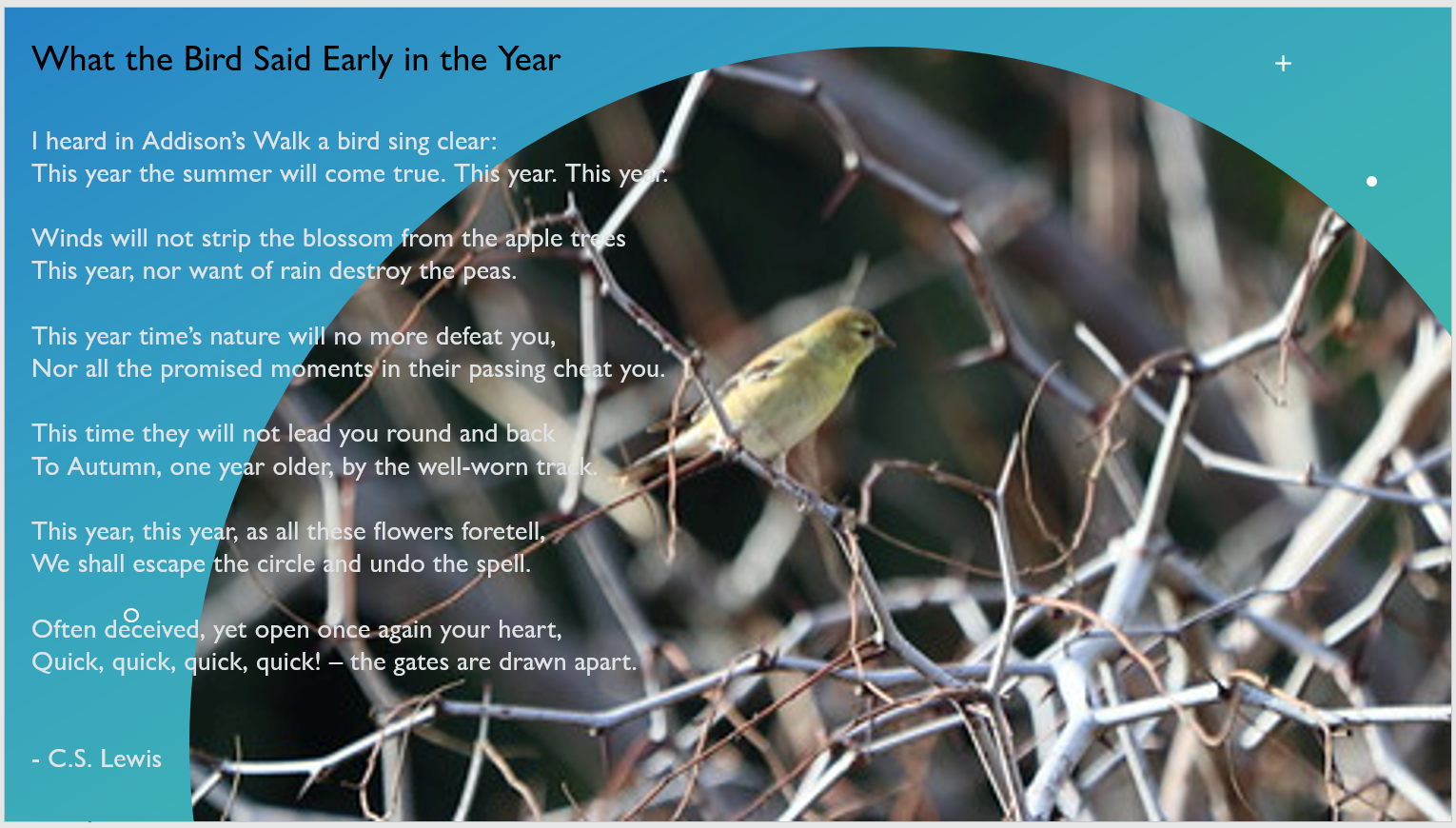
This is going to be a year absolutely packed with literature.

It’s going to be a year of taking risks with writing, including no longer dipping a toe into fantasy and fairy tales, but diving in, and also… taking my poetry writing seriously. I’m not fond of calling myself a writer, much less a poet… somehow the idea of A Poet seems much more deep and knowledgeable and serious than my iamb-counting, form-conforming, rule-bound, doggerel scribbling self. How do people become poets, anyway? In the same way that we become writers – by doing the thing, I’m told. So, I will be doing the thing, taking serious study with a textbook and instructors and all, and with scheduled practice time.

It’s… a little terrifying, honestly. But, it’s also very hopeful and anticipatory – much like the 365 neat, blank squares marching importantly through our calendars. So many things cluster close to our imaginations, tugging on our fine hairs, breathing into our ears, “Maybe this year! Maybe this year!”

Well? Maybe it is all going to happen this year. But, how will we find out if we don’t start?

Poetry Friday is hosted by Ruth, all the way from Haiti, at There Is No Such Thing As A God-Forsaken Town. Have a lovely, restful weekend – because Monday’s the day we jump in and make it all happen!

{#winterlight: exercises}

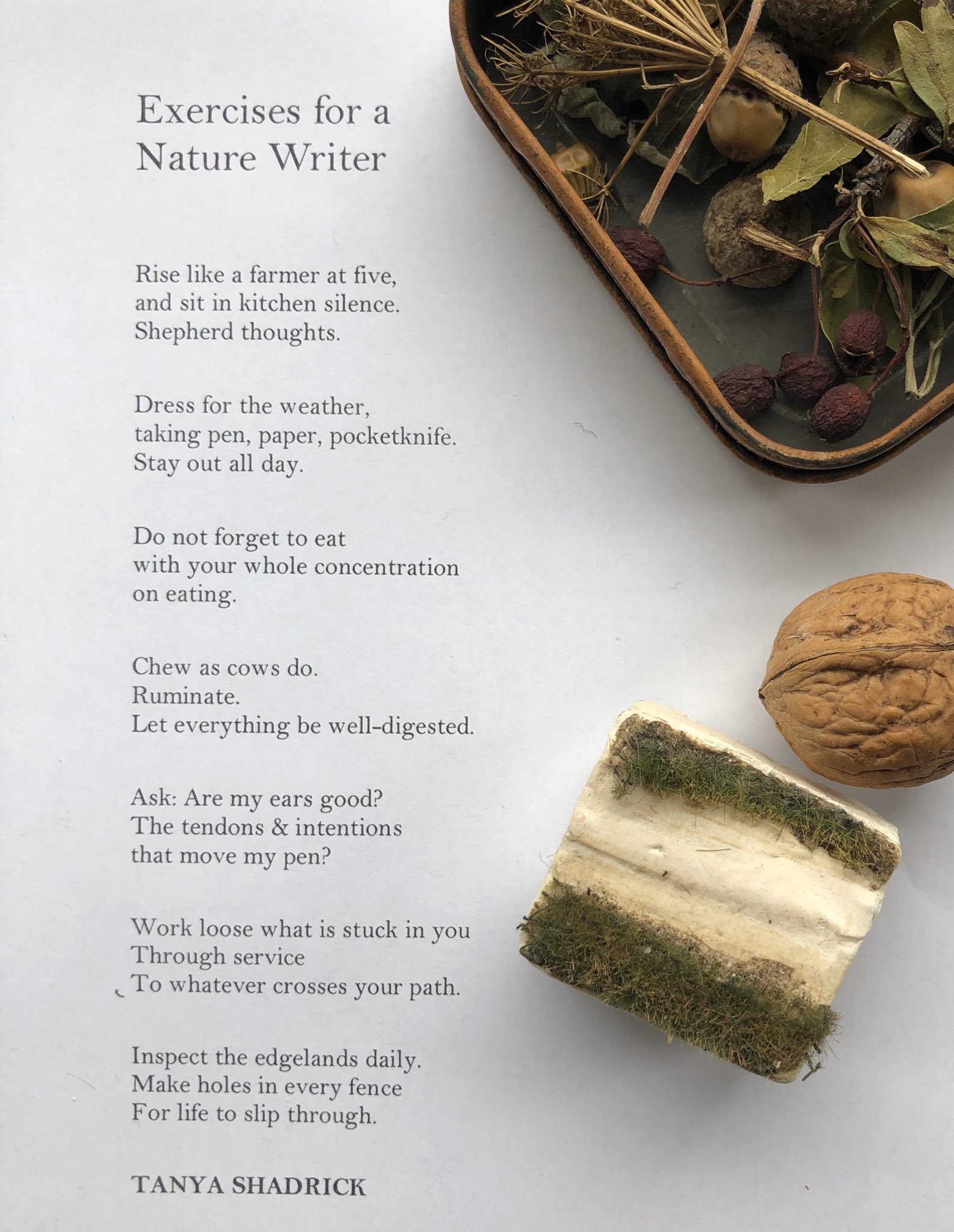
I know that the title to this poem specifies that these are exercises for a nature writer, but I think they’re worth being revisited in this liminal space at the New Year. Dress for the weather. Ruminate. Hold your boundaries and walk your fence lines. Work through what is troubling you through serving something else. Make space for life to slip through.

I don’t bother with many things – making resolutions being one of them, as it tends to be about making myself “better” based on a set of external guidelines rather than the interior work of self-investment which pays dividends that the world cannot always see. Yes, one could always make better habits, take up decluttering, eat more veg, or lose a pound or two, perhaps, but I categorically refuse to allow that to be your business when it’s my own, and certainly not during the month of January when people demanding others change are most obstreperous and vocal. I believe it a useful exercise to anticipate growth – not to pretzel oneself into growing into the expectations of others’ – so I will set my mind on that tomorrow, perhaps. However you complete this page of the calendar, I hope you do it warmly ensconced and centered in your own heart. Happy New Year.

{#winterlight: walking away}

I have an older friend whose somewhat disorganized chaos of an orderly life by turns astounds and horrifies me. She is on too many committees, does too much volunteering, and works too many hours – and puts up with too much. In this year of abrupt reversals and sudden losses, what I have learned at least faintly is how ludicrous it is to keep on living that way, when so much is lost so soon. I want to tell her “Choose what you love, and walk away from the rest!”, but the things we do are nine-tenths habit, and one-tenth cement, and change is hard. So, I gentle my words, and bite my tongue. But this poem made me think of her – and all of us – walking in circles this year. May this coming year we wend a path through the year, out walking only regrets and hurrying toward what makes us shine.

Stirling 12

Heaven’s Gate

In her nineties and afraid
of weather and of falling if
she wandered far outside her door,
my mother took to strolling in
the house. Around and round she’d go,
stalking into corners, backtrack,
then turn and speed down hallway, stop
almost at doorways, skirt a table,
march up to the kitchen sink and
wheel to left, then swing into
the bathroom, almost stumble on
a carpet there. She must have walked
a hundred miles or more among
her furniture and family pics,
mementos of her late husband.
Exercising heart and limb,
outwalking stroke, attack, she strode,
not restless like a lion in zoo,
but with a purpose and a gait,
and kept her eyes on heaven’s gate.

– Robert Morgan

{#winterlight: closer than you think}

There’s something about the end of a year that makes me think… about all manner of things. I know people who have made it habit and tradition to do a major clearing out – of clothing, of photographs and possessions, and I think it’s also useful to do a major clearing out of the mind. We always have two or three opportunities per year – there’s the Lunar New Year, there’s Rosh Hashanah, for some, there’s Shab-e-Barat, or National Day of Forgiveness, which seems as good a day as any to begin again… but as with many things, renewals and new beginnings first require distance.

Distance

The world is large, when its weary leagues two loving hearts divide;

But the world is small, when when your enemy is loose on the other side.

– John Boyle O’Reilly

Kelvingrove Park 159

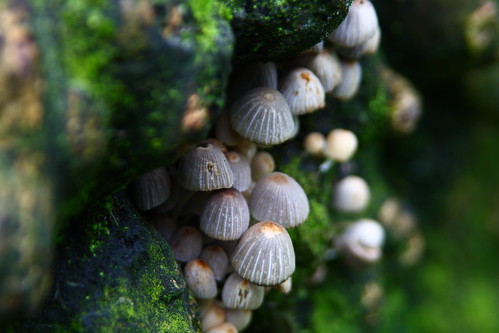
The mushrooms in the photo are so teensy-tiny that it took a high-powered lens to capture them… and you can’t really tell, can you? When we’ve stepped away from something, it’s sometimes easier to see – and other times, a lot harder. I’m intrigued by how such small things can be mistaken for something large. I’m pretty sure there’s some kind of object lesson in that, but… I’ll just leave you with the pretty picture instead of belaboring it, hm?

{#winterlight: liminal}

I’m already tired of people’s predictions.

Days into the annual interstice of just-finished and not-yet, and already the air is thick with the blether of people telling us how next year will be.

As they, too, were surprised by incidents in this current year, I am disinclined to take much heed of them.

This does not, however, have much effect on their speaking.

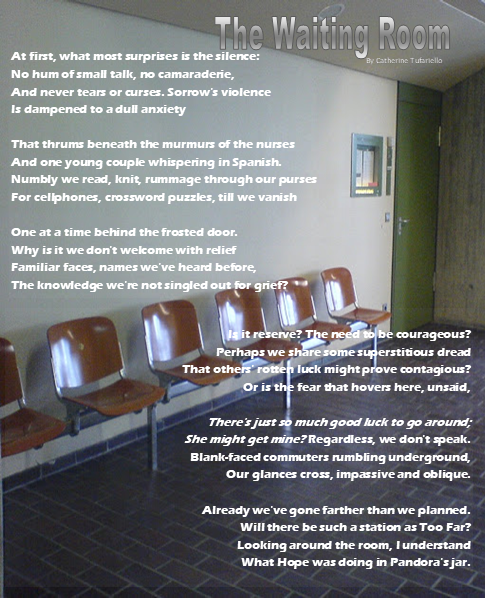
We spend a lot of time waiting, in life. Airports, post office, doctor’s offices, only the vaguest idea of what will come next, of what more will be required of us. This week between the last holiday of one year and the first of the next always puts me in mind of the labyrinthine waiting rooms in medical centers, moving between a series of larger and smaller waiting rooms down astonishingly similar beige-and-green hallways. It’s always a relief to just get out of the whole building.

Of course, it always occurs to me later that maybe the waiting bit isn’t the worst part…

Oddly, at the time of year when we’re most supposed to be keyed in to other people, Christmas and New Year’s people tend to become super insular… which is why it’s a lonely time for many. Getting all of these jolly cards and holiday posts on social media, it might be difficult to remember that there are people waiting for an answer, waiting to feel better, waiting to see if their test comes back clear… we need that little bit of hope in Pandora’s jar.

{#winterlight: still discovering}

I had so much fun speculating on the truthiness of history the other day, so perhaps we can apply that brush to the Christian tale of The Birth, and remove the soft-focus and the endearing, talking animals today? We have to eliminate, too, the preconception that the stable was a terrible, filthy cave and open our minds to the fact that other cultures live closer to their animals than those in suburbia. In other countries, it’s perfectly reasonable that the stable is on the first floor of a home. So, not so poor and wretched – certainly not ideal, no, but not quite so “away” in a manger as all of that.

Meanwhile, the wise men wanted to go home…

Oh, to discover how to be human now… isn’t that #lifegoals.


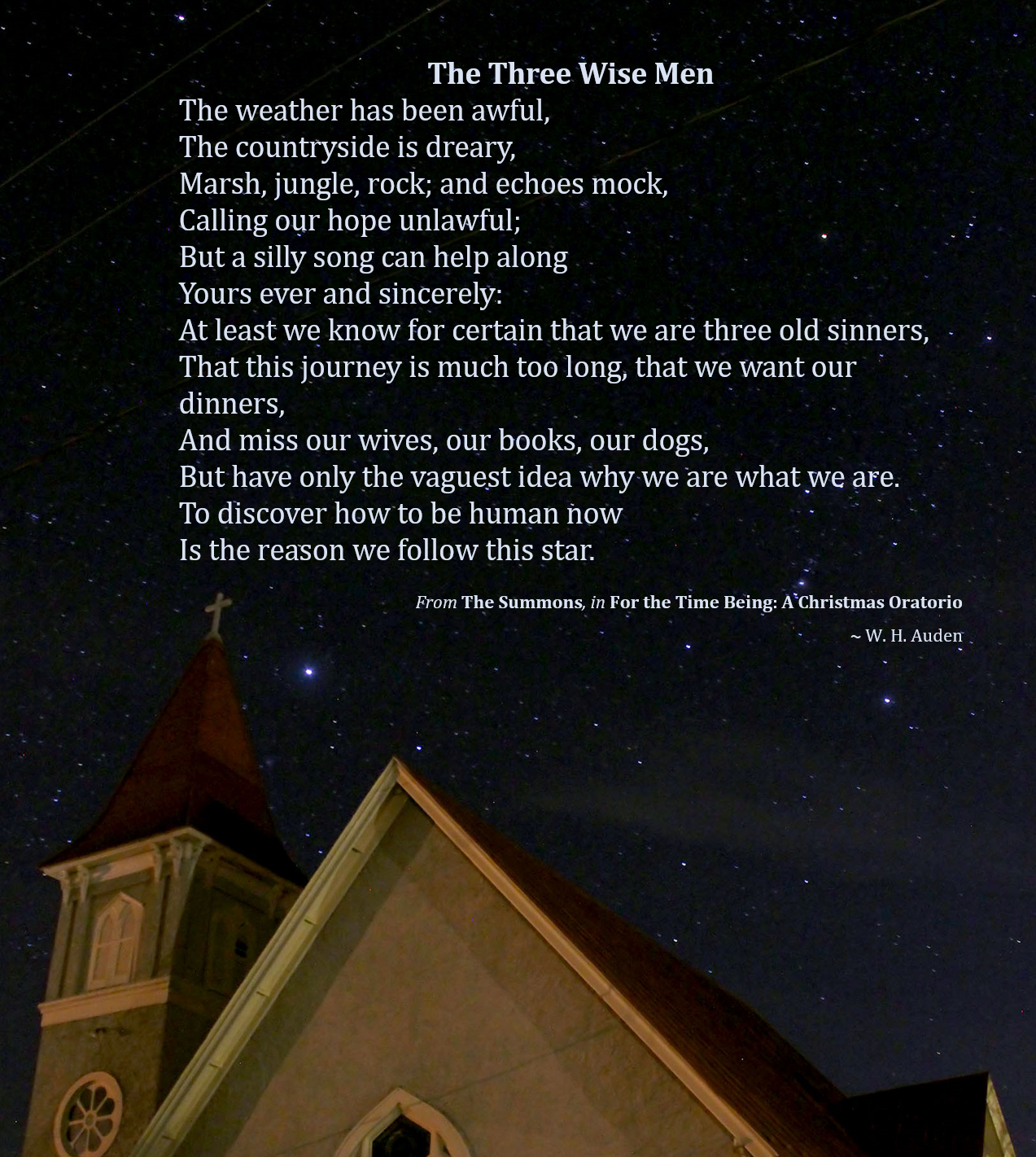
For The Time Being: A Christmas Oratorio was written by W.H. Auden in 1942 – after the British entry into World War II. It isn’t one most people have heard, except for in excerpts, because it’s still under copyright AND because it’s…1500 lines long, or 52 pages. (For comparison: Shakespeare’s Macbeth is about 2100 lines long. Yes. Let the mind boggle.) If you’d like to read the whole, it’s found in his Collected Poems. If you’d like to read a bigger chunk, check this out.

{#winterlight: by firelight}

The American Chemical Society in 2018 filmed a YouTube video of four hours of a fire burning, with all the lovely attendant sounds of popping and hissing wood, snapping sparks… and overlaid it with the ethereal looking, ephemerally beautiful chemical equations that make up fire, gingerbread, Santa’s suit, reindeer, whisky, chocolate, …and Xanax, I think. This year, the Monterrey Bay Aquarium has a lovely video of fiery colored jellyfish… against a soundtrack of popping, hissing fire. It is not… quite… the same. Himself calls it Sizzling Sealife, which is both horrifyingly amusing and right on the money.

…which kind of brings me to today’s poem, which is one of my all-time favorites, and which I discovered during a college English exam. I had a professor whose joy it was to introduce to us a poem during an exam and require us to write at minimum a five-paragraph in-class essay in response. For many reasons, each time I read it, I am struck anew by the aching beauty of this poem.

Those Winter Sundays

Sundays too my father got up early
and put his clothes on in the blueblack cold,
then with cracked hands that ached
from labor in the weekday weather made
banked fires blaze. No one ever thanked him.

I’d wake and hear the cold splintering, breaking.
When the rooms were warm, he’d call,
and slowly I would rise and dress,
fearing the chronic angers of that house,

Speaking indifferently to him,
who had driven out the cold
and polished my good shoes as well.
What did I know, what did I know
of love’s austere and lonely offices?
“Those Winter Sundays” from Collected Poems of Robert Hayden, ©1966.


I learned years later that Robert Haydn was Black, and that twinged my heart even harder. Generations of men, working in silence, putting out the fires that threaten and starting the ones that warm. Misunderstood, misanthropic, perhaps, inarticulate and unstinting. Men like my Dad. Keep warm the fires of your hearth – the hearths of your family, chosen or born. Take no love for granted.