{pf: the poetry peeps peruse potluck}

Welcome to another Poetry Friday Adventure!


Poetry Peeps! You’re invited to our poetry challenge for the month of JUNE.

Here’s the scoop: we’re greeting the opening act of summer with a triptych. Tabatha Yeatts-Lonske introduced West Coast poet and essayist Louise Ireland’s three-act August Triptych to me a long while back, and commented that she would use it as a mentor text someday. While I don’t know if Tab ever got there (probably yes), our someday is our today! Louise Ireland wrote from the trailing edge of summer’s wane, while we’ll compose our own triptych on the theme of diving into to the waxing of the season – in whatever way moves us. Are you in? Good! You’ll have the month to craft your creation and share it June 26th in a blog post and/or on social media with the tag #PoetryPals. See you then.


From Process…

Welcome to the potluck! For me, potlucks are ever and always church-y, bringing to mind the people and things which helped shape my primary foundations for ethics and behavior, for good or for ill. One of those church people was a four-foot-nothing Scottish woman of indeterminate age with a bubble of brown curls, spiky faux lashes, pearled pink nail polish, a tiny lisp, and a huge heart. Sandy McMahon helped out in the 4-5 year old children’s ministry department, keeping us mannerly and handing us our papers after class was over. She also kept her hard-sided purse full of treats. And, every week at potluck, she brought a molded salad – always red Jello, sometimes with fruit cocktail, sometimes with pineapple rings and sophisticated piped mayonnaise. It was her go-to offering.

Alas, I am unfond of the squidge of Jello. I loathe the cloy of mayonnaise. Then there was the ginger ale and the fruit cocktail with the (peeled!!!!) grapes in… And let’s not even go into the Cool Whip. 🤢 On good days there were mandarins. On okay days, my serving did not include one grape. On the very worst days, there were strawberries, cooked to slimy limpness by hot Jello. That texture sets my teeth on edge even in memory. But I ate everything my mother put on my plate – including that jello salad – Every. Single. Week. For one, food was to be eaten, not looked at, played with, poked at, pouted over: eaten; thus sayeth the Mother. For another thing, after potluck, Miss Sandy gave out teensy boxes of raisins to all the five-and-under crowd in the clean plate club (a dried fruit digestif, I guess). So we feral little heathens ate up, then swarmed her, hands out, all demand and barely leashed impatience. We slammed those raisins down, then walked around blowing into the boxes, making high-pitched whistling squeaks and annoying everyone. Good times.

…To Poetry

But, come to the table! Your fellow Peeps are gathering, and the Poetry Sisters are opening bags and coolers – Laura dropped by to bless the table with a blossoms before whisking away. Cousin Mary Lee – today’s Poetry Friday hostess (Thank you, Mary Lee!) – brought a gorgeous bowl of beans. As always, Sara’s chips go with everything. Tricia’s brought her Mom’s dish to share, and Liz brought hers on a vintage plate. Cathy Stenquist brought fruit salad…plus, and Michelle K. brought a golden shovel-full of goodies, and Denise brought a basket. For the whole Poetry Friday roundup, don’t forget to circle back to Mary Lee’s post, where there’s even sides and postprandial activities! More Peeps bearing delish dishes and good gossip may show up throughout the weekend, so don’t forget to check back to see more potluck poetry links here.


Obviously, Miss Sandy deserves a poem. Which I will write. Someday. Until then, there is potluck food poetry. One rhymed randomly, the other ridiculous-but-ruly, because Padraig asked for pantoums this week, and that form was on my mind. In the random poem I took great pleasure in seeing in my mind’s eye the picture of me, age two, at church – patent leather shoes and red cabled tights, sitting primly, legs crossed… and then imagining the sticky, shouting, feral wee beastie I know lived insides – within every child (and every human, if we’re being fair). I amused myself with both poems – sometimes it’s just plain fun to write about something tiny pet peeves that are less than very minor blips in terms of the universe. Jello. Potluck. Behaving. All things which can easily be endured.
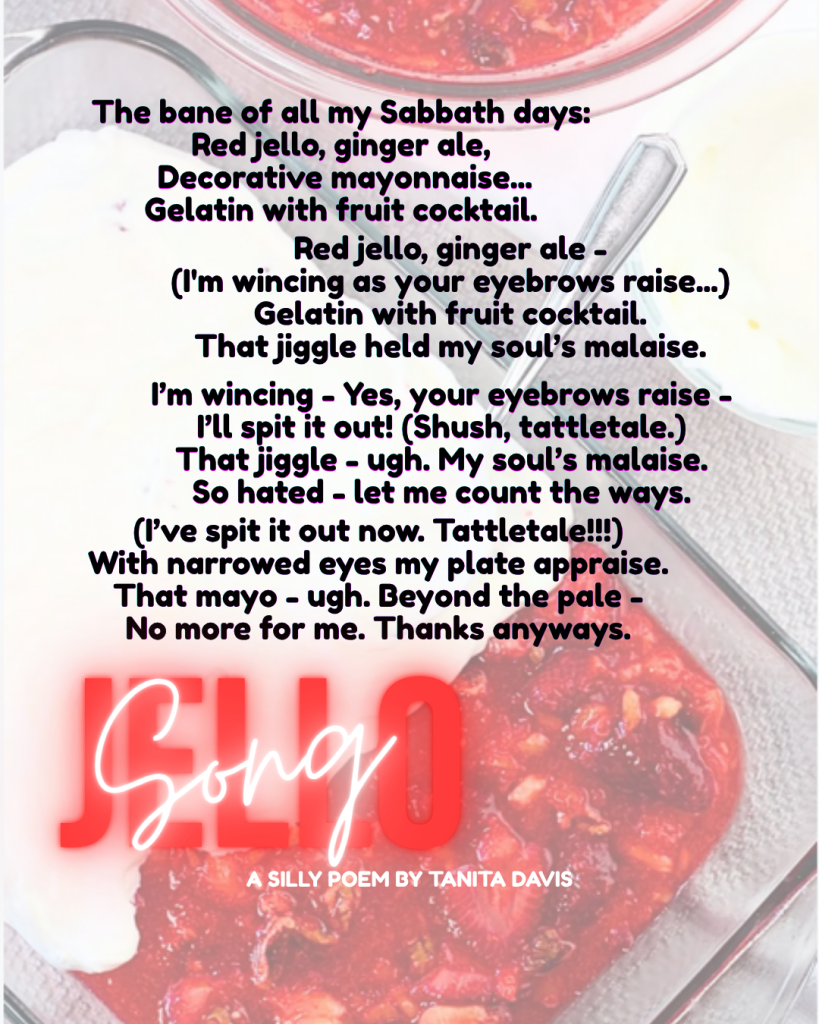
Jello Song

~ A Very Silly Poem Draft ~
The bane of all my Sabbath days:
Red jello, ginger ale,
Decorative mayonnaise…
Gelatin with fruit cocktail.

Red jello, ginger ale –
(I’m wincing as your eyebrows raise…)
Gelatin with fruit cocktail.
That jiggle held my soul’s malaise.

I’m wincing – Yes, your eyebrows raise –
I’ll spit it out! (Shush, tattletale.)
That jiggle – ugh. My soul’s malaise.
So hated – let me count the ways.

(I’ve spit it out now. Tattletale!!!)
With narrowed eyes my plate appraise.
That mayo – ugh. Beyond the pale –
No more for me. Thanks anyways.

And of course, the raisins have to have their moment:
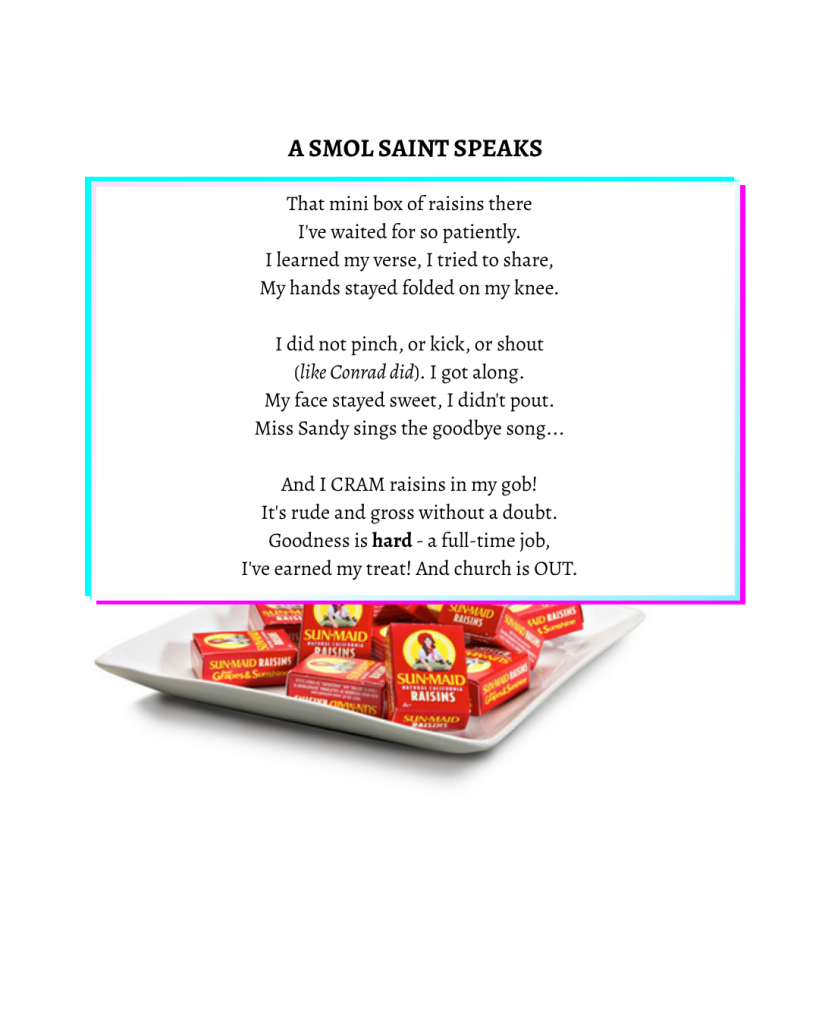
A Smol Saint Speaks

That mini box of raisins there
I’ve waited for so patiently.
I learned my verse, I tried to share,
My hands stayed folded on my knee.

I did not pinch, or kick, or shout
(like Conrad did). I got along.
My face stayed sweet, I didn’t pout.
Miss Sandy sings the goodbye song…

And I CRAM raisins in my gob!
It’s rude and gross without a doubt.
Goodness is hard – a full-time job,
I’ve earned my treat! And church is OUT.


As I grew, Miss Sandy stayed around, though busy with a new crop of Very Smols to look after, so in the natural manner of things, I forgot her a bit. Though somehow, in a church with 600 to 800 members on the books and two services, she was still paying attention to her former charges. When I turned twelve, she presented me with a beautifully tissue-wrapped satiny peignoir from the 60’s – probably one of hers. It was the swankiest, fanciest sugary pink nylon and lace confection of a babydoll nightgown to ever be beloved by a young girl’s heart, and I simply SWOOPED around the house in that thing like I was on Dynasty. I LOVED that thing, and I cannot imagine what prompted her to gift me with that – except somehow she saw beyond the awkward sullenness and general geekery to someone whose secret longing was for pretty things. Looking back as an adult, this is even more amazing – what a brave thing to do, for a snotty tween who might have been awful to her. What a way to celebrate a growing-up moment with someone who wasn’t sure she/it was anything to celebrate (jury’s still out). May we all have a Miss Sandy in our lives when we need one – a person for whom we will eat dubiously textured things because she sees us and loves us. And, if we don’t HAVE a Miss Sandy, the Universe extends an invitation: Be One. Be the Miss Sandy you want to see in the world.

Until next time friends, remember you are so, so loved.

Happy Weekend🌷
{constant reader reads: not only anne}

Dear TBR,

When nine-year-old me first stumbled on a 1930’s edition of ANNE OF GREEN GABLES in a pile of discarded books, I was mainly interested in its thickness, and the fact that it would mean several hours during which I could escape the airless and stifling eternity that was summer vacation. The book itself was mysterious – cloth-bound and hardbacked, covered only in a woven white and green baize and lacking a dust cover, so the title only appeared faintly on the spine. Who was Anne? Where was Green Gables? Later I would be intrigued by the internal landscape of a very weird girl, and her wide vocabulary of unknown words which I nonetheless employed with confident inaccuracy – turning heads with my increasingly foreign pronunciations and effusive expressions, becoming more and more the “white girl” I was often told I spoke like. I can’t really blame Anne for my complete weirdness as a child – but I can say that I welcomed the knowledge that someone else was an entirely square peg in a round hole like me. As a white, Canadian, Victorian possessed of prejudices and a touchy pride that I didn’t have, we weren’t twins, but we were definitely kindred spirits. I read that book over and over and over that summer and for many years, annually – because Anne’s emotional interior, if not her skin tone, time period, or even her concerns – was all me.

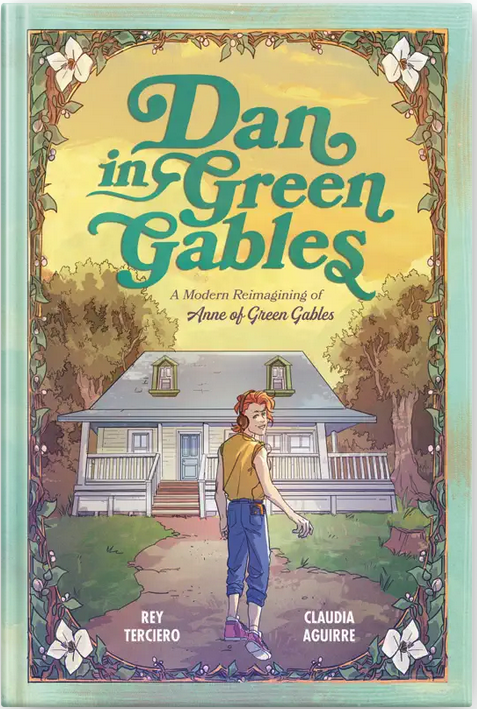
Anne Shirley, though first of her name, was not alone. There have been multiplicities of Annes, from the Japanese spin-offs of the 70’s to the more recent adult adaptations – Anne in Philly or whatnot. They’ve all been female, though… until Rey Terciero most recent graphic novel. DAN IN GREEN GABLES. Did the world need another Anne? Not necessarily – but though the emotions of the book are true enough to have made a space for many, they didn’t make a space for everyone… perhaps the author felt there needed to be a specific place for LGBTQ readers. In Terciero’s version, Dan isn’t orphaned – at least in his own mind. His Matthew and Marilla are, instead of geriatric siblings, grandparents – his. And rather than having only one kindred spirit, Dan’s world extends and expands to include two – in different ways – and numerous lighter bonds of relationships which nevertheless create the web which suspends him above the lava of his own emotions at times. Since Anne’s story is familiar I won’t go into the details, nor is this meant to be a beat-for-beat comparison between the original and Terciero’s newer work. The details differ, but the heart is the same.

When Dan’s mother takes him, after years of it largely being the two of them against the world, to a little house in the Great Smoky Mountains, he doesn’t know where they’re going – or why. He only knows his mother is in a ‘mood.’ It’s a shock when they roll up to the home of his paternal grandparents. Conservative farm folk, they live quietly and mostly contentedly within their church community, so a couple of itinerant city-dwellers who sometimes sleep in the back of their truck is quite a disruption. A further disruption occurs when Dan’s mother immediately argues bitterly and vociferously with his grandfather – and then slips out in the middle of the night, leaving her teen-aged son behind with essential strangers. Though he’d met his grandparents as a small child, Dan doesn’t remember them – at all. His mother has never talked about them, or even his father very much. He knows nothing – and as an expressive gay teen is as welcome as an ulcer to his tightly wound, judgmental and homophobic grandfather. While his Mawmaw is ready with armloads of unconditional love, it’s apparent that even she can be made uncomfortable by Dan’s flamboyant appearance and wounded by his touchy temper which occasionally lashes viciously from the depths of his fear and grief at being abandoned. Dan’s wounds, questions, doubts, and determination are very Anne, and would have resonated with nine-year-old me, even though neither our skin color, nationality, gender, nor concerns are the same.

Dan, overall, is Anne – crushed by disappointment and mockery, hiding deeper heartbreak, salty and snarky, flying off the handle and jumping to conclusions, elated and ebullient, hopeful and hilarious – all that made Anne-with-an-e relatable makes Dan the same. As in the original book, religion is a cornerstone element of Dan’s story, as his grandparents are church cornerstones, and his deacon grandfather is deeply concerned with how they appear as a family to their church community. Some readers may be uncomfortable at the characterization of some Christians – accurate, though rather damning – but others will feel relieved to find the words for what they may have thought, questioned, hoped for, or affirmed in the depiction of others in faith.

Resilient, inclusive, quick to anger, quick to forgive, willing to examine his own behavior and to see the world through another’s point of view, Dan has all of the genuine, personable human elements that gave Anne such well-loved main character energy. Definitely imperfect and thin-skinned – he is learning to be a person in this book, as well as learning to be someone cared for, instead of a caretaker – Dan’s road is full of missteps. He is just as exasperating as Anne was when she first came to Avonlea – and like Anne, Dan grows and changes. To my mind, he becomes even stronger in this single volume than Anne learned to become in two. People who fear that this version of Anne of Green Gables is merely a faded imprint of a saccharine-sweet character who goes on to Do Good will be relieved. People who love beautifully drawn graphic novels will be delighted – in these images Dan is colorful, expressive, and beautiful, and Avonlea is the perfect time capsule of a Appalachian farm town. I came to this book surprised by how well I liked it, and wistful that it was a graphic novel that doesn’t go on forever. This gave me the experience of coming to Anne of Green Gables for the first time, all over again.

I’ve carried my nine year old self and my first encounter with Anne Shirley with me for the whole of my life – I imagine that Dan in Green Gables will become a strong and portable fragment of someone’s heart – and hope – for a lifetime as well.


Fresh onto the TBR:

  • Darksight Dare, Lois McMasters Bujold
  • The Saltwater Curse, Avina St. Graves
  • Behind Frenemy Lines, Zen Cho


Until the next book, 📖

Still A Constant Reader

{constant reader reads: HEAs & HFAs}

HEA. HFN. The fairy tale staple of “happily ever after” is a rather limited construct in kidlit novels, as one has to ask, what does “ever after” mean when you’re thirteen or sixteen or even eighteen? Does a YA or MG novel really support a forever sort of bliss? Probably not – but in my continuing quest to read All The Tween Love Stories, and so support my editor’s goal of me actually writing one, I occasionally ask the question…


WE COULD BE MAGIC, Melissa Meyer and Joelle Murray

Tabitha, like many other girls in her universe or ours, grew up on a steady diet of “princess” – in books, games, and movies via a franchise called Somerland created by a fictional author named Winda Somers. From a very early age, Tabi knew the movies word-for-word, had her own understanding of the villains and heroines, and believed with all her pure heart that love conquered everything… thus her parents’ divorce crushed her little heart. She didn’t understand and couldn’t accept the end of everything she’d understood, so in an attempt to help heal her broken heart, her father takes her on a Daddy-and-Me trip to Somerland… where she finds her next goal: she’s going to return to Somerland as a princess in her own right someday. Fast forward to high school, and Tabi’s finally old enough to make her case to the interviewers, telling the story of how her broken heart was mended as a small child, asking her favorite prince and princess pair to please love each other forever – unlike her own parents. She gets the job, and is overwhelmingly excited to turn up for orientation, eager and bubbly and still a believer in the magic of the stories of princesses and villains and heroes that shaped her heart when she was young. But right away, it’s clear that there are actors… and then there’s The Story. For some kids, taking part in The Story is just a summer job, not a chance to be the magic that helps some child get through a rough moment in childhood. And as it turns out, The Story is not even Tabi’s job – she gets relegated to the nacho stand, completely unready for all the dance steps, all the work, all the sweating in character costumes that is part of the work they do to make magic. After working long enough to land an audition, Tabi realizes she was unprepared for reality, and needs to do a lot more work to make her dream happen. Somerland isn’t a walk in the park for the workers – and not all of the people who are inhabiting the princess costumes at the park aren’t like she’d expected. Not everyone is bubbling over with the joy of just being there – and some of them are wondering if Tabi, curvy and short – has a place there when the royalty they’re all trying out for are svelte and slim and tall. But what keeps Tabi from feeling completely discouraged is her new friend, James, who believes in her, and the magic that brought her there. And, as James shows Tabi the real park, and encourages her to trust in her own magic, she solidifies her belief that royalty comes in all shapes, hues, and sizes, and that we are the magic in The Story – always.

Yes, Your Serpentine Excellency, Kate Stradling

Joanna Marlow is… humiliated. The man who she was dating with has turned out to be a thief – and a gambler. He’s stolen her heirloom glowstone brooch, and so now she’s following him to the gambling house where he’s going to use it as an entry stake, in hopes of nipping in and stealing back her heirloom without having to have an ugly confrontation – where he’d be sure to try and lie his way out of things. Joanna is not a fond of chaos, of discomfort, and most of all, not a fan of confrontation. Courting has turned out to be – for the last time – humiliating and uncomfortable. She’s done. She’s resigning herself to spinsterhood and her cats. Unfortunately, there’s a complication – Joanna’s nearly caught and skips into what she thinks is an empty room in the gaming house – which instead houses a dragon. Who decides to follow her home.

Joanna neither wants nor needs a dragon. Additionally, this is a talking dragon, who somehow finds her house halfway across town and just lets itself into her living room, which has wards and blessings on all the doors and windows. Since Joanna lives on Marlow Hill with her entire, nosy, bossy family – who are all far too interested in maintaining the boundaries of their closed neighborhood – she knows he has to go. Magical beings are all conscripted into military service or the church in this kingdom, and skips have historically been conscripted by the crown to be assassins. Joanna’s family is protective of her – the only one of them to serve the church for five years – and they keep their neighborhood tightly regulated for a reason – to keep chaos and danger away from them, their elderly, and their children. Unfortunately, a dragon brings its own chaos – first in the form of the master of the gaming house from which he came, next from a series of gullible young heiresses who believe he’s a soothsayer and pay dearly for his “advice,” and finally from a high-powered mage carrying a deadly spell from one of the magical mob Families in the kingdom to take “her” dragon back. Joanna’s life… which was meant to be that of a quiet spinster working her courier job and taking care of her cats – has taken a decided turn for the chaotic… and that chaos seems to go through all the magical Families in the kingdom, and perhaps right on up into the King’s court. Nothing that Joanna thought is as it seems – herself, her family, and least of all, the dragon…

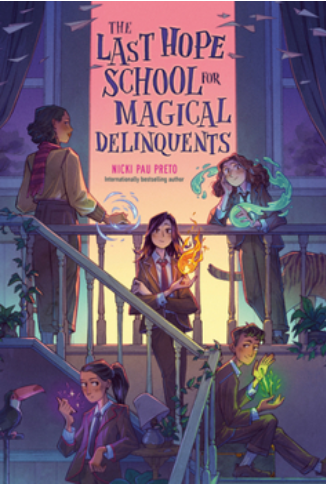
The Last Hope School For Magical Delinquents, Nicki Pau Preto

Lavina Lucas – Vin, to herself, since she has no real friends – has spent the last several years being a magical disaster. Somehow, no matter which school for budding magicians she’s sent to, everything goes wrong there. It’s never what she wants, but it’s always what she gets. Smoke. Explosions. Floods. Broken furniture. Broken bones. Disasters, major or minor, sooner or later find her hauled to the principal’s office, and then before the school board. With grim faces, she’s told that she’s an aberration – a danger to others – and absolutely not allowed to stay a moment longer. When Vin’s latest expulsion finds on the steps of The Last Hope school, Vin is… resigned. She is the magical delinquent they’ve named her, and there’s no hope – this placement isn’t going to go well either. Soon the kids will be gossiping about her and trying to bully her like they always do, and soon her magic will explode out of her, destroy glass and pipes and benches and desks and —

Somehow, though, The Last Hope is different. First, the Headmistress is… kind of amazing. She listens, and Vin is slowly beginning to believe that she might be an adult who actually tries to understand her. Vin is assigned fellow students to help her get settled. Gilly, Theo, and his sister, Araminta, are …nice to her. Oddly nice. Sure, there are still some hiccoughs – chaos seems to follow Vin regardless of her wishes – but with her new friends, things get settled, reversed, and …solved. Life becomes bearable – then more than bearable. Attending school with friends is a fragile treasure that Vin wants desperately to protect, so when she discovers that the school is facing a true threat from the so-called Free Mages, she throws herself at the threat bodily. When you’ve found a place to call home, it’s life or death to protect it. (This is the first of three books, so I’m being a LOT more vague with the plot, so as to avoid spoilers.)

Three vastly different magical books, but a similar unifying theme – happily ever after arrived at through having a place to belong, owning one’s literal or metaphorical magic and being allowed to simply be. This the type of happiness of which most tweens and teens – and people of any age – can dream. What I think is the best part, though, is that each of these books, in their own way, model how to create a HEA for someone else. #goals


Fresh onto the TBR:

  • Darksight Dare, Lois McMasters Bujold
  • The Saltwater Curse, Avina St. Graves
  • Camp Frenemy, Liz Montague


Until the next book, 📖

Still A Constant Reader