{npm♦4/16}

It is an odd thing to be aware of living in history. At some point I imagine archaeologists and historians will dig through the detritus of this era. I wonder what they make of the political ads, newspaper headlines and digital commentary from news reports. Taken together, I imagine this will be a confusing record. It can be nothing else, since every day, we have our own questions of how we got here – and how we’re going to get out of this place.

untitled history

Doubtless,
History’s voice
Retelling this moment
Will echo our bewilderment
“But why?”


{npm♦4/14}

Odd that ‘doomscrolling’ only first appeared in 2018, but here we are with it a relevant household term. While widely recognized as increasing anxiety, distress, and emotional fatigue, in the moment, doomscrolling …relaxes us. Since constant exposure to distressing content reduces emotional responsiveness and empathy, it actually allows our brains to confirm our bias that everything is crap – which produces a dopamine burst, providing brief satisfaction. It creates the illusion that by reading about the news we’re somehow in control of it, even a little bit. Which we aren’t…even a little bit… which our brains points out to us later, usually between two-thirty and three AM.

Psychologists have a name for this constant emotional dysreguation via doomscrolling: Headline Stress Disorder.

“Do not go gentle into that good night,” Dylan Thomas advised us. If we’re all going to crumble, let it not be like this, led to our executions with our souls abscessed and our eyes glued to our phones. The only way we can reliably bear witness is to occasionally bare our faces to fresh air and sky, connect with what we’re fighting to preserve, and stay grounded. Rage against the dying of the light – and admire a bit of moonlight, too. Otherwise, none of us will finish this race, and it’s a marathon, not even a little bit of a sprint…

(im)passive

had I my druthers
I’d always come out swinging
walk with running steps
plan every contingency
prepared for whatever comes.
given no choices
I’ll take what I am given:
my own self-control
conscious delusion? Maybe.
…most we can do is our best.


{npm♦pf – 4/4}

Tricia is raising the bar this month, revisiting her “try-random-poetry-form” posts for NPM. She shared the Venn Diagram poem today for Poetry Friday and it is BRILLIANT. Having committed to reflecting on lines from Naomi Shihab Nye’s “Gate A-4” this month, I immediately knew I had try this new form with one of my phrases.

From Process…

Of course, Tricia didn’t tell me this was going to be so HARD. I didn’t think it would be – it’s basically two Golden Shovels back to back, with the mentor poem phrase in the middle of the overlapping circles so that it both ends and begins two poems or poem stanzas. I don’t know why this took me forever to get my brain around, but – wow. Three hours to get eight lines is kind of ridiculous, but I am trying to go with the spirit of the phrase as well – so the lines needed to end with the idea that not everything is lost.

…To Poetry

TBH, that is DAILY the thing that takes the most time with these poems.

I refuse to be cheesy and write sermon illustrations that are sunny and cheery and essentially meaningless. I refuse to do the “it gets better” thing with such a great woman’s work – I don’t want to write Chicken Soup for the Beleaguered American’s Soul type of crap that says the sun will come out tomorrow and everything will be fine. Damage – so, so much damage – is being done, not just to institutions and systems, but to people. Much like the immigrant children separated from their parents the last time this administration’s brutality was left unchecked, some things will never be repaired. I grieve that as any person of morals and sense does. It will not be “fine,” but it will be…well, in the Julian of Norwich sense of wellness. Things are chaotic, and we’re brokenhearted, but all manner of things will be well – because we are still here. The grievously ill body politic may not recover, but God is still here. And, we are not done working to save PEOPLE yet.

*Ahem.* Anyway – off my soapbox, here’s the poem.

All Shall Be Well

It hurts – how can it not?
We assumed that The Dream was everything.
But found how fleeting a daydream is.
A handful of bubbles, captured, then lost.

Not by might do the best dreams come,
Everything will not yield to the bark of the gun.
Is our land solely gold-makes-rules thugs and no more?
Lost Dream, steel our spines. We know what we stand for.


{npm ♦ 4/2}

The People’s House is on fire.

Each news story emits another disorientating plume of oily smoke as something new succumbs. The incomprehensible losses of systems and institutions is like a home invasion – each new rending means order lost and chaos blinds our eyes with the stinging dust of collapsing foundations. Is that the roar of flames I hear, or the roar of my own fearful pulse in my ears? I circle the corridors, testing doors lightly with my fingertips, but the fire is both nowhere and everywhere… where there’s smoke, there is fire, isn’t there? Is there not fire? Coughing, I wonder – is the smoke the point?

Gaslights were progress –
Steady illumination
No need for candles:
         Peer again, past the darkness –
         Through the open window, stars.

{pf: poetry peeps find ‘A Word’}

Welcome to Poetry Friday!
Poetry Peeps! You’re invited to our challenge for the month of March! Here’s the scoop: We’re writing back to four Lucille Clifton poems, in her notes to clark kent series: “if i should;” “further note to clark;” “final note to clark;” and “note passed to superman.” We’ll be ‘in conversation’ with Ms. Lucille’s poems – talking to them, talking back to them, or talking about them, whether that’s all of them, or any of them, either in form or in substance. Once you’re sure how that’ll look for you, you’ve got a month to craft your creation(s), then share your offering on March 28th in a post and/or on social media with the tag #PoetryPals. We hope you’ll join the fun!


“…And that’s what your holy men discuss, is it?” asked Granny Weatherwax.

“Not usually. There is a very interesting debate raging at the moment on the nature of sin, for example,” said Oats.

“And what do they think? Against it, are they?”

“It’s not as simple as that. It’s not a black and white issue. There are so many shades of gray.”

“Nope.”

“Pardon?”

“There’s no grays, only white that’s got grubby. I’m surprised you don’t know that. And sin, young man, is when you treat people like things. Including yourself. That’s what sin is.”

“It’s a lot more complicated than that–”

“No. It ain’t. When people say things are a lot more complicated than that, they means they’re getting worried that they won’t like the truth. People as things, that’s where it starts.”

“Oh, I’m sure there are worse crimes–”

“But they starts with thinking about people as things.”

–from CARPE JUGULUM, by Terry Pratchett.

People, and things. Things, and people…

Sometimes the subjects we find in conversation with each other are mirror images, and sometimes they’re complete contrasts.

From Process…

Some of you know that for reasons of faith my parents didn’t allow me to read fiction in junior high and high school. No fiction, much less fantasy fiction with a witch – Granny Weatherwax – and an Omnian priest (a made-up sect that goes hard with the door-to-door solicitation) and… vampires, as were featured in Terry Pratchett’s Carpe Jugulum. And though my parents wanted me to be a celebrant of truth as defined by the term “non-fiction,” there’s …just a whole lot of truth in the previous fictional passage, too, isn’t there? The intersection of People Treated Like Things and Injustice is the corner whereon most of the problems begin. Pick out any deeply unfortunate moment in history – the Doctrine of Discovery, the advent of chattel slavery in the Americas in 1619, the forced migration of The Trail of Tears, The Triangle Shirtwaist Factory Fire, Executive Order 9066 – ? All of those things come down to people treated as things. Own-able. Moveable. Modifiable. Disposable.
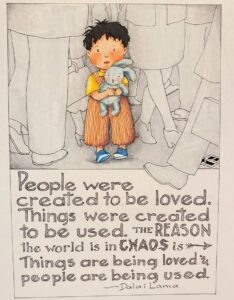
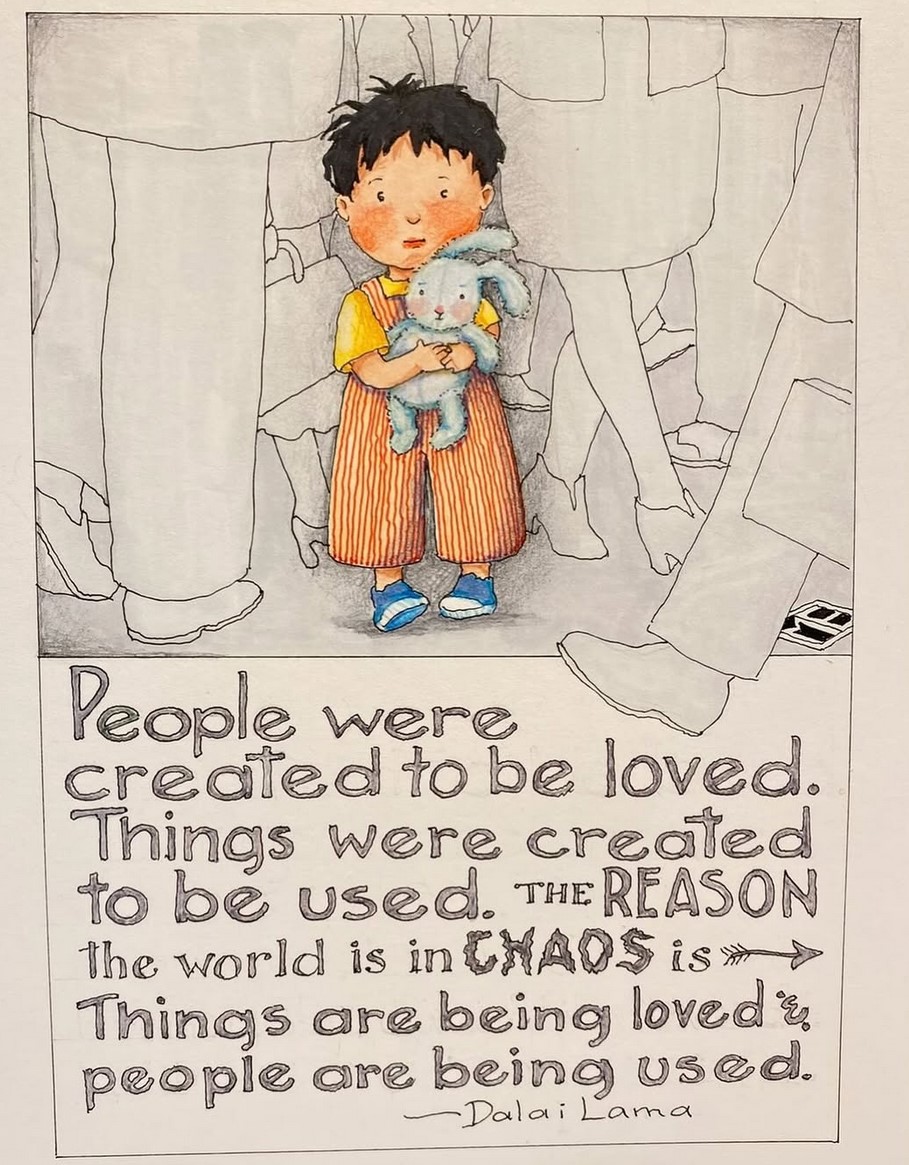
Today’s thoughts are in conversation with Granny Weatherwax’s profound statement (as brought to us by a renown British author who started out as a journalist) and with the Dalai Lama’s (a spiritual leader of great renown who started out as a mostly regular Buddhist priest). I could not believe how similar the statements between these very disparate people were when I found them on a Mary Engelbreit print which the artist shared on Instagram on February 21st of this year. (That one needs to be a print, no?) Two roads diverge on this highway, and they are People and Things. Two vastly different entities, two vastly different purposes, but human society confuses them so frequently. One made to be loved, and the other made to be used. How difficult for some to keep that straight.

…to Poetry

Though I missed the poetry meet-up this month (boo!) I felt like I already had a good feel for this kind of poem, which I’m leaning towards playing with some more to kind of unpack the current news of the day as I process it with its abundant catch words. This time, it was an obvious choice to write several poems as well, or at least two, because my brain has kept circling around the linked but contrasting noun categories of People and Things. But, after running across the Dalai Lama’s statement on my socials, two new words elbowed their way to the front – Loved and Used.


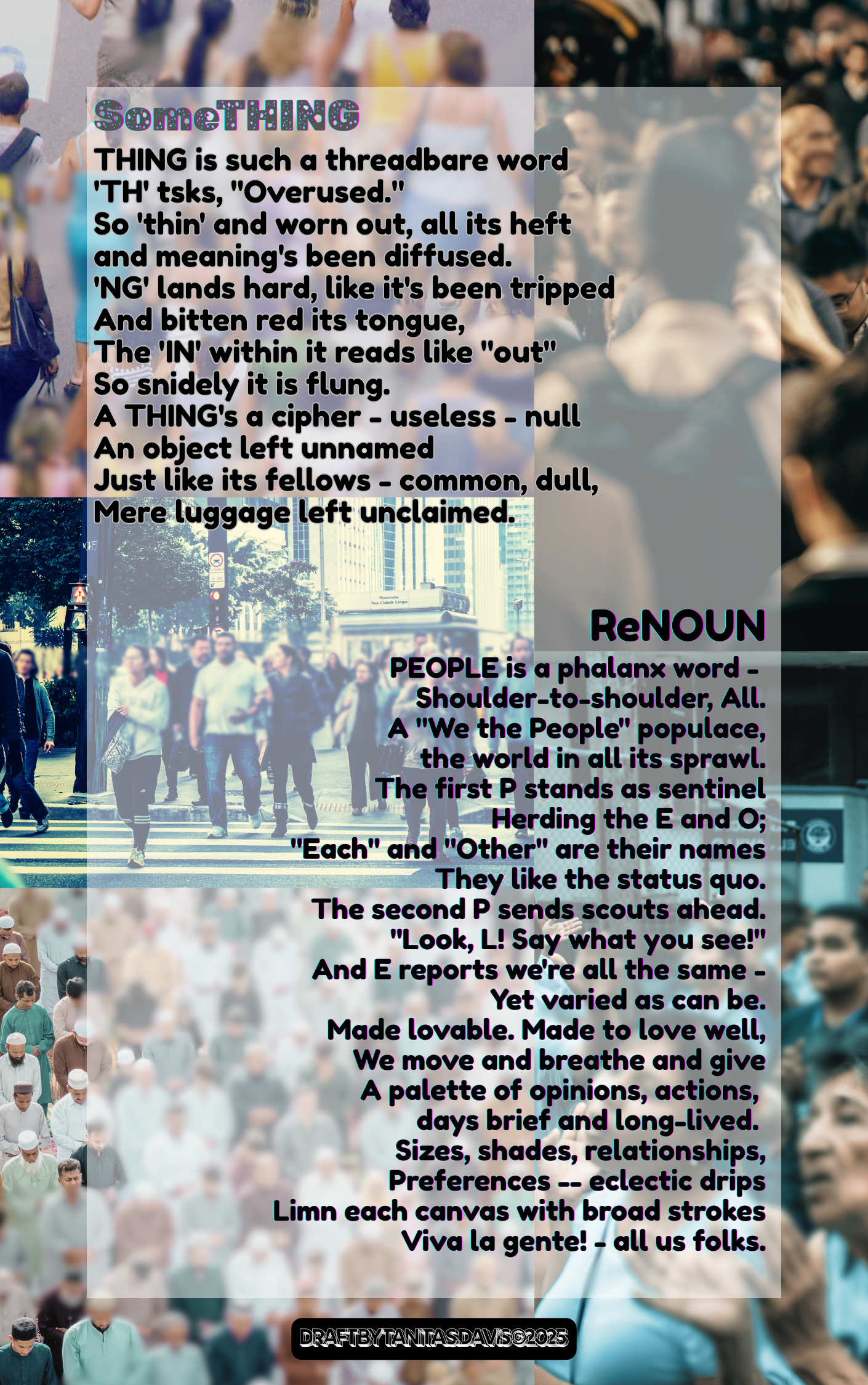
someTHING

THING is such a threadbare word
‘TH’ tsks, “Overused.”
So ‘thin’ and worn out, all its heft
and meaning’s been diffused.
‘NG’ lands hard, like it’s been tripped
And bitten red its tongue,
The ‘IN’ within it reads like “out”
So cruelly it is flung.
A THING’s a cipher – useless – null
An object left unnamed…
Just like its fellows – common, dull,
Mere luggage left unclaimed.

reNOUN

PEOPLE is a phalanx word – shoulder-to-shoulder, All.
The “We the People” populace,
The world in all its sprawl.
The first P stands as sentinel
Herding the E and O;
“Each” and “Other” are their names
They like the status quo.
The second P sends scouts ahead.
“Look, L! Say what you see!”
And E reports we’re all the same –
Yet varied as can be.
Made lovable. Made to love well,
We move and breathe and give
A palette of opinions, actions,
days brief and long-lived.
Sizes, shades, relationships,
Preferences — eclectic drips
Limn each canvas with broad strokes
Viva la gente! – all us folks.

This form lends itself to some real creativity for me, in terms of just letting my brain go and feeling my way into a word’s deeper meaning through what it remind me of, its internal sounds, the shapes of its letters, and whatnot. I like that “______is a Word” invites both wordplay and a thoughtful liberation like few other forms – I don’t have to make these poems rhyme. I don’t have to observe meter or number of lines, or anything else if I don’t want to. I just need to examine the word from all facets and let the word speak to ME – as didactically or as simplistically or as complexly and cleverly as I may. So, this was delightful – and I hope you find these word meditations delightful – useful, and illuminating – as well.

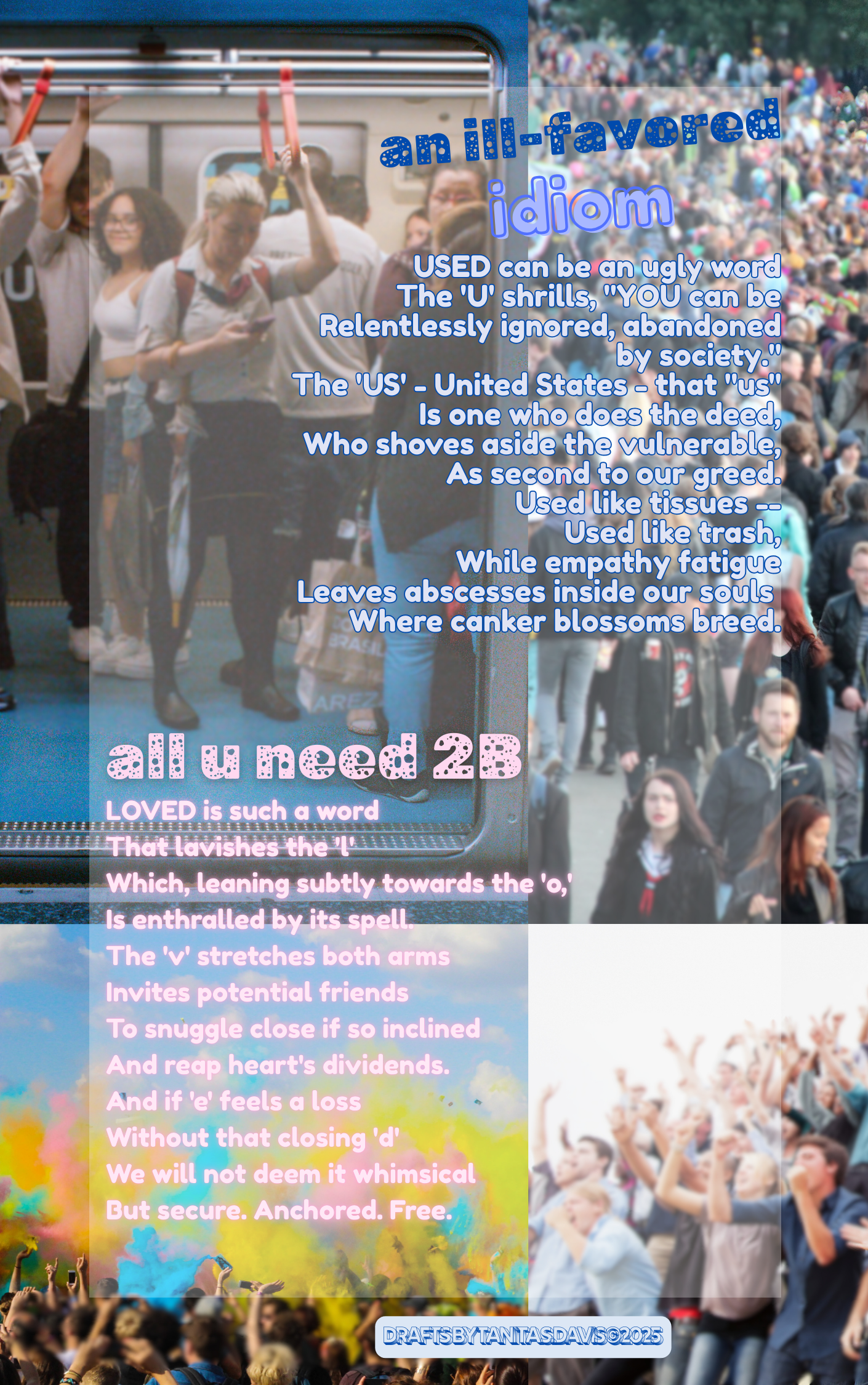
an ill-favored idiom

USED can be an ugly word
The ‘U’ shrills, “YOU can be
Relentlessly ignored, abandoned
By society.”
The ‘US’ – United States – that “us”
Is one who does the deed,
Who shoves aside the vulnerable,
As second to our greed.
Used like tissues —
Used like trash,
While empathy fatigue
Leaves abscesses inside our souls
Where canker blossoms breed.

all u need 2B

LOVED is such a word
That lavishes the ‘l’
Which, leaning subtly towards the ‘o,’
Is enthralled by its spell.
The ‘v’ stretches both arms
Invites potential friends
To snuggle close if so inclined
And reap heart’s dividends.
And if ‘e’ feels a loss
Without that closing ‘d’
We will not deem it whimsical
But secure. Anchored. Free.

There are quite a few other folks who dipped a toe in to the “_______is a Word” challenge this month. Laura’s post is here, and you’ll find Sara’s poem here. Liz’s poem is here. Mary Lee’s post is here, and Tricia’s poem is here. Linda B’s poem is here, and Rose joins us here. Michelle K’s poem is here. Jan from Bookseed has joined the fun, while Susan’s poem is here. More Peeps may be popping up during the weekend, so don’t forget to come back for the full roundup. Meanwhile, Poetry Friday is hosted this week by the delightful Denise Krebs, so don’t miss popping over for more poetry celebrations at Mrs. D. Krebs’ EduBlog! Thanks, Denise!

One of the MOST fun things about this style of poem is writing them with a thesaurus to hand. I often think of a word… and then look it up, and use the fifth or sixth synonym of it, so that I can sharpen my meaning – or even obscure or enlarge it. For instance, phalanx is a great word with multiple meanings, one of which was originally …log – a shoulder-to-shoulder line formation used in ancient Greek military battles. I LOVE that the plural of phalanx is phalanges… the names of the bones of the fingers or toes. People are each other’s foundation to stand on, or as Gwendolyn Brooks said it, “we are each other’s business, we are each other’s magnitude and bond.” We are each other’s hands to hold or extend in help and support – so to keep our battalion together. I appreciate the dichotomy of that – our little battalion standing with our shields linked, being both tethered and tied in, yet completely independent. Isn’t that the confidence that being loved gives to us?

I suspect Esme Weatherwax would think that nice little man in the saffron robe and wire-rimmed glasses was good people, and invite him over to sit a spell and listen to her bees. And I suspect His Holiness the Dalai Lama would get a kick out of reading about the kingdom of Lancre in the Ramtops where the strong-willed Granny Weatherwax catches babies, raises bees, and practices “headology,” which is a lot of philosophy mixed with a generous serving of stubbornness and a heavy sprinkle of common sense. The topics we find in conversation with each other sometimes aren’t that far apart after all… As more and more people are treated as things and things are cherished as people ought to be, we’ll figure out how to flip that particular script. Until then… perhaps we’ll keep this conversation simmering on the back burner – and let people who need to know, know that they are, as always, well-loved. Happy Weekend.

all poems ©2025, tanita s. davis
{poetry friday: acknowledging hard things in poetry}

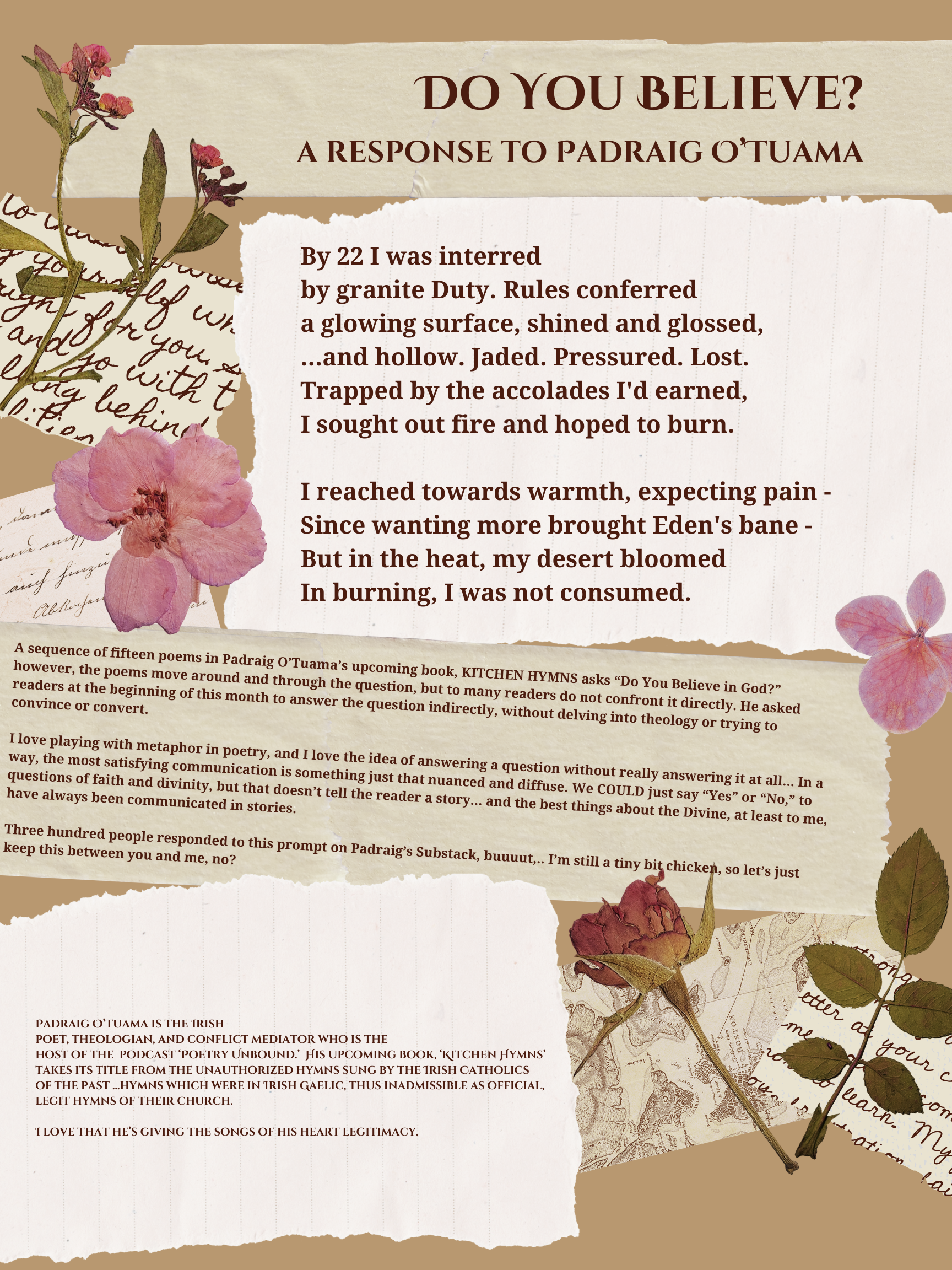
This is definitely not under the banner of my #winterlight offerings, because it’s not particularly encouraging, but rather… thinky. I’m grateful for the friends who have dragged me into poetry practice, and for my Deeper Dive poetry group, whose exercises help me to look differently at the poetry I read.

This week, my group read several mentor poems which touched on grief or despair, and using repetition, direct address and present tense voice lead the poem towards a commonality of experience, allowing the reader to both feel and release their own similar emotions. Yesterday I wrote a draft of a poem describing the rise and fall of Allensworth, CA, the first township in my home state to be founded, financed, and governed by African-Americans – the “Buffalo soldiers,” of the Civil War. I have been fiddling with the idea of writing historical fiction set in this town – or writing fantastical fiction about magical happenings in this town. All of this is still in the very bubbling-stew-of-imagination stages.

Today I’m attempting to look objectively at another poem from the Harlem Renaissance using the same tools as we identified yesterday. If this has a lot of the tone of an English paper, that’s because I think I fall back on the strategies that worked for me in my upper level English courses. Additionally, writing things down is sometimes a way that I further process and remember them. So, aren’t you glad to be here to crib my notes for the test on Monday? Enjoy! 😂

If We Must Die

by Claude McKay

If we must die, let it not be like hogs
Hunted and penned in an inglorious spot,
While round us bark the mad and hungry dogs,
Making their mock at our accursèd lot.
If we must die, O let us nobly die,
So that our precious blood may not be shed
In vain; then even the monsters we defy
Shall be constrained to honor us though dead!

(Do read the rest at The Poetry Foundation.)

Born Festus Claudius McKay in Sunny Ville, Jamaica in 1889, Claude McKay loved English literature and studied and wrote poetry as a young man – about his feelings, about the world around him, and about the things he observed. Logically, we know McKay observed a great deal of racism – both in his home nation, and during his lifetime in the United States. The themes of both his poetry and novels reflect this. The poem, “If We Must Die” is one of his best known, and most celebrated, not just among the Black community, but more on that later. The feel of the poem is, despite its formal tone, in some ways very American – very macho. “Mejor morir a pie que vivir en rodillas,” right? Better to die on your feet than to live on your knees. (This quotation attributed to Emiliano Zapata, 1877-1919, and quoted by FDR in 1941 when receiving an honorary doctorate from Oxford University – apparently meant to be encouragement to a war-stressed Britain.)

Many times, poems which deal in difficult topics use the natural world as a foil, pointing to the continuous cycles of nature as a contrast to the brevity of the human cycle. While McKay does mention hogs and dogs, he mentions them in a disturbing similarity to human beings – Black people chased down, cornered, and executed like hogs, white people like baying hounds, harrying them and running them down. While it at first seemed to me a departure from his animal metaphor when he urges the subject of the poem to make the ‘monsters’ pay for every drop of blood shed, I thought about how dangerous hogs are to come across in the woods. Even if you’re not hunting them, you don’t want to run afoul of them – they’re aggressive, and they’ll come after you if they’re even startled. Like the 1546 proverb said, “Even a worm will turn.” Even the meekest and most docile of the animal kingdom can be pushed too far, and the Black man McKay describes with such polished, formal language is apparently a man pushed outside of his natural bent for civility and calm – or, at least his language seems to imply that’s man’s natural bent, anyway.

That high-toned language and …the poem’s precise shine in general seems deliberate. The poem is a Shakespearean sonnet, with all of the structure this rule-bound form allows – and with all of the history and travel that the sonnet implies, from thirteenth century Italy to 1500’s England to the more recent pen of a Jamaican-born Black man. With this history and through this distance, McKay speaks to a certain kind of reader – to men, ostensibly, as the poem cries out to “O, Kinsmen!” at one point, and readers are encouraged to die “like men.” Those kinsmen could be American men, or McKay’s fellow Afro-Caribbean immigrants. Today I learned that there is an urban myth that Winston Churchhill (!!!! NB: there is no record of it, so this is wholly mythical and sourced from people’s memories at the time) read this poem aloud on the radio during the siege of London in 1940. Because this sonnet lacks specific identifying markers – the “We” who must die are called “kinsmen” and “men” and their oppressors simply “monsters” – the clarion call of standing with one’s back to the wall and fighting to the death, couched in the scholarly lines of a very European poetic form makes it allegedly relatable even to the Prime Minister of England. Who knows – maybe the poem is intended to speak to long-ago Italians and Englishmen as well. McKay’s direct address invokes whatever present moment the reader finds themselves in, which is often claustrophobically close in the ‘painful topic’ poem genre, and gives the reader a sense of tempus fugit – of a time that is fleeing, and so right this minute you must listen to the poet, and hear his wisdom, which may not be available beyond this epoch. I imagine the narrator running, ghostlike, along with a person fleeing a lynching, urging him to not just run but to consider stopping and making a last stand instead, to make the monsters pay. Even with these sterling words and high tone, though, it’s hard to imagine someone running for their life being very open to the whole thing.

The long-ranging discussion of violence and non-violence, of “By Any Means Necessary” and passive protest is present in this poem, but wrapped in the idea of nobility and honor. Is it better to “nobly die” not like a slaughtered hog, but “fighting back?” Or will you still be just dead? McKay definitely seems to believe that an honorable death is the best death – but the jury’s still out.

Thank you for coming to my English Lit discussion.

EDITED TO ADD: Can you believe that Susan @Chicken Spaghetti is also celebrating the poetry of Claude McKay today??? What are the chances?

{poetry friday: the poetry peeps tan-ku into 2025}

Welcome to Poetry Friday!

Poetry Peeps! You’re invited to our challenge for the month of February! Here’s the scoop: We’re taking advantage of the rich bounty of the Poetry Friday Universe and writing ____is A Word Poems, wordplay invented by poet Nikki Grimes and shared by Michelle Barnes. Here’s the roundup from our first foray in October 2021, which was a lot of fun. Our words will be ‘in conversation’ somehow. We’re not sure yet, but once YOU have a word in mind? Go! You’ve got a month to craft your creation(s), then share your offering on February 28th in a post and/or on social media with the tag #PoetryPals. We hope you’ll join the fun!


WHEW. We made it.

We’ve climbed the last cliff and clambered onto the last Friday of the last week of a month that seems to have lasted six years, at least.

It feels like the Poetry Peeps’ theme of “In Conversation” this year is going to be so apropos. So much is intertwined and related. So much of life is in conversation. We can take a strange comfort that what is happening now has happened before, in other places and other times – our present is in conversation with our past. We are – for better or for worse – once again aware of ourselves as living history. How will we take part in the conversation? What are we going to say? When is it our turn to speak? Our dip into the tan-ku, the poetic combination of the tanka answered by a haiku reflects this thoughtfully.

From Process…

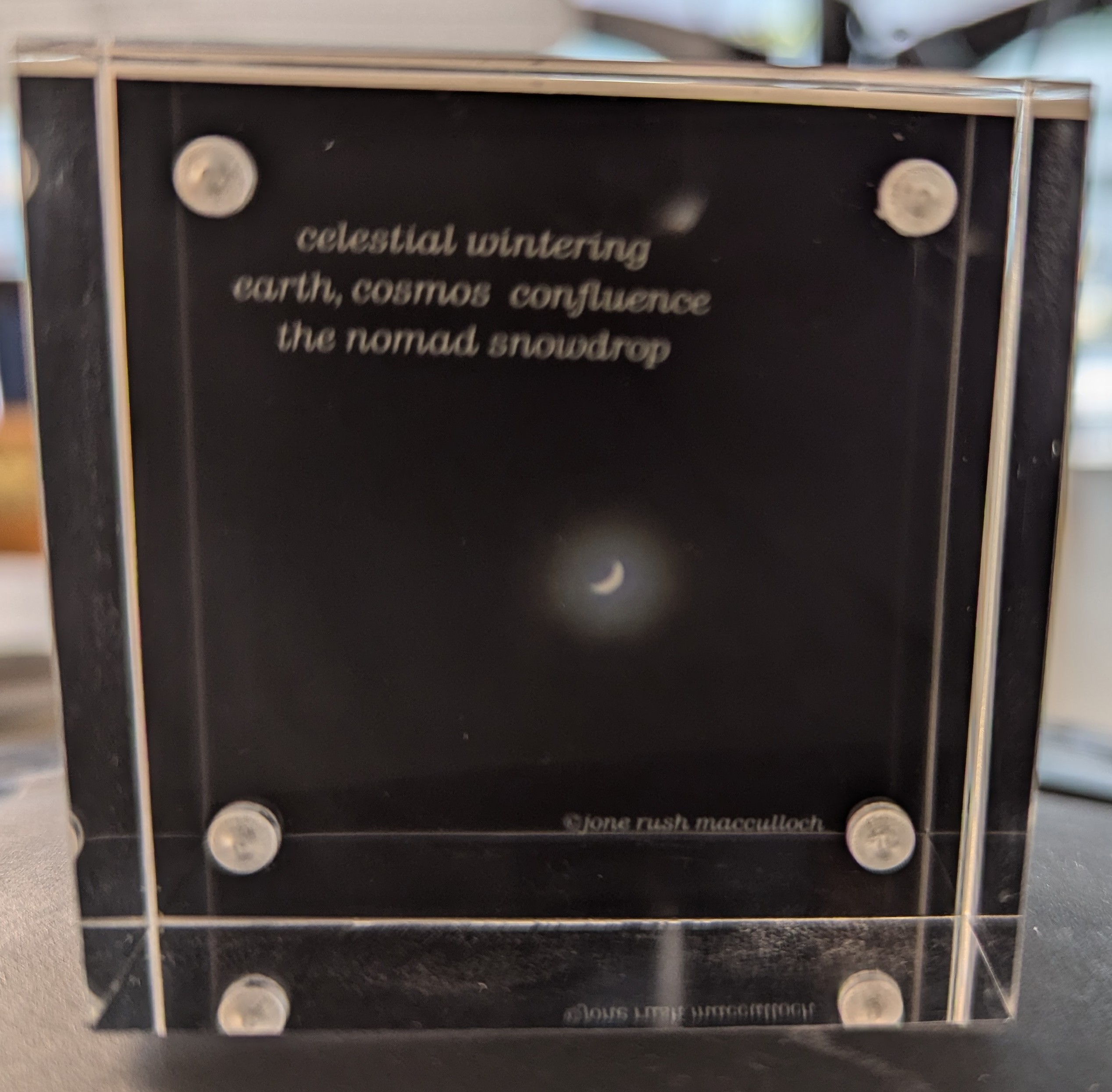
Admittedly we chose this month to begin with a shorter poem form for the specific purpose of giving ourselves less to do because we had a shorter time frame to work with. However – we acknowledged CLEARLY in our group hang this month that SHORTER NEVER MEANS EASIER. Like, ever. Japanese Haiku is a hard form, full stop. It’s beautifully compact and thought-provoking and symbolic – all those good things that I’m not. I like to play with tanka, because it’s …somehow less pressure? I feel like it’s somehow more acceptable with tanka to lean in to the Western idea of haiku (just a short poem that MIGHT mention nature and DEFINITELY counts syllables) and tag on a couple of end lines that wrap the whole thing up with…a bit of clever emphasis. However, this time I decided I was going to make more of an effort to actually observe the… quietness of haiku, not just its brevity. I wanted to try to embrace the beauty and more ephemeral aspects of haiku, which celebrate small facets of the giant surround sound theater that is the natural world. With a whole year’s worth of haiku from THE Jone Rush MacCulloch – most awesome Solstice Poetry Swap partner – I set out to try.

The New Moon was January 29th, which was also the Lunar New Year’s eve. I’ve started to notice the phases of the moon a lot more since I become increasingly insomniac at various times of the month. Sometimes it’s too bright. Sometimes it’s too… quiet. Sometimes I need ice in my water. Like a devious toddler, my brain is just making up excuses to be awake at this point, but in any event, the other night, I realized that I had to turn on both of my night lights at 3AM in order to have enough light to read (Good news: Grown-ups don’t have to use the flashlight under the covers anymore). It was REALLY dark, and we’ve been having hard frosts, too – so in that cold darkness was the perfect opportunity to look up and see northern stars scattered like little chips of ice against the dark sky, to imagine the numerous beings outside, hunkering down. Since forever, there has been winter and cold – and even as much fire and ice as there has been this winter, just not in recorded memory. Nothing really is new, after all.

In a determined state of peace – not fretting about being awake again – I sat and observed the darkness of the new moon, recalling that in that darkness, millions far away were beginning their celebration of the Year of the Snake, symbolizing for some, among other things, transformation. Remembering my corn snake’s blindness and predilection for hiding under rocks when he was in the itchy, skritchy process of shedding his skin, the darkness of the moon seemed really fitting to me. Tonight’s moon will be a waxing crescent with only 2% illumination (the image in Jone’s picture is waxing a bit more than tonight’s will be, by about five days or so). The moon waxes gradually, so we’ll be in the dark for quite a bit longer. But, while we’re in darkness – and oh, the darkness is Stygian and profane these days – don’t forget that we’ve been here before. History, in conversation with the present, once told the story of oligarchs and excess, of predators and proletariat. Haven’t we always had the poor – and the poor in spirit – with us? Like a wheel turning, or a pendulum’s swing, history, empires, republics all rise and retreat. There is darkness. And then, there is light.

…to Poetry

That thought, so early in the morning, seemed rather profound. I’d talked about wanting to write to this moment with my tan-ku, and express the enormity of the scope of the darkness and the singular shine of people like Mariann Edgar Budde, whose previous work on behalf of Matthew Shepard’s family years ago already told us who she was, and whose unflinching ability to do the work set before her continues to shine. I wanted to write about that shine – without excessive panegyric – and remain in conversation with what helps us see the shine, which is indeed darkness. We don’t have one without the other, do we?

lux aeterna, 1/2
a waning gibbous
smothers a sky in shadow –
though starlight brightens,
though dawn has always followed,
wisdom fears a moonless night

this deeper darkness
no tame wick illuminates
then it dawns on us
= = = = = = = = = =
the singular role
of Earth’s celestial bodies:
reflect and return
in strength, the greater light as
lucent, faithful rendering.

deep is night’s ocean:
moon’s ‘lesser light’ sounds the depths
we dive, unafraid
draft by tanita s. davis ©2025

There are more Poetry Peeps who are grappling with this idea of being “in conversation” this month, and using the conversational form of the tan-ku to do so. Have a read. Sara’s post is here, and Laura’s post is here. Liz’s poem is here, while Mary Lee’s can be found here. Miss Margaret’s poem is here and Linda B’s poem response is here. Carol V’s poem joins the chat here, and Michelle K’s poem is here. Denise rounds out the list with a tan-ku for America. More Peeps may be popping into the Group Chat throughout the weekend, so don’t forget to circle back for the whole tan-ku round-up.

Poetry Friday today is richly hosted by Jan from Bookseed Studio, who has ALL the links and all the good stuff, and also provided a Sly and the Family Stone earworm which I will now share with you. Don’t miss the full round-up there. Thanks much, Jan.

Is it counterintuitive to think of diving into the darkness, delving into it to find its source? It is somehow a comforting thought to remember the toughness of our ancestors, through Depressions, through wars, through robber barons and revolution. All over the world, the path is illuminated by those who have gone before. Can we walk it, everyday people, unafraid, maybe putting a little color into the world as we go?

Though my soul may set in darkness, it will rise in perfect light;
I have loved the stars too truly to be fearful of the night.

– Sarah Williams, 1868

Happy weekend to we, the people. We who walk in darkness, hold up your light.

{poetry friday: believing}

Welcome to Poetry Friday!

Poetry Peeps! You’re invited to our challenge for the month of January! Here’s the scoop: we’re composing tan-ku, conversations between a haiku and a tanka, as created by Mariko Kitakubo & Deborah P. Kolodji. (This is a short-but-sweet challenge, given that we don’t have a full month to ponder it.) Are you in? Good! You have …two weeks to craft your creation and share it on January 31st in a post and/or on social media with the tag #PoetryPals. We hope you’ll join the fun!


One of my modest goals for 2025 is to share my poems a bit more often. Since I’ve been writing with the Poetry Sisters since 2007, I have amassed a ton of poems, some of which I even feel okay about, but they tend to languish in folders and never see the light of day. Rather than continue to emulate the Belle of Amehurst and have someone find all of this on my hard drive when I’m dead, I’m going to start sharing… they may be good, bad, or indifferent, but the point is that I did like them once, so… here goes.

The following poem is less of a real answer to a poem, and more of an illustration, if not quite a parable. I think religious writings of any faith practice contain a lot of stories, because that’s the way to break concepts down into digestible bits for the average person… belief is a MASSIVE topic. We all believe something …sometimes. That old saw about atheists and foxholes come to mind – even if our belief is ephemeral and unthinking, sometimes it exists, and I think it’s part of life that deserves examination like the rest…


Poetry Friday is hosted by Tricia’s Smith Corona at The Miss Rumphius Effect. Thanks, Tricia.

Happy Weekend, friends.

{pf: the poetry peeps look seven different ways at…}

Welcome to another Poetry Friday Poetry Peeps Adventure!

Poetry Peeps! You’re invited to our challenge for the month of October! Here’s the scoop: We’re building! Our prompt comes from p. 139 of The Practice of Poetry: Writing Exercises from Poets Who Teach, edited by Robin Behn and Chase Twichell, and we’re writing a poem in which we literally build and/or take apart something – large or small. Our focus will be on constructing or deconstructing, taking into account technical terms, instructions, and perhaps even material sources. A great mentor poem would be something like this, or this. Are you in? Good! You have a month to craft your creation and share it on October 25th in a post and/or on social media with the tag #PoetryPals.


It’s literally the eleventh hour as I’m posting this poem, and I’m laughing at myself, because somehow, as sometimes happens, at the last minute, I so disliked what I’d already written and prepared that I had to start over – at about an hour before dinner and two hours before rehearsal tonight. Tomorrow I’ll be glad I did this, though – tomorrow is my husband’s birthday, and I came up with this poem because I was thinking of him.

From Process…

Originally this Wallace Stevens poetry prompt was meant to be all seven of the Seven Sisters poetry crew getting together to choose ONE object that we looked at seven different ways, but that quickly became a non-starter, as with the onset of the school year, many of us have ramped up school visits, teaching duties, and other stuff. We’ve been having trouble being all in the same place at the same time, so we never did choose one object – but we decided to at least choose something symbolic. We don’t want to choose something meaningless,” A Person said at one point, “like a t-shirt, or a sock.” We then immediately did a 180 on that and discussed how nothing is meaningless in the hands of a good poet (“A sock is a pocket for your toes!” A sock, friends, is never meaningless). Well, that must have percolated in my brain for the following week, because even though I chose “Seven Ways of Looking at a Republic” and later tried to say Something Meaningful about democracy, baseball, voting… and then, eggs, vaccination, and sleep, what finally stuck? “Seven Ways of Looking at an Old Shoe.”

…To Poetry

…and, just to get it out of my system, I’m going to go ahead and BLAME SARA for this, because she’s the one who said something about socks, and obviously, what goes with socks? Shoes. Actually, it’s not really on Sara. I read the idiom about something being as “comfortable as an old shoe” somewhere this week and it stuck, oddly. This simile was once put “as easy as an old shoe,” and was first recorded in J. T. Brockett’s North Country Glossary (1825), so it’s stuck around for a while in the English language. So, it can’t be meaningless if it’s old, right? And, because lately I still find myself astounded that Himself and I have been married since we were twenty and twenty-one (THIRTY YEARS), the idea of being as “comfortable as an old shoe” also resonates – still kind of weird, but whatever, here we are.


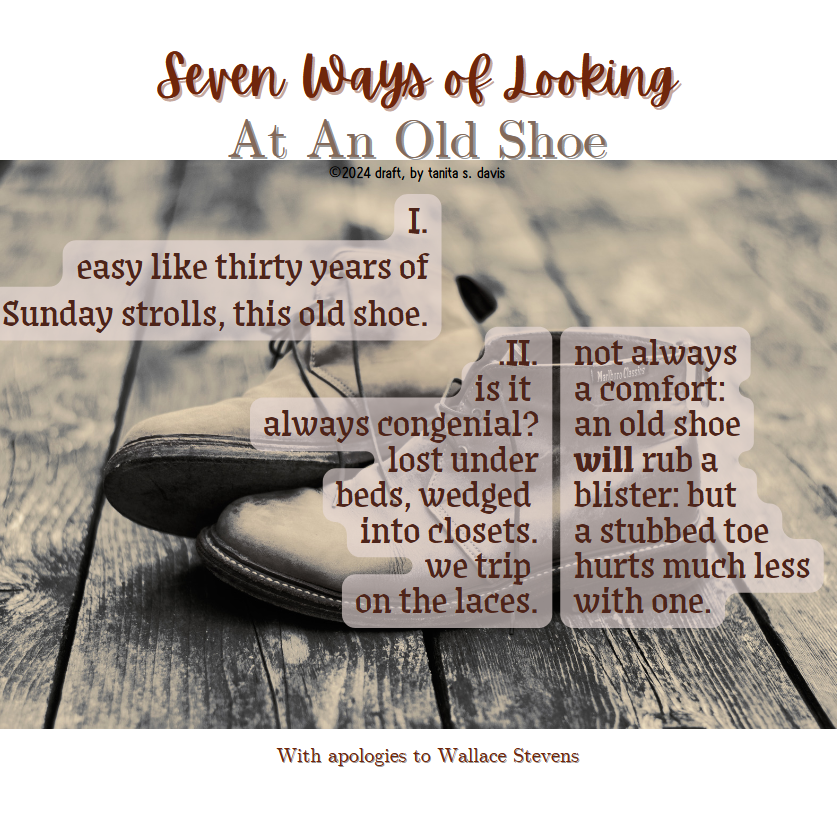
Seven Ways of Looking at An Old Shoe.

I.
easy like thirty years of
Sunday strolls, this old shoe.

II.
is it
always congenial?
lost under
beds, wedged
into closets.
we trip
on the laces.
not always
a comfort:
an old shoe
will rub a
blister: but
a stubbed toe
hurts much less
with one.

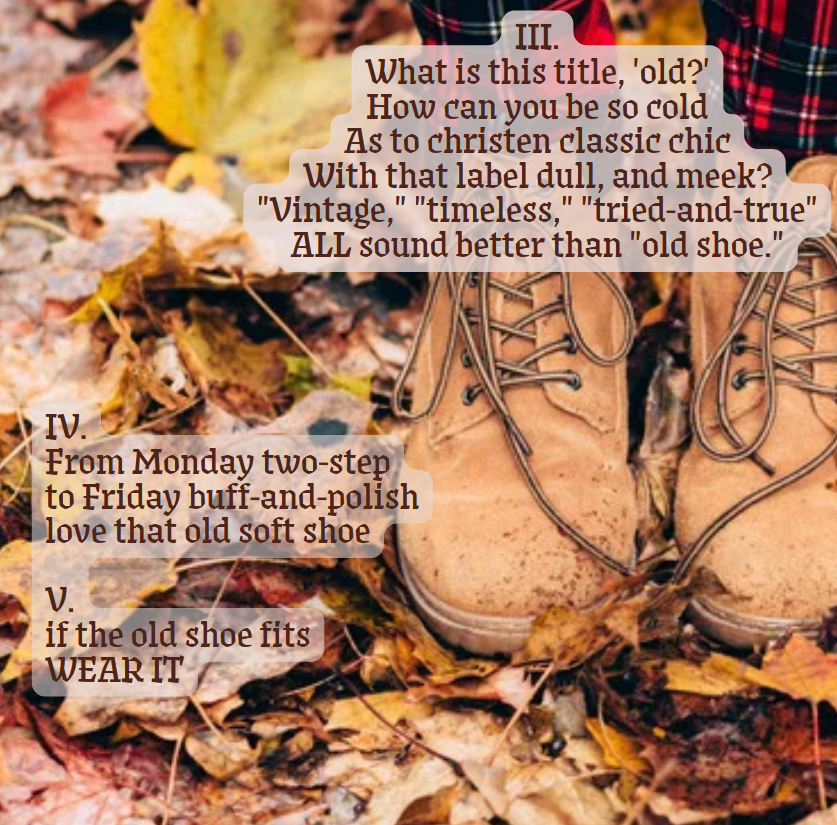
III.
What is this title, ‘old?’
How can you be so cold
As to christen classic chic
With that label dull, and meek?
“Vintage,” “timeless,” “tried-and-true”
ALL sound better than “old shoe.”

IV.
From Monday two-step
to Friday buff-and-polish
love that old soft shoe

V.
if the old shoe fits
wear it

VI
a curving structure
bones, ligaments, and tendons
archly supported:
all that is needful, designed.
mama doesn’t want new shoes

VII
there was an old woman who loved her old shoe
it fit her wide foot in the toe box, too.
As perfect when worn out to paint the town red,
As it was worn staying in with a book instead.

Proving, once again, that a poem can be ABOUT ANYTHING. Stay tuned – I’m sure I’ll come up with something on socks next. ☺

Thank-you to Ms. Irene for rounding us up today. She’s also sharing about The Mistakes That Make Us, so do be sure to pop over there for more poetry magic. Meanwhile, more non-shoe ways of looking can be found with more poetry peeps. Liz’s poem is here. Sara’s poem is here. Tricia’s poem is here. Laura’s poem is here. Kelly’s poem is here. Michelle K’s poem and show news is here, Denise K’s precious poem celebrating Phoebe is here. Karen E’s looking at interruptions – welcome Karen!!! Buffy Silverman’s poem is here – welcome to the party, Buffy! And welcome to first-timer Tracy Kiff-Judson, whose poem is here. Linda M. is looking hilariously at middle age, and Linda B’s poem is here. Carol has chosen six ways to look at autumn, and Margaret is looking ten ways at a grandchild. THANK YOU, SO MUCH everyone for playing, and for Linda B. for inviting others. More poets = more fun. More ways of looking may be peered at throughout the day, and I’ll post the poems as I find them – stay tuned for the roundup!


I hope you take a look at your world this weekend and find the myriad tiny ways that – even in the midst of stress and strife – there is still growth, there is still life, there is still beauty, and peace. Hold tight to what is good. Happy Friday.