{pf: poetry peeps burn down a haibun}

Welcome to Poetry Friday!

Poetry Peeps! You’re invited to our challenge for the month of November! Here’s the scoop: We’re composing ‘Eavesdropped & Overheard’ poems, in tribute to our friend of the long-running Chicken Spaghetti blog, Susan Thomsen. Much has changed since last we accepted this challenge in 2022 – including the number of newspapers with accessible, paywall-free ‘Overheard’ articles. Never fear, however – here’s useful scuttlebutt from DC to points West, and from areas all over if you’re not as much of a in-real-life stickybeak as the rest of us. Are you in? You’ll have a month to craft your creation(s), then share your offering on NOVEMBER 28th in a post and/or on social media with the tag #PoetryPals. Join the fun!


We did it! The Poetry Sisters managed to all show up at a pre-write meet-up! It had NOTHING WHATSOEVER to do with how impossible the prompt felt this month! Nothing at all! We just missed each other!! And needed to vent about prose poems! And stuff!

Okay, so we had a brief moment of “WHOSE IDEA WAS THIS!?” and we couldn’t recall, since prompts for the year are thought up in one fell swoop, each of us nursing our potion of choice, and who even knows what we were thinking (or drinking) in January. So… here we begin with a haibun, which in itself feels challenging as they are chiefly autobiographical ‘prose poems’ with subtracted lines. We add poet Torrin A. Greathouse’s transitional step of an additional erasure poem with an added element of flame creating a ‘burning’ haibun, which then collapses into the traditional haibun concluding haiku (perhaps reflecting how, like cinders, the original poem crumbles in on itself?), and…our annual theme of ‘poems in conversation.’ Hmmm…🤔😶

From Process…

As we talked about where each of us felt we could take the poem, I had basically bupkis, until I thought about burning in the most literal, elemental way. California has had it with fire – burn scars, burn years, and burn names. The first autumn after the Tubbs fire, I hyperventilated when smelling woodsmoke from someone’s fireplace. When it has destroyed so much of what you love – the Caldor fire took out part of the thousand acre summer camp where I worked from age 16-21 and took the first steps towards adulthood – it leaves scars. I don’t think I’ll be able to happily sit around a crackling campfire ever again.

Despite the need for this to come from an autobiographical space, I felt like I needed boundaries on all of these pesky feelings, however. Historically, we all know how I feel about unrhymed and unruled poetry prompts 😖 – they become unhinged and unruly in my hands. Because I need boundaries, I had to define a prose poem first. From my extensive reading, I concluded that it is prose that utilizes the elements of poetry – notably alliteration, repetition, rhyme, literary devices, and figurative language. Except for the line breaks and traditional shaping of poetry, it’s a poem. So. I tried to toe the line between the two.

…To Poetry

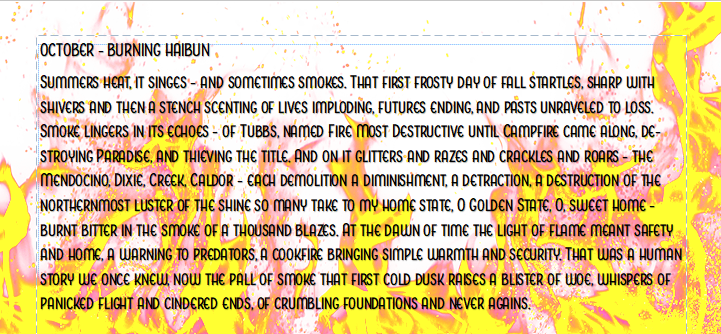
Summer’s heat, it singes – and sometimes smokes. That first frosty day of fall startles, sharp with shivers and then a stench scenting of lives imploding, futures ending, and pasts unraveled to loss. Smoke lingers in its echoes – of Tubbs, named Fire Most Destructive until Campfire came along, destroying Paradise, and thieving the title. And on it glitters and razes and crackles and roars – the Mendocino, Dixie, Creek, Caldor – each demolition a diminishment, a detraction, a destruction of the northernmost luster of the shine so many take to my home state, O Golden State, O, sweet home – burnt bitter in the smoke of a thousand blazes. At the dawn of time the light of flame meant safety and home, a warning to predators, a cookfire bringing simple warmth and security. That was a human story we once knew, now the pall of smoke that first cold dusk raises a blister of woe, whispers of panicked flight and cindered ends, of crumbling foundations and never agains.

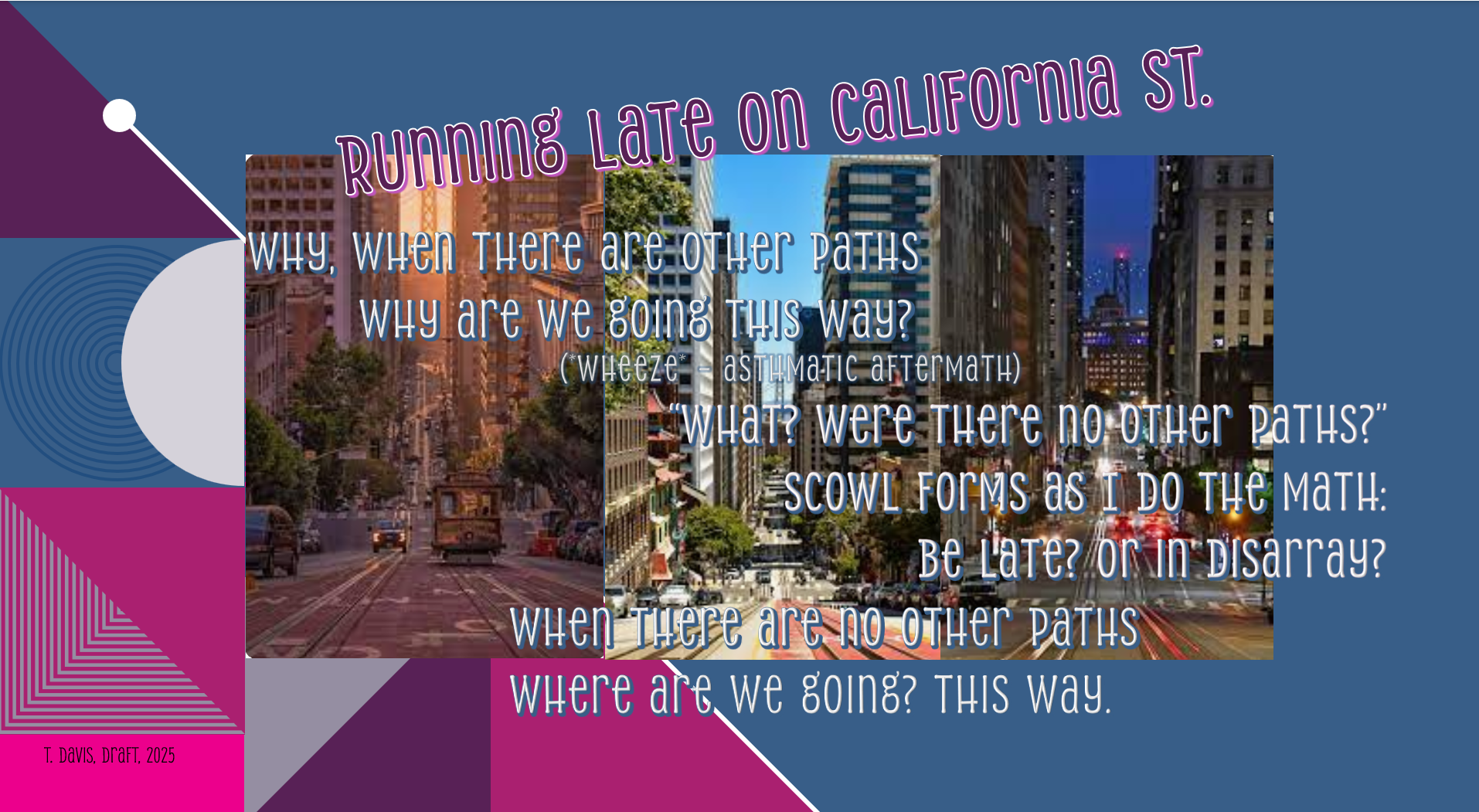
And now, we begin the burning. The second phase of the burning haibun is meant to represent a state wholly different from the first, so I went from heat to cold:

It singes – that first frosty day of fall,
Sharp with shivers, scenting futures and pasts.
Smoke lingers, destructive paradise, and it glitters –
A diminishment, a detraction, a destruction of the shine so golden –
O, sweet smoke of a thousand dawn predators,
Bringing a story that whispers
of flight.

I like how …ominous that one sounds. I tried to bring that sense of menacing portent to the haiku. (I also tried hard not to use the traditional 5-7-5 syllabic form, because Japanese haiku actually doesn’t do so slavishly, and I need to get out of the elementary school version of haiku someday.)

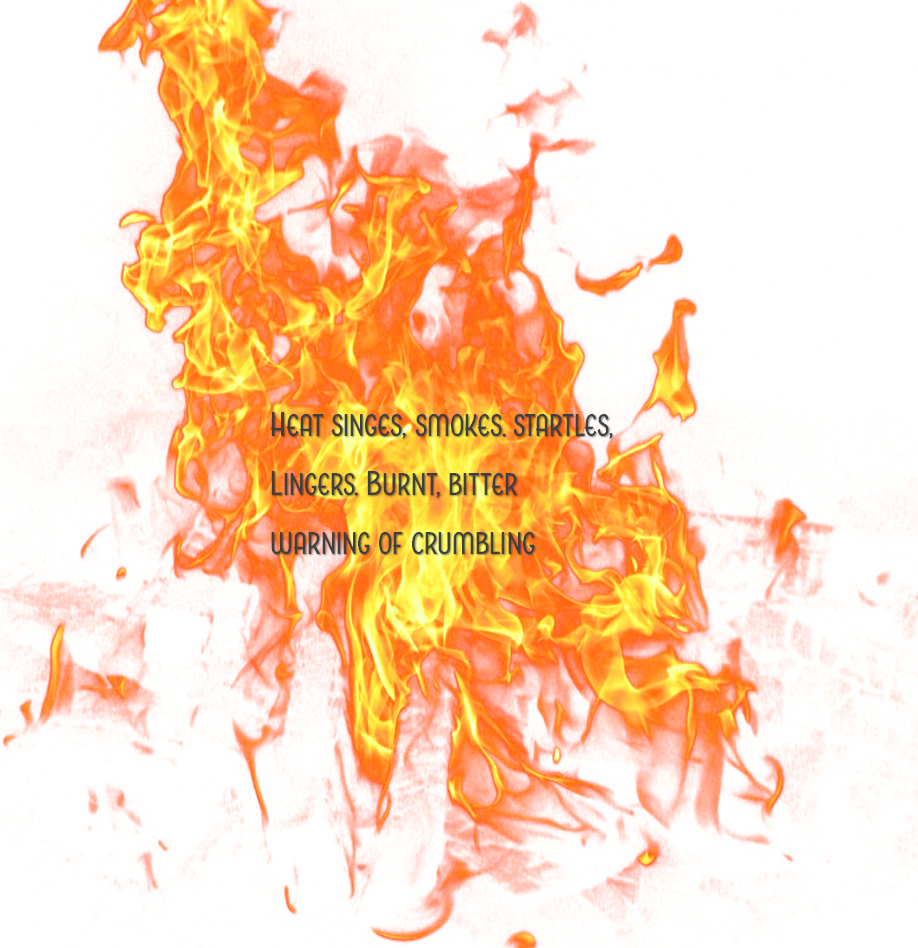
heat singes, smoke startles,
lingers, burnt bitter
warning of crumbling

I wasn’t entirely satisfied with this — though I think it fulfilled the requirement. But, I wanted to write a burn-book burning haibun. Why not use Shakespearean insults? (“Your brain is as dry as the remainder biscuit after voyage.” As You Like It [Act 2, Scene 7]; “Thou damned and luxurious mountain goat.” Henry V [Act 4, Scene 4] 🐐, or what has to be one of my all-time favorites “Thou whoreson zed, thou unnecessary letter!” King Lear [Act 2, Scene 2]. Imagine being insulted as the “unnecessary” letter z!🤣) Or can you imagine a poetic “yo mama” battle? There were so many ways to ‘burn’ with this, once I was able to let go of being literal… I’ll have come back to those another day. Meanwhile, others have emerged victorious from the burning! Tricia’s poem is here. Sara’s poem is here. Laura’s poem is here. Mary Lee’s poem is here, and Liz’s poem is here. Michelle K went the second mile with two haibun, while Karen rose to beautifully meet the challenge here. Carol’s poem transformation is here. More Poetry Peeps may check in throughout the weekend, so check back later for the full roundup. And if this challenge wrecked you, no worries! We’ll catch up with you next time.


Poetry Friday today is hosted today by the autumn-appropriate Jone Rush MacCulloch, whose Halloween-esque haiku and full-moon artwork I’m enjoying on the calendar she gave me. Thanks doubly, Jone. Though sometimes it feels like the world is on fire, our present suffering is no more than others have faced in other nations at other times, and it, too, shall pass. I remind myself as well as anyone else who needs to hear it: trouble is neither as special nor as unique as we might think – which means we are not alone in it, especially if we look up and reach out to those around us who are very likely feeling some kind of way, too. Nolite te bastardes carborundorum – in hoc una sumus. Remember, at this and every other time, you are so well-loved.

{this wasn’t on my September bingo card, but I’ll take it}


Sometimes, the ways in which we are really, really fortunate are breath-taking. I was blessed to have a second chance at publishing when Katherine Tegen took an interest in my work. I’ve been privileged to work with really wonderful editors, copyeditors, and designers at Harper-Collins. Brittany Jackson’s art is a-mazing, and I am blessed to have FOUR of my books sporting covers of hers. Berry’s tangerine (and slightly rage-fueled) energy in this illustration even caught Booklist’s eye. Drinking deep of the last dregs of summer, I am happily readying for the brilliant, sizzling colors of decorative gourd season, looking forward to my book’s release in a couple more weeks, and gratefully counting my blessings.

{pf: poetry peeps are pen-pals with poetry}

Welcome to Poetry Friday!

Poetry Peeps! You’re invited to our challenge for the month of September! Here’s the scoop: We’re going to take up the challenge of tritina. Invented by poet Marie Ponsot, this less restrictive younger sibling of the sestina uses three repeated words to end three tercets. The order of word-endings for the tercets are 123, 312, 231, with a final line acting as the envoi, featuring all three words in the 1-2-3 order used in the first stanza. Additionally, we’ll continuing with our theme of poetry in conversation, in whatever way that is individually defined. Sound a little tricky? Maybe? Are you still in? You’ll have a month to craft your creation(s), then share your offering on September 26th in a post and/or on social media with the tag #PoetryPals. We hope all of you will join the fun!


It hardly seems possible that the harvest season is here and that summer is slouching towards completion. The choral season has kicked off, and we were greeted the first night of rehearsal with bushels of cherry tomatoes from someone’s out-of-control indeterminate plant. From our own wildly out of control mini-orchard, we have picked two tree’s worth of pears, and three tree’s worth of apples, most of the mulberries and we’re just getting started on the table grapes that are turning a deep purple. We’re feeling particularly grateful to family and friends and have not yet stooped to midnight produce deliveries to strangers… but we’re getting close. (THIS is why we don’t grow zucchini anymore…) I feel my Depression-Era grandma’s memory peering over my shoulder as I chop out the wormy bits and bag apples for the freezer. (Ninety-six cups and counting. 🫣) To be honest, I am grateful for both the bounty and for the distraction – it widens my focus from the continuing heaviness of grief in the world, and helps me gain a little bit of perspective. Seedtime and harvest persists, in spite of the destruction of so many other reliable cycles.

From Process…

Processes continuing was on my mind this month. Having missed yet another gathering of the Poetry Princesses, I was determined to make up for the loss of writing in community by really leaning in to the poet herself. I read a few Giovanni poems before circling back to this one, more to hear her voice than anything else. Then, I listened to the poet read this poem aloud – from a video of the first season of HBO’s Def Comedy Jam from 2001.

Writing in conversation with a narrative poem is tricky. I found I wanted to imitate the poem more have a discussion with it, or with the poet. After reading the questions in the poem, I realized that Giovanni’s interrogation asked questions only human beings could answer. In essence, where are we taking poetry? Where has it been seen? Is it lost, and useless, as many people suspect (I admit to still being annoyed that the NPR Books newsletter a few weeks ago asked, “Whatever happened to poetry?” with apparently no irony intended)? Have we forgotten what gifts the arts have given us which have carried us through to this current moment? Was what carried us poetry? Does it have a place, in this blues-making world? What will allow poetry, stories, art in general – emotion expressed in imagery, allegory, rhyme, or meter – to persist?

…To Poetry

I’m not generally a person who likes to write poems about poetry, but that seemed to be the assignment. Though there are many other things Giovanni could be talking about or addressing her words to, I chose to take her words literally and look at poetry across the table. I dislike talking about poetry in general because I try to avoid making direct and sweeping statements about arts. I have Opinions – so many – about what I like in poetry, what I think is overdone, and what is definitively not to my taste, nor ever will be. Nikki Giovanni seems to have had opinions throughout her career, too – but here, she works to subvert both readers’ expectations and possibly her own by writing to poetry as if it is both audience and speaker, confessor and consort, both the discarded art and the callous deserter. I attempted to mimic the poet’s confiding tone and close, fron-porch-conversational vibe:

Sing With Me, Poem

After Nikki Giovanni’s “Talk to Me, Poem. I Think I Got the Blues.”

Sing with me, Poem.
A solo just now
feels like spotlight
and stage fright.

Have you crooned loss and lament, Poem?
A lot of poems serenade on setbacks,
hum the hundred thousand hymns
of ‘alone’ and being left,
of the broken and bereft.

Hear how melody marks your trail –
constructing cairns rife with rhythm.
Stanza beckons scansion,
Employing unexpected enjambment, as
Pas-de-deux, couplets kiss,
Alliterating the way to bliss.

I know: blank verse is more respected.
Too much rhyme’s mostly rejected
(Think Dickinson and “Yellow Rose -”
Some only stan a poet who loves prose.)
But… who sings the tune without a beat?
Meter sans rhyme seems incomplete.

So, what’s next for you, Poem?
You’ve done American idyll,
Been burnished on plinths,
brayed from pulpits, and
laureled by laureates. Even my socials
Sing your songs on Instagrammed posts
passed along.

…can we sing with you, Poem?
Even if we don’t have the words?
What makes a song enough to be heard?


Despite what all else Giovanni’s poem asks, I find the real question is, what will make poetry persist? I think the answer is… WE WILL. And we’re already doing it, right here in this community. Liz’s persistence is here. Tricia’s poem is here, and Michelle poem is here. More Poetry Peeps might swing by with their creative conversations with Nikki Giovanni’s poem, and I’ll round ’em up here by the end of the weekend. Meanwhile, coffee aficionado and all-round lovely person Karen Edmisten – sharing her own delightful poetic conversation – is our Poetry Friday hostess today. “>Thanks, Karen!

There’s a lot of moving parts in this world, and a lot of feelings and thoughts about that to process. As long as there’s emotion in need of expression, there will be poetry. As long as there are people, there will be emotions, and words. As long as there are circumstances which delight, confuse, infuriate, grieve, and annoy us (with things like too many apples), there will be a poem to illuminate, celebrate, or merely to elucidate. In the meantime, don’t forget to wash your hands – the creeping crud is surging yet again. Hydrate. Dress your bed with gorgeous sheets. Call your youngest family member and horrify them with your use of ‘stan.’ Live a little. Love a lot. And remember, your current circumstances won’t last forever. In this and every moment, you are well-loved.

{pf: poetry peeps are desperately seeking sedokas}

Welcome to Poetry Friday!

Poetry Peeps! You’re invited to our challenge for the month of August! Here’s the scoop: If poetry is a love letter to readers, this month, we’re writing back. Using Nikki Giovanni’s “Talk to Me, Poem, I Think I Got The Blues” as a mentor verse, we’re writing poetry directly in conversation with a poem. Whether you talk back directly to Ms. Giovanni’s work, or choose another poems to pass notes to is up to you, as is length and form. Are you in? You’ll have a month to craft your creation(s), then share your offering on August 29th in a post and/or on social media with the tag #PoetryPals. We hope all of you will join the fun!


That screech you just heard is your girl sliding in to Poetry Fridayland just under the wire. I’m grateful it’s Friday, but I much prefer to have time to write a poem and ponder over it. It’s a Poetry On The Fly type of day, following a week of life-on-the-fly which included missing the Poetry Sisters meet-up, so please to bear with my scattered and mildly inarticulate writing-the-poem-right-now thing. Ah, well – the point is the exercise, no?

From Process…

In “Asphodel, That Greeny Flower” William Carlos Williams, after many meandering lines, finally takes one of his more wonderful poetic turns when he says, “It is difficult / to get the news from poems / yet men die miserably every day / for lack / of what is found there.” The lack of “what is found there” is a breadth of unnameable, unknowable things, different for each person, but one specific thing that I know that people are dying from is from lacking understanding of how much the same we are. When we read poetry, we know that your experience and mine, though lived in different nations, under different stars, is the common stuff of humanity. (If politicians knew that and believed, surely they could legislate with mercy and justice, no?)

The Poetry Sisters’ “In Conversation” theme fits particularly well with the idea of shared human experiences communicated through poetry. I decided today’s Poetry Friday exercise would be to look very literally at the idea of it being difficult to get “the news” from poetry by looking at poetry through the lens of the news of the day. I tried to be very specific – the news needed to be from THE DAY – which for me meant the last twenty-four hours. There was quite a bit of local news that tempted me, but I chose a national story, one that is our latest national shame.

By now you’ll have heard of the latest executive order.

As a child, one of the next door neighbors worked with patient programs at a mental hospital. Petra didn’t talk about it much, until the state funding for the programs were cut under the 40th president when I was about nine or ten, and then we ALL heard about it. She was furious – and afraid of what would happen to the many, many people in need of care. That was my first experience of understanding that not every political decision was unanimous. Through her vociferous complaints I learned that there was no assumption of agreement just because everyone was an American.

…To Poetry

Myriad people have myriad responses to the decisions made on behalf of Americans today. I put my responses in the form of sedokas, unrhymed poems made up of two three-line stanzas called katauta, because sedoka are comprised of a pair of katauta and each one may address the same subject from a different perspective. One of the most valuable things we can do is to see the news from multiple directions. This isn’t just an exercise in argument – the devil needs no advocates – but an extension of the idea of the commonality of experience. I used direct quotes from organizations and people quoted in news stories as the titles for these sedokas, and as a sort of date stamp of a particular bit of news from a particular point in time. I think this might actually be a difficult but satisfying National Poetry Month exercise – opening the paper (physical or digital), grabbing a headline or quotation, and writing sedoka that strive to experience the news from varying but complementary perspectives. Here are today’s efforts:

According to research from Charles Schwaub, 59% of
Americans are one paycheck from homelessness

I.

With walls closing in
exit raised hands and voices
this home is not a castle.

Flirt with disaster,
We sixty percent tease it
one wink away from homeless.

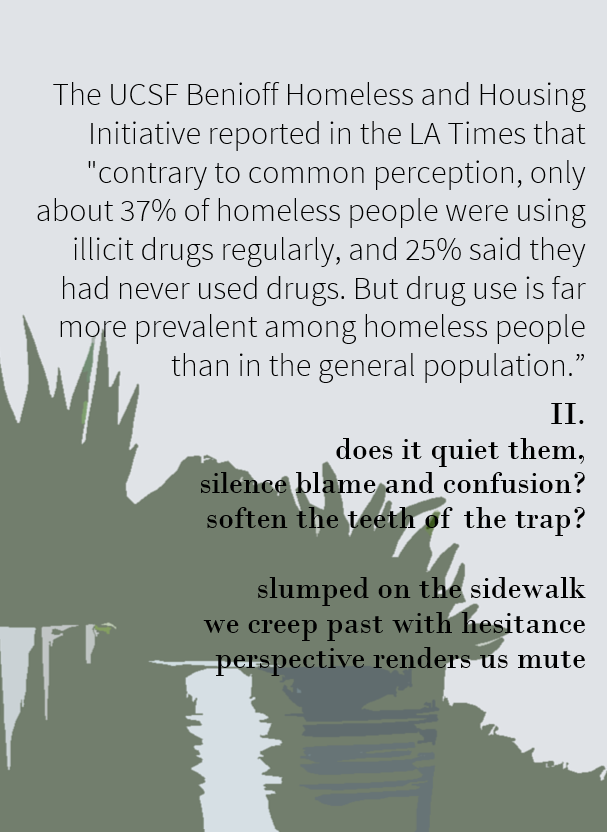
The UCSF Benioff Homeless and Housing Initiative reported in the LA Times that “contrary to common perception, only about 37% of homeless people were using illicit drugs regularly, and 25% said they had never used drugs. But drug use is far more prevalent among homeless people than in the general population. Just over 65% reported having regularly used at some point in their lives, and 27% had started after becoming homeless.”

II.
does it quiet them,
silence blame and confusion?
soften the teeth of the trap?

slumped on the sidewalk
we creep past with hesitance
perspective renders us mute.

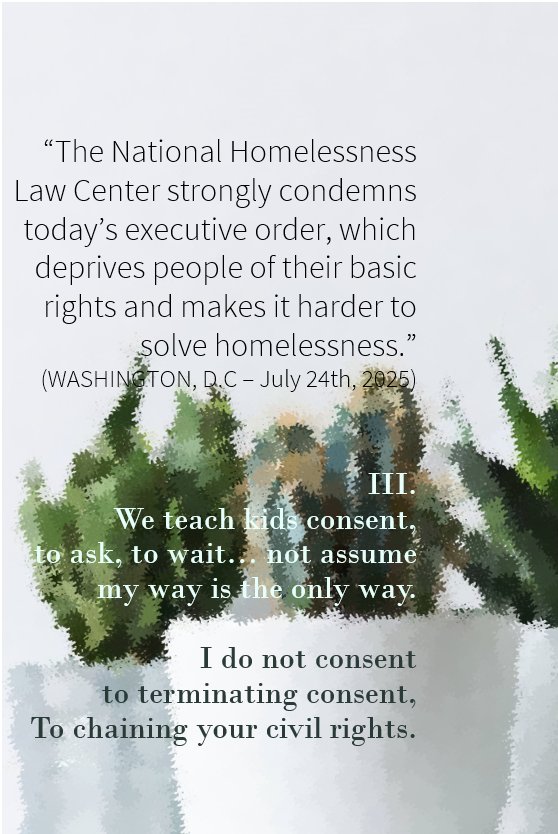
“The National Homelessness Law Center strongly condemns today’s executive order, which deprives people of their basic rights and makes it harder to solve homelessness. …This order does nothing to lower the cost of housing or help people make ends meet. The safest communities are those with the most housing and resources, not those that make it a crime to be poor or sick. Forced treatment is unethical, ineffective, and illegal.” (WASHINGTON, D.C – July 24th, 2025)

III.
We teach kids consent,
to ask, to wait. Not assume
my way is the only way.

I do not consent
to terminating consent
To chaining our civil rights.


I’m eager to see what my participating Poetry Sisters and everyone else came up with this month. Tricia’s post is here. Mary Lee’s book review plus poem is right here. Michelle’s sedoka is here. Diane’s sun-positive sedoka is here. More Poetry Peeps might swing by with their sedoka and I’ll round ’em up here by the end of the weekend. Meanwhile, Marci is our Poetry Friday hostess today, and is probably far more organized than anyone around here, even with just getting back from a fabulous-looking writing retreat. Thanks, Marci!

There’s a lot more news to consider, but there’s also a time to close the paper, and go outside. Don’t forget to appreciate the things that you are fighting to preserve. Touch grass. Hydrate. Reach out to friends. And remember, you are loved.

{pf: a summer swap surprise and the community is the point}

Welcome to Poetry Friday!

Poetry Peeps! Just a reminder that our challenge for the month of July is… the Sedoka. You’ll have a month to craft your creation(s), then share your offering on July 25th in a post and/or on social media with the tag #PoetryPals. We hope all of you will join the fun!


These last several weeks have been a bad combination of crazy busy and deeply fatigued as we’ve packed, moved, unpacked, and proceeded to do the summer hustle of enjoying visitors in between catching up on appointments. I knew with as much as I have going on that I wouldn’t have time to really make a good effort with the Summer Swap this season, so I bowed out of participating. Imagine my astonishment to receive – on the same day, no less – two poems from Poetry Friday stalwarts who nourished me with images and words of beauty and certainty. Linda Mitchell and Rose Cappelli gave me a spark of life this week, and I am deeply grateful. Muchísimas gracias, poets.

You can click on the image to enlarge it and see Linda’s handwritten invitation for me to ‘Begin Here,’ which was wrapped around a beautiful poem based on a Joy Harjo title (that woman has the best titles for her poetry collections!), and gaze greedily at the lacy water from the glorious fountains at Longwood Gardens, a place I clearly need to go and spend a whole week someday. (I think the postman read Rose’s poem as well, as he took an extra moment with her card before slipping it into our box. Poetry on postcards is a win for the world.)

From Process…

I especially needed the kick in the bum Linda’s ‘junque’ journal provided (I cannot use her word, ‘junk,’ with any seriousness, even knowing this journals is made of bits and bobs from weeded library books, unused student notebook paper and prompt pages from the On Being summer project), because poetry in a time of busyness is hard, but poetry in a time of shrinking – and flinching – is nearly impossible.

When I was a child, I used to jump when the teacher raised her voice at other children. I cringed when my siblings were disciplined – or, let’s be real, punished. I don’t do well with… unkindness, and right now, there is just. so. much. I’ve been flinching like a dog recoiling from fireworks every time I read the news or hear a Morning Edition on NPR for weeks now. What did Adam Serwer tell us in 2018? The cruelty is the point… and it grinds down my soul like a cheese grater. When I read the first prompt from Krista Tippet, asking what brought me despair and what brought me hope, I could answer at least half of the question reflexively.

I was privileged to do a poetry exercise with the exceptional poet-teacher Michelle Schaub the other day, focusing on figurative language and metaphors. Using Quilts by Nikki Giovanni as a mentor poem, we discussed the effect of the metaphor in comparison, but also in contrast. Once I decided to use an extended metaphor in this week’s poem, I knew I needed to figure out ways to shed light on opposite themes. If hope is a thing with feathers, then what thing is it not? If what is filling me with despair is cruelty, what is giving me hope? I was stuck on that hope bit for an annoyingly long time.

…to Poetry

Rereading the beginning of the Atlantic piece gave me an inkling. It’s in the rather grisly beginning, where Serwer recounts what he calls the “catalog of cruelty” found at The Museum of African-American History and Culture through photographs, not so much of the deaths of African Americans, but the unhinged, grinning glee of their murderers. He writes, “Their names have mostly been lost to time. But these grinning men were someone’s brother, son, husband, father. They were human beings, people who took immense pleasure in the utter cruelty of torturing others to death—and were so proud of doing so that they posed for photographs with their handiwork, jostling to ensure they caught the eye of the lens, so that the world would know they’d been there. Their cruelty made them feel good, it made them feel proud, it made them feel happy. And it made them feel closer to one another.” Et voila. What gives me hope, and what has always given me hope as an adult with still such an incomplete understanding of the word, is community. That gathering around and embracing of a shared ideology. That source of collaboration, assistance, understanding, camaraderie. That thing which, for much of my younger years was simply an abstract, but which, as I have stepped away from the rigid isolation I grew up in, I’m beginning to find the shape of… Community is what both the cruel and the compassionate are seeking.

The community didn’t make it very far into today’s poem except in the envoi. Cousin Mary Lee’s fourth of July poetry prompt seemed to me to be for protest and resistance, not necessarily collaboration and coming together. I’ll circle back to this another day, but for now, this is a day for history to remind us of a two-fold truth: this IS who some of us are, and who some of us want to be – and the rest of us who don’t want this? Will reach out to their neighbors, circle up the wagons, and resist.

4TH OF JULY 2025

Looking back, THE
history books will show
how, six months in, CRUELTY
has not plateaued.
My country as it IS
I do not know.
We once fought hate, we THE
shield of small and slow.
But now, axe sharpened to a POINT
The fascist thinks to deal out a death blow.

Though cruelty is some people’s way of life
Together we are strong, even through strife.


Whether or not you protest or party today, know that the tiny thread of connection in all people is our need for community. What are the ways that you can gather in strength and strengthen others? What are the ways that you in particular can use a passion or a skill particular to you to pour oil, bind wounds, or strengthen the courage of your community? I know I’ll be thinking of the answer to those questions myself this Fourth. If you’d like to continue to think in nuanced ways about this complicated and confusing country we call home, and read more poetry of protest and praise on its birthday, head over to A(nother) Year of Reading, and thanks, Mary Lee for hosting.

Be well, friends, and do good.

{come for the poetry friday roundup! stay for the peeps wrestling the raccontino!}

Welcome to Poetry Friday!

Poetry Peeps! You’re invited to our challenge for the month of July! Here’s the scoop: We’ll going to write brief poems called Sedokas. A Sedoka is an unrhymed poem made up of two three-line katauta with a 5/7/7, 5/7/7 syllable count. Since a Sedoka has only six lines, you can totally do this! Of course, we’re continuing our theme of being ‘in conversation,’ next month as well (and since Mary Lee has invited us to join her at A(nother) Year of Reading for protest Poetry on Independence Day next Friday, this might be a great short form to use for that!). Are you in? You’ll have a month to craft your creation(s), then share your offering on July 25th in a post and/or on social media with the tag #PoetryPals. We hope all of you will join the fun!


Whew – just like that, summer has come in, and wow is it trying to redefine the definition of “heat” in much of the United States. To those of you prostrated before your AC and fans, we see you. Normally it’s California sweltering with no mercy, but so far this year we’ve had a really slow beginning to the more vicious heat – which leads us to believe we’ll be in steaming puddles by August, but let’s kick that can of sweat down the road, shall we?

Meanwhile, THIS is the place for Poetry Friday links!

Click, Friend, And Enter


Can I take a moment to revisit my Poetry Peeps invitation for last month and snicker? I wrote, “We’ll going to write a couple of couplets and make a Raccontino. Never heard of the form? No worries. If you can count to two, you can play with this delightful form.” Can anyone tell I’d forgotten that I’d struggled with writing a Raccontino before? The Poetry Sisters did, in fact, attempt them before. In 2015 I bleated, “This raccontino stuff is BLOODY DIFFICULT.” …Heh. So much for the ‘delightful form,’ huh? And yet: while it’s definitely complicated, this time around, it hasn’t been that bad.

From Process…

In Italian, a raccontino is a narrator or storyteller, so it stands to reason that the Raccontino form tells a story. From the title, which some poets compose as part of or an entire sentence, to the couplets, to the end words of the odd-numbered lines, each element tells a small story that braids together into a whole. I came back to this frequently.

When we gathered for our drafting session, the Poetry Sisters recalled our previous processes. Last time I tried this, I tried writing the odd-numbered end line phrase first, the even-line rhyme scheme second, and the title/rest of the poem after that. That worked for most people, except I could only think of long quotes/sentences for my end-line story, so ended up with ten thousand couplets. (I started over a lot, and whined a lot more.) We got a giggle remembering how last time Sara jiggered the end lines only after writing the poem – yet somehow made that chaos work into a beautiful, heartfelt piece. Those who can throw down with chaos do, I guess!?

…to Poetry

This time around, I started with a handful of end-line quotations to use, but some of them were a little too close to the bone, and I abandoned the very first poem I wrote mid-word. What is it about poetry that sometimes leads it to be …well, too true? Anyway, I turned to my back-up phrases and hoped they were a bit more generic. The title of the first one I got through was based on something my little sister said, and the rest is realism based on a comment about ability/mobility and arthritis from another poet in our circle. I liked how they came together.

Because a Raccontino calls for only one rhyming application, as I wrote that second poem, I found myself struggling with the meter. I could write a …decent enough collection of words within the boundaries of the rules, but I spent a lot of time cherry-picking and fussing, trying to find a flow. I gave it up as “good enough” when somehow, a third poem just… suggested itself. I came up with it because I went back to reread my 2015 post and words in conversation with the concept of “it’s a jungle out there,” arrived from the title of my first poem. (And, hand to God, as my friend L says, I didn’t even realize that the first part of the end-line words, “Undeclared, this war rages on, grab hands, stay close” were written in reference to the 2015 undeclared war against ISIS in Iran and Syria until I was writing this right now. Plus ça change, plus c’est la même chose, non? God save us from ourselves.) Because it’s a jungle out there, we need to live with honest hearts and true, and keep each other close… still holding hands before we jump, which I unthinkingly reechoed from the past. Just for fun, I’ll share both finished poems, but the last is definitely today’s winner for me.

I’m Not Lazy, I’m In Power Saving Mode

We ran full-tilt, but now we take it SLOW –
(Our changing bodies outside our control.)

We hustled once, but forced, we’re slowing DOWN,
Extending Pain-Free days is now the goal.

It’s galling when the doctor croons, “Hey, YOU,”
And lays out reasons, with her words cajoles,

Assigning PT. We relearn to MOVE:
(Make no mistake, pain’s jail without parole.)

Our choices going… gone – Have yours gone TOO?
Does freewill feel like what your body stole?

We whine, but truth to tell, life changes FAST
Who knows – someday we might again feel whole.

This chronic pain crap may leave you downcast.
But keep the faith: Life’s mysteries are vast.

You’ll notice I’ve included a little envoi as if this were a sonnet. I don’t know – somehow today it felt like envoi were necessary? Additionally, the image is of the Bay Bridge in SF – not the well-known and fancily painted Golden Gate, but the plain old Bay Bridge which carries much of the common daily commuter traffic – not the 59th Street Bridge, but probably as pedestrian for people just getting to work or cycling across one bit of water to get somewhere else. Maybe the drivers are not yet feeling groovy, but having the potential for it…I like that link to joy in the ordinary.

Other Raccontino wrestlers are perhaps feeling pretty groovy or reveling in the ordinary as they share their forays into this form. I got a tiny preview Sunday and know that Tricia’s efficiently composed poem is here. Sara probably chose more chaos here, Mary Lee – always prepared – is here. Laura’s short and to the point is here, and we can’t wait to see what Liz has done. Karen rose to the challenge and wrestled her Raccontino here. Michelle K’s poem has punch, and we have a newcomer – let’s welcome Diane and her Raccontino to the Peep Squad. Margaret’s poem is here, and Carol V’s lovely poetry-filled post is here. More Poetry Peeps might swing by with their Raccontinos (Raccontini?) and I’ll round ’em up here by the end of the weekend.

Life, Improvised

So, how does it start? You, what, simply hold
Your heart on your sleeve and hang it out there
To sweat in the spotlight – your fate in its hands?
Sounds awful! Exposed! Most people’s nightmare.
A big life says, “Yes.” Acceptance adds, “And?”
An honest life asks that you lay yourself bare.
Why skulk in the shadows when courage cries, Jump!’
Living your truth means that you build wings midair.

Freefall has its benefits — and by and by
You’ll forget about falling. You’ll have learned to fly.


My nephew graduated from high school nine days ago, and turned eighteen seven days ago, so the imagery of jumping into life – nervous, but holding hands – improvising, and learning to fly is definitely on my mind. The younger set remind us we all need a little help to get aloft – our neighbors, our chosen family and friends, and the community we need to keep close, now more than ever as the clouds close in. Elf’s fledgling flight might be a ragged one, with a bit of frantic flapping and barely missing crashing into windows at first, but if he falls, I’m counting on the rest of us to raise him up and run until he finds the wind again – into whatever extraordinary life is allotted to him. Whatever your age, may your circle do the same for you. May we never discount the power of community.

Look for the interconnected stories you’re telling, or have been told, and see where your narrative intersects. Remember that Yes. and And? are invitations to acceptance and connection. Know how well you are loved – and may it fuel you to love in return.

Happy weekend. Be well and do good.

{npm♦4/30}

On the eve of a turning page of American history, it feels important to keep looking back. History has a certain weight and inevitability… We lived through it. No matter what various heads of state try to delete, they can’t erase family stories, personal recollection nor every diary and attic stored record. We are here. We remain. We persist.

transient

Spring without flowers
Still comes, days bright and warming:
Know winter passes.

♥•♥


{npm♦4/28}

A collection of nostalgia fills the words, My Country, ‘Tis of Thee. Despite a tune shared with the British anthem, the song resonates, and raises longing eyes to the horizon of our imagination, in memory of a collective past most did not share. Not the land where all our fathers died. Not all descended from prideful pilgrims. Still we have craved the intimation of freedom, a definition of ‘belonging’ expanding to include us as we struggle to fit our picture into the American album. This is Nye’s shared world – not one of rejection but of acceptance, of mamool shortbread, and powdered sweetness dusting open palms.

we believed it would last forever

hold a moment more
the shape of home, of ‘country’
a sapling stretching
        in deep-rooted certainty
        of endless ripples of rings

♥•♥


{npm♦4/26-27}

Last week I used the phrase “sickly uncertain” to describe the feelings of this current moment, and that resonated strongly with several others. Uncertainty is something most humans avoid and yet, so much of our lives are made up of it. We’re unsure even how to react there’s days. And yet, we are surrounded by so many people just now who seem to dwell in certainty – certain that they are right, are making the right choices, and are leading us to the best possible future for the most people. Of course our children should be raised like theirs. Of course we believe like they do. Of course this is how it should be.

If only we were certain they were right.

not faith: certainty
that DIY deity
gaslighting us all

our greatest hits

let’s call it’s ‘discord’
since ‘diversity’ is bad:
divergent voices
     bring each note to the table
     each in turn, we still make song


{pf: npm♦4/25 & the poetry peeps have ekphrastic exchanges}

Welcome to Poetry Friday!

Poetry Peeps! You’re invited to our challenge for the month of May! Here’s the scoop: We’ll be in conversation with Elizabeth Bishop’s “Letter to N.Y. in the form of a golden shovel, as created by poet Terrance Hayes. Of course, your choice of line from the many is entirely up to you. Once you’ve chosen, you have a month to craft your creation(s), then share your offering on May 30th in a post and/or on social media with the tag #PoetryPals. We hope you’ll join the conversation!


This has been a poetry-rich month already, so moving to look at something old in a new way was a pleasure. The Poetry Seven deliberately chose ekphrastic for April’s challenge, intending it to be easier for the many of us writing daily poetry. The only rule was that our poem had to be in conversation with a vintage photo – and we made no rules about what “vintage” meant, as it means something different to all of us.

From Process…

I felt as if I’d cheated a bit by prepping ahead for this challenge. Part of my NPM practice has been creating weekly collages of Americana – photographs, posters, and bits of ephemera representative of America to me while writing short poems as an attempt to process our current… moment. I had access to myriad pictures this month, and enjoyed taking the time to really look at them. The photograph I chose is for this poem is from May, 1943, taken in a Harlem, NY neighborhood by the brilliant photographer Gordon Parks for the Farm Security Administration/Office of War Information. The Library of Congress has myriad of Mr. Park’s FSA/OWI photographs in their Flickr collection, and I find that sifting through them is an experience like looking at old family albums. You don’t know who any of those people are, and your mother can only remember it was her mother’s second or third cousin’s auntie, and not a single name, but regardless, you retain a sense of connection. Once upon a time, these people lived lives like yours, put things out to thaw in the morning for dinner later, exclaimed over the first strawberries of the season, muttered over weeds, took out the trash, tightened their shoelaces. Once upon a time, their lives were like your life, and so on and so on it will go, until one day the vintage image in the photograph will be one of you, and your people, and your time. There is a true sense of connection in all of our stories.

I especially appreciate that Parks spend a lot of time photographing the ephemera of segregation that are recorded in a lot of other images from this time. You don’t see a focus on Whites Only signs or anything like that. Most of that he obfuscated by photographing ordinary people… living their ordinary lives. His images aren’t composed and tidy, but spur of the moment snaps that showed how people really navigated the American landscape. I really do encourage you, as you have time, to page through his collection at the Library of Congress, or the myriad other images on the Library of Congress’ Flickr collection. It’s quite a piece of history, and we need to embrace it while we have it.

…to Poetry

I have forced my focus to be on short poems this month, though I have moved between haibun, cinquain, and tanka, unable to settle on any one form for what I want to say. As that has worked fairly well, I decided to deliberately move between forms again, allowing myself to look at different aspects of this very striking yet ordinary photograph through the lens of an elfchen, cinquain, and finally a haibun. This image is composed of myriad small things. What I love about it is that those small things shows me so much. Look at the care this woman took with her appearance – her nails are painted, though we can’t see the deep red her thumbnail and perhaps her lips sported. She’s wearing hoops, her brows are plucked and shaped, and her hair has marks of a roller set. She’s got on a snugly buttoned cardigan beneath her wool coat, and on the windowsill, the newspaper is spread. I wish I knew what was in her hand – her house keys? A spoon for her tea? A handkerchief or the puppy’s leash? Her presence in that window has the flavor of ritual. Perhaps she’s going to pop back inside in a moment to grab something to munch on while she checks out who wore what to work today, and who is being seen home from the bus stop by whom. I love how her dog is just as eagerly interested in the events outside of his house – his territory is being sniffed out, and listened to, and he’s rigid with attention. I love that we have a picture of a Black woman with a pet. Not a mop or a vacuum. Not a passel of children or a man. A pet, a manicure, and a good coat, and every appearance of self-satisfaction as she looks out of the window alone. Bully for you, girl.

Pavement Patrol

Windowsill leaners
Afternoon dreamers,
Nose for the news of the day on the street.
Watching the weather
Birds of a feather
Harlem-bred harbingers gossip and greet.

Harlem Hound

Sit. Stay.
Eyes sharp, ears high
Voices rise like hot air
Scent unrolling tales like newsprint
Good boy.

Elfchen für eine Harlemite

Eyes
A shade
Of skeptical,
Girl’s already seen it all
before.

(The colorized image is courtesy of amateur colorist PaadonMe in March of 2015 on the Shorpy.com website.)

Though I can only see her right hand, and don’t know if her left bore a ring, I admire her classy wool coat and seeing her knitted cardigan layered beneath know that May evening wasn’t quite warm enough yet for the windows to all be thrown quite so wide. Still, she’s ready for a change, eager for it in jaunty hoops and red-varnished nails, perhaps a domestic, breathing in the evening from her very own window, an office typist or a wartime riveter returned home for the evening, spreading out the paper and checking on the neighborhood between headlines. Perhaps she has a kettle at the boil, readying a last cup of coffee before she settles in, the wind in her face, and change on the horizon.

She wasn’t lonely
With such brave companionship
And the world turning
        Below, everything changing
        Country unstitched and made new.


There’s more in the photo album. You’ll find Tricia’s poem here. Liz’s poem is here. Laura’s skinny poem and Sara’s tribute is here. You’ll find Mary Lee’s poem here and Michelle K’s poem is here. More peeps may join in the ekphrastic exchanges before the weekend is over, so do check back for the full round-up. Meanwhile, Poetry Friday is ably hosted today by my second cousin, Heidi in her juicy little universe, where you’ll find plenty more poetry on all subjects, plus the latest stop on the Kidlit Progressive Poem, so don’t miss it. Thanks, Heidi!

The world is filled with hard things this week – maybe harder things than you’ve expected, in this moment. But in the words of Eleanor Roosevelt, “We do not have to become heroes overnight. Just a step at a time, meeting each thing that comes up, seeing it is not as dreadful as it appeared, discovering we have the strength to stare it down.” We are leaning next to you, in our own hero-training. We share your windowsill and we’re looking out and giving a skeptical, brows raised, dispassionate stare at whatever is currently troubling you, right next to you. Whatever this moment is bringing you, you are not alone in it – remember, you are well-loved.

Have a courageous weekend.