{poetry…comics…?! npm ’26}

NPM ’26 ♦ Sing On, O Mighty Pen

In 2007, my friend Sarah and I saw artist, author, puppet maker, and all-round personified avatar of art Yuyi Morales in San Francisco. (It was at Alma Flor Ada’s Reading the World conference, a single day event put on by the International & Multicultural Education Department of the University of San Francisco from about 1998 – 2009. It was life-changing, and I don’t say that lightly. That year we also heard from the glorious Ashley Bryan of blessed memory, and the incisive and intimidating Jane Yolen). During her talk, Artista Morales spoke about creation as an act of faith, and how her act takes belief in herself, persistence and determination. On a handout with some of her drawings, she shared her prayers to Señor Tlalocan, the Aztec god of rain, lightning, and fertility who “makes things sprout.” Her hope and determination that her creativity and her art would flourish have stuck with me, all these years later. And so I think of Sra. Yuyi today this month as I write my “O, mighty pen” project. Because, even if I feel like an imposter as a poet, my pen is mighty, and with it, my creativity has – and will – sprout.

Of course, I feel like even more of an imposter as an artist.

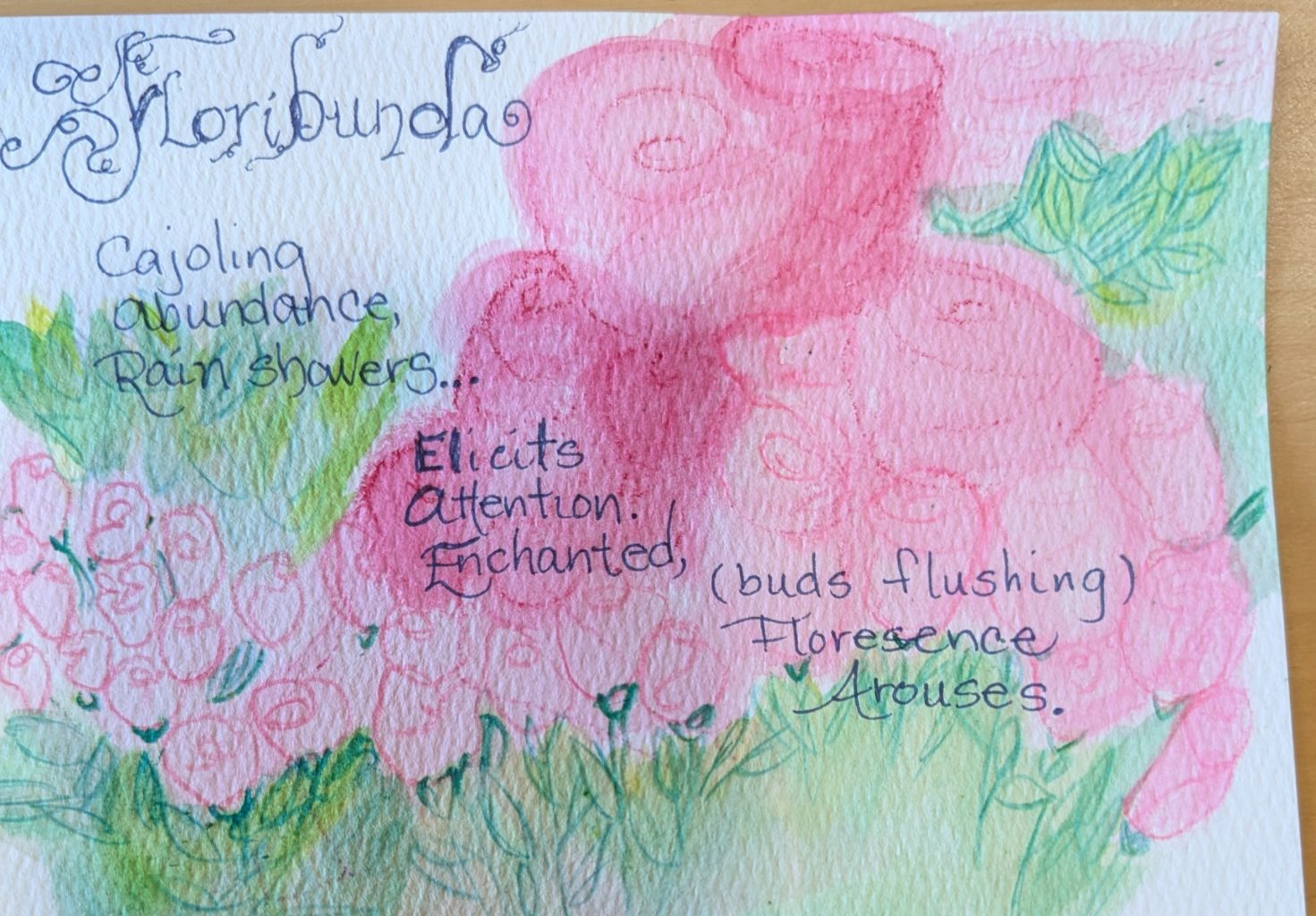
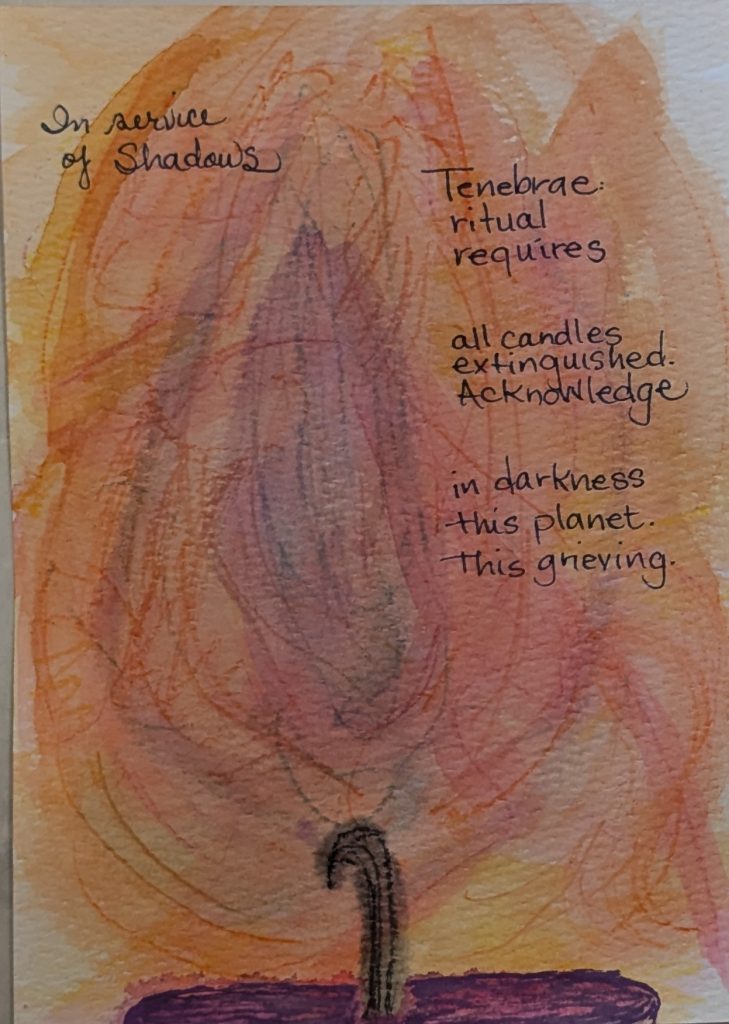
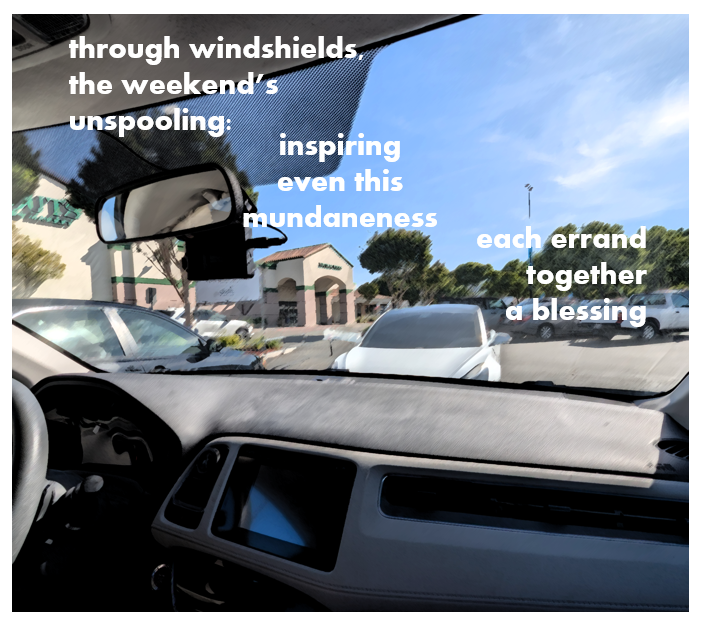
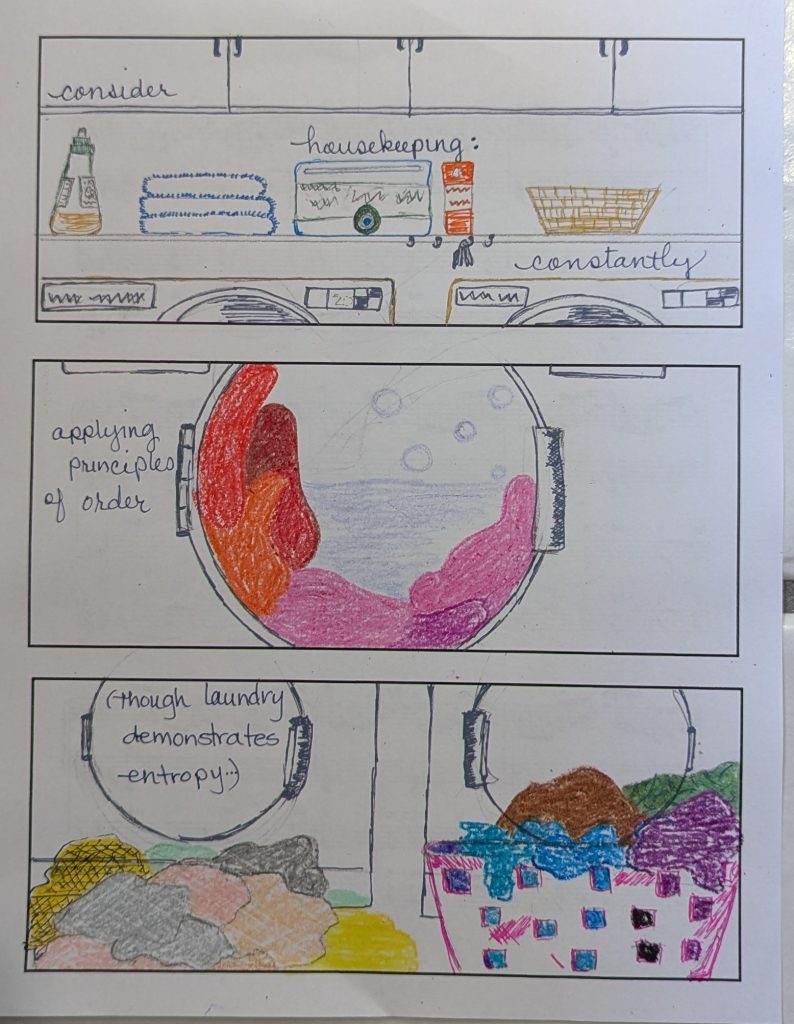
…and yet, I’m lifting my mighty colored pencils this month and taking on one more challenge. In 2023 as part of his classroom visits to schools, poet and illustrator Grant Snider put up a Substack called How To Make Poetry Comics. He reposted it last year, and I was intrigued. It is brilliant in its simplicity – and very direct about what poetry comics are, and are not to him. I’ve seen Grant Snider’s work and followed his Instagram for quite a while now, and I really like how he takes concepts and mulls them over in such a small space, so… thoughtfully and lyrically. Looking at his work, I’ve felt like four small squares – or three small panels – are surely not too much to fill, even for a person with a visual-spatial difficulty… right?

So, that’s this year’s project. Poetry + Art. Poetry Comics. Words and doodles.

Despite Grant Snider’s instructions, sometimes my art will be illustrating my poems instead of the other way around, but other times, I’m going to try and let the form direct the focus. To begin with, I’ll take it easy on myself, and just share a few of the tricube and haiku poems that strike me during the incredibly busy (!!!!) Easter weekend ahead, but later I’ll make sure and use all of his prompts – Four Senses, Here & Now, Horizontal/Diagonal/Vertical Movement, Zooming In/Zooming Out, Poem + Comic, Haiku – and then as I get braver, I’ll see where my pens and pencils take me from there…

O, Mighty Pen, don’t fail me now.


As always Jama-j has the full National Poetry Month in Kidlit rounded up here.

{pf: poetry peeps offer up the ovillejo}

Welcome to another Poetry Friday Adventure!


Poetry Peeps! You’re invited to our poetry challenge for the month of MARCH.

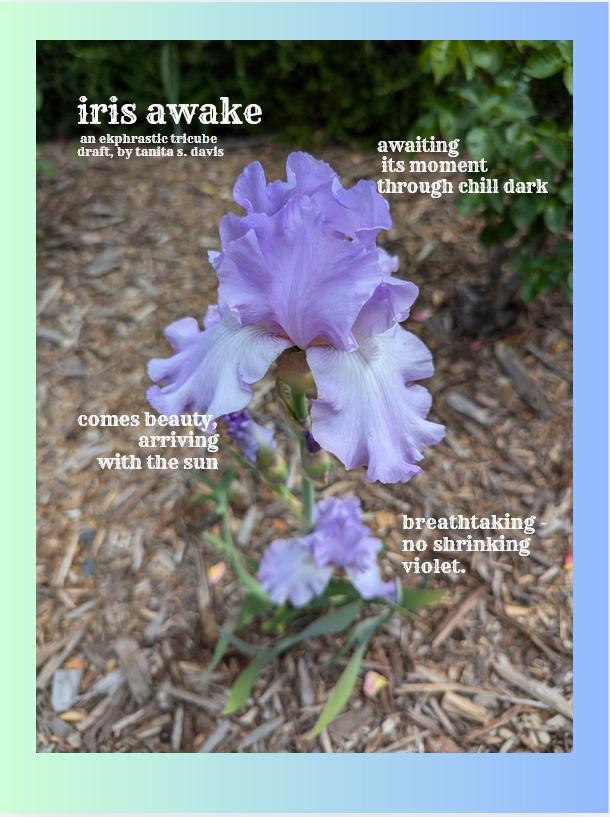
Here’s the scoop: we’re writing ekphrastic poems, which might pair beautifully with your plans for National Poetry Month (I’m attempting poetry comics). Ekphrasis is a Greek word which means “description,” and you’re invited to choose your own image from anywhere – personal pictures or otherwise. Are you in? Good! You’ll have the month to craft your creation and share it April 24th in a blog post and/or on social media with the tag #PoetryPals. We hope you’ll play along!


From Process…

Greeting, Poetry Friends! If this form was a challenge to you – well, I can’t exactly say ‘mea culpa,’ but I will own that this month, this form is one I chose…possibly unwisely, since, once again, I based my choice on cleverness and appearance… Or, in other words, because, it looked easy. I mean, it had Rules! A clear Rhyme Scheme. There was Meter and Boundaries! Except for that bit about the quatrain written in trochaic tetrameter, it was even straightforward. What could possibly go wrong?

Well… the first issue was my assumptions. Spanish is a romance language, so surely this form, first popularized in Spain, was going to be a lyrical, dance-y walk in the park, no? Er… no.

The second issue was time – and just how much this form insisted on consuming… in terms of how long I spent thinking about trochaic tetrameter and remembering what that was.😂 It’s been a minute since grad school, and I can’t honestly say when last I spelunked into the cavernous depths of poetic meter. Perhaps as an undergraduate…? In any event, a quick search reminded me – of Blake’s Tyger, of the fairies and the witches speeches in Shakespeare’s Scottish play and in “A Midsummer’s Night Dream,” and of the hard syllabic pulse of Hiawatha, which Longfellow likely meant to mimic Native American drums. The skip-stumble “falling” cadence of tetrameter in lieu of the more regular pentameter might have been second nature in 16th century Spanish, which is the original language of the ovillejo, but it was afterthought enough that I decided against attempting to use it consistently, feeling that the redondilla refrain at the end was difficult enough. The final line of the quatrain wherein previous lines are recycled came with difficulty, and the Poetry Sisters discovered during the group write that if one did not give any thought to it ahead of time, it would All Go Very Badly. We all agreed on the wisdom of beginning the poems there…

…To Poetry

…so, I did. The first time. But, I admit that I’m contrary enough to have tried just writing the poem straight out – surely that’s what Cervantes did? Writing the poem straight out required a lot more piecing things together and fussing, and revising, revising, revising – but both poems had some dissonance, written from front or back. This poem was 9/10ths revision – and I’m grateful to like pieces of both, but this was not the unqualified win that I assumed. Which, given assumptions? Is my own fault. 😂

In the spirit of applying maximum rules in order to achieve some measure of success, I tried a theme-focus first. Twilight – whether civil, nautical, or astronomical – is one of those fascinating liminal periods that lend themselves well to poetry. Since our Poetry Friday hostess is already celebrating her book of the same name, I tried to lean in as much as I could to that changeable transitoriness. The other Poetry Sisters went other directions, of course. Sara’s poem leaned into answering a question. Mary Lee joined in on theme. Laura’s fierce poem is here, while Liz’s exploration is here, and Tricia’s offering is here. You’ll find Karen’s poem here, and Denise’s poem is here. Michelle K’s poem is right here, and Margaret’s ovillejo is here. Linda B’s poema is here, and Carol V’s ovillejo offering is here – and Carol L joins us here. It’s so nice to see so many participating! More Poetry Peeps may offer their own ovillejos throughout the weekend, so do pop by for the full roundup.

The next poem I tried to come to with fewer expectations. It obviously needed to be… the opposite of liminal. I wanted it to be unsubtle, blatant. High noon, no shade. I also decided to pry my grip off of the rules for this one. In spite of this, the second poem still has elements of twilight (which happens twice a day, despite many of us only acknowledging the evening one) and took a ton of revision and probably more time than I would normally give a poem that is meant to just be a challenge. …I’m still not fond of the dissonance the form created, so stubbornly, I kept polishing. Eventually I discovered that enjambment is actually a saving grace of this form, and I was able to move away from trying to make a workable rhyme scheme towards focusing on a smoother poetic arc and making more meaning. This is where I quit:

“NIGHT SONG”
for Marci Flinchum Atkins

Light slips its leash and starts to slide –
Eventide.
In slate and *mauve, dusk’s shadow grows.
Afterglow
Veils twilight, takes its light inside,
Beautified.

Day breathed its last, and night replied
A lingering note. As warm light drained,
Cool starlight rose up in refrain:
Eventide. After glows, beautified.

(Mauve here is pronounced the way I learned it – in French, so its long /o/ matches ‘stove.’ And, no, I don’t know why it matters.)

☀️MERIDIAN
Near solid, nourishing seeds, slow,
sun seeps, then glows.
Light tips. Sparks, shaken out and stirred –
The living, served.
No shade, just brightness unconfined
in “Sunshine.”

A subtle scent – soil, blade, and vine,
The warming earth and air duet
at Equinox. Its minuet
Sweeps and grows, and serves up sunshine.


Despite the second image not matching the poem (pictures of noon are …somewhat boring), this has been a fun project. An excuse to dig into snapshots from the past – that picture of Keflavik is one of my favorites – an excuse to try a new form – a good time, even when it doesn’t go as I envisioned – and an excuse to do poetry in community with my peeps and the Sisters. I’m looking forward to taking this viewpoint of the harmony between words and images into my NPM project next month. And however you plan on moving through April – in anticipation of renewal and hope, through a steady, measured practice of daily poetry, or in an exuberant exploration of simply sipping poetry from all corners, I wish you warming winds and calm skies, elegant elucidation and resonant rhymes. Happy National Poetry Month to come! Remember, you are well-loved.

©2015, David T. Macknet
{poetry friday: comfort in community}

You’ve Arrived! Welcome to Poetry Friday!

Poetry Peeps! You’re invited to the Poetry Sisters’ challenge for the month of MARCH.

Here’s the scoop: we’re writing tight little bundles of poetry called Ovillejos! That’s exactly what the word means – a bundle of yarn. This Spanish form bundles together ten lines, made up of 3 rhyming couplets interspersed with three verrrry short lines, and a quatrain. The last line is a “redondilla,” a “little round” that collects all three of the short lines and casts off the poem, as it were. The Ovillejo plays with repetition in a way that will allow some cleverness and wordplay. I’m excited to dig into a new-to-me poetic form, first popularized sometime between the late fifteen hundreds by Miguel de Cervantes (he lived between 1547-1616 so it’s been a minute – may as well make it popular again) – and might even throw in a Spanish word or two, just to challenge myself. Are you in? Good! Take this week to craft your creation and share it March 27th in a post and/or on social media with the tag #PoetryPals. This form looks like fun, so we hope you’ll us!


This is THE PLACE! for poetry links!

Click here to enter


The events of January, 2026 were the crucible from which formed the Hennepin Avenue United Methodist Church’s Singing Resistance, a Minneapolis-based, grassroots movement using song to protest the illegal federal agent activity in that state and throughout the nation. Time after time in our nation’s history, protest singing has been a tool for organizers, as a form of embodied protest – from “Yankee Doodle,” sung in protest against British imperialism in the 1700’s to “The Battle Hymn of the Republic,” sung by marching suffragists and labor organizers, to “We Shall Overcome” sung through the years by protestors for civil rights in the early 1900’s to “No nos moverán” sung by Dolores Huertas and the UFW movement, and more. Every major sea change in American politics and society has come with a soundtrack of people singing together.

However, in the past several decades group singing has waned outside of religious circles. Even in some religious spaces, singing has largely become a competitive reality TV type of thing where “the best” is elevated and ‘the rest’ are meant to sit in properly awed silence. In today’s atmosphere, the commonly sung American folk song had all but vanished. Dorian Lynskey, author of “33 Revolutions Per Minute: A History of Protest Songs,” theorized in an interview that American individualism in music also has its role in this musical shift. Older songs used the word “we.” “We shall overcome.” “We shall not be moved.” Or, “All we are saying is give peace a chance.” He observed that the spirit of “we” as found in community and cooperation is largely absent in modern pop music.

…but now as the old protest songs are being taught to new voices, and as new troubadours arrive, necessary change is coming with them. Now we’re reaching across aisles, across cultures and preferences, trying to anchor ourselves, our country, and each other.

A song heard at almost every singing protest, many of you are already familiar with Heidi Wilson’s “Hold On.” The words are simple, the tune adapting easily to harmony, and it has reverberated – from the U.S. to Cornwall to Wales and Ireland to Australia and beyond. A new generation of singers is carrying this song with them, and like a stone dropped into a pond, its message of quiet, almost prayerful endurance is rippling outward.

And when you learn from writer and composer Heidi Wilson the impetus behind the song she wrote in 2020 (thank you, Liz, for sharing this), you’ll understand what a gift it truly is. In the words of the Spiritual-turned Southern-ism (or vice versa), “Trouble don’t last forever.” Or, from the Christian Bible in the book of Psalms, “Weeping may endure for a night, but joy comes in the morning.” So, while everything looks rough, feels rough, is indisputably rough – hold on.

Hold On

Hold on, hold on

My dear ones, here comes the dawn

Heidi Wilson,
Plainfield, VT 2020
(Sheet music free at the link above, but please compensate and support the musician as you can.)

A song is simply a poem set to music, and this one is a direct, unrhymed lullaby that grounds us in persistence and courage. It’s a seed to pull us through the last, dark days of winter, a promise of renewal and green sprouts, baby goats and, someday, an end to this moment. This is a song that calls us to community. I am challenging myself to find other song-poems like this – and I hope you do so, too. And as you do, hold on, dear ones. Hold on to who you are, what you know to be right, and how you live – with open hands, helping your neighbor and community, and uplifting sanity and kindness. Hold on – to each other, too, to community, and to creating the world we want with our hands linked. And in doing so may we each in our own ways hold up our arms to carry the dawn as it comes.

Happy Friday, friends; you are so well-loved.

{pf: the peeps shine a light on Arthur Sze}

Welcome to another year of Poetry Peeps Adventures!

Poetry Peeps! You’re invited to our poetry challenge for the month of MARCH.

Here’s the scoop: we’re writing tight little bundles of poetry called Ovillejos! That’s exactly what the word means – a bundle of yarn. This Spanish form bundles together ten lines, made up of 3 rhyming couplets interspersed with three verrrry short lines, and a quatrain. The last line is a “redondilla,” a “little round” that collects all three of the short lines and casts off the poem, as it were. The Ovillejo plays with repetition in a way that will allow some cleverness and wordplay. I’m excited to dig into a new-to-me poetic form, first popularized sometime between the late fifteen hundreds by Miguel de Cervantes (he lived between 1547-1616 so it’s been a minute – may as well make it popular again) – and might even throw in a Spanish word or two, just to challenge myself. Are you in? Good! You’ll have the month to craft your creation and share it March 27th in a post and/or on social media with the tag #PoetryPals. This form looks like fun, so we hope you’ll us!


From Process…

“That’s one of the things poetry does,” Sze says. “We’re not writing in competition—we’re all trying to create poems, and they’re all shining light on each other.”

Thanks to Poetry Sister, Sara, who listened to a podcast and urged us towards this man, it has been our honor this month to learn a bit more about our newly appointed poet laureate, Arthur Sze. We all admitted to feeling a little awkward that we knew NOTHING about him. While the work of Tracy K. Smith, Joy Harjo, and Ada Limon, our previous three laureates, were already known to us, I know I came to Mr. Sze’s poetry only knowing that he is a translator whose early focus was translating classical Chinese poetry. Mr. Sze’s previous scholarship shows in his attention to words, his ability to both dial in and step back while retaining an immense focus on his subject, and his facility with using simple words to paint emotionally lush, immersive pictures. I really enjoyed reading his work. Finding a mentor poem of his wasn’t difficult – rather, narrowing his body of work down to just ONE was the issue.

Though this month was full of topics which easily lend themselves to poetry, I found that I didn’t quite know where to begin with Arthur Sze in conversation with any of these. It’s not that he doesn’t write about daily life in the world, but it’s more that he hyper-focuses on tiny bits of it that really wrest the ordinary from the daily. Subjects which reappear in his poetry come largely from the natural world – various leaves, lakes, celestial bodies – but he also has a fascination with hands. He repeatedly mentions X-rays. His poetry is stillness that moves, movement made meaning – impact and explosion, sting and spin – and always, grasping at understanding the internal through the lens of the external. Eventually I limited myself to the first few poems of his that I’d read and decided to try two forms – one, creating a Golden Shovel from an especially toothsome line, or two, trying to recreate relief and resignation using an ordinary life moment turned to metaphor and given substance as he so often does.

…To Poetry

The first mentor poem I chose was about smoke. Living in the Western U.S., this was an easy choice; having had the experience of being downwind of fires in Canada or Alaska or Washington State – or even further north in my own state. The repetition of the first line and the phrase ‘days of smoke’ reflects the multiplicity of days we’ve endured this, and the final stanza resigns itself to knowing that we can’t slide back the moves on time’s Rubik’s Cube from yesterday – today requires a new solution.

Downwind

from Into the Hush by Arthur Sze,
Copper Canyon Press, 2025; *Winner of the 2025 Bollingen Prize for American Poetry for Lifetime Achievement*

When the air clears after days of smoke,
you yearn to swim in an alpine lake
that mirrors clouds and wash the scent
of burned pines from your hair;
from the west, smoke has traveled
a thousand miles, the point of ignition
where a pine snapped a transmission line.

When the air clears after days of smoke,
you notice the serrated edges along
apple leaves, locate a point of ignition
in a word, a jab: a man chalks
a cue stick and, slamming the white ball
into a pyramid of balls, feels for a millisecond
a point of ignition and surge in the clatter.

When the air clears after days of smoke,
you believe you were simply casualty
downwind, but, as you hold
a Rubik’s Cube of time in your hands,
the orange sunrise is nowhere,
everywhere, and—damn—that the pieces
are pieces you cannot flip back.

To find my own place with this poem, using Arthur Sze’s style as my mentor, I needed to use his deliberate, expansive phrasing, leaving room for my immediate meaning, and other weights of meanings a reader would bring to the piece. Each stanza needed to tell a story, complete within itself, of a moment or action. …And I needed to avoid rhyme like my life depended on it. (Guess which one of those was really trying.😖) In a nod to his translations, I threw in a couple of undemanding-to-non-speakers Spanish words.

At present, I find fire and its environmental impacts too grief-inducing, so I tried for a lighter direction. I chose a positive moment – small and internal – and then tried to use a less heavy hand in describing regret and resignation.

Updraft

When the sky clears after days of clouds,
you yearn down steep staircases
once known but long left unexplored
as whetted, curiosity bustles back up again –
And pausing, with winter no less present,
el clima’s daughter gestures to her brother.
el niño y la niña’s salsa spins scour the floor.

When the sky clears after days of clouds,
you notice that viridian is Gaia’s favorite shade,
followed familiarly by fern, or maybe sage.
exclamations of dun birds – sparrows? – are lime limned,
though faintly heard by the slow-sap forest;
evergreen rising, a point of departure,
draping the hills, a softening, moss-fuzzed mantilla.

When the sky clears after days of clouds,
you believe you feel potentiality’s
updraft, but as the acetic
wind curdles the clouds, vernal promises
of equinox diminish –
while hollow bellied thunder growls,
a ‘not yet’ that can’t be unheard.

I liked the word ‘updraft’ because, like ‘downwind,’ it is a minor thing that speaks to something huge. An updraft is a small, rapid, upward current of air, caused by wind rising from warmed ground, or forced over topography – and it’s the engine behind clouds, moisture formation, hail, and thunderstorms. It gently sends regrets as I think of spring, and plunges us back into yet another tormenta.

My final poem I wasn’t going to share, but I really found far too many neat turns of phrase in Sze’s work NOT to mess with my Shovel idea. “Winter Wishes” borrows from the poem, “X-Ray,” the first line of which reads In my mind, a lilac begins to leaf. I went again with a lighthearted approach, sticking to my theme of kind of not complaining about rain (nobody with any sense who lives in a drought-prone place does that), but merely suggesting that I’m really ready to start (very sloooowly) digging out the hillside for my garden if we could have a few days pause early next month? Yes, Dr. Nimbus, thank you.

Winter Wishes

on the store front, signs smile, “welcome In,”
while bagged soils, stacked, find my
fingers fidgeting. It’s TIME – past time, to my mind
though mind over matter can’t leave the land less a
lake. yesterday the first lilac
hyacinths raised bowed heads. Crowing, “Now it begins!”
I scrambled to the garden center, anxious to
find the finest fertilizer to fortify my be-leaf.

My Poetry Sisters are scintillating on the poetry of Arthur Sze from wildly different directions this month. Liz’s poem is here. Laura’s poem is here, Cousin Mary Lee’s is here, and Sara’s poem is here. Tricia’s poem is here, and Susan’s poem is here. Michelle K’s poem is here. More Peeps may show up throughout the weekend, so don’t forget to check back to see their links rounded up here.

Our lovely hostess this Poetry Friday is Ms. Margaret, at Reflections on the Teche, so don’t miss stopping by for more poetry! Thanks for hosting.


Book Giveaway! You have 31 days to win copies of BERRY PARKER DOESN’T CATCH CRUSHES. A book club, school library, or home school group is eligible to receive ten copies, which was published by Harper Collins in September of 2025, and is all about a young woman growing up and learning that love is not pie, and that sharing it out doesn’t require it to diminish. It’s a book about love and growing into change and compromise, through the lens of middle school. If you’re a book club host, or know a teacher or librarian who could use a boost this very long winter, don’t hesitate to sign up. Continental U.S. only, please, with apologies and acknowledgment of the murky tariff situation – may it clear soon.


We’re finally seeing the calendar and astronomical end of winter in a few weeks, though meteorological winter has yet to give way. In month two of this year, it seems we are already we’re in the stutter stop of weeks that extend years long, followed by days that just blink past. This was somehow the shortest Olympics, EVER, and yet, it’s been another endless month of this national moment. It’s so strange how time both shrinks and stretches, warps and morphs, all inchworms and seven-league boots. I longed as a child to be the magical ages of both seventeen and thirty-six (?? no idea), and then – life leapfrogged a decade and some, and now neither of those is even visible in my rear view anymore. Psychologists suggest that the more information the brain processes, the slower time seems to move, and as we age, much less seems like new information. When we’re kids, time moves like those deposit cans they used to send along through pneumatic tubes at the bank; a whoosh and the packet of our days is delivered elsewhere – grades and birthdays brought forward in a flash.

While we’re being both stretched and stationary, remember – b r e a t h e. On this ride, may you stop and look, cramming your moments with new faces, new textures, and new experiences, expanding the river of what you think you know down through its tiniest tributaries. May your brains have to slow down so that you can step deliberately into new understanding – giving depth and new dimension to knowledge you thought you’d already learned. And as you suck down cold, fresh mouthfuls of this spring to come, may you remember that no one will experience the new season just like you – so celebrate your original self because you are so well-loved.

{happy…antiValentine’s! Here’s a giveaway!}

Berry Parker Doesn’t Catch Crushes

‘Tis the season for love, and to all my people out there who kind of hate Valentine’s Day… I see you. I was you, not because I was particularly anti-love, but because it all seemed like a lot of nonsense and noise – at least when I was in junior high. In honor of that somewhat oblivious girl, I’m offering a library or classroom (book club and home school libraries count, too) giveaway of ten copies of BERRY PARKER DOESN’T CATCH CRUSHES through Pop Goes the Library. Drop by, read Jen’s interview with me, and if you’re inclined, check out the giveaway, which is on from now through March.

Happy Valentine’s.

{poetry friday: poetry peeps try the tricube}

Welcome to another year of Poetry Peeps Adventures!

Poetry Peeps! You’re invited to our poetry challenge for the month of FEBRUARY.

Here’s the scoop: we’re composing poetry in response to a poem of Arthur Sze, former chancellor of the Academy of American Poets and current United States Poet Laureate. Arthur Sze is very much interested in poetry in translation, and during his term hopes to bring more opportunities for both reading and writing it to the American public. I’m excited to dig into a new-to-me voice in Asian American poetry, and look forward to meeting this challenge. Are you in? Good! You’ll have the month to craft your creation and share it on February 27th in a post and/or on social media with the tag #PoetryPals. We hope you’ll join the fun!


This was such a great poetry form to kick off the year. It’s …kind of a joy to stride into our shared poetry space without my usual whinge of, “Oh, deary me, I thought this would be easy, and it turns out…” Haha, let no one deceive you: tricubes are dead easy. No, seriously. They’re easy and I love them. Of course, easy doesn’t necessarily mean simple. Those three syllables per line take simplicity right off the table. Making sense in a tight space, and saying something that isn’t choppy or trite… is a challenge. Aaand, it didn’t always happen for me, but a tricube’s saving grace is that it’s so short that one can write twenty or thirty and pick the ones that come out the best. At least one of my poetry sisters simply wrote a bunch of trisyllabic lines on a theme and picked and choose from among them to compose a whole. That sounds so easy that it feels like cheating. I found myself breaking the world into those three syllable phrases – I even wrote a tricube with my fingertip on a phone notepad at 4AM sans glasses (and as nearsighted as I am, that was quite a feat). All this to say: tricubes are addictive. If you’ve never before, try one today.

From Process…

2026 is lining itself up to be a poem-SUFFUSED year. Living through fascism isn’t something we always notice (we have always lived in the castle, friends, don’t mistake it), but the times when we are forced to acknowledge it unequivocally require… more time to process. Poetry helps me regulate mentally and my journaling usually turns into some kind of couplets, at minimum, so the ease of writing for a tricube really helped me to lean into that. Of course, I don’t always like to use my Poetry Peeps time for …like, a reality play-by-play so I made a deliberate effort to use our shared space in a kinder way this month. We can’t escape entirely from negative feelings, but I am sharing this space with some of you who need a flipping break. (I see you, friend.) I made conscious choices not to use certain names or words or concepts in what I shared today, and to lean in the direction of simply using the first stanza of my three stanza poem to explore an idea in a vague and general way, and then to intensify it by the end but to still keep it universal. And, I tried to keep the first three syllable line… simple-ish. (Again: didn’t say easy.) The very first tricube I wrote was on January 7, and the first three syllable line was “A cannon.” That object spoke well enough to my feelings that the rest of the poem could fall into that line. So my plan for all of them became a.) Focus on an object/statement topically. b.) Add intensifier or clarifying lines, and then, c.) a succinct Fin. And then I wrote. And wrote. And wrote. Seventeen tricubes later…

…to Poetry

…I have a few to share.

CATENIGMA
Matter’s states:
Solid, gas,
or liquid,

Yet the cat’s
puddled sleep
doesn’t match.

Solid sound:
Contentment’s
liquid purr.

Pear – Shaped
Lovely pear:
Round-bottomed,
Pale, sweet, mild.

British slang
notes ‘pear-shaped’
means awry.

Distortion:
one round world
falling flat.

This was a definition poem. I idly wondered why things that were ‘pear shaped’ were so bad when a pear is half the social ideal for a good figure in modern society (the whole is an hourglass, of course. Or a violin? So hard to keep track of what random shape we’re supposed to be today). And then I read that it was a phrase coined during WWII when Royal Air Force pilots were making loops… if you came out of your loop and the vapor trail behind your plane wasn’t circular, but pear-shaped? You needed to course correct, or you were going to hit the ground…

Lift, Every Voice
When singing,
buoyant breaths
lift our hearts.

Metaphor?
This truth is
literal:

Keep breathing.
Let your soul
elevate.

To sing we have have to inhale before we begin. A deep breath expands the diaphragm, and the heart, which rests directly atop the diaphragm, connected by the pericardium, rises. Literally. Lift every voice, indeed.


My Poetry Sisters tried out tricubing as well this month. Liz’s post is here. Sara’s trio of tricubes is here, and Cousin Mary Lee’s is here. Tricia’s poem is here, and Michelle K’s tricube is here. Margaret Simon’s tricube is here, and Carol V’s are here, and Rose’s tricube is here. More Peeps may show up throughout the weekend, so don’t forget to check back to see their links rounded up here.

Our lovely hostess this Poetry Friday is Amy VanDerwater at the Poem Farm, so don’t miss stopping by for more poetry! Thanks for hosting, Amy.


What a month. As it limps to a close, I’ll reiterate the Encouragement³ tricube I posted on Instagram:

A small thing
can change worlds.
One small change.

One small spark
ignites fire.
One heart warms.

“There are things
I can do.”
Repeat it.

Believe it.

No matter what the weekend brings, no matter the next loss or shadow that steals your breath, no matter the Sturm und Drang, be anchored. Be held. Be sure: You are so well-loved.

{2026 January Poetry Peeps Challenge}

Welcome to another year of Poetry Peeps Adventures!

Happy (Calendar) New Year, Peeps! You’re invited to the first challenge of the year in JANUARY, 2026! Here’s the scoop: we’re composing tricubes, those mathematically delightful three-to-the-third-power poems which have three syllables per line, three lines per stanza, and three stanzas. No theme. No rhyme. No other rules. (This is a short-but-sweet challenge, given that we don’t have a full month to ponder it.) Are you in? Good! You have …twenty-five days to craft your creation and share it on January 30st in a post and/or on social media with the tag #PoetryPals. We hope you’ll join the fun!


I was so sad to miss the CONVERSATION about the Year in Conversation we had in 2025, but I’m struggling with a compromised immune system during ‘flu season, despite all my caution and immunization. Thank you to those who sent cards – yours are coming! Thank you to those who have sent your good wishes – so appreciated. It’s back to bed for me just now, but Happy January anyway. Keep your hands washed and your masks handy, and remember you are so well-loved.

{on the eve of solstice}

Welcome to Poetry Friday!

Poetry Peeps! Just a reminder: you’re invited to this year’s capstone challenge for the month of December! We’ll be in conversation with the theme of light, hope, and peace. No form requirements, and no length rules – just vibes, and a theme. Are you in? You’ll want to start early this month to craft your poetic creation(s), because we’ll share our offerings on December 26th in a post and/or on social media with the tag #PoetryPals. Light and hope to you! We hope you’ll join us in closing out the year.


If one wants to be technically correct, we’re not quite to Solstice yet, that’s Sunday night, but I saw this Wendell Berry poem and couldn’t resist. I feel like the first line would make a beautiful peace piece of art in its own right, but the poem as a whole is just – mysterious and beautiful, just like a lovely, new moon night feels. Maybe it’s not always Sol Invictus. Maybe sometimes it’s Luna Invicta. Or, Nox Bonum. Maybe goodness and peace in darkness is something we can make work, too.

To Know the Dark

To go in the dark with a light is to know the light.
To know the dark, go dark. Go without sight,
and find that the dark, too, blooms and sings,
and is traveled by dark feet and dark wings.
-Wendell Berry, from Soul Food – Nourishing Poems for Starved Minds

{pf: poetry peeps eavesdrop & overhear}

Welcome to Poetry Friday!

Poetry Peeps! You’re invited to this year’s capstone challenge for the month of December! Here’s the scoop: We’ll be in conversation with the theme of light, hope, and peace. No form requirements, and no length rules – just vibes, and a theme. Are you in? You’ll want to start early this month to craft your creation(s), because we’ll share our offerings on December 26th in a post and/or on social media with the tag #PoetryPals. Light and hope to you! We hope you’ll join us in closing out the year.


Friends, welcome to the week of gratitude – I hope you’re enjoying not just the food, but the chance to pause, think, read, and otherwise exist and make space for and process the events of a year rapidly receding into the rear view. There have been so many gut-wrenching challenges and losses this year, and for those struggling to finish strong, we see you; we see you, and we love you. ♥


As always, I look at our November challenge and think, “Right, we came up with an easy one for Thanksgiving week on purpose!” Aaaand, every year, I think, “Curses, foiled again.” Partially, this time was almost a fail because I suffer from a sort of internal insulation this time of year, as I walk around wearing hats over my hears, scarves that might touch my lobes and make movement… I don’t know, noisier or something… Coats and sweaters are noisy, okay? It’s harder to be nosy when you’re bundled up. And the nosiness is the point, here.

From Process…

Knowing that I was going into the city this past weekend, I tried to be conscious of …other people. One of the weird things about how people act in cities, even small cities like San Francisco, is the studied non-observance that we wield in order to allow ourselves privacy in public. Of course, here it only goes so far – friends from New York who have relocated here sometimes say they miss the ability to avoid interactions and ignore people. People on the West Coast will make eye contact and smile (frequently they’ll even greet you, which low-key alarms many, tee hee). Our weekend plans included a restaurant and a light show, so I figured sitting and eating or sitting in the audience before the show would be the best place to listen in. …Of course, that was before we realized that carpooling and not taking the train meant we’d get stuck behind an accident on the bridge, miss our reservation, circle all four parking garages in a two block area for thirty-five minutes, and have to park a half mile from our location. 😈 Which also meant we’d have to hurry up California Street to Mason before we could get to the venue… Oh, wait. Allow me to show you:

Image of The Fairmont Hotel courtesy of the National Register of Historical Places.
Note how precipitously the road drops away. Imagine me trying to look cute whilst climbing.

That part of California St. is about a 24.8% grade, so it’s not that steep, but we took it to avoid Leavenworth, which in parts has a 31.8% grade… Honestly, it all becomes relative with the panting and perspiring after a point. We all agreed to take the hill at our own paces. My pace required stopping halfway to look down and marvel. And then a speedwalking couple passed me and I heard this priceless conversation:

“Why are we going this way? Did you take me this way because you were cold?” The man, in tones of disbelief.

“I’m not cold anymore,” his partner sang out, stomping along in three-inch stilettos, clad in a strappy, slinky, slip-dress, arms and legs swinging bare in the cool November air…

I started upwards again grinning. That’s going to be how I choose my routes everywhere from now on – by vibes and core temperature. Let’s take this hill because I’m cold, dear. It’ll be fun, dear.

…To Poetry

In a more thoughtful moment, I wondered if I should take the whole “why did you bring me this way” as a message from the Universe that this moment required a more serious poem, but… nope. As I coughed for ten or twelve minutes at the top (bronchoconstriction in cold, dry air is a beast), we crossed the road, and climbed the stairs to the cathedral and joined the line. For distraction I made up a quickie haiku:

We arrive, aglow,
flushed with triumph, all bearing
air-kisses from the Bay

I realized later that poem doesn’t exactly count, since it doesn’t use the actual quotation – and it also doesn’t hold to our annual theme of “conversation” since I skipped the whole exchange. So – I came back with a triolet, which is a form that is delightful for a short poem built on a brief conversation. Also enjoy the images of California as looking down from the Fairmont (these are images taken from famous SF posters).

Running Late on California Street
Why, when there are other paths,
Why are we going this way?
(*wheeze* – Asthmatic aftermath)
What, were there no other paths?
Scowl forms as I do the math:
Be late? Or in disarray?
When there are no other paths,
Where are we going? This way.


My health nonsense has crept up on me to the point that I hadn’t realized how much I don’t go anywhere anymore, so this whole evening – traffic, missed dinner, weird parking and all – was a gift, and the poem embellishes the memory.

The rest of the Poetry Peeps are assembling! Laura’s poem is here. Mary Lee’s poem is here. Susan Thomsen was ready for this challenge in her honor – and her poem is here. Michelle K’s poem is here, and Jone’s poem is here. More Peeps will doubtless drop by as soon as the food coma wears off, so don’t forget to drop by later in the weekend for the rest of the roundup. Meanwhile, Buffy Silverman is our Poetry Friday hostess this week – thank you, Buffy for introducing your cousin! – so don’t forget to pop by and treat yourself to even more poetry.

Plenty of time this past year I’ve asked myself, “Why this way? Why couldn’t some other plan have worked out?” And honestly, many of us have felt perhaps pushed into narrow paths we could have gleefully done without. Here’s to making the best of the walkway we’re on – whether slogging through sloughs or inching up inclines, keep marching, friends. Progress is possible – if we keep it moving.

Walk on with hope in your heart – you are so well-loved.

Happy🍁Weekend.

{pf: poetry peeps burn down a haibun}

Welcome to Poetry Friday!

Poetry Peeps! You’re invited to our challenge for the month of November! Here’s the scoop: We’re composing ‘Eavesdropped & Overheard’ poems, in tribute to our friend of the long-running Chicken Spaghetti blog, Susan Thomsen. Much has changed since last we accepted this challenge in 2022 – including the number of newspapers with accessible, paywall-free ‘Overheard’ articles. Never fear, however – here’s useful scuttlebutt from DC to points West, and from areas all over if you’re not as much of a in-real-life stickybeak as the rest of us. Are you in? You’ll have a month to craft your creation(s), then share your offering on NOVEMBER 28th in a post and/or on social media with the tag #PoetryPals. Join the fun!


We did it! The Poetry Sisters managed to all show up at a pre-write meet-up! It had NOTHING WHATSOEVER to do with how impossible the prompt felt this month! Nothing at all! We just missed each other!! And needed to vent about prose poems! And stuff!

Okay, so we had a brief moment of “WHOSE IDEA WAS THIS!?” and we couldn’t recall, since prompts for the year are thought up in one fell swoop, each of us nursing our potion of choice, and who even knows what we were thinking (or drinking) in January. So… here we begin with a haibun, which in itself feels challenging as they are chiefly autobiographical ‘prose poems’ with subtracted lines. We add poet Torrin A. Greathouse’s transitional step of an additional erasure poem with an added element of flame creating a ‘burning’ haibun, which then collapses into the traditional haibun concluding haiku (perhaps reflecting how, like cinders, the original poem crumbles in on itself?), and…our annual theme of ‘poems in conversation.’ Hmmm…🤔😶

From Process…

As we talked about where each of us felt we could take the poem, I had basically bupkis, until I thought about burning in the most literal, elemental way. California has had it with fire – burn scars, burn years, and burn names. The first autumn after the Tubbs fire, I hyperventilated when smelling woodsmoke from someone’s fireplace. When it has destroyed so much of what you love – the Caldor fire took out part of the thousand acre summer camp where I worked from age 16-21 and took the first steps towards adulthood – it leaves scars. I don’t think I’ll be able to happily sit around a crackling campfire ever again.

Despite the need for this to come from an autobiographical space, I felt like I needed boundaries on all of these pesky feelings, however. Historically, we all know how I feel about unrhymed and unruled poetry prompts 😖 – they become unhinged and unruly in my hands. Because I need boundaries, I had to define a prose poem first. From my extensive reading, I concluded that it is prose that utilizes the elements of poetry – notably alliteration, repetition, rhyme, literary devices, and figurative language. Except for the line breaks and traditional shaping of poetry, it’s a poem. So. I tried to toe the line between the two.

…To Poetry

Summer’s heat, it singes – and sometimes smokes. That first frosty day of fall startles, sharp with shivers and then a stench scenting of lives imploding, futures ending, and pasts unraveled to loss. Smoke lingers in its echoes – of Tubbs, named Fire Most Destructive until Campfire came along, destroying Paradise, and thieving the title. And on it glitters and razes and crackles and roars – the Mendocino, Dixie, Creek, Caldor – each demolition a diminishment, a detraction, a destruction of the northernmost luster of the shine so many take to my home state, O Golden State, O, sweet home – burnt bitter in the smoke of a thousand blazes. At the dawn of time the light of flame meant safety and home, a warning to predators, a cookfire bringing simple warmth and security. That was a human story we once knew, now the pall of smoke that first cold dusk raises a blister of woe, whispers of panicked flight and cindered ends, of crumbling foundations and never agains.

And now, we begin the burning. The second phase of the burning haibun is meant to represent a state wholly different from the first, so I went from heat to cold:

It singes – that first frosty day of fall,
Sharp with shivers, scenting futures and pasts.
Smoke lingers, destructive paradise, and it glitters –
A diminishment, a detraction, a destruction of the shine so golden –
O, sweet smoke of a thousand dawn predators,
Bringing a story that whispers
of flight.

I like how …ominous that one sounds. I tried to bring that sense of menacing portent to the haiku. (I also tried hard not to use the traditional 5-7-5 syllabic form, because Japanese haiku actually doesn’t do so slavishly, and I need to get out of the elementary school version of haiku someday.)

heat singes, smoke startles,
lingers, burnt bitter
warning of crumbling

I wasn’t entirely satisfied with this — though I think it fulfilled the requirement. But, I wanted to write a burn-book burning haibun. Why not use Shakespearean insults? (“Your brain is as dry as the remainder biscuit after voyage.” As You Like It [Act 2, Scene 7]; “Thou damned and luxurious mountain goat.” Henry V [Act 4, Scene 4] 🐐, or what has to be one of my all-time favorites “Thou whoreson zed, thou unnecessary letter!” King Lear [Act 2, Scene 2]. Imagine being insulted as the “unnecessary” letter z!🤣) Or can you imagine a poetic “yo mama” battle? There were so many ways to ‘burn’ with this, once I was able to let go of being literal… I’ll have come back to those another day. Meanwhile, others have emerged victorious from the burning! Tricia’s poem is here. Sara’s poem is here. Laura’s poem is here. Mary Lee’s poem is here, and Liz’s poem is here. Michelle K went the second mile with two haibun, while Karen rose to beautifully meet the challenge here. Carol’s poem transformation is here. More Poetry Peeps may check in throughout the weekend, so check back later for the full roundup. And if this challenge wrecked you, no worries! We’ll catch up with you next time.


Poetry Friday today is hosted today by the autumn-appropriate Jone Rush MacCulloch, whose Halloween-esque haiku and full-moon artwork I’m enjoying on the calendar she gave me. Thanks doubly, Jone. Though sometimes it feels like the world is on fire, our present suffering is no more than others have faced in other nations at other times, and it, too, shall pass. I remind myself as well as anyone else who needs to hear it: trouble is neither as special nor as unique as we might think – which means we are not alone in it, especially if we look up and reach out to those around us who are very likely feeling some kind of way, too. Nolite te bastardes carborundorum – in hoc una sumus. Remember, at this and every other time, you are so well-loved.