Welcome to Poetry Friday!
Poetry Peeps! You’re invited to our challenge for the month of February! Here’s the scoop: We’re taking advantage of the rich bounty of the Poetry Friday Universe and writing ____is A Word Poems, wordplay invented by poet Nikki Grimes and shared by Michelle Barnes. Here’s the roundup from our first foray in October 2021, which was a lot of fun. Our words will be ‘in conversation’ somehow. We’re not sure yet, but once YOU have a word in mind? Go! You’ve got a month to craft your creation(s), then share your offering on February 28th in a post and/or on social media with the tag #PoetryPals. We hope you’ll join the fun!
WHEW. We made it.
We’ve climbed the last cliff and clambered onto the last Friday of the last week of a month that seems to have lasted six years, at least.
It feels like the Poetry Peeps’ theme of “In Conversation” this year is going to be so apropos. So much is intertwined and related. So much of life is in conversation. We can take a strange comfort that what is happening now has happened before, in other places and other times – our present is in conversation with our past. We are – for better or for worse – once again aware of ourselves as living history. How will we take part in the conversation? What are we going to say? When is it our turn to speak? Our dip into the tan-ku, the poetic combination of the tanka answered by a haiku reflects this thoughtfully.
From Process…
Admittedly we chose this month to begin with a shorter poem form for the specific purpose of giving ourselves less to do because we had a shorter time frame to work with. However – we acknowledged CLEARLY in our group hang this month that SHORTER NEVER MEANS EASIER. Like, ever. Japanese Haiku is a hard form, full stop. It’s beautifully compact and thought-provoking and symbolic – all those good things that I’m not. I like to play with tanka, because it’s …somehow less pressure? I feel like it’s somehow more acceptable with tanka to lean in to the Western idea of haiku (just a short poem that MIGHT mention nature and DEFINITELY counts syllables) and tag on a couple of end lines that wrap the whole thing up with…a bit of clever emphasis. However, this time I decided I was going to make more of an effort to actually observe the… quietness of haiku, not just its brevity. I wanted to try to embrace the beauty and more ephemeral aspects of haiku, which celebrate small facets of the giant surround sound theater that is the natural world. With a whole year’s worth of haiku from THE Jone Rush MacCulloch – most awesome Solstice Poetry Swap partner – I set out to try.
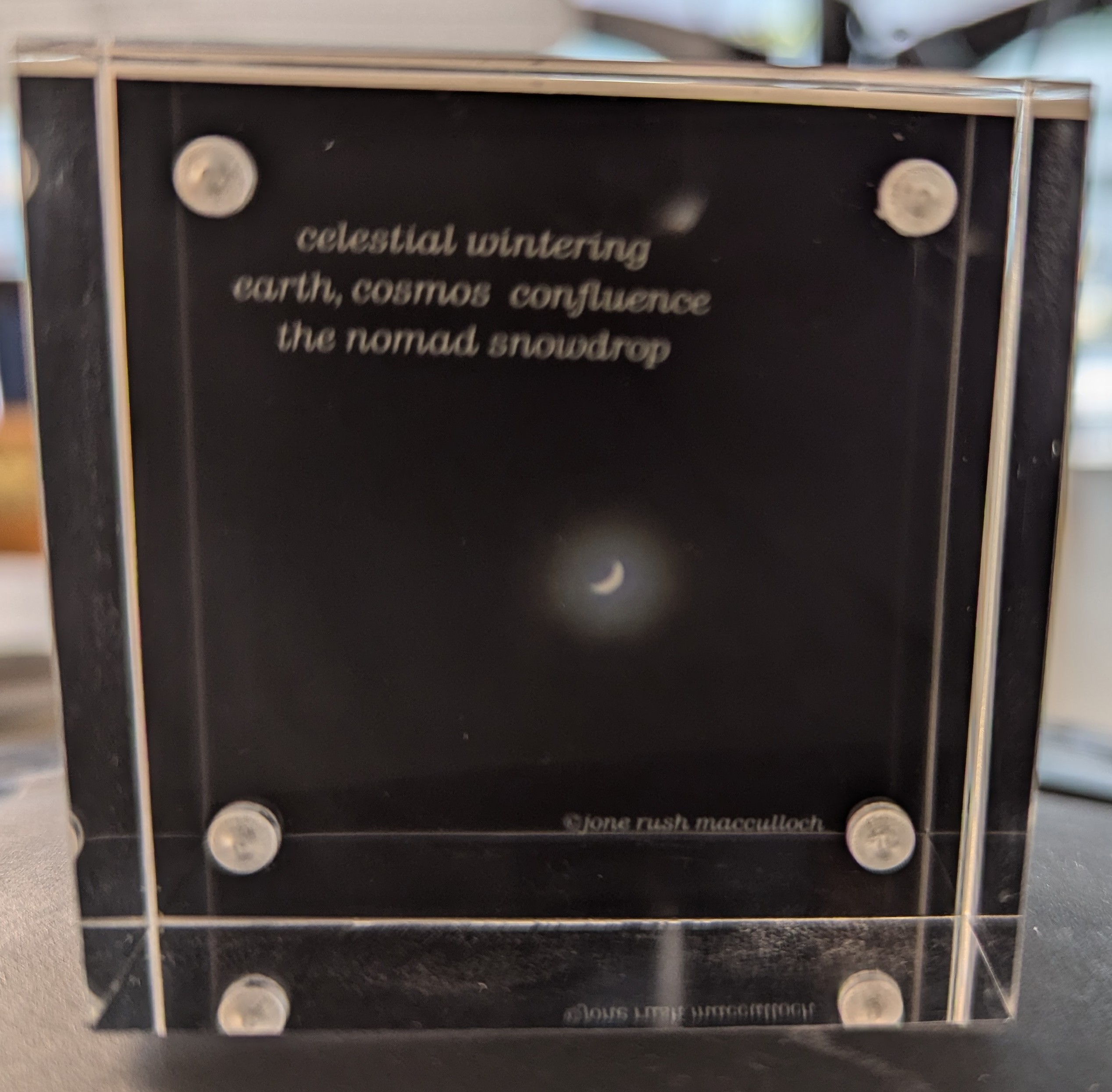
The New Moon was January 29th, which was also the Lunar New Year’s eve. I’ve started to notice the phases of the moon a lot more since I become increasingly insomniac at various times of the month. Sometimes it’s too bright. Sometimes it’s too… quiet. Sometimes I need ice in my water. Like a devious toddler, my brain is just making up excuses to be awake at this point, but in any event, the other night, I realized that I had to turn on both of my night lights at 3AM in order to have enough light to read (Good news: Grown-ups don’t have to use the flashlight under the covers anymore). It was REALLY dark, and we’ve been having hard frosts, too – so in that cold darkness was the perfect opportunity to look up and see northern stars scattered like little chips of ice against the dark sky, to imagine the numerous beings outside, hunkering down. Since forever, there has been winter and cold – and even as much fire and ice as there has been this winter, just not in recorded memory. Nothing really is new, after all.
In a determined state of peace – not fretting about being awake again – I sat and observed the darkness of the new moon, recalling that in that darkness, millions far away were beginning their celebration of the Year of the Snake, symbolizing for some, among other things, transformation. Remembering my corn snake’s blindness and predilection for hiding under rocks when he was in the itchy, skritchy process of shedding his skin, the darkness of the moon seemed really fitting to me. Tonight’s moon will be a waxing crescent with only 2% illumination (the image in Jone’s picture is waxing a bit more than tonight’s will be, by about five days or so). The moon waxes gradually, so we’ll be in the dark for quite a bit longer. But, while we’re in darkness – and oh, the darkness is Stygian and profane these days – don’t forget that we’ve been here before. History, in conversation with the present, once told the story of oligarchs and excess, of predators and proletariat. Haven’t we always had the poor – and the poor in spirit – with us? Like a wheel turning, or a pendulum’s swing, history, empires, republics all rise and retreat. There is darkness. And then, there is light.
…to Poetry
That thought, so early in the morning, seemed rather profound. I’d talked about wanting to write to this moment with my tan-ku, and express the enormity of the scope of the darkness and the singular shine of people like Mariann Edgar Budde, whose previous work on behalf of Matthew Shepard’s family years ago already told us who she was, and whose unflinching ability to do the work set before her continues to shine. I wanted to write about that shine – without excessive panegyric – and remain in conversation with what helps us see the shine, which is indeed darkness. We don’t have one without the other, do we?

lux aeterna, 1/2
a waning gibbous
smothers a sky in shadow –
though starlight brightens,
though dawn has always followed,
wisdom fears a moonless night
this deeper darkness
no tame wick illuminates
then it dawns on us
= = = = = = = = = =
the singular role
of Earth’s celestial bodies:
reflect and return
in strength, the greater light as
lucent, faithful rendering.
deep is night’s ocean:
moon’s ‘lesser light’ sounds the depths
we dive, unafraid
draft by tanita s. davis ©2025
There are more Poetry Peeps who are grappling with this idea of being “in conversation” this month, and using the conversational form of the tan-ku to do so. Have a read. Sara’s post is here, and Laura’s post is here. Liz’s poem is here, while Mary Lee’s can be found here. Miss Margaret’s poem is here and Linda B’s poem response is here. Carol V’s poem joins the chat here, and Michelle K’s poem is here. Denise rounds out the list with a tan-ku for America. More Peeps may be popping into the Group Chat throughout the weekend, so don’t forget to circle back for the whole tan-ku round-up.
Poetry Friday today is richly hosted by Jan from Bookseed Studio, who has ALL the links and all the good stuff, and also provided a Sly and the Family Stone earworm which I will now share with you. Don’t miss the full round-up there. Thanks much, Jan.
Is it counterintuitive to think of diving into the darkness, delving into it to find its source? It is somehow a comforting thought to remember the toughness of our ancestors, through Depressions, through wars, through robber barons and revolution. All over the world, the path is illuminated by those who have gone before. Can we walk it, everyday people, unafraid, maybe putting a little color into the world as we go?
Though my soul may set in darkness, it will rise in perfect light;
I have loved the stars too truly to be fearful of the night.
Happy weekend to we, the people. We who walk in darkness, hold up your light.
Tanita, wow. You give me hope with your history lesson in the intro. We can “remain in conversation with what helps us see the shine, which is indeed darkness” So true.
I’m taking this with me today too: “Can we walk it, everyday people, unafraid, maybe putting a little color into the world as we go?” Yes, we can!
TANITA. I weep. These are miraculous — the way you took your thoughts and feelings around Mariann Edgar Budde and translated them into something so imagistic and so graspable all at the same time. Wisdom DOES fear a moonless night… I am having a hard time shaking the darkness right now and I am grateful for your words….
@Liz Garton Scanlon: I am SO hopeful that everyone can pick up a small spark of light from this. Pax, friend.
Such beautiful words, Tanita. I was especially moved by
“deep is night’s ocean:
moon’s ‘lesser light’ sounds the depths
we dive, unafraid”
Thank you for the inspiration!
@rosecappelli: We might not be entirely unafraid, but …here’s to diving anyway.
This is the third time I’ve come back to try to comment. I am simply in awe of this poem and your ability to shift a response to the noise of the news into the beauty of words and form and The Bigger Picture.
I’m saving this one and will keep coming back for the reminder of “then it dawns on us” and the courage of “we dive, unafraid.”
@Cousin Mary Lee: Wow, thank you – from the haiku-mistress that means a lot.
Tanita, your final haiku feels like a hymn I want to sing in an ancient stone cathedral, surrounded by some steadiness of time passing, of things surviving. This is gorgeous!
@laurasalas: I think that’s what I look to the natural world for – the steadiness that speaks to time’s passage and of survival in the face of incredible odds and massive changes. We have evidence of ice ages – no one said it was comfortable to live through those, but ‘we’ collectively lived. I think the natural world helps me to take a step back from ‘me’ to ‘we,’ and it brings a necessary space into my thoughts… so, thank you for this. I’m so glad it didn’t come off tritely.
Tanita, I love all of this, and especially these lines:
reflect and return
in strength, the greater light as
lucent, faithful rendering.
Let’s return in strength, friend. “There is darkness, and then there is light.” ❤️
@Karen Edmisten: When I heard the words of Rev. Budde I thought of the 39th aria from Mendelssohn’s Elijah that I was privileged to hear years ago as part of the chorus… “then, then shall the righteous shine forth like the sun in their heavenly father’s realm.” She brought to mind that reflection – that faithful, lucent rendering of light returned in strength. This poem is my attempt at a long-distance hug. ☺
That’s so beautiful. She is a light shining forth indeed!
Thank you for all of your words. I’ve been singing a song from “The Suffs” musical lately: “Your ancestors are all the proof you need / that progress is possible, not guaranteed / it will only be made if we keep marching / keep marching on.”
I too have been thinking a lot in the night when I can’t sleep. This week I wrote a “Portrait of Mercy” poem inspired by Rev. Budde.
Your last line “we dive, unafraid” is something to aspire to! Thank you!
@Marcie Flinchum Atkins: WHOA. I had to look up The Suffs and I’ve been listening to that song on repeat. THANK YOU. Wow, wow, wow.
I’ve long been enamored of the ability eons ago for people to find ways of light, sometimes wonder what they did before. I know there are stories of invention, both real & imagined of humans using/making/experimenting with light, usually meaning fire & the ways they guarded it. I am struck by your poem, feeling like it is a story to remember, to use the words “this deeper darkness/no tame wick illuminates” & remember “no tame,” then the ending, “we dive, unafraid.” Thank you, Tanita, for the words that came before your poem, too!
@lindabaie: Like everyone else, I’m scrabbling for meaning in the dark – but the light is there. Thank you for being here, too.
Powerful poem Tanita, and so apropos as I’ve been watching the nighttime sky and our glorious red ringed mars planet next to the gemini constellation. Thanks to your poem and dear moon as we have some abysmal depths ahead… And, drum role please, love your musical accompaniment!!! And then it rolled right into: https://youtu.be/4URogrXiKsI?si=5Pm_LK56Q1W5s19l Thanks for all this light!!!
@Michelle K: Your weekend party is started!
Cheers, friend!
You always hold up your light, my dear. Thank you for this beautiful and profound post. Your poem is alive with deep darkness and bold light… and your gorgeous graphic this month! It’s perfect for the form.
@SaraLewisHolmes: Thank you! I’m really having fun with Canva (and I figured out if you make things small and somewhat transparent, you don’t have to worry about if your lines are all straight). I like the idea of light and dark being in conversation – like we are still connected to the dark side of the moon, though we don’t see it, it’s still part of the whole…