{pf: p7 shovel gold with Elizabeth Bishop}

Welcome to Poetry Friday!
Poetry Peeps! You’re invited to our challenge for the month of June! Here’s the scoop: We’ll going to write a couple of couplets and make a Raccontino. Never heard of the form? No worries. If you can count to two, you can play with this delightful form. Of course, we’re turning our faces to the winds of ‘conversation,’ as always. Are you in? You’ll have a month to craft your creation(s), then share your offering on June 27th in a post and/or on social media with the tag #PoetryPals. We hope you’ll join the fun!


In leagues worth of understatement, it’s been a HELLUVA month. As of this post we’ve been in our new house for a week and three days, and we’re 97% unboxed. Now we’re back to the stupid phase of any packing/unpacking expedition wherein you want to shriek and fling your possessions into the street just so you can be DONE, but I’m hanging on, faithfully sorting and deciding what we no longer need – something it would have made sense to do on the other end, but that only works if all parties packing have the same idea. Sometimes… it’s just easier to do these things when one has a quiet moment. Ahem. So! Chaos abounds, which is why I realized that a.) it was the end of the month and b.) the last Friday of the month exactly twelve hours before this post. Oops! And yes, that means the entire crew missed our Sunday meet-up last week… but honestly? Summer: it happens.

From Process…

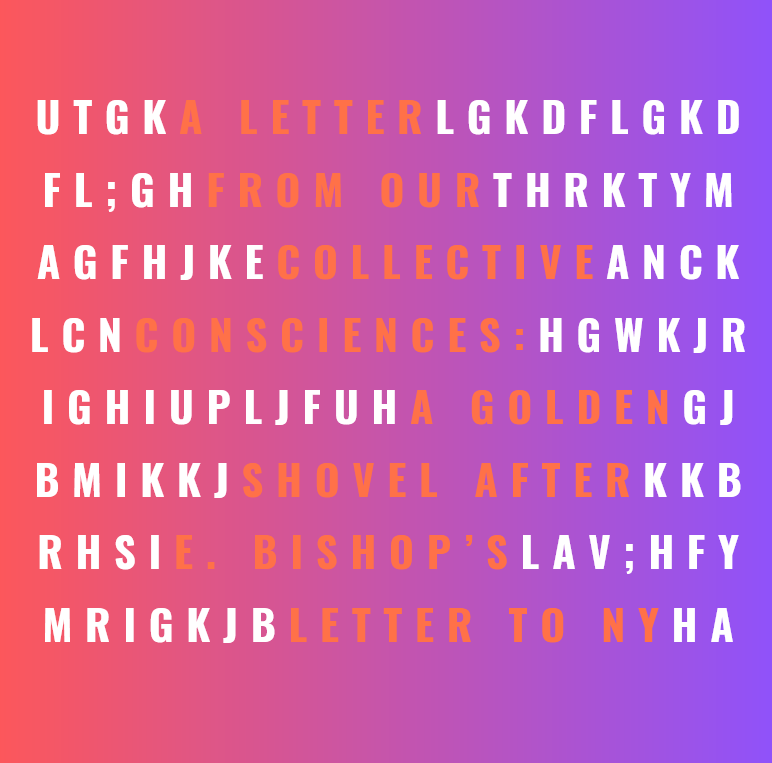
Oh, it’ll be fine, I told myself. A golden shovel is a very forgiving poetic form. Well, yes… and no. I knew my topic almost immediately, since we were using Elizabeth Bishop’s “Letter to NY” for our mentor poem – I knew I wanted to write a letter to someone, be in conversation with someone or something unusual – but a letter to my erstwhile sanity seemed just slightly on the nose, and a little too narrow of a topic (though I truly could go on and on about it). And yet, moving house: all there IS is chaos, and lacking sanity. However, it also occurs that it’s been chaotic nationally for a …while now….and getting louder. But could I pull any of that from the mentor poem and use it in a meaningful way?

…to Poetry

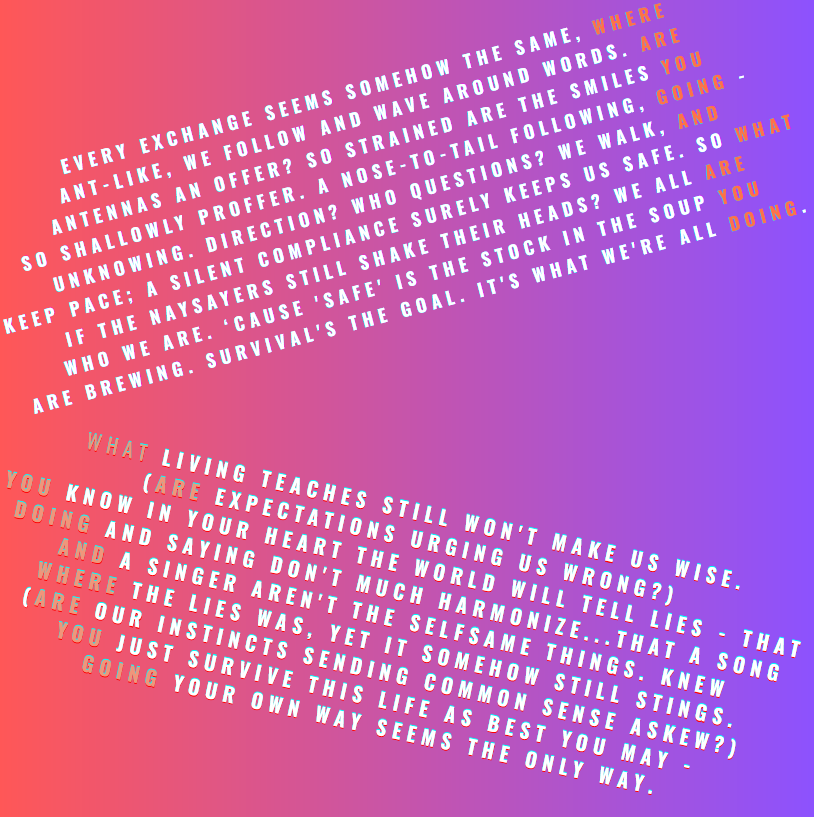
I decided to delve into writing a golden shovel from opposite directions. Much like the opposing voices within our national conversation, there are very loud opinions of who is doing what correctly, and why, and I wanted this chaotic letter to reflect two ways of looking at a single idea, like survival – something that is both nebulous and distinctly individualized. What does it mean to live your ‘best life’ in the midst of chaos? Is there a way to do that? What’s your best route to safety – or is living your best life not bound up in safety? With these thoughts in mind, I began to compose – keeping in mind that I truly did not have time to make a lot of rhyme, but trying to give a nod to internal rhyme anyway.
A Letter From Our Collective Consciences

Every exchange seems somehow the same, WHERE
Ant-like, we follow and wave around words. ARE
antennas An offer? So strained are the smiles YOU
So shallowly proffer. A nose-to-tail following, GOING
Unknowing. Direction? Who questions? We walk, AND
Keep pace; a silent compliance surely keeps us safe. So WHAT
If the naysayers still shake their heads? We all ARE
Who we are, and ‘safe’ is the stock in the soup YOU
are brewing. Survival’s the goal. It’s what we’re all DOING.
***
WHAT living teaches still won’t make us wise.
(ARE expectations urging us wrong?)
YOU know in your heart the world will tell lies – that
DOING and saying don’t much harmonize…That a song
AND a singer aren’t the selfsame thing… Knew
WHERE the lies was, yet it somehow still stings.
(ARE our instincts sending common sense askew?)
YOU just survive this life as best you may –
GOING your own way seems the only way.

These are definitely in conversation, yet not as much in opposition as I had imagined when I first began, perhaps. Survival is a topic which elicits similar emotional investment, and sometimes, we end up more closely aligned in heart than we expected to… In any event, I’m happily joined in this golden shovel challenge by my fellow Poetry Sisters, who are very likely much better diggers than I. Laura’s poem is here. Tricia’s poem is here, and Sara’s poem is here. Liz’s poem is here, and early bird Michelle K’s poem is here. Other Poetry Peeps may pop in throughout the weekend to take part in this challenge, so stay tuned for the round up; I’ll post ’em as I find ’em. Additionally, Poetry Friday is ably hostessed today by the one and only Karen Edmisten, whose shockingly cleverly named blog makes me smirk every time. Thanks, K – may your coffee stay hot and your mornings be energized.

If chaos and survival are on your mind this month, don’t forget to take naps, touch grass, drink water and remember to hug a friend. Your mental health will thank you, and more than that, it will remind you that we’re all just trying to survive, and to perhaps be kinder than you want to, when you encounter someone whose world worldview runs counter to your own. Courage, friends!🌼
{national poetry month: “not everything is lost”}

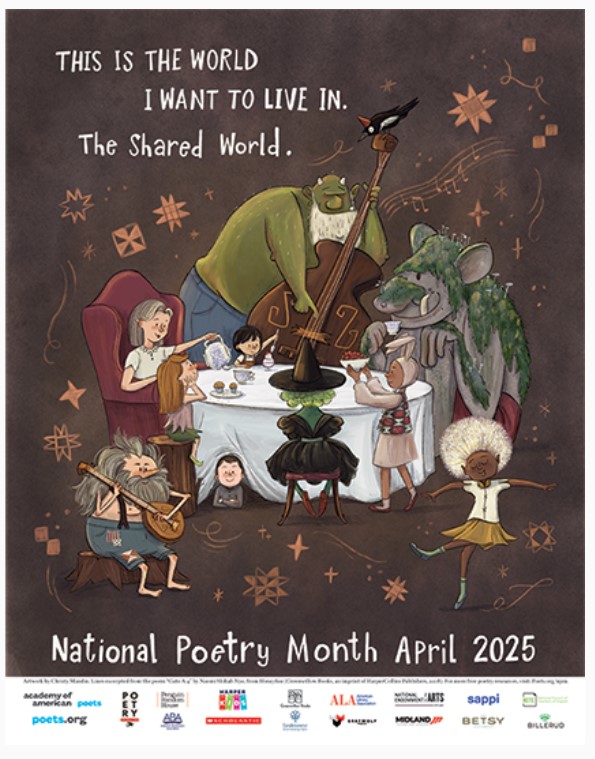
“This / is the world I want to live in. The shared world.”

The 2025 NPM poster features lines from “Gate A-4”, a poem by Naomi Shihab Nye, as well as artwork by New York Times-bestselling author and illustrator Christy Mandin. “Gate A-4” is a poem which has always resonated – because I used to love the swirl of humanity in airports, all the people-watching and the excitement of going. This was, of course, when I was in my twenties and still new to air travel, still believing in the public transportation contract of paying-to-ride, before a world where people beat a man and dragged him off a plane because they’d overbooked and wanted his seat for someone else. Post 2001, I saw air travel’s underbelly – a world wherein adults sometimes wept silently, frightened, frustrated by a language barrier and exiled from all they knew. I had the …experience of flying aboard a USAID flight where I put on the seat belts of other adults and a woman with a tiny infant because the flight attendant talked at them – and there was no translator. It was literally – for it was a flight out of Miami – a steaming hot mess. A toilets backed-up-and-overflowing – people airsick and vomiting – no AC on the whole flight – grit-your-teeth-and-endure hot mess, from Miami to Minnesota. I prayed those people found a home where they could be clean and fed and free of the wailing bewilderment they seemed mired in that day.

Suffice it to say I can almost feel the frustration of the gate attendant, the wary, xenophobic cringing of the other passengers at all that… foreign emotion, and the bleak despair of the woman on the floor wailing. Naomi Shihab Nye’s act of mercy and humanity made so many people’s lives better in that two hour wait for the next flight, but it is the final lines of the poem, rather than the two that the American Academy of Poets highlighted for this month that make me tear up and hold my breath: “This can still happen anywhere. Not everything is lost.”

Those last two sentences always make me want to whisper, “Really? Do you promise?”

Yes. Not everything is lost: because everyone who is loved is found.

Not everything is lost: because we have it within us to be maps.

Not everything is lost: because not everything we lose is a loss.

Not everything is lost: because we can find beauty and meaning in remnants.

I don’t know what’s going to come out of me for National Poetry Month, but I will be in conversation with this, and have settled on this as my theme – and my hope. “This can still happen anywhere. Not everything is lost.”

“Not everything is lost.” It’s true. It’s got to be true. Not everything, not all the time – and we will find ourselves again.

{pf: poetry peeps pass notes to superman}

Welcome to Poetry Friday!

Poetry Peeps! You’re invited to our challenge for the month of April! Here’s the scoop: We’ll be in conversation with a vintage, antique, or just plain old photograph. Of course, your photograph needn’t be from either of these archival photography sites, but take a poke around, and see what you find. Your poem should be based on an image which is at least, say, forty years old, or at least something you consider “old.” Once you’ve got your image nailed down, you’ve got a month to craft your creation(s), then share your offering on April 25th in a post and/or on social media with the tag #PoetryPals. We hope you’ll join the fun!


When we chose these poems to be in conversation with, I was excited – because the poems were offbeat and a bit amusing, and I thought this would be easy.

Literally EVERY TIME I THINK THAT I should snap my wrist with a rubber band or something. Writing poetry is never a slam dunk when I think it’s going to be. Never. Ever. Why do I keep deluding myself this way???

From Process…

Clifton’s “four notes to Clark Kent” addresses the idea of a rescuer through varying personal lenses. Though she is still writing to him, Lucille Clifton seems to have misgivings about the dude who can leap tall buildings in a single bound… I mean, what good is that, her first poem seems to ask, when she’s dealing with more immediate issues between the four walls of her home? Who can save her from all of the broken dreams and emotional paucity that waits there, him? No – she doesn’t think so. She names him “tourist;” reminding the reader that he’s not from Metropolis – he’s a stranger, a literal alien. While she’s hanging by her fingernails from the edge of a ledge, waiting for rescue, he’s just visiting, isn’t he? Maybe he’s not really there to save her after all. While in her third poem, she appears to forgive him – and forgive herself – for just human and other. The idea of the Superman mythos has inflated him past life-sized and she graciously allows him to shrink. By her fourth poem, she openly decides he’s pretty hot, but I still don’t get the idea that the poet feels he’s all that super – just cute. She calls him by his Clark Kent moniker, referencing his other persona solely as an adjective rather than a name, which I found interesting.

I shared some of Clifton’s misgivings about Mr. “faster than a speeding bullet.” I didn’t grow up on Superman comic books, and the blandly handsome, lantern-jawed superhero in the movies didn’t particularly …convince me, as a kid. As a fellow four-eyes, I was completely OVER the trope of “dreamboat without his glasses,” and thought Clark and Superman looked exactly alike – because they WERE, of course.🙄 Further, his mild-mannered, awkward persona grated on my nerves (I somehow missed the point that he was acting so people wouldn’t equate him with his outgoing alter ego). He was noble to the point of ridiculousness, and I didn’t resonate with him as an American icon. Like Smokey the Bear, he somehow seemed to be just another childhood talking head in cartoon form who told you how to behave. He never seemed particularly heroic to me, so I realized that Clifton’s doubting had infected me, too. Who was this guy who was supposed to save us? And who were we, just …sitting there, waiting to be saved?

…to Poem

When we got together for our Sunday poetry chat, Cousin Mary Lee said she couldn’t find a lighthearted bone in her body and didn’t feel like she could speak to the poem. At which point I thought, “Oh, humor was an option!?” I didn’t have any lighthearted thoughts on Superman either. In my initial draft I had taken a deep dive into the idea of saviors, the idea of Americans exceptionalism, of Americans striding in to play savior – after like as not having started the conflict. I wrote about the learned helplessness of people who have lived with privilege for so long that they don’t ever think anything can happen to them, and about the non-SUPER-ness of people who stop voting and such. *cough* The poem was taking me somewhere I didn’t want to go, so I thought I’d sit down and try being funny – just – out of nowhere. I wanted to write about the really cheesy 80’s Superman movies I didn’t watch until decades later (they DID NOT age well). I wanted to write about Spanx underpants over spandex leggings and capes (“No capes!” screams Edna Mode in my brain) and battling wedgies while leaping over tall buildings in a single bound. I did NOT, however – I restrained myself! Sara probably did too. Tricia definitely wrote something classier, as did Laura. Mary Lee’s poem is here, and here’s Liz’s poem, Michelle K’s poem is here. More Peeps may be checking in throughout the day, so don’t miss the whole Clark Kent roundup. And for more poetry that fortunately doesn’t have anything to do with spandex and capes, visit the Poetry Friday round-up Marcie Flinchum Atkins’ blog. Thanks for hosting today, Marci.

While I didn’t write about wedgies, I did try to write amusingly, so… I thought about Lois Lane, who tried so hard to be cool about Superman, but… she just was not.

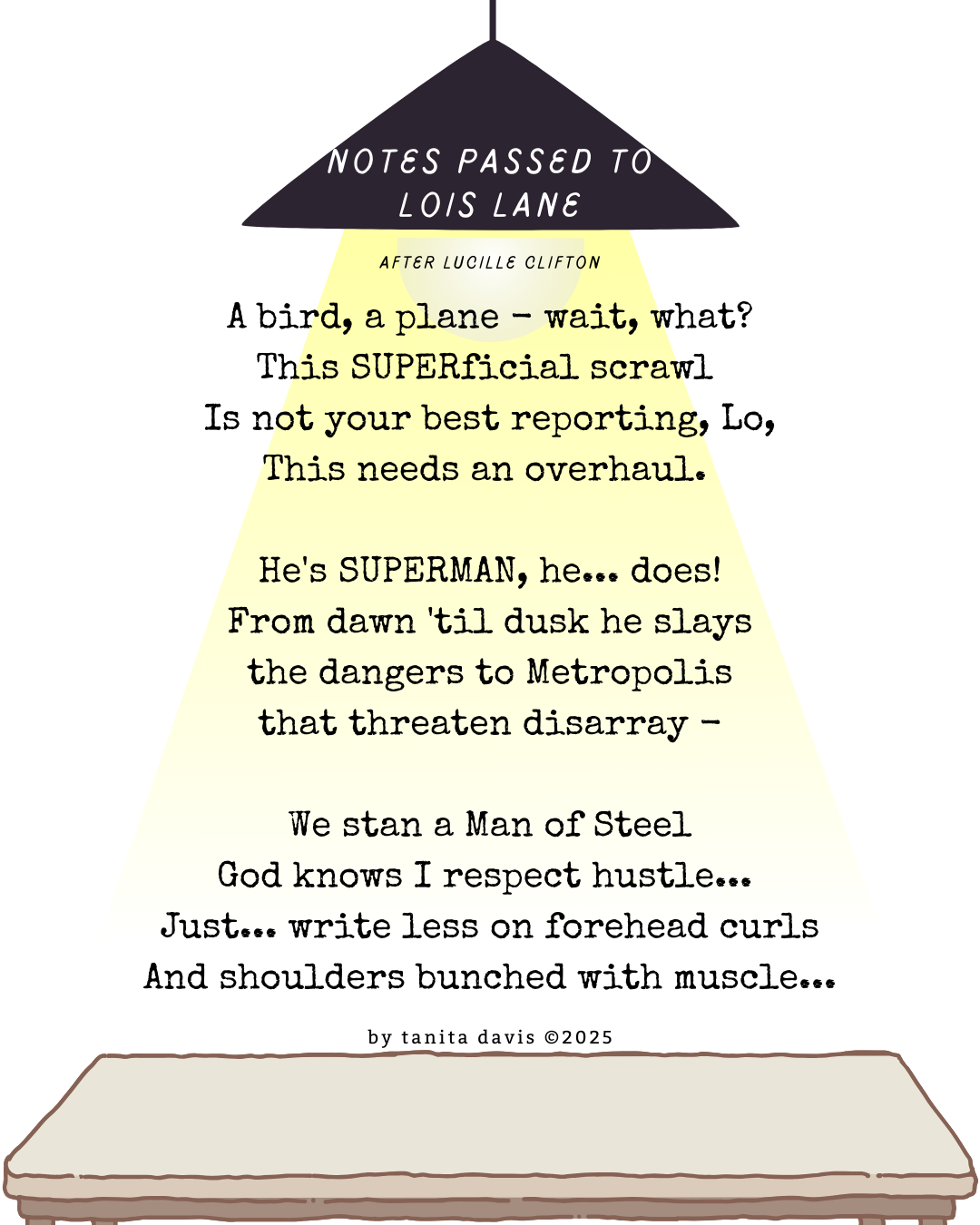
Notes Passed To Lois Lane (Probably by her editor, Perry White)

A bird, a plane – wait, what?
This SUPERficial scrawl
Is not your best reporting, Lo,
This needs an overhaul.

He’s SUPERMAN, he…does!
From dawn ’til dusk he slays
the dangers to Metropolis
that threaten disarray –

We stan a Man of Steel
God knows I respect hustle…
Just… write less on forehead curls
And shoulders bunched with muscle…

Okay, okay, I know and YOU know that Lois Lane Would Never, she was a thorough-going professional. But it still made me smile.

I’ll be honest – I couldn’t salvage this other poem. The ‘serious’ one was plunging down a lot of rabbit holes I don’t have the energy to follow, so I sort of tried to pull back on some of the over-emoting, and left it where it lay. Reminding myself that this poem is in conversation with the others is what helped me stay more on track — and while this doesn’t yet say what I need it to, it’s a start. If nothing else, I do believe that if we don’t hang together, we’re all going to hang separately, and despite my little red hats, I mean that across aisles and political divides. This is bigger than the red v. blue v. green color war, I’m afraid.

Notes In The Margin of The Daily Republic

Not any man would do, we’ll want SUPERman:
SUPERlative – from cape to brawny chest.
Spotlighting our best selves, and our SUPER land,
Our destiny to be forever blessed.
Granite jaw and steady stare – he’s sensational.
SUPERbly snaring manhood in his trap
With orphan-makes-good tropes. He’s educational
He models how to rise on our bootstraps…

Why an alien would show up when we’re losing,
To fight the thugs Metropolis can’t stop
No one ever seems to ask. It IS confusing
…The comics show folks screaming “Help!” nonstop,
And the victims standing, looking ’round for saviors,
Wringing hands instead of maybe calling cops…?

In MY book I’ve inserted on page borders,
Small hands cupped ’round a tiny screaming face
Which shouts, “People! Don’t just stand and wait for orders!”
In YOUR Daily Republic – your birthplace!
For future’s sake, speak up – protect what matters
Resist and rail against the treasonous.
One rock is small – a rock slide buildings shatter…
Join hands. We’ll be the ones to rescue us.

I’ll be ready Poetry Friday notes from a short beach glass hunting sabbatical, but I’ll definitely get around to answering any messages. I hope you take – and are taking – some time away to get outside and witness this slow turning of the seasons, as the earth wakes and stretches toward the possibility enshrined in Spring. Turn off the noise for a while, and just be – and then breathe. I plan to not just touch grass but touch rocks, possibly newts and beetles. (Anything squishier may require gloves.) While it’s true that no one is coming to save us, with any luck, and a bit of cooperation, there’s still enough to save of ourselves. Happy Weekend.

{pf: poetry peeps find ‘A Word’}

Welcome to Poetry Friday!

Poetry Peeps! You’re invited to our challenge for the month of March! Here’s the scoop: We’re writing back to four Lucille Clifton poems, in her notes to clark kent series: “if i should;” “further note to clark;” “final note to clark;” and “note passed to superman.” We’ll be ‘in conversation’ with Ms. Lucille’s poems – talking to them, talking back to them, or talking about them, whether that’s all of them, or any of them, either in form or in substance. Once you’re sure how that’ll look for you, you’ve got a month to craft your creation(s), then share your offering on March 28th in a post and/or on social media with the tag #PoetryPals. We hope you’ll join the fun!


“…And that’s what your holy men discuss, is it?” asked Granny Weatherwax.

“Not usually. There is a very interesting debate raging at the moment on the nature of sin, for example,” said Oats.

“And what do they think? Against it, are they?”

“It’s not as simple as that. It’s not a black and white issue. There are so many shades of gray.”

“Nope.”

“Pardon?”

“There’s no grays, only white that’s got grubby. I’m surprised you don’t know that. And sin, young man, is when you treat people like things. Including yourself. That’s what sin is.”

“It’s a lot more complicated than that–”

“No. It ain’t. When people say things are a lot more complicated than that, they means they’re getting worried that they won’t like the truth. People as things, that’s where it starts.”

“Oh, I’m sure there are worse crimes–”

“But they starts with thinking about people as things.”

–from CARPE JUGULUM, by Terry Pratchett.

People, and things. Things, and people…

Sometimes the subjects we find in conversation with each other are mirror images, and sometimes they’re complete contrasts.

From Process…

Some of you know that for reasons of faith my parents didn’t allow me to read fiction in junior high and high school. No fiction, much less fantasy fiction with a witch – Granny Weatherwax – and an Omnian priest (a made-up sect that goes hard with the door-to-door solicitation) and… vampires, as were featured in Terry Pratchett’s Carpe Jugulum. And though my parents wanted me to be a celebrant of truth as defined by the term “non-fiction,” there’s …just a whole lot of truth in the previous fictional passage, too, isn’t there? The intersection of People Treated Like Things and Injustice is the corner whereon most of the problems begin. Pick out any deeply unfortunate moment in history – the Doctrine of Discovery, the advent of chattel slavery in the Americas in 1619, the forced migration of The Trail of Tears, The Triangle Shirtwaist Factory Fire, Executive Order 9066 – ? All of those things come down to people treated as things. Own-able. Moveable. Modifiable. Disposable.

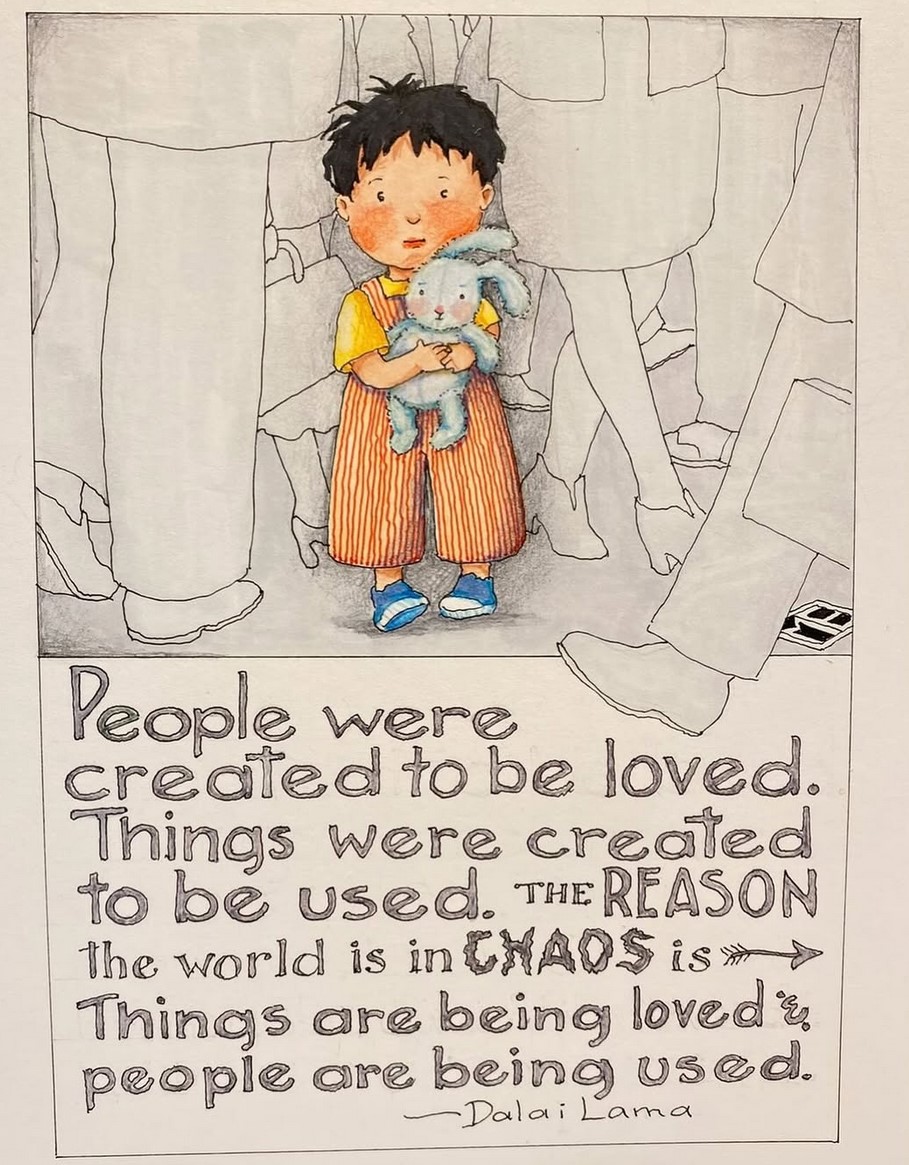
Today’s thoughts are in conversation with Granny Weatherwax’s profound statement (as brought to us by a renown British author who started out as a journalist) and with the Dalai Lama’s (a spiritual leader of great renown who started out as a mostly regular Buddhist priest). I could not believe how similar the statements between these very disparate people were when I found them on a Mary Engelbreit print which the artist shared on Instagram on February 21st of this year. (That one needs to be a print, no?) Two roads diverge on this highway, and they are People and Things. Two vastly different entities, two vastly different purposes, but human society confuses them so frequently. One made to be loved, and the other made to be used. How difficult for some to keep that straight.

…to Poetry

Though I missed the poetry meet-up this month (boo!) I felt like I already had a good feel for this kind of poem, which I’m leaning towards playing with some more to kind of unpack the current news of the day as I process it with its abundant catch words. This time, it was an obvious choice to write several poems as well, or at least two, because my brain has kept circling around the linked but contrasting noun categories of People and Things. But, after running across the Dalai Lama’s statement on my socials, two new words elbowed their way to the front – Loved and Used.


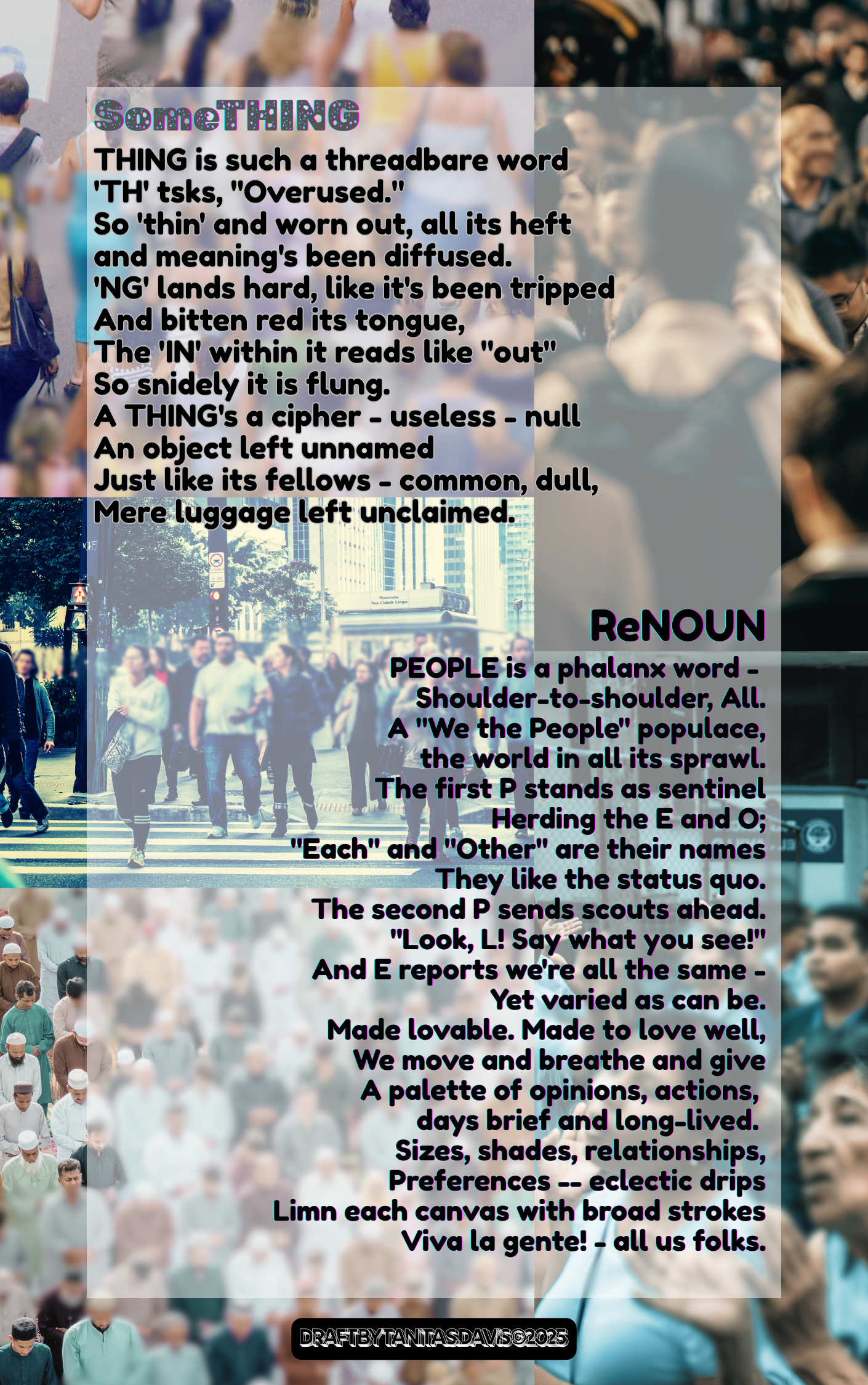
someTHING

THING is such a threadbare word
‘TH’ tsks, “Overused.”
So ‘thin’ and worn out, all its heft
and meaning’s been diffused.
‘NG’ lands hard, like it’s been tripped
And bitten red its tongue,
The ‘IN’ within it reads like “out”
So cruelly it is flung.
A THING’s a cipher – useless – null
An object left unnamed…
Just like its fellows – common, dull,
Mere luggage left unclaimed.

reNOUN

PEOPLE is a phalanx word – shoulder-to-shoulder, All.
The “We the People” populace,
The world in all its sprawl.
The first P stands as sentinel
Herding the E and O;
“Each” and “Other” are their names
They like the status quo.
The second P sends scouts ahead.
“Look, L! Say what you see!”
And E reports we’re all the same –
Yet varied as can be.
Made lovable. Made to love well,
We move and breathe and give
A palette of opinions, actions,
days brief and long-lived.
Sizes, shades, relationships,
Preferences — eclectic drips
Limn each canvas with broad strokes
Viva la gente! – all us folks.

This form lends itself to some real creativity for me, in terms of just letting my brain go and feeling my way into a word’s deeper meaning through what it remind me of, its internal sounds, the shapes of its letters, and whatnot. I like that “______is a Word” invites both wordplay and a thoughtful liberation like few other forms – I don’t have to make these poems rhyme. I don’t have to observe meter or number of lines, or anything else if I don’t want to. I just need to examine the word from all facets and let the word speak to ME – as didactically or as simplistically or as complexly and cleverly as I may. So, this was delightful – and I hope you find these word meditations delightful – useful, and illuminating – as well.

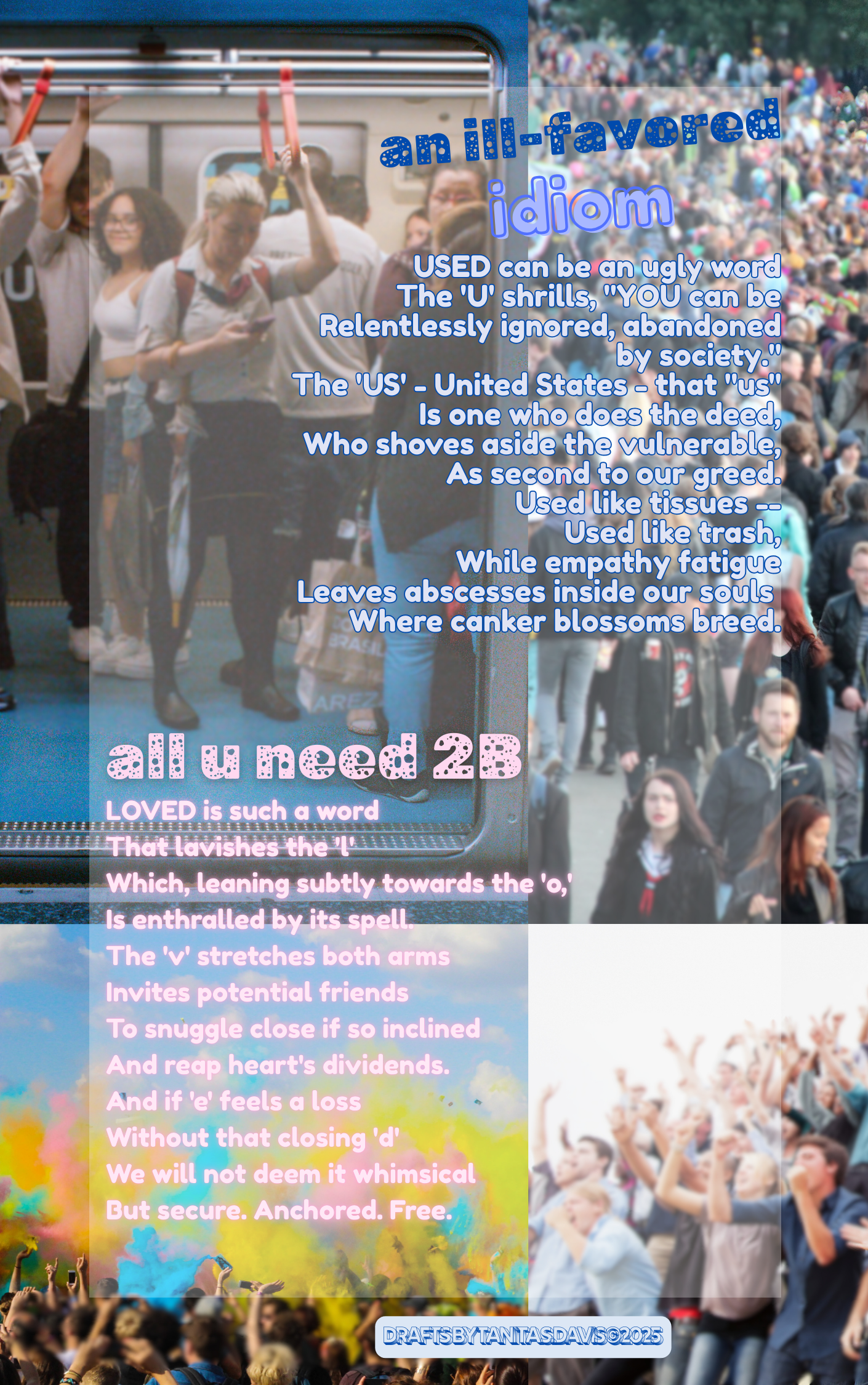
an ill-favored idiom

USED can be an ugly word
The ‘U’ shrills, “YOU can be
Relentlessly ignored, abandoned
By society.”
The ‘US’ – United States – that “us”
Is one who does the deed,
Who shoves aside the vulnerable,
As second to our greed.
Used like tissues —
Used like trash,
While empathy fatigue
Leaves abscesses inside our souls
Where canker blossoms breed.

all u need 2B

LOVED is such a word
That lavishes the ‘l’
Which, leaning subtly towards the ‘o,’
Is enthralled by its spell.
The ‘v’ stretches both arms
Invites potential friends
To snuggle close if so inclined
And reap heart’s dividends.
And if ‘e’ feels a loss
Without that closing ‘d’
We will not deem it whimsical
But secure. Anchored. Free.

There are quite a few other folks who dipped a toe in to the “_______is a Word” challenge this month. Laura’s post is here, and you’ll find Sara’s poem here. Liz’s poem is here. Mary Lee’s post is here, and Tricia’s poem is here. Linda B’s poem is here, and Rose joins us here. Michelle K’s poem is here. Jan from Bookseed has joined the fun, while Susan’s poem is here. More Peeps may be popping up during the weekend, so don’t forget to come back for the full roundup. Meanwhile, Poetry Friday is hosted this week by the delightful Denise Krebs, so don’t miss popping over for more poetry celebrations at Mrs. D. Krebs’ EduBlog! Thanks, Denise!

One of the MOST fun things about this style of poem is writing them with a thesaurus to hand. I often think of a word… and then look it up, and use the fifth or sixth synonym of it, so that I can sharpen my meaning – or even obscure or enlarge it. For instance, phalanx is a great word with multiple meanings, one of which was originally …log – a shoulder-to-shoulder line formation used in ancient Greek military battles. I LOVE that the plural of phalanx is phalanges… the names of the bones of the fingers or toes. People are each other’s foundation to stand on, or as Gwendolyn Brooks said it, “we are each other’s business, we are each other’s magnitude and bond.” We are each other’s hands to hold or extend in help and support – so to keep our battalion together. I appreciate the dichotomy of that – our little battalion standing with our shields linked, being both tethered and tied in, yet completely independent. Isn’t that the confidence that being loved gives to us?

I suspect Esme Weatherwax would think that nice little man in the saffron robe and wire-rimmed glasses was good people, and invite him over to sit a spell and listen to her bees. And I suspect His Holiness the Dalai Lama would get a kick out of reading about the kingdom of Lancre in the Ramtops where the strong-willed Granny Weatherwax catches babies, raises bees, and practices “headology,” which is a lot of philosophy mixed with a generous serving of stubbornness and a heavy sprinkle of common sense. The topics we find in conversation with each other sometimes aren’t that far apart after all… As more and more people are treated as things and things are cherished as people ought to be, we’ll figure out how to flip that particular script. Until then… perhaps we’ll keep this conversation simmering on the back burner – and let people who need to know, know that they are, as always, well-loved. Happy Weekend.

all poems ©2025, tanita s. davis

{poetry friday: the poetry peeps tan-ku into 2025}

Welcome to Poetry Friday!

Poetry Peeps! You’re invited to our challenge for the month of February! Here’s the scoop: We’re taking advantage of the rich bounty of the Poetry Friday Universe and writing ____is A Word Poems, wordplay invented by poet Nikki Grimes and shared by Michelle Barnes. Here’s the roundup from our first foray in October 2021, which was a lot of fun. Our words will be ‘in conversation’ somehow. We’re not sure yet, but once YOU have a word in mind? Go! You’ve got a month to craft your creation(s), then share your offering on February 28th in a post and/or on social media with the tag #PoetryPals. We hope you’ll join the fun!


WHEW. We made it.

We’ve climbed the last cliff and clambered onto the last Friday of the last week of a month that seems to have lasted six years, at least.

It feels like the Poetry Peeps’ theme of “In Conversation” this year is going to be so apropos. So much is intertwined and related. So much of life is in conversation. We can take a strange comfort that what is happening now has happened before, in other places and other times – our present is in conversation with our past. We are – for better or for worse – once again aware of ourselves as living history. How will we take part in the conversation? What are we going to say? When is it our turn to speak? Our dip into the tan-ku, the poetic combination of the tanka answered by a haiku reflects this thoughtfully.

From Process…

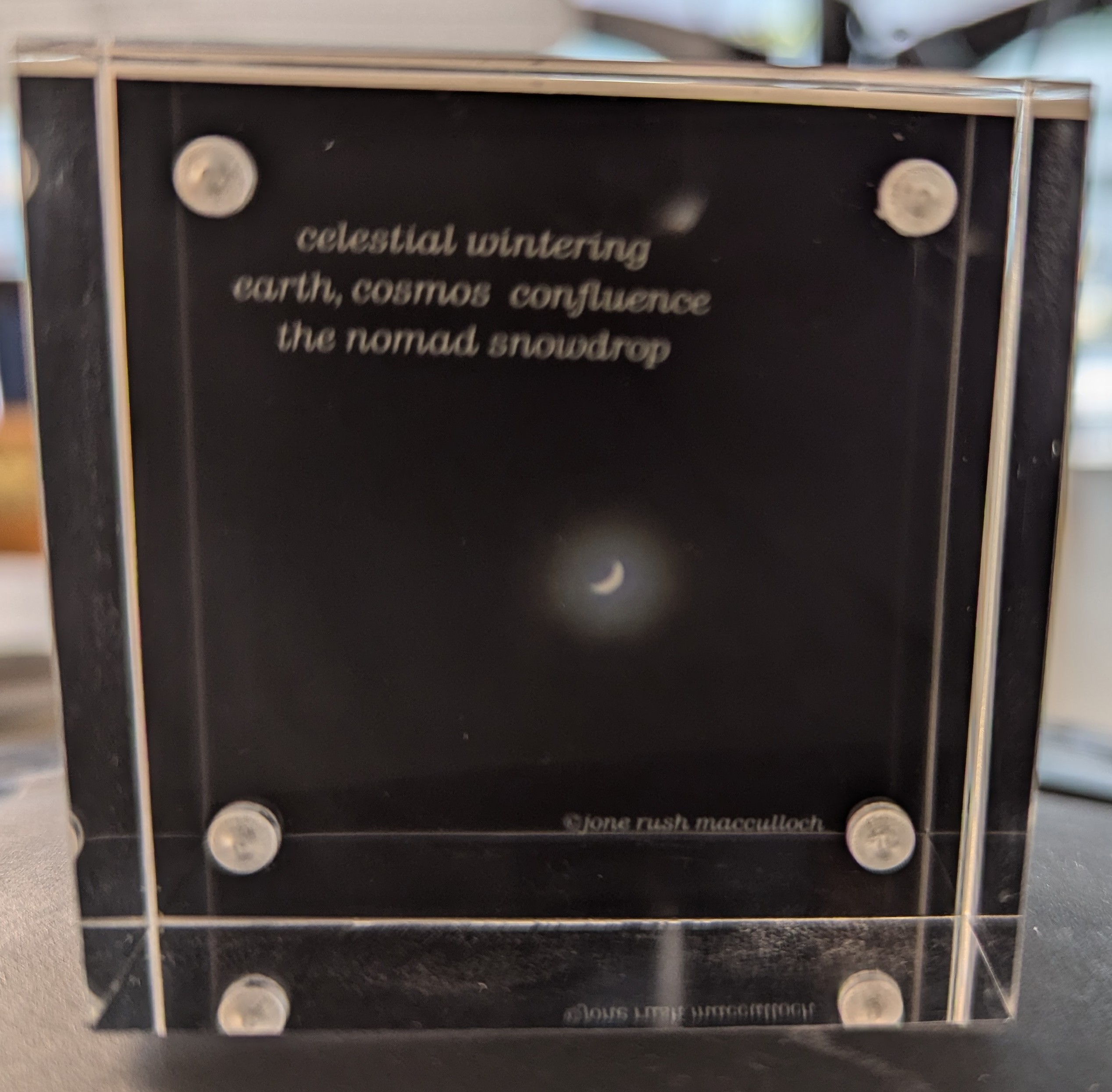
Admittedly we chose this month to begin with a shorter poem form for the specific purpose of giving ourselves less to do because we had a shorter time frame to work with. However – we acknowledged CLEARLY in our group hang this month that SHORTER NEVER MEANS EASIER. Like, ever. Japanese Haiku is a hard form, full stop. It’s beautifully compact and thought-provoking and symbolic – all those good things that I’m not. I like to play with tanka, because it’s …somehow less pressure? I feel like it’s somehow more acceptable with tanka to lean in to the Western idea of haiku (just a short poem that MIGHT mention nature and DEFINITELY counts syllables) and tag on a couple of end lines that wrap the whole thing up with…a bit of clever emphasis. However, this time I decided I was going to make more of an effort to actually observe the… quietness of haiku, not just its brevity. I wanted to try to embrace the beauty and more ephemeral aspects of haiku, which celebrate small facets of the giant surround sound theater that is the natural world. With a whole year’s worth of haiku from THE Jone Rush MacCulloch – most awesome Solstice Poetry Swap partner – I set out to try.

The New Moon was January 29th, which was also the Lunar New Year’s eve. I’ve started to notice the phases of the moon a lot more since I become increasingly insomniac at various times of the month. Sometimes it’s too bright. Sometimes it’s too… quiet. Sometimes I need ice in my water. Like a devious toddler, my brain is just making up excuses to be awake at this point, but in any event, the other night, I realized that I had to turn on both of my night lights at 3AM in order to have enough light to read (Good news: Grown-ups don’t have to use the flashlight under the covers anymore). It was REALLY dark, and we’ve been having hard frosts, too – so in that cold darkness was the perfect opportunity to look up and see northern stars scattered like little chips of ice against the dark sky, to imagine the numerous beings outside, hunkering down. Since forever, there has been winter and cold – and even as much fire and ice as there has been this winter, just not in recorded memory. Nothing really is new, after all.

In a determined state of peace – not fretting about being awake again – I sat and observed the darkness of the new moon, recalling that in that darkness, millions far away were beginning their celebration of the Year of the Snake, symbolizing for some, among other things, transformation. Remembering my corn snake’s blindness and predilection for hiding under rocks when he was in the itchy, skritchy process of shedding his skin, the darkness of the moon seemed really fitting to me. Tonight’s moon will be a waxing crescent with only 2% illumination (the image in Jone’s picture is waxing a bit more than tonight’s will be, by about five days or so). The moon waxes gradually, so we’ll be in the dark for quite a bit longer. But, while we’re in darkness – and oh, the darkness is Stygian and profane these days – don’t forget that we’ve been here before. History, in conversation with the present, once told the story of oligarchs and excess, of predators and proletariat. Haven’t we always had the poor – and the poor in spirit – with us? Like a wheel turning, or a pendulum’s swing, history, empires, republics all rise and retreat. There is darkness. And then, there is light.

…to Poetry

That thought, so early in the morning, seemed rather profound. I’d talked about wanting to write to this moment with my tan-ku, and express the enormity of the scope of the darkness and the singular shine of people like Mariann Edgar Budde, whose previous work on behalf of Matthew Shepard’s family years ago already told us who she was, and whose unflinching ability to do the work set before her continues to shine. I wanted to write about that shine – without excessive panegyric – and remain in conversation with what helps us see the shine, which is indeed darkness. We don’t have one without the other, do we?

lux aeterna, 1/2
a waning gibbous
smothers a sky in shadow –
though starlight brightens,
though dawn has always followed,
wisdom fears a moonless night

this deeper darkness
no tame wick illuminates
then it dawns on us
= = = = = = = = = =
the singular role
of Earth’s celestial bodies:
reflect and return
in strength, the greater light as
lucent, faithful rendering.

deep is night’s ocean:
moon’s ‘lesser light’ sounds the depths
we dive, unafraid
draft by tanita s. davis ©2025

There are more Poetry Peeps who are grappling with this idea of being “in conversation” this month, and using the conversational form of the tan-ku to do so. Have a read. Sara’s post is here, and Laura’s post is here. Liz’s poem is here, while Mary Lee’s can be found here. Miss Margaret’s poem is here and Linda B’s poem response is here. Carol V’s poem joins the chat here, and Michelle K’s poem is here. Denise rounds out the list with a tan-ku for America. More Peeps may be popping into the Group Chat throughout the weekend, so don’t forget to circle back for the whole tan-ku round-up.

Poetry Friday today is richly hosted by Jan from Bookseed Studio, who has ALL the links and all the good stuff, and also provided a Sly and the Family Stone earworm which I will now share with you. Don’t miss the full round-up there. Thanks much, Jan.

Is it counterintuitive to think of diving into the darkness, delving into it to find its source? It is somehow a comforting thought to remember the toughness of our ancestors, through Depressions, through wars, through robber barons and revolution. All over the world, the path is illuminated by those who have gone before. Can we walk it, everyday people, unafraid, maybe putting a little color into the world as we go?

Though my soul may set in darkness, it will rise in perfect light;
I have loved the stars too truly to be fearful of the night.

– Sarah Williams, 1868

Happy weekend to we, the people. We who walk in darkness, hold up your light.

{poetry friday: believing}

Welcome to Poetry Friday!

Poetry Peeps! You’re invited to our challenge for the month of January! Here’s the scoop: we’re composing tan-ku, conversations between a haiku and a tanka, as created by Mariko Kitakubo & Deborah P. Kolodji. (This is a short-but-sweet challenge, given that we don’t have a full month to ponder it.) Are you in? Good! You have …two weeks to craft your creation and share it on January 31st in a post and/or on social media with the tag #PoetryPals. We hope you’ll join the fun!


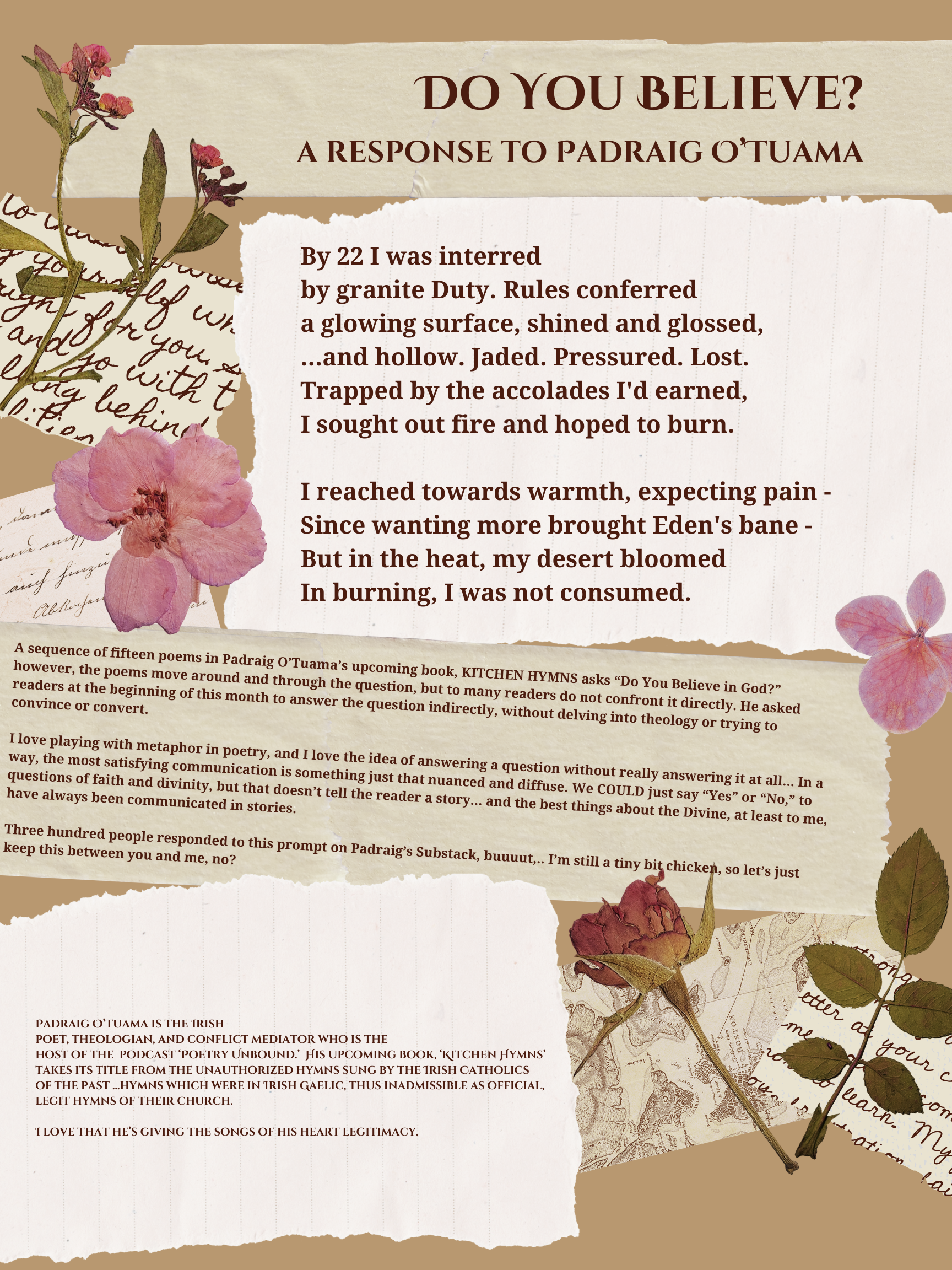
One of my modest goals for 2025 is to share my poems a bit more often. Since I’ve been writing with the Poetry Sisters since 2007, I have amassed a ton of poems, some of which I even feel okay about, but they tend to languish in folders and never see the light of day. Rather than continue to emulate the Belle of Amehurst and have someone find all of this on my hard drive when I’m dead, I’m going to start sharing… they may be good, bad, or indifferent, but the point is that I did like them once, so… here goes.

The following poem is less of a real answer to a poem, and more of an illustration, if not quite a parable. I think religious writings of any faith practice contain a lot of stories, because that’s the way to break concepts down into digestible bits for the average person… belief is a MASSIVE topic. We all believe something …sometimes. That old saw about atheists and foxholes come to mind – even if our belief is ephemeral and unthinking, sometimes it exists, and I think it’s part of life that deserves examination like the rest…


Poetry Friday is hosted by Tricia’s Smith Corona at The Miss Rumphius Effect. Thanks, Tricia.

Happy Weekend, friends.

{poetry peeps: it’s tan-ku season!}

Welcome to another year of Poetry Peeps Adventures!

Happy (Calendar) New Year, Peeps! You’re invited to the first challenge of the year in JANUARY, 2025! Here’s the scoop: we’re composing tan-ku, conversations between a haiku and a tanka, as created by Mariko Kitakubo & Deborah P. Kolodji. (This is a short-but-sweet challenge, given that we don’t have a full month to ponder it.) Are you in? Good! You have …two weeks to craft your creation and share it on January 31st in a post and/or on social media with the tag #PoetryPals. We hope you’ll join the fun!


2025: A Year In Conversation!

The Poetry Sisters discussed an overarching theme of CONVERSATION this year. How do we speak our truths? This year we’re celebrating the subtle yet direct ways we can say what needs to be said – in conversation with poems, poets, and the world around us. You’re invited along for the ride – whether you join us every month and share, or just write to our prompts for yourself. Thank you for being part of the poetic community, and enriching our conversation this year!

{pf: p7 hoping for a haibun}

Welcome to the last Poetry Friday Adventure for 2024!

Thank you so much for joining us for our 2024 Poetry Peeps Adventures. You have made our poetry year more fun and meaningful, and we thank you for taking part as we challenged and stretched our skill this year. Challenges for 2025 are forthcoming! Stay tuned for the announcement of the January challenge on January 15.


By the time you read this post, it will be well after Christmas, and on the way to the calendar (as opposed to Lunar) New Year. I hope that you have had a wonderful, restful, music-and-book filled time – with all the family and/or all the quiet you might desire. I hope that those of you who have lost friends and loved ones this year felt close to their memories and that those of you who have welcomed new family and loved ones enjoyed time with them. Happy Winter Holidays! Here’s to the invincible light that illuminates the darkness.


Did you know that the poet, Bashō, coined the word haibun? The form as it is today existed in Japan even before the seventeenth century when Bashō first brought it to the attention of the world. Mini lyric essays, sharing an array of sensory details, created a mood and highlighted a season through a poet’s observations, and then set the tone for haiku, which went even more deeply into the natural world. These aren’t really meant to be long poems, but to bring the reader deeper into the spirit of haiku, which Bashō felt was useful to create a sense of longing, empathy, or sadness. (Not a small order, that.)

From Process…

The Poetry Sisters were quiet busy this month as so many of us were, so we mostly worked on our poems alone. Liz and I got together for our live chat, and found that we hadn’t really thought ahead to what our topics might be. We talked about what we’d been doing, and both of us agreed that we might settle on writing about the Solstice, since it had been the day before. That seemed a reasonable topic. What surprised us was how, when we came together to discuss and read aloud our poem drafts, we had fallen into a synchronicity of thought. Not only had we used similar topical beginnings (though I’d crossed mine out), we ended on eerily similar final lines. How did we do that, after only speaking to each other for about twelve minutes before working solo for twenty minutes?? We determined that the Universe has been speaking – loudly. Somehow, poetry tuned us in to the right frequency.

…To Poetry

Here’s Liz’s poem – which I found to be stunning. And here’s the frequency wherein the rest of the Poetry Peeps came in – Laura’s poem is here. Mary Lee’s poem is here. Tricia’s poem is here. Jone’s poem is here. Michelle K – who is our Poetry Friday hostess today – adds both Hanukkah and a Haibun to the fun, at More Art 4 All. Thanks, Michelle! More Poetry Peeps may check in between now and New Year’s, so do check back for the full round-up.

While I was unaware of being particularly tuned-in to the Universe, I knew we had chosen the Haibun as a particularly short and low-rule poetic form that ALLEGEDLY would be easier to write. ALLEGEDLY. We think this every time we encounter a short form, and in all honesty, short forms are sometimes even harder to finagle. Haibun is a form which is meant to evoke mood and season, diminish the poet’s presence in the work, but avoid merely being a listing of what one sees in the natural world. It’s meant to make you FEEL something… All I could feel, however, was how dark it was, even though it was early afternoon. Some years more than others I struggle with the shades drawing down of the seasons – but this year, after November, especially, I have felt like the light has bled out of the world. Not to be overly dramatic – the world has been a dim and barren place before throughout history – but sometimes we’re wearier than other times. Sometimes, the grimness is a little harder to take. And I know I have so much to be thankful for! Because – among other things – every time the darkness comes, we’re reminded of the contrast of the light, are we not? If we never knew the shadow, we would never love the sun.

And with that, I realized that I had my whole prose bit, anyway.

The haiku – as I sat scribbling with a single candle lit – practically wrote itself.

AFTER NOVEMBER,
the autumn sky seems shoulder high, sheer rags of clouds stretched thin.
Like a breaker thrown, no matter that it’s 3PM, dark’s edge…falls. Sharp as a guillotine,
sudden as a cut-off scream. Darkness, and the moon is a pale coin for the ferryman,
as sky blue bleeds down black, and the longest night begins, burying the corpse of an endless year.

Scraped raw we stumble through the gloom, barking our shins, fumbling for a glimmer,
as a kind of heedless desperation steering our night-blind gaze. We strain towards… something.
Anything.
But, what if we’re looking in the wrong direction?
What if we are the dawn?

Light every candle
and breathing clouds of mist, rise
meet the dark singing


We have, some of us, settled into a trough. We are in a low place, as the light has ebbed, as the night is long, as the cold feels endless. Solutions, answers, and light seem in short supply. But – we can’t stay here. We won’t stay here. Every day, the light’s return comes closer. Every day, the dawning of the year comes nearer. Maybe we don’t have a plan yet. Maybe we feel – strongly – that we need one, but don’t know where to start. Even if we don’t move, we’ll come to the place where there’s another beginning. And another one. And another. I would rather meet the days ahead on my feet than be dragged into the stage lights, unprepared. I don’t know what I’m standing up to meet, but I’ll be on my feet – ready to move. And I know you will, too. So – take a breath. Tighten your shoelaces, and plant your feet. We’ve got things to do, and we’ve got this.

Happy New Year. You are well-loved.

{poetry friday roundup is HERE: plus, p7 revise Hirshfield’s “Two Versions”}

Welcome to the Poetry Friday Roundup and another Poetry Peeps Adventure!

Poetry Peeps! You’re invited to our challenge for the month of December! Here’s the scoop: we’re composing haibun, beautifully brief melanges of a prose poem + haiku, as created by Matsuo Bashō. Are you in? Good! You have a month to craft your creation and share it on December 27th in a post and/or on social media with the tag #PoetryPals. We hope you’ll join the fun!


Hello! Welcome to the roundup this post-Thanksgiving/Friendsgiving Friday! I hope today finds you reasonably comfortable (READ: not still really, really full), content, and ready to take on the world in whichever way you prefer – whether that means with matching T-shirts, walkie-talkies and Black Friday sales with friends, frantic napping before the onslaught of holiday rehearsals, or snuggled down in silence with a laptop and plans to do the housecleaning much, much later. However today finds you, may you be safe and well.

HAPPY POETRY FRIDAY, PEEPS! YOU’RE IN THE RIGHT PLACE!

CLICK, FRIEND, AND ENTER!


Jane Hirshfield has many poems more familiar than “Two Versions,” included in her 2024 poetry collection, “The Asking.” As a matter of fact, her “Poem With Two Endings” is so much better known that I kept mixing it up with our actual mentor poem this month. But, when the dust settled, I was glad we chose her lesser known work.

From Process…

The poem begins as a description of two similar dreams, one of camping by a watering hole, with an arm outstretched, and the parade of little bodies which tromp across it. Hirshfield, a practicing Buddhist, wonders if her sleeping body is trying to interact with the insects and animals of the natural world, though she also wonders why she dreamed of her hand outstretched to them. The second dream is of lying in the way of a herd of sleeping animals who are greatly thirsty, and wishing she could beg their pardon for being in their way, forty years later. On the surface, these are the sorts of weird, innocuous dreamscapes our minds often throw out for us, but spending more time with the text and gives access to deeper and deeper reflections. Sleeping and wakefulness – or even ‘woke’-ness. Injury and pardon. Action and passivity. The forty years past the poet mentions calculates, this year, anyway, to 1984, which provides its own odd dreamscapes. All in all, we had quite a healthy smörgåsbord of ideas from which to take a line or a theme to give foundation to our own poem…

…this still doesn’t mean it was easy, though Sara’s poem is here. Mary Lee’s poem is is here. Liz’s poem is here, and Laura’s can be found here. Tricia’s poem is found here. Michelle’s post is here. Linda B. poem is shared here. More Peeps may tune in throughout this holiday weekend, so stay tuned and check back for the full roundup.

…To Poetry

Meanwhile, I took a rare road for me – a climate poem. It seemed inescapable from the tenor of Hirshfield’s words – dreaming of being in the way, of needing to beg pardon, of having misjudged the needs of the animals passing by, around, and over her. That’s …if that’s not a description of how we’ve not-so-loved the world, I don’t know what is. We’re definitely going to reap what we’ve sown – or not sown, as the case may be – but in some small ways, we’ve been given an unanticipated grace. We’ve been given a breath of time. How are we doing to use it? And I say ‘we’ in the way which means all of us. I recognize fully that much of what people take personal responsibility for is the combined responsibility of individuals plus elected lawmakers and corporations, and many of us beat our heads against an unyielding wall trying to move the dial alone. But – not alone, but collectively, braided together, what action can we undertake?

(Climate) Anxiety Dreams

How can we sleep? This foreboding
With shrill sirens splinters the air.
Inchoate nightmares come swarming,
As we mutter weak “thoughts and prayers,”
Forty years past, we begged pardon.
Knew someday that “progress” would come
Hands outstretched for pay, face hardened,
We promised the piper this sum.
And who can sleep while swindling
The future of what it is due?
We chopped our planet for kindling.
It smolders… now what do we do?

If nightmare loosens and retracts
Can you awake, sit up and act?


The various images in the poem seemed to me to need corralling and so I relied, as I often do, on a form to put gather them in their place. I tried to make this poem somewhat positive – though Hirshfield’s interrupted sleep has some disturbing images, it’s not nightmarish, exactly. These are animals who need… something. Perhaps the reader can supply this without making the poem wholly about themselves…


I’ll be so interested to see how others tackled this challenge, as well as revel in the myriad poems that come in this week. I hope you take some time this weekend, in a slow, quiet moment, to indulge yourself in poetry as well. Meanwhile, happy autumn, as we savor its last twenty plus days, and happy beginning of the holiday whirl. Get your vaccinations while you can, sleep deeply, rest well, and feel your feelings which are neither right nor wrong, but simply are. You are well-loved.