{npm 26 • 1}

And So It Begins

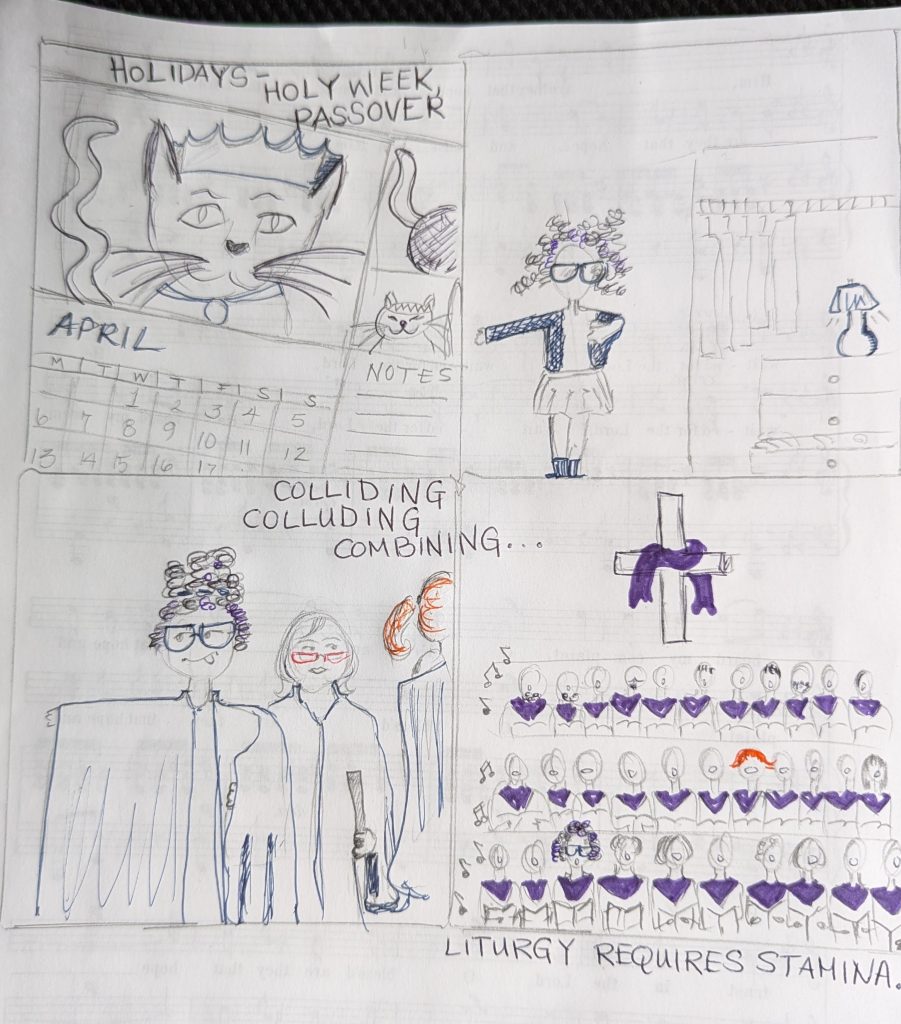
Holidays –
Holy Week,
Passover

Colliding,
Colluding,
Combining…

Liturgy
Requires
Stamina.

I can already tell that the poetry and the panels will be a challenge. I’ll need to sketch much faster with far less detail! It’s hard to wean oneself away from perfection. Additionally, for a tricube, I really only needed three panels… I don’t know what I was thinking, except somewhere in my head all comics require four panels? Anyway – onward into the marathon week of rehearsals and services and why not pick up a daily poetry and drawing practice this week as well? It makes perfect sense!🙄

P.S. – I really do have a bizarre medieval animals calendar with a crowned cat on it. @medievalistmatt – an Instagram account run by a history professor at Ohio Dominican University – is responsible, as his hilarious account is the reason I have these silly calendars… as it appears that most of the monks clearly had never been outside, much less even seen a horse, and they drew worse than I do. Anyway, happy Wednesday, happy April – and remember, you are well-loved.

{final pf of ’25: a poetry peeps wish of light, hope & peace}

Welcome to Poetry Friday!
Poetry Peeps! We did it! A very long year, but it’s nearly done, done, done. Thank you for being with us this year as we wrote poetry in conversation with each other and with the world. We don’t know yet what’s ahead thematically, but we’ll let you know the 2026 deets after January 4th when the Poetry Sisters put their heads together and figure out the next twelve month’s themes and challenges. Stay tuned!


Friends, I would have been writing this to you from other shores, except better sense intervened and kept us close to home this year. I’ll be happy to see friends abroad in June, but until then, I’m glad for the rain, and settling in to gratefully be a bit quiet and cozy at home.


As our overarching theme this month remains writing in conversation, and the words or ideas of ‘light,’ ‘hope,’ and ‘peace’ I thought I’d be fairly challenged with getting the words to fall together organically. I mean, granted – the December holidays, from Bodhi Day to Yalda, to Solstice to Hanukkah to Christmas are all about hope and light in one way or another, and light in the darkest part of the year is inevitably hopeful. But, peace… seems to be in a bit of short supply around any holiday that requires special foods and observances. I couldn’t figure out how to get peace as a concept to fit in organically…

From Process…

…until I started looking at these concepts from the opposite direction.

I started writing a Solstice poems a few years ago and shared a few. It’s an easy theme – the shortest day, the longest night, and facing forward to the idea that this is it, it’s Winter… but this is also the shortest day, and all days hereafter will be longer, even if by a minute, hallelujah, Amen. I even heard a brief mention of Solstice in the Advent homily as the reader said gleefully, “More light to come!” And we all cheered… but I found myself thinking, “…or, maybe we could just sit a minute with the cold and dark?” Admittedly, I was in a thinky mood and often homilies make my mind wander, but I realized that Christian religions, at least, seem only to do this ‘sit with the dark’ thing briefly, if at all. Some of us are weird about shadows and much prefer the sun and the shiny. Which, fair enough, but our insistence on only sunshine is imbalanced. We need the night, the moonlight , and the end of day. Plants don’t only need sunlight. Life doesn’t only exist by daylight. We can’t fast-forward the parts of living we don’t like, and dark exists for a reason… even if it makes us uncomfortable. Maybe especially then.

All times and seasons are part of our cycle, the turn of the wheel of days. Wherever we may be in one part of our pattern, we always know there’s more to come… The longer I live, the more I realize there’s no point in hating where we are. As my mother always said, “This, too, shall pass…”

…To Poetry

No matter how often I realize this, it always seems like… a new thought. Or, at least a thought I return to this again and again in poetry. I’ll choose to see it as a meditation instead of mere repetition. 😀

I paged through some of my poem forms because seasons – and recurring thoughts – tend to lend themselves to poems with repetitious forms. I started with a rondeau redoublé, but ended up with a villanelle (because end of year = lazy. I’ll return to the rondeau redoublé soon), a familiar friend. I leaned in to my love of alliteration as well – repeating thoughts deserve repeating sounds, after all – and just let myself ramble along until I came up with something. I’ll admit I’d forgotten how carefully one must choose the first line of the initial idea… I always start with that couplet of statements that feel solid enough to draw a poem out of, but boy, you’re really stuck with that first end word. Still, this came together quickly, and then lent itself to fiddling with for another day as the idea coalesced. This is the beauty of such a strict form – you only have so much wiggle room, so you have to make what you’ve come up with count. It’s not done, but I’m comfortable leaving it along for now.
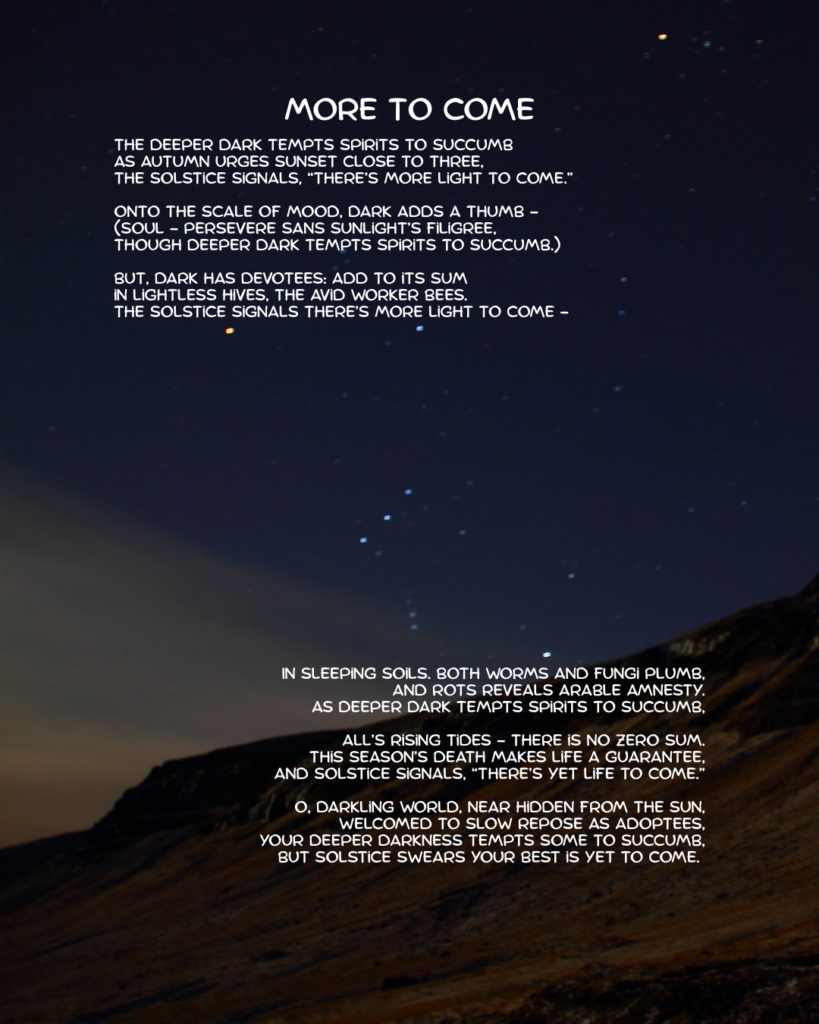
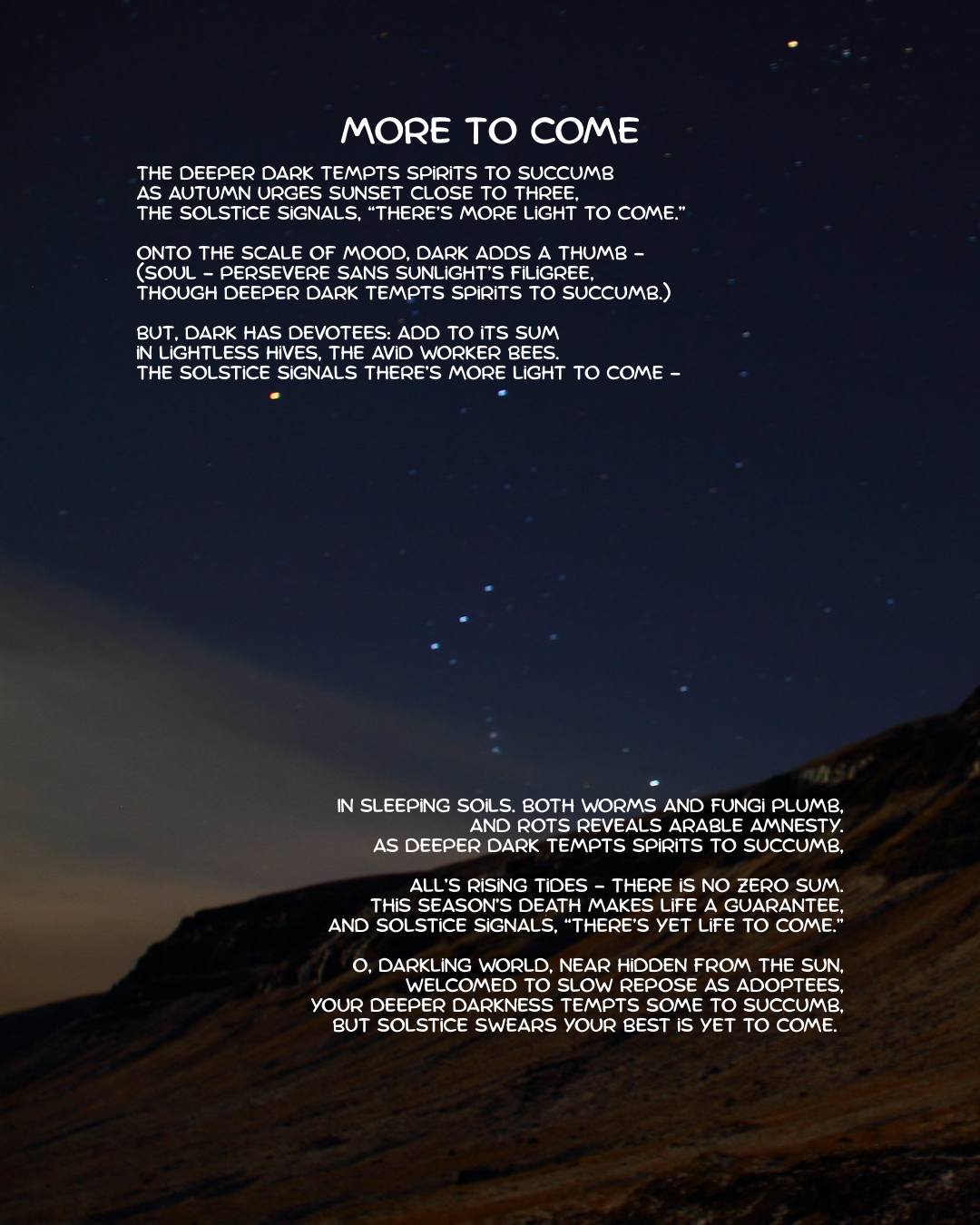
More To Come

The deeper dark tempts spirits to succumb
As autumn urges sunset close to three,
The solstice signals, “There’s more light to come.”

Onto the scale of Mood, dark adds a thumb –
(Soul, persevere sans sunlight’s filigree
Though deeper dark tempts spirits to succumb.)

But, dark has devotees: add to its sum
in lightless hives, the avid worker bees.
The solstice signals there’s more light to come –

In sleeping soils. Both worms and fungi plumb,
And rots reveals arable amnesty.
As deeper dark tempts spirits to succumb,

All’s rising tides – there is no zero sum.
This season’s death makes life a guarantee,
And solstice signals, “There’s yet life to come.”

O, darkling world, near hidden from the sun,
Welcomed to slow repose as adoptees,
Your deeper darkness tempts some to succumb,
But solstice swears your best is yet to come.

This image was taken by Tech Boy in 2010, and it remains my favorite night sky photograph of his, clearly showing the December night sky in Iceland, where we were tooling around at some unearthly hour in zero-degree weather, chasing the aurora. We didn’t see it that night, but the Orion nebulae was a most excellent consolation.

I hope you are enjoying this most wonderful Boxing Day, are ready for Kwanzaa, and had a wondrous Chrismukkah. If you’d like to peruse more poetry, the Peeps have got you. Sara’s poem is here. Laura’s poem is here. Mary Lee’s poem is here. Liz’s poem is right here. Michelle K’s post is here. Molly’s post coincidentally joins the list here. The usual suspects may filter in throughout the weekend, so don’t forget to check back for the full round up. (NB: I’m having blog issues and there will be some updates going on, so if your commenting is more difficult than usual, apologies, and feel free to drop me a thought on my contract form or an email.)

The end of the month, the end of a year, and a recurring thought – all three things added together are a solid refrain of time keeps flowing, and we’ll keep going. How we do so is entirely up to us. We’ll continue to love and live in the light, but as the dark folds around us this season, I hope we can sit with it deliberately, explore its hidden corners and let it speak to us what stories we may need to be told. And as always, in sunlight or under the glow of the moon, you are ever so well-loved.

{pf: poetry peeps burn down a haibun}

Welcome to Poetry Friday!

Poetry Peeps! You’re invited to our challenge for the month of November! Here’s the scoop: We’re composing ‘Eavesdropped & Overheard’ poems, in tribute to our friend of the long-running Chicken Spaghetti blog, Susan Thomsen. Much has changed since last we accepted this challenge in 2022 – including the number of newspapers with accessible, paywall-free ‘Overheard’ articles. Never fear, however – here’s useful scuttlebutt from DC to points West, and from areas all over if you’re not as much of a in-real-life stickybeak as the rest of us. Are you in? You’ll have a month to craft your creation(s), then share your offering on NOVEMBER 28th in a post and/or on social media with the tag #PoetryPals. Join the fun!


We did it! The Poetry Sisters managed to all show up at a pre-write meet-up! It had NOTHING WHATSOEVER to do with how impossible the prompt felt this month! Nothing at all! We just missed each other!! And needed to vent about prose poems! And stuff!

Okay, so we had a brief moment of “WHOSE IDEA WAS THIS!?” and we couldn’t recall, since prompts for the year are thought up in one fell swoop, each of us nursing our potion of choice, and who even knows what we were thinking (or drinking) in January. So… here we begin with a haibun, which in itself feels challenging as they are chiefly autobiographical ‘prose poems’ with subtracted lines. We add poet Torrin A. Greathouse’s transitional step of an additional erasure poem with an added element of flame creating a ‘burning’ haibun, which then collapses into the traditional haibun concluding haiku (perhaps reflecting how, like cinders, the original poem crumbles in on itself?), and…our annual theme of ‘poems in conversation.’ Hmmm…🤔😶

From Process…

As we talked about where each of us felt we could take the poem, I had basically bupkis, until I thought about burning in the most literal, elemental way. California has had it with fire – burn scars, burn years, and burn names. The first autumn after the Tubbs fire, I hyperventilated when smelling woodsmoke from someone’s fireplace. When it has destroyed so much of what you love – the Caldor fire took out part of the thousand acre summer camp where I worked from age 16-21 and took the first steps towards adulthood – it leaves scars. I don’t think I’ll be able to happily sit around a crackling campfire ever again.

Despite the need for this to come from an autobiographical space, I felt like I needed boundaries on all of these pesky feelings, however. Historically, we all know how I feel about unrhymed and unruled poetry prompts 😖 – they become unhinged and unruly in my hands. Because I need boundaries, I had to define a prose poem first. From my extensive reading, I concluded that it is prose that utilizes the elements of poetry – notably alliteration, repetition, rhyme, literary devices, and figurative language. Except for the line breaks and traditional shaping of poetry, it’s a poem. So. I tried to toe the line between the two.

…To Poetry

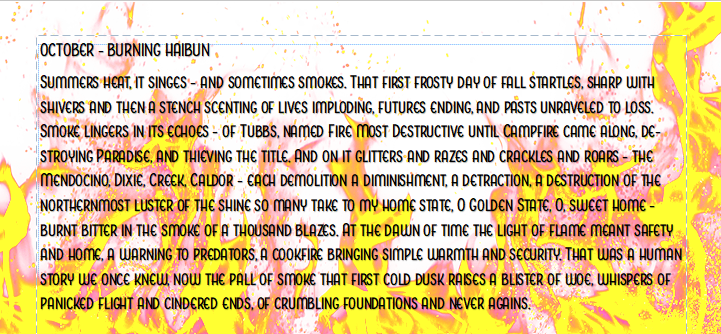
Summer’s heat, it singes – and sometimes smokes. That first frosty day of fall startles, sharp with shivers and then a stench scenting of lives imploding, futures ending, and pasts unraveled to loss. Smoke lingers in its echoes – of Tubbs, named Fire Most Destructive until Campfire came along, destroying Paradise, and thieving the title. And on it glitters and razes and crackles and roars – the Mendocino, Dixie, Creek, Caldor – each demolition a diminishment, a detraction, a destruction of the northernmost luster of the shine so many take to my home state, O Golden State, O, sweet home – burnt bitter in the smoke of a thousand blazes. At the dawn of time the light of flame meant safety and home, a warning to predators, a cookfire bringing simple warmth and security. That was a human story we once knew, now the pall of smoke that first cold dusk raises a blister of woe, whispers of panicked flight and cindered ends, of crumbling foundations and never agains.

And now, we begin the burning. The second phase of the burning haibun is meant to represent a state wholly different from the first, so I went from heat to cold:

It singes – that first frosty day of fall,
Sharp with shivers, scenting futures and pasts.
Smoke lingers, destructive paradise, and it glitters –
A diminishment, a detraction, a destruction of the shine so golden –
O, sweet smoke of a thousand dawn predators,
Bringing a story that whispers
of flight.

I like how …ominous that one sounds. I tried to bring that sense of menacing portent to the haiku. (I also tried hard not to use the traditional 5-7-5 syllabic form, because Japanese haiku actually doesn’t do so slavishly, and I need to get out of the elementary school version of haiku someday.)

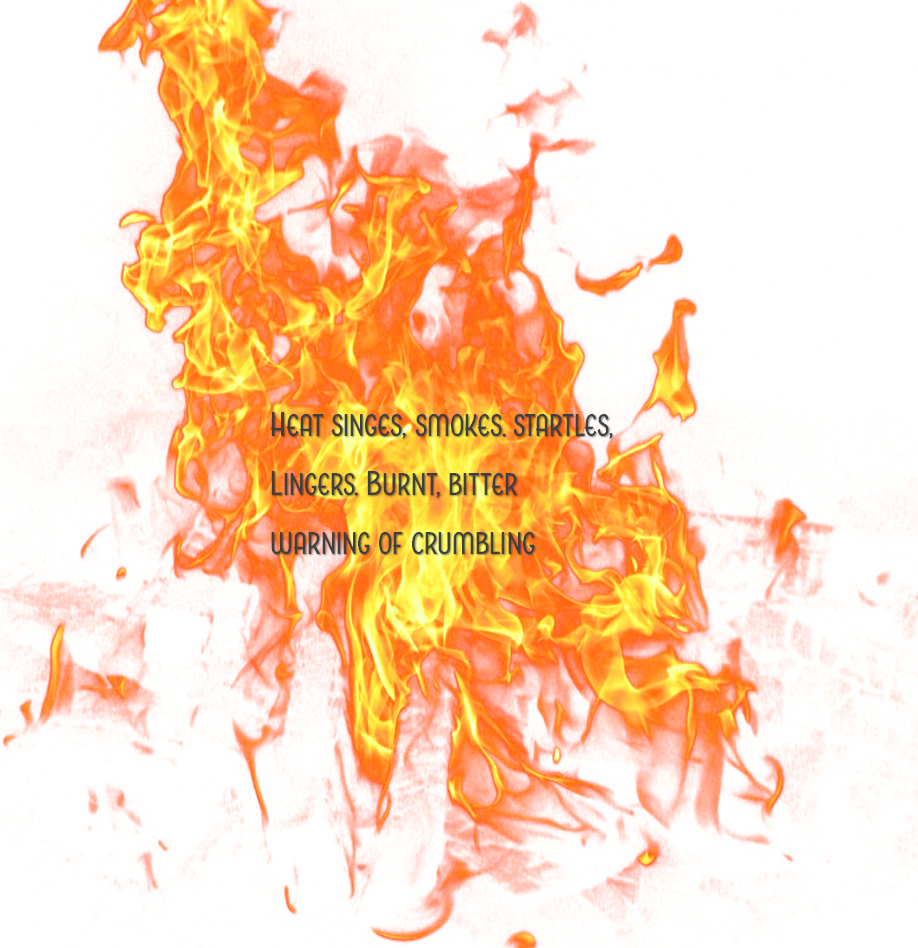
heat singes, smoke startles,
lingers, burnt bitter
warning of crumbling

I wasn’t entirely satisfied with this — though I think it fulfilled the requirement. But, I wanted to write a burn-book burning haibun. Why not use Shakespearean insults? (“Your brain is as dry as the remainder biscuit after voyage.” As You Like It [Act 2, Scene 7]; “Thou damned and luxurious mountain goat.” Henry V [Act 4, Scene 4] 🐐, or what has to be one of my all-time favorites “Thou whoreson zed, thou unnecessary letter!” King Lear [Act 2, Scene 2]. Imagine being insulted as the “unnecessary” letter z!🤣) Or can you imagine a poetic “yo mama” battle? There were so many ways to ‘burn’ with this, once I was able to let go of being literal… I’ll have come back to those another day. Meanwhile, others have emerged victorious from the burning! Tricia’s poem is here. Sara’s poem is here. Laura’s poem is here. Mary Lee’s poem is here, and Liz’s poem is here. Michelle K went the second mile with two haibun, while Karen rose to beautifully meet the challenge here. Carol’s poem transformation is here. More Poetry Peeps may check in throughout the weekend, so check back later for the full roundup. And if this challenge wrecked you, no worries! We’ll catch up with you next time.


Poetry Friday today is hosted today by the autumn-appropriate Jone Rush MacCulloch, whose Halloween-esque haiku and full-moon artwork I’m enjoying on the calendar she gave me. Thanks doubly, Jone. Though sometimes it feels like the world is on fire, our present suffering is no more than others have faced in other nations at other times, and it, too, shall pass. I remind myself as well as anyone else who needs to hear it: trouble is neither as special nor as unique as we might think – which means we are not alone in it, especially if we look up and reach out to those around us who are very likely feeling some kind of way, too. Nolite te bastardes carborundorum – in hoc una sumus. Remember, at this and every other time, you are so well-loved.

{npm kidlit progressive poem}

It’s time! The lovely progressive poem has “progressed” for twenty days, and now it’s my turn! Here’s the panoply of poets playing this year:

April 1 Linda Mitchell at A Word Edgewise
April 2 Tricia at The Miss Rumphius Effect
April 3 Robyn at Life on the Deckle Edge
April 4 Donna Smith at Mainely Write
April 5 Denise at https://mrsdkrebs.edublogs.org/
April 6 Buffy at http://www.buffysilverman.com/blog
April 7 Jone at https://www.jonerushmacculloch.com/
April 8 Janice Scully at Salt City Verse
April 9 Tabatha at https://tabathayeatts.blogspot.com/
April 10 Marcie at Marcie Flinchum Atkins
April 11 Rose at Imagine the Possibilities | Rose’s Blog
April 12 Fran Haley at Lit Bits and Pieces
April 13 Cathy Stenquist
April 14 Janet Fagel at Mainly Write
April 15 Carol Varsalona at Beyond LiteracyLink
April 16 Amy Ludwig VanDerwater at The Poem Farm
April 17 Kim Johnson at Common Threads
April 18 Margaret at Reflections on the Teche
April 19 Ramona at Pleasures from the Page
April 20 Mary Lee at A(nother) Year of Reading
April 21 Tanita at {fiction instead of lies}
April 22 *Patricia Franz
April 23 *Ruth at There’s No Such Thing as a Godforsaken Town
April 24 Linda Kulp Trout at http://lindakulptrout.blogspot.com
April 25 Heidi Mordhorst at My Juicy Little Universe
April 26 Michelle Kogan at: https://moreart4all.wordpress.com/
April 27 Linda Baie at Teacher Dance
April 28 Pamela Ross at Words in Flight
April 29 Diane Davis at Starting Again in Poetry
April 30 April Halprin Wayland at Teaching Authors

(EDITED TO ADD – tomorrow’s line will be found at Rose’s blog, and the poem will go forward from there. Please skip Patricia for now. Thank you!)

For those of you new to the process: this NPM children’s poetry celebration was originally begun by Irene Latham, and the mantle taken up by Margaret Simon, who wrangled this year’s distracted poets into a cohesive whole. Linda M. started us off with a gloriously open April window…

From Process…to Poetry (Line)

April thus far has been a particularly scattered month for me, but reading poetry has been particularly grounding, especially seeing this poem grow in creation. In this April garden, nothing yet has come to grief. It is full of the actions of joy. As I breathed the “gift of the lilacs,” and imagined myself painting and breathing and dabbling and gamboling, I thought about what we verb-y activities we haven’t yet done in this poem – eaten, spoken, shouted, screamed/squealed, or slept (we’re playing in this garden alone, which is its own kind of delightful). I also meditated on the scents on my back porch just now of an evening – orange blossoms from my dwarf citrus tree. It almost feels like we opened that April window into a glorious morning, and now… taking my cue from the thanks at the “day’s end,” and “long-ago springs,” as well as Cousin Mary Lee’s flowering shrubs, I decided to forget about eating (I couldn’t figure out how to fit it in 😂) and drink in a sense of peace and rest. That’s what this April garden has given to me this month. Since we’ve stayed in four lines per stanza, I’ll add an ellipse and begin a new one…and then it’s over to you, Patricia Rose!

Open an April window
let sunlight paint the air
stippling every dogwood
dappling daffodils with flair

Race to the garden
where woodpeckers drum
as hummingbirds thrum
in the blossoming Sweetgum

Sing as you set up the easels
dabble in the paints
echo the colors of lilac and phlox
commune without constraints

Breathe deeply the gifts of lilacs
rejoice in earth’s sweet offerings
feel renewed-give thanks at day’s end
remember long-ago springs

Bask in a royal spring meadow
romp like a golden-doodle pup!
startle the sleeping grasshoppers
delight in each flowering shrub…

Drinking in orange-blossom twilight

{rylee makes the Chicago Public Library best fiction list}

Well, here’s some fun news for a Wednesday!

The Chicago Public Library, like many libraries, does an end-of-year list thing, and Rylee has made it onto the ‘best fiction for older readers’ list. This is an EXCELLENT list, too – there are several books I’m looking forward to digging out of my own teetering TBR list, including Saadia Faruqi’s THE PARTITION PROJECT, as this is the FIRST book for children I have EVER seen, fiction or otherwise, on Partition, and I think it’s an important topic it’s hard to get some older people to talk about; Katherine Rundell’s IMPOSSIBLE CREATURES, Hena Khan’s WE ARE BIG TIME, and Kekla Magoon’s THE SECRET LIBRARY, to name just a few. I admit that I’m not always a huge fan of “best” of anything list, but as this list is actually made by staff who have READ the books and aren’t just regurgitating sales stats or whatnot, this is a great list with which to populate your own TBR list. Do check it out!

Meanwhile, I’m really proud of being included among these greats, which includes winners of the NBA and the ALA awards as well. Hooray for science, for friendship, and for a difficult book that has turned out to be one of the more satisfying that I’ve ever written. YAY, RYLEE!


{THE CYBILS: it’s happening!}

Friends, it’s been a helluva summer. My fatigue has kicked my backside, but I STILL turned in a book – on time, thankyouverymuch – and now for my reward is taking part in the second round judging for the CYBILS Award. Every time I think I don’t have time, I find that it is just one of my singular joys to be a part of the crew. I am SO happy to be back. I try and hold back, as a Board member, because I participated seven years in a row, and it’s always nice to have Other People get a chance, but when I’m needed I am OVERJOYED to be there. And look: we have new badges this year!!!!

And here’s the POETRY badges:

I’m a 2nd Round Poetry Judge, and I couldn’t be prouder. I feel quasi-qualified this time, too, since I have a poem being published in 2026 in an anthology from Lerner! Woot! But, even if I didn’t have that, I know that my only qualification needs to be that I love poetry, and I’m willing to speak about my opinion, and listen to the opinions of others. Together we’ll celebrate what we love the best – and that’s the joy of the CYBILS.

Friends – especially poetry, nonfiction, and speculative fiction friends – when you have a chance to nominate books, DO IT. Being a part of this singularly nerdy award which started all the way in 2006 is proof positive that we – average ordinary librarians, teacher, and readers – can make our voices heard about the work we love to read. Join the fun, please!

{pf: p7 classified haiku}

Welcome to another Poetry Friday Poetry Peeps Adventure!

Poetry Peeps! You’re invited to our challenge for the month of July! Here’s the scoop: We’re indulging in ekphrastics – poetry based on pictures. We’ll be exchanging images from our personal stashes, but we’re also free to use photo from sites like Unsplash or the Library of Congress’ pictorial library to help us out. From there our poems will grow out of whatever form, topic, length, or theme. Are you game? Good! You have a month to craft your classified creation and share it on August 30th in a post and/or on social media with the tag #PoetryPals.


Poetry Pea podcast: “Hino Sōjō observed that senryū are poems that make people nod in agreement whereas haiku make people feel.” Don’t you love that? I hope you feel that nod happen for you today!


The last time we did this exercise, in 2012, I moaned about it a great deal, MOSTLY because I’d just finished an international move and still had book deadlines, but also, because haiku ads only SOUND easy, or clever people would put them in the paper and online all the time. Such a short form you’d think you could make effortlessly clever and fun, but the haiku/senryu syllabic rules are definitely working against you. Last time I tried haiku ads, were doing a “12 Poems in 12 Months” challenge that, little did we know, would end up being something we’ve done for years now, and we had a Google doc where we could all comment on each other’s work – and fuss about it. This time, we were all so busy we couldn’t even get online together for our meetup. So… everyone’s poetry today is a full on surprise. That’ll be fun!

From Process…

Since I was missing the meet-up energy I usually get in the hour we spend talking about the challenge, any form issues, and our plans, I went back to those older blog posts, where I could, and reread our clever work. I actually really liked several of them, and it reminded me of the breadth of what counts as classified ads and how we could make them a bit more mysterious (Laura’s Riddle-ku style) and less straightforward. I also brushed up on senryu – what it is, and what it focuses on – because, despite my best efforts, I don’t think I’ve written a real haiku ever in my life. Finally I perused other people’s efforts. Haiku Society of America’s senryu winners came with some really enlightening judges comments. The Atlantic’s contest was a lot of fun – some of them really made me chuckle. I feel like I’ve gotten a bit of a better feel for what the emotional range of senryu can be… even though that doesn’t mean I can definitely write it.

…To Poetry

One thing I read and observed is that the syllable form is much less strict with senryu – and I immediately decided that this time, I was going to have vari-syllabic verses. That… didn’t really happen. I tend to become very fixated on the structure of a thing, so I kept having to remind myself that “it doesn’t have to be 5-7-5. Of course, the minute I abandoned the rules, I didn’t actually like anything I wrote anymore. ☺ Typical. The second challenge was finding a leftover scrap of imagination as the next heat wave roared upon us. I began and discarded poems about breezes, wind, and cold air (there was quite a theme going on). Finally, I stepped away, determining that my best bet was to simply try writing one haiku a day, until I got more of a feel for what I was after.

I enjoy writing short poetry like this over a period of days sometimes because I can remember what I was thinking when I wrote it – and do that “nod in agreement” thing that senryu provokes in the best ways. For instance:

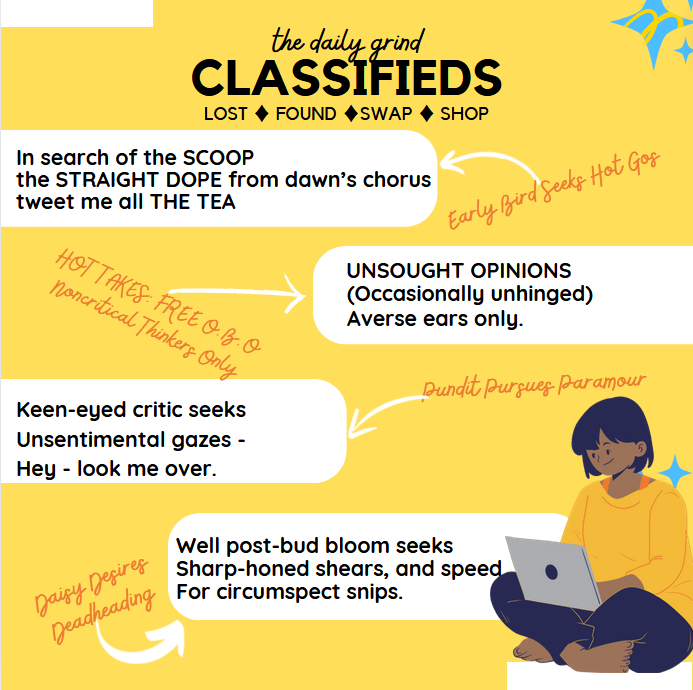
In search of the scoop
the straight dope from dawn’s chorus:
tweet me all the tea

This bird poetry comes courtesy of sleeping with all the windows and the slider open – and realizing just how early those little featherwits get up. I remind them that the dawn (gossip) chorus begins when there’s, you know, dawn? They disagree.

Unsought opinions
(Occasionally unhinged)
Averse ears only

Yes, these unsought opinions come in their original packaging, and they’re completely content-free!

Ah, we love an election year, don’t we? Bleh. Some of my acquaintances could really stand to keep their political texts/email forwards/comments to themselves…

Keen-eyed critic seeks
Unsentimental gazes
Hey – look me over.

I was writing a scene wherein a girl gets her first look at the engagement ring her mother’s boyfriend shows her, and I asked my writing group to gush-check me, because I am TERRIBLE at swoony scenes. I’m still the girl who asked her boyfriend, “So… are we doing this, or what?” Yes, that’s what he got for a proposal. Unsentimental gazes FTW!

Well post-bud bloom seeks
Sharp-honed shears, and speed
For circumspect snips.

Ohhh, I wanted to use secateurs – it’s such a delightful word! Sadly… far too many syllables!


July was a great month for a concise poetry form, as we’re all hip-deep in the requisite rounds of visitations and vacations that make up summertime. The brevity and the theme meant that many of us at least had a minute to try some, which makes it fun. Laura’s poem is here. Mary Lee’s poem is here. Tricia’s poem is here, and Liz’s poem is here. Michelle K’s ads are here, Denise’s ad is here, and Jone’s ad inviting us a riparian life is here. More Peeps may haul out a haiku or two before the end of the weekend, so don’t forget to pop back to see the senryu/haiku ad round-up. Meanwhile, Marcie Flinchum Atkins (who has an interesting looking YA novel in verse upcoming!) is our Poetry Friday hostess today – thanks, Marcie! You’ll find the full Poetry Friday panoply @

{book news: rylee swanson earns a star!}

Hello Friends!

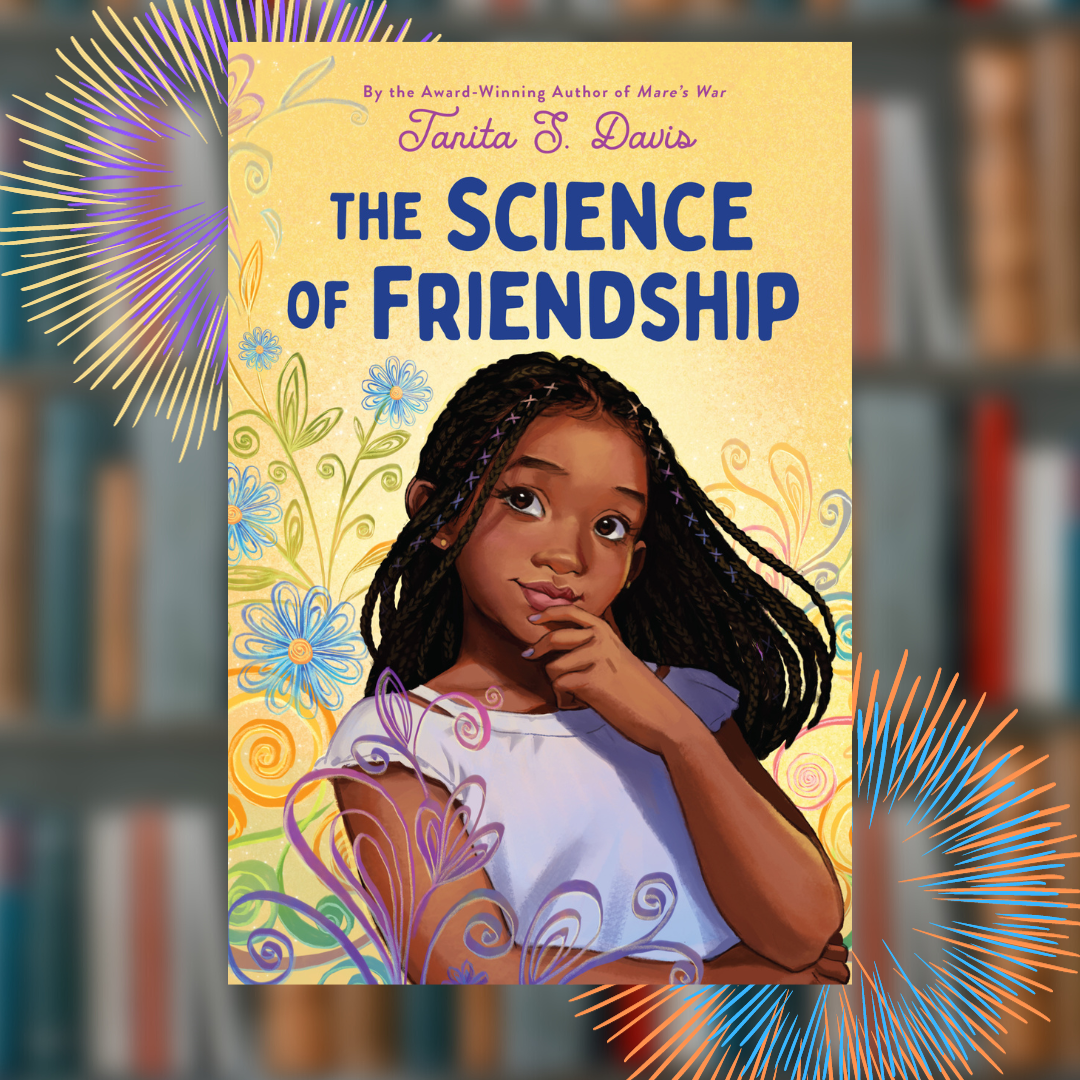
The Science of Friendship hits bookshelves near the end of August, but we’re already hearing good things from readers. My first and favorite mention remains Afoma Umesi from Reading Middle Grade who mentioned a favorite quote on her Instagram page. She chose one of my favorite Rylee scenes, and I was excited to hear she enjoyed it.

Meanwhile, Kirkus is renown for its rigorous anonymous reviews, and I am deeply gratified to have received a nod from them. What I love, love, LOVED was how the reviewer talked about the growing Rylee did in this book. Our girl is hit with some tough stuff, but it, in turn, makes her turn and look at herself. (I mean, eventually – nobody gets into self-reflection right away.) According to the review, in THE SCIENCE OF FRIENDSHIP you can find “the gentle modeling of emotional-regulation skills such as self-compassion.” I need to sit and appreciate how smart that makes this book sound. I don’t read reviews unless my editor sends them to me, but this one – this one makes it feel pretty worthwhile.

You can read the it here for yourself, and I can’t wait ’til you meet Rylee this summer.

Meanwhile, Happy Weekend!