This poem brought to you by the letters P and I, and the word “autoimmune”
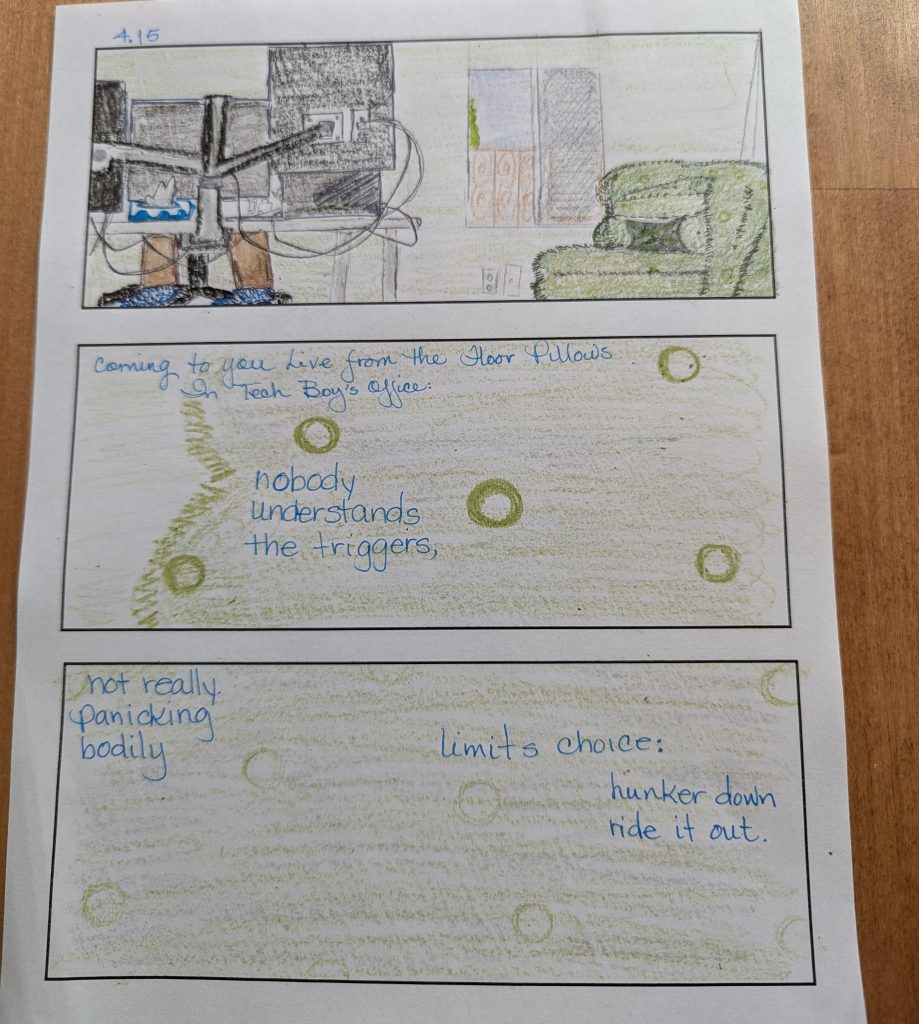
coming to you live from the floor pillow in Tech Boy’s office
nobody
understands
the triggers,
not really.
panicking
bodily
limits choice:
hunker down,
ride it out.
This poem brought to you by the letters P and I, and the word “autoimmune”
nobody
understands
the triggers,
not really.
panicking
bodily
limits choice:
hunker down,
ride it out.
Heard the factoid this morning that Queen Elizabeth I’s courtiers blackened their teeth with soot to mimic her own genuinely decaying teeth, as in 1533 their monarch’s unrestrained love of sugar had left its mark and dentistry was not yet really A Thing. The podcast compared this to the myriad women who have gone under the knife to change their appearance and appeal to the putative head of this government in the year of our Lord twenty twenty-six. …And, I was thinking how we’re all grasping so frantically, even since primary school, for somewhere to belong, in the most galling fashion at times (see: Junior High). …and, how standing out and solitariness is not how most of us are naturally inclined, and how much effort it must take to stay true to oneself in that environment, and not even change your makeup routine to resemble the herd… And, how in two years or six months or less, the herd is going to look wholly different and even more ridiculous than it does now, and for those whose surgeries can’t be undone, then what? For whom are we changing our very bodies and selling our souls, with no reciprocity?
Collectively, We The People need Dr. Rudine’s windows, mirrors, and sliding glass doors… and for heaven’s sake to maybe have a sit and a quiet think… Because beyond all of the other *waves hands* …murderous, callous, unethical, illegal, ungodly -ists and -isms, none of that “go along to get along” stuff is ever sustainable. Weren’t we all supposed to learn that in junior high?
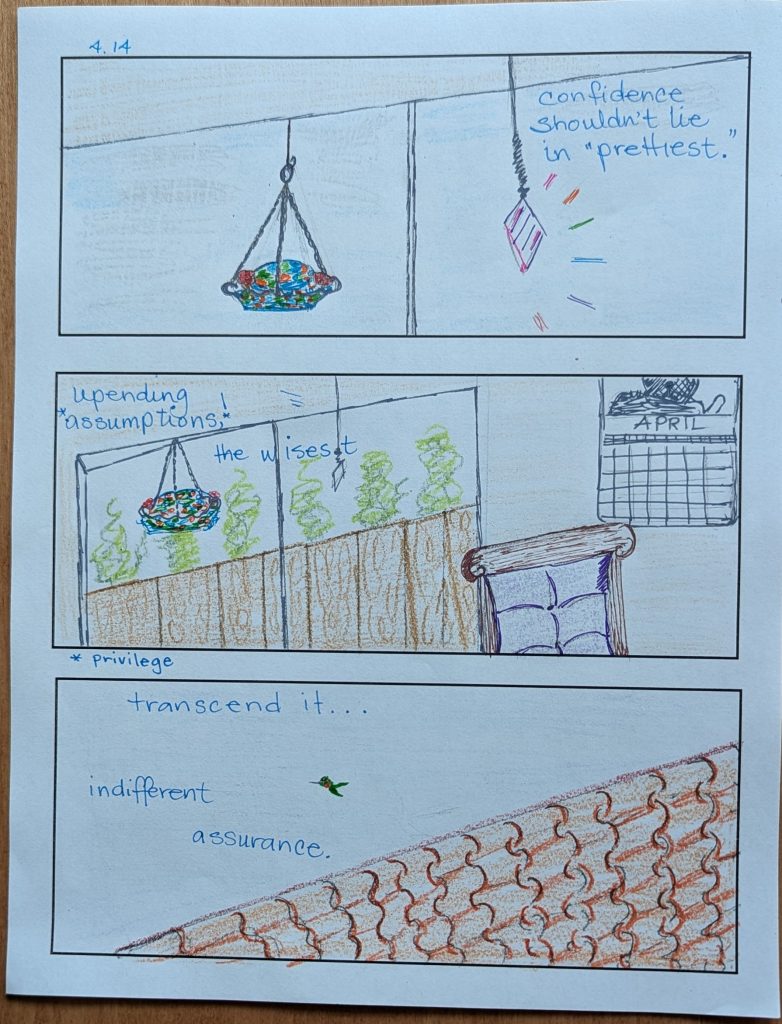
confidence
shouldn’t lie
in “prettiest.”
upending
privilege,
the wisest
transcend it.
Indifferent
assurance.
Hummingbirds (which I cannot draw) are the ultimate in assured indifference. Beautiful, but may or may not come to the feeder. Exquisite, but may merely give you a quick side-eye as they pass. Stunning, and could not care less what you’re all about. #goals.

This is the year’s first novel-in-verse that I’ve read – and boy, does it shine.
The year is 1963 and fifth grader Cooper Dale is not looking forward to her school year. She has The Mean Teacher, and she’s dreading dealing with Ms. Keating, whom everyone says is just terrible. Cooper hates being the only Colored girl in her class, and hates how everyone looks at her when the history lesson is on slavery. Only the summer before, four girls only a little older than she is were killed in a church bombing by the Klan. The world seems full of scary, mean white people who hate her for being the color she is, and it’s dispiriting and exhasuting. What makes it all worse is a boy named Wade Carter, because Wade just can’t seem to leave Cooper alone. He is a bully, and his bullying is almost always racial in nature, taking the form of microaggressions that are not terribly micro, when taken together. Wade wears Cooper down. She loves her family, loves their gatherings, and otherwise loves her culture, but at school, she dearly wishes that she were white and could blend into the crowd.

Cooper is a worrier, and like many kids in early middle grade, though her worrying is part of her growing up and growing to see adults – and the larger world – as entities separate and with their own backstories, those worries sometimes consume her. She worries about her parents, and wishes they didn’t have to work so hard. She worries about disappointing them, and worries about seeming likeable. She worries that her siblings and cousins and extended family will be ashamed of the way she thinks and feels – and sometimes acts. Cooper feels like it’s harder to be herself – whoever that is – because her parents have told her repeatedly that she needs to “shine” in all that she does. To Cooper, that means that she should make straight A’s. She struggles with this. More, as Ward’s pestering gets under her skin, Cooper struggles with her behavior, earning herself a smack with a ruler from her scary teacher, her parents’ disappointment, and worse – her own. Why can’t this year be easy? Though Cooper’s dearest wish is to be just treated like everyone else, that’s never going to happen for the lone Black girl in a white-dominated school in 1960’s America. What Cooper finally determines is that her only option to counteract her frustrations are to shine, like her mother says she should. She’ll be so good that no one can ignore her. Cooper asks the input of her older siblings, and her cousins on how they succeed and deal with things, and vows to make her shine brighter. Ward Carter’s family hiring her mother as household help while Mrs. Carter is ill IMMEDIATELY makes that 1000% harder.
Still, as the school year goes on, through its ups and downs, Cooper begins to faintly understand that what she really should be looking to be is radiant – not just shiny on the outside, but radiating light and goodness and kindness from the inside that isn’t just external polish. And when real-world trouble touches their school community, Cooper finds out that radiance can’t be easily extinguished.

This book is accessible in terms of having short, spare poems, tons of historical references, from the Kennedys to Crayola’s “flesh” tone’s shift to peach, Ed Sullivan introducing the Beatles, and a classmate whose interest in African culture and language really reflects the shift to the nascent 60’s attitudes of “Blackness” as divorced from the outdated terms “Negro” and “Colored.” Cooper is a young, but thoughtful fifth grader, and the novel takes the far-ranging themes of racism and prejudice and recolors them through the lens of forgiveness, family, and community. No one is perfect in this book – but no one and nothing is irredeemable, even bullies. Vaunda Micheaux Nelson subtly weaves a steady emotional pulse of a coming of age book with the everyday banalities of the fifth grade to create a quiet but memorable novel in verse that has a lot of heart.
Fresh onto the TBR:
In a world that seeks to dull us, may we ever be the radiance that it needs. Stay reading!
Still A Constant Reader
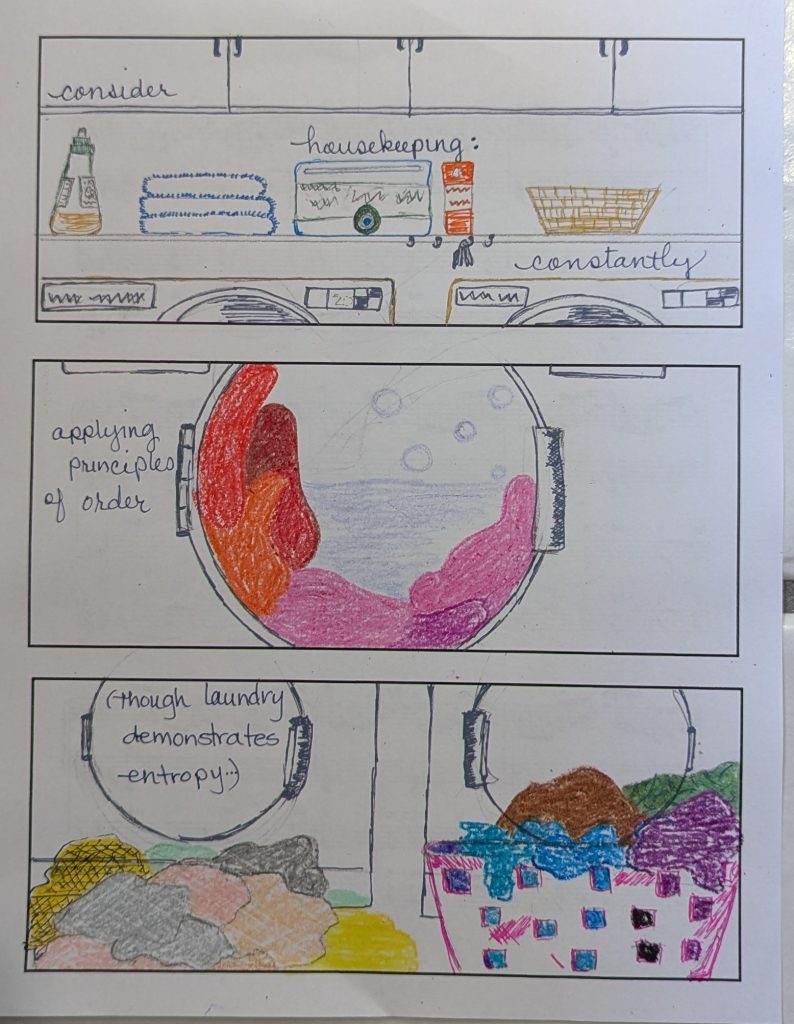
Consider
housekeeping:
constantly
applying
principles
of order.
(though laundry
demonstrates
entropy…)
(Since even my washing machines have windows, they seemed fair game for observation.)
Monday, November 13, 1620, the Mayflower came ashore. After they probably kissed the ground in gratitude for someplace solid to stand, the Pilgrim-esses hauled out the wash… because it was Monday, after all, and that’s what one did on Monday.
Every time I manage to do laundry on a Monday I feel some sort of bizarre kinship with hundreds-of-years-ago Englishwomen, who started this, and all who came after… Just trying to impose order on chaos, tying the days of the week to some sort of recognizable pattern, trying to make meaning of drudgery. Good luck to all of us who keep trying…
The Indian Appropriations Act of 1889 reapportioned lands once belonging to the Cherokee, Chickasaw, Choctaw, Creek, and Seminole peoples who had been forcibly removed. The Oklahoma Land Rush that same year was an historical event where what was considered some of the best ‘unassigned’ land in the U.S. was up for grabs by non-Native Americans. Historical record tells us that the race started at ‘high noon’ on April 22, 1889, and that an estimated 50,000 people were lined up at the start, seeking to gain a piece of the available two million acres. Jewell Parker Rhodes uses this foundation to tell an excellent story.
Will and his family are sharecroppers in Texas five years after the Emancipation Proclamation. Though their lives changed when Will’s grandfather and father walked away from the Louisiana plantation where they had been enslaved, the changes haven’t been big enough. Sharecropping meant turning over 70% of their crops to someone else – someone who charged them for the seed they used to grow it, leaving them almost no profit. Will’s father finds sharecropping just as unjust as slavery, so when he hears of the Land Rush, it’s a gamble that he absolutely must take.
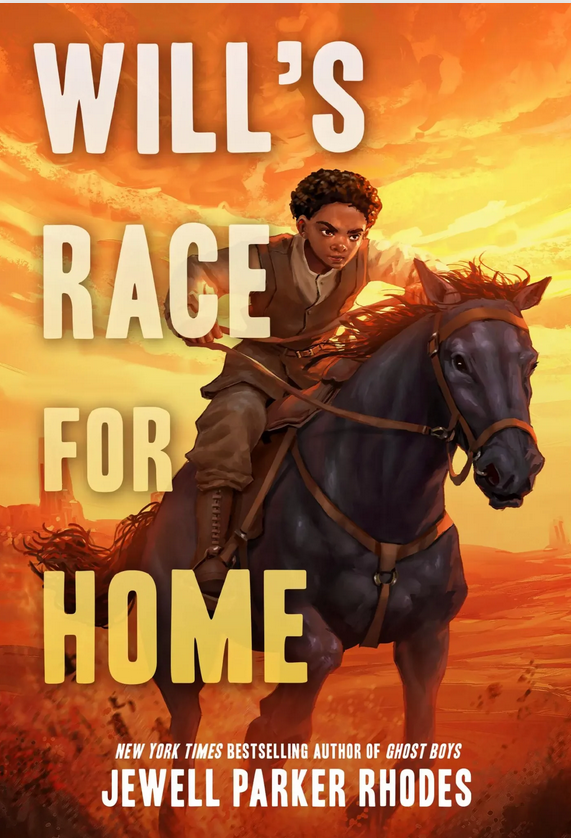
Unlike Will, who is a bit undecided about life, Will’s father is a long-range thinker; silent, thoughtful, and determined. He hasn’t been soft, or particularly loving towards Will, so when it is decided that Will, rather than his grandfather, will accompany Will’s father on the cross-country trip, Will is both nervous and exhilarated. Could it be possible that they can soon share the type of closeness that Will’s father and grandfather do? Or will the family mule, Belle, remain Will’s best and only confidant?
Along the trail, Will encounters dust, boring scenery, hot days, flooding rains, and Americans – some for whom the possibility of free land brings out their worst, and others who behave honorably. As in any good Western, there are gunslingers, sheriffs, and saloons. Will’s eyes are opened by his travels, and he learns that there are choices which, once made, will change a person – forever. Considerations of the cost of war, what it means to be a man, and how one’s faith can be a prick to the conscience as well as a guide for life deepen this story from mere adventure to something more. Will changes from a boy who thought he knew the answers into a young man who knows that life holds questions that he hasn’t even thought to ask. A great novel for those who like history, Westerns, and complex tales of growing up, Will’s Race for Home should be on your TBR list this year.
Fresh onto the TBR:
In the words of Hank Green, “The truth resists simplicity.” Never buy the lie that life, with its astoundingly complex array of beliefs and systems, history and sociology, is anything like simple. Neither the story of the theft of the American West nor the story of the settlement of African Americans within the West is a matter of a simple, monolithic truth – that’s why it’s important to read widely and think deeply. Friends, stay reading!
📚 Still A Constant Reader
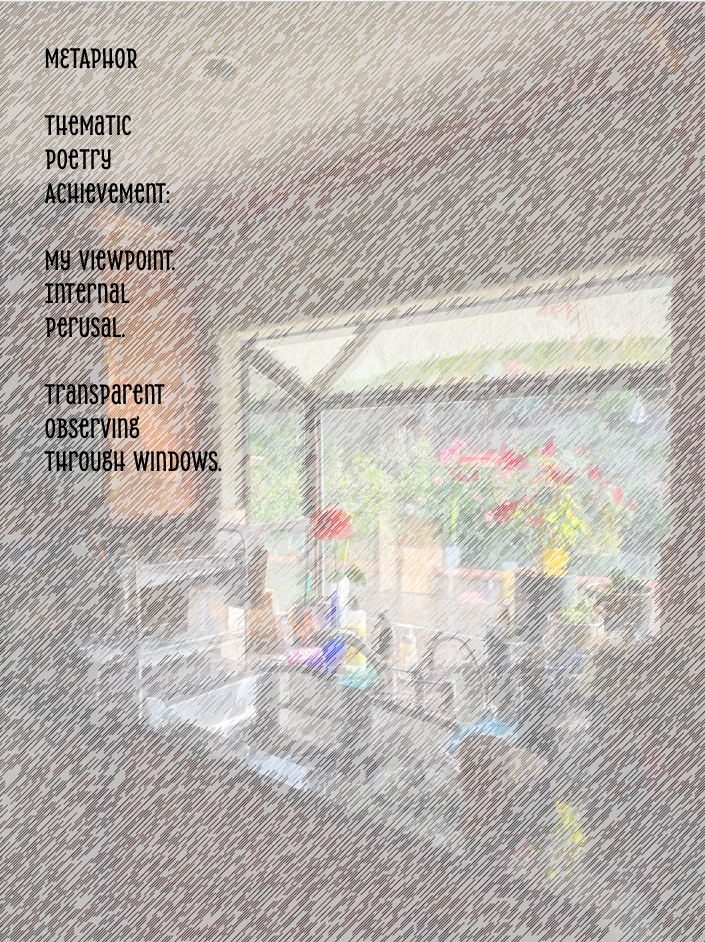
Thematic
Poetry
Achievement.
My viewpoint:
Internal
Perusal.
Transparent
Observing,
Through windows.
It finally clicked when I came up with a stained glass window rather than draw anything else the other day. It’s all becoming clear to me now…?
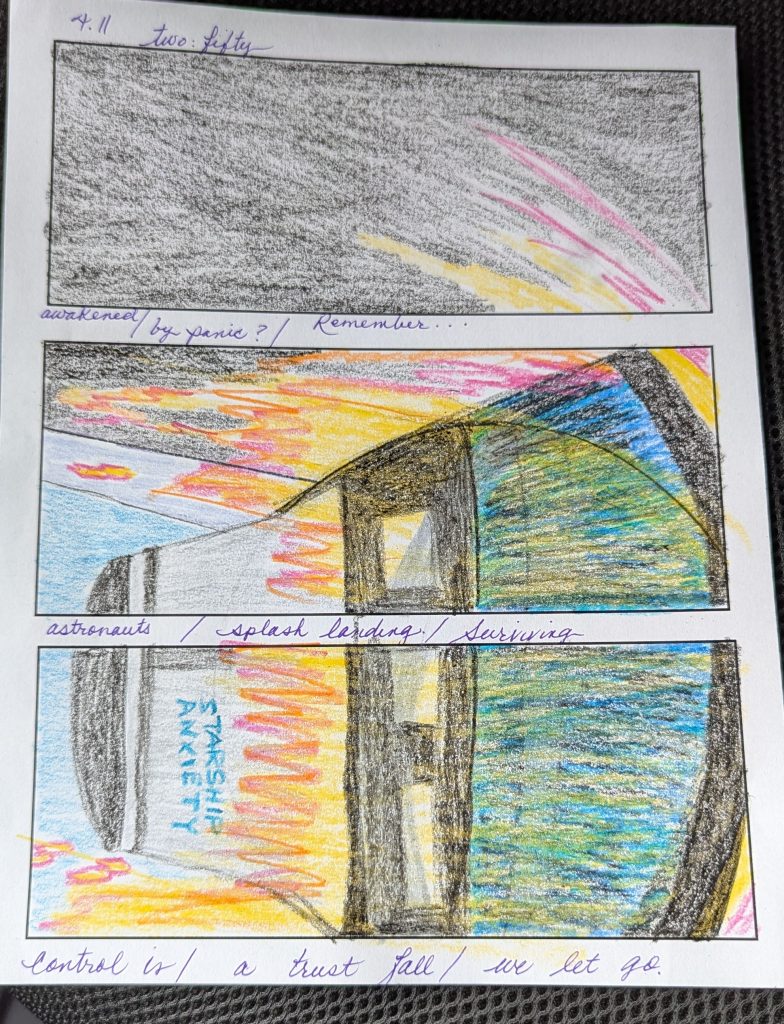
Awakened
by panic?
Remember
astronauts
splash landing,
surviving.
Control is
a trust fall
we let go.
Thank you, anxiety, for the lesson. Can I go back to sleep now?
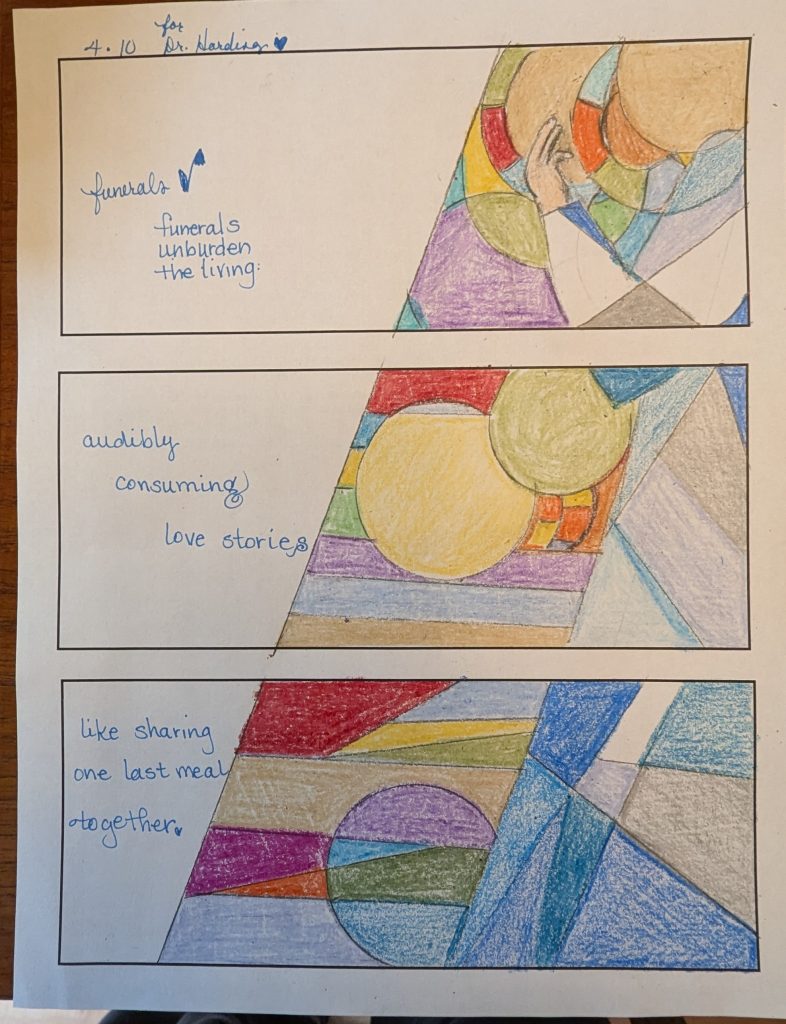
funerals
unburden
the living,
audibly
consuming
love stories
like sharing
one last meal
together.♥
Though I wanted to be, your girl is NOT a ball-and-bat-and-sweats-and-spike girlie. I played football in junior high because I was fast and aggressive and very, very angry so bashing my body into boys without getting a felony count seemed like a good idea, until I was yanked unceremoniously off the team by my father. It was fine, really – while I did my best, sports are one place where my spatial disability makes me trip a lot, run left when I should run right, be clueless about yardage and — yeah. Football plays make as much sense to me as knitting patterns, so it wasn’t going to have lasted long anyway.
But I WANTED to be a sporty girl. And reading these two books about the team solidarity and body-mind connection that sports require are giving pure Title IX.
IT’S ALL OR NOTHING, VALE,, by Andrea Beatriz Arango
Vale – or Valentina Marí Camacho – is a Puerto Rican girl from Virginia who has been competitively fencing for years and years and years. Fed on a steady diet of “pain is just weakness leaving the body,” “winner’s don’t quit,” and told so long that “it’s all or nothing,” Vale has honed herself to be determined, 100% serious effort. She’s never been good at anything, really, unlike her brother, but she’s good enough at fencing to have been tagged to go to the junior Olympics. As an athlete, she’s at the top of her game and fiercely proud of it. But an accident on the back of her father’s motorcycle breaks her leg in multiple places and suddenly Vale is out of competition for four long months.

Her return – which is where the book begins – is not the glorious sprint she envisioned, but a pained limp. Her parents argue constantly about whether or not she should sit down, use her cane, do yoga, or try whatever random internet-sourced cure that Vale’s mother has found. Her Papí, meanwhile, believes nothing but that she is fine, and that she will be back to 100% if she just puts in the time. Her mother her to be hyperfragile and her father believing she’s indestructible has more to do with them than with Vale, but she’s unable to see that, because the family cannot themselves articulate their own feelings – or fears. Vale returns to her fencing group unsure if “disabled” is a bad word, hearing whispers of dolor chronico, and terrified but unable to share it. And to her shock, the forceful, graceful effort that fencing requires seems no longer available to her, even with Vale giving it 150%. And to make everything exponentially worse, Cuban Myrka Mareero – a gorgeous, pink-haired newcomer, has not only taken Vale’s spot, she’s also got her attention in a way that Vale isn’t sure she’s ready to deal with. At ALL.
SO much to love in this book – from the stunning cover to the liberal use of Spanish, which challenged me but left carefully placed context clues for if I couldn’t remember a vocabulary word. I don’t think I’ve ever read a MG story about chronic pain, injury, and perfectionism that hit me in the same way, and the fact that the novel doesn’t end with a conclusion “and then Vale decided X, and she lived happily ever after” is one of its major strengths. The novel is merely a moment in a long process which is just beginning – a truth so important which we need more novels which center. Healing and survival are always-in-progress things.
OUT OF OUR LEAGUE,, edited by Dahlia Adler & Jennifer Iacopelli
Reading an ensemble book like an anthology is usually an uneven experience for me – some stories I love so hard that I could squeeze them, and other stories rate little more than a “Meh” or a baffled question as to how they were included. This anthology of sixteen short stories about female athletes held far more winners than expected, and is HANDS DOWN the best sports anthology I’ve ever read. I can’t talk about all of story, I’ll highlight a few I especially enjoyed:
“Safe at Home” by Jennifer Iacopelli opened the book strongly with a story of sisters pitted against each other in the under18 amateur baseball championship. Even going viral for footage of her stealing home – making her older sister, Meredith, drop the ball as she bashed into her – wasn’t the major victory Molly Hancock expected it to be. She’s always felt less-than her brilliant, accomplished older sister, and making the winning run for her team is quickly overshadowed, first by her getting into her university of choice, then next by the whispers of sports commentators. Male sports commentators. She dropped the ball to give her sister the win. Isn’t that sweet? Of all the things Molly expected to be wondering about, that was never a question.
“Sidelined” by Maggie Hall pits friends Ollie and Lexie against each other on the basketball court and for Oliver, on the football field. In just a few short weeks, their winning combination will be dissolved – while they go to colleges on opposing sides of the map. Lexie is settling – but she doesn’t want to acknowledge it. She’s been offered a basketball scholarship, and thought it’s not really her game – she’s her high school star, and they offered, and she’s an athlete, right? Leaving her dearest friend and her brother behind shouldn’t make a difference, if she gets to come out ahead and compete, right? …Right?
“Power Ten in Two” by Leah Henderson was utterly delightful – Emersyn knows all there is to know about her sport, and she’s been playing against high school students since she was a seventh grader. She’s a senior headed for a Division 1 soccer team in college, and a true believer in her coach’s mantra of Outplay. Outwork. Outlast. Outshine. Nothing matters more than winning… but when Emersyn but when she gets dumped in with a jayvee crew team for two weeks, she knows less than the newbies. How could her coach do this to her? Why is she in the WORST boat? And, what the heck is a ‘power ten?’ Emersyn has to learn – and quickly – what she’s with the rowing team to learn – but fortunately for her, it isn’t to win against impossible odds.
Volley Girl, by Dahlia Adler made me smile because every summer camp, whether its a sports camp or not, has some similarities. Camp Ilan is coming to a close for Azi, and all the memories she’s made with her girls, all the horrible volleyball coaching she’s endured, every fight she’s broken up, every hour spent perfecting her serve – pretty soon none of that is going to matter to anyone in the larger world. It’s hard to embrace the idea that winning isn’t not only not everything, that sometimes it’s not anything – and that there’s more to life, but Azi is going to try…
Fresh onto the TBR:
Even if some of us weren’t meant to be sports stars, we can all look up and find our own guiding stars – which in these books were literally playing for love of the game – and for love of self, which turns out to be an unbeatable combination. Stay reading!
📚 Still A Constant Reader
Grr. I’m so discombobulated today I thought it was Friday. It’s the noise. I’m going to really need the neighbors (and the HOA) to coordinate on a day when they have the yardwork done, because the minute it stops raining it gets ridiculous…

“Don’t chase poems,”
let them come,”
I insist.
Arriving
afterwards,
an assault –
Leaf blowers.
Honestly,
What’s the point?!
SOMEONE is a little grumpy this morning. I really hope it’s going to go better tomorrow – on the plus side, the verse portion of today’s project went very, very quickly…
Seeing as its nearly Poetry Friday (sigh: not Friday yet. Alas), I am leaving myself a reminder to check in on the Kidlit Progressive Poem. This annual creative exercise, ably organized by poet Margaret Simon, is fascinating for someone who hated group projects in school. Somehow, even with all of our varied styles, the group pulls it off, though the verse takes frequent(!) unexpected (!!!) turns. I find the whole process enormously entertaining, so I’ve joined this year again, next in line after my play cousins Karen, Heidi, and Mary Lee. The theme this year is metaphorical, and so far it’s very… avian? in the Land of Poetry. Today kicks off a second stanza – I expect we’ll take another of those unexpected turns, so I look forward to seeing where we all end up…