Welcome to Poetry Friday!
Poetry Peeps! You’re invited to our challenge for the month of March! Here’s the scoop: We’re writing back to four Lucille Clifton poems, in her notes to clark kent series: “if i should;” “further note to clark;” “final note to clark;” and “note passed to superman.” We’ll be ‘in conversation’ with Ms. Lucille’s poems – talking to them, talking back to them, or talking about them, whether that’s all of them, or any of them, either in form or in substance. Once you’re sure how that’ll look for you, you’ve got a month to craft your creation(s), then share your offering on March 28th in a post and/or on social media with the tag #PoetryPals. We hope you’ll join the fun!
“…And that’s what your holy men discuss, is it?” asked Granny Weatherwax.
“Not usually. There is a very interesting debate raging at the moment on the nature of sin, for example,” said Oats.
“And what do they think? Against it, are they?”
“It’s not as simple as that. It’s not a black and white issue. There are so many shades of gray.”
“Nope.”
“Pardon?”
“There’s no grays, only white that’s got grubby. I’m surprised you don’t know that. And sin, young man, is when you treat people like things. Including yourself. That’s what sin is.”
“It’s a lot more complicated than that–”
“No. It ain’t. When people say things are a lot more complicated than that, they means they’re getting worried that they won’t like the truth. People as things, that’s where it starts.”
“Oh, I’m sure there are worse crimes–”
“But they starts with thinking about people as things.”
People, and things. Things, and people…
Sometimes the subjects we find in conversation with each other are mirror images, and sometimes they’re complete contrasts.
From Process…
Some of you know that for reasons of faith my parents didn’t allow me to read fiction in junior high and high school. No fiction, much less fantasy fiction with a witch – Granny Weatherwax – and an Omnian priest (a made-up sect that goes hard with the door-to-door solicitation) and… vampires, as were featured in Terry Pratchett’s Carpe Jugulum. And though my parents wanted me to be a celebrant of truth as defined by the term “non-fiction,” there’s …just a whole lot of truth in the previous fictional passage, too, isn’t there? The intersection of People Treated Like Things and Injustice is the corner whereon most of the problems begin. Pick out any deeply unfortunate moment in history – the Doctrine of Discovery, the advent of chattel slavery in the Americas in 1619, the forced migration of The Trail of Tears, The Triangle Shirtwaist Factory Fire, Executive Order 9066 – ? All of those things come down to people treated as things. Own-able. Moveable. Modifiable. Disposable.
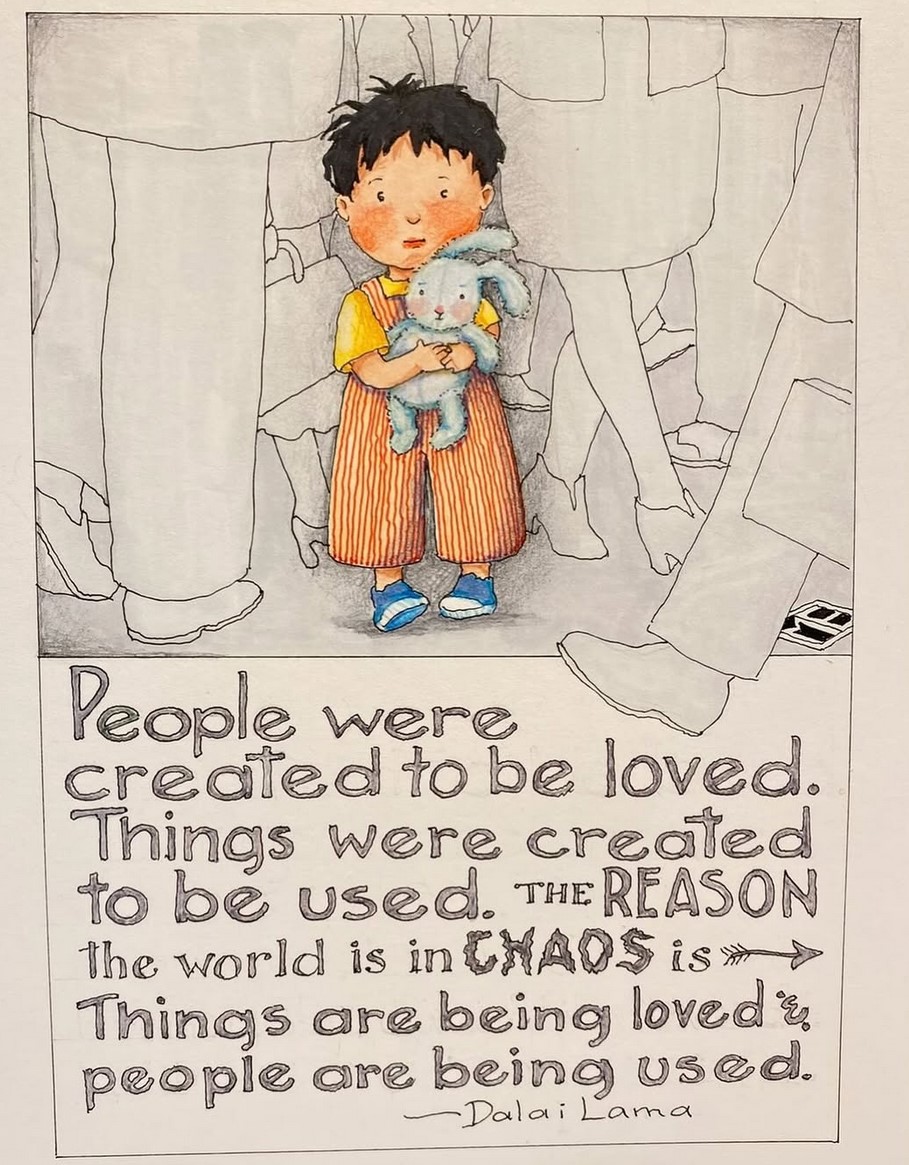
Today’s thoughts are in conversation with Granny Weatherwax’s profound statement (as brought to us by a renown British author who started out as a journalist) and with the Dalai Lama’s (a spiritual leader of great renown who started out as a mostly regular Buddhist priest). I could not believe how similar the statements between these very disparate people were when I found them on a Mary Engelbreit print which the artist shared on Instagram on February 21st of this year. (That one needs to be a print, no?) Two roads diverge on this highway, and they are People and Things. Two vastly different entities, two vastly different purposes, but human society confuses them so frequently. One made to be loved, and the other made to be used. How difficult for some to keep that straight.
…to Poetry
Though I missed the poetry meet-up this month (boo!) I felt like I already had a good feel for this kind of poem, which I’m leaning towards playing with some more to kind of unpack the current news of the day as I process it with its abundant catch words. This time, it was an obvious choice to write several poems as well, or at least two, because my brain has kept circling around the linked but contrasting noun categories of People and Things. But, after running across the Dalai Lama’s statement on my socials, two new words elbowed their way to the front – Loved and Used.
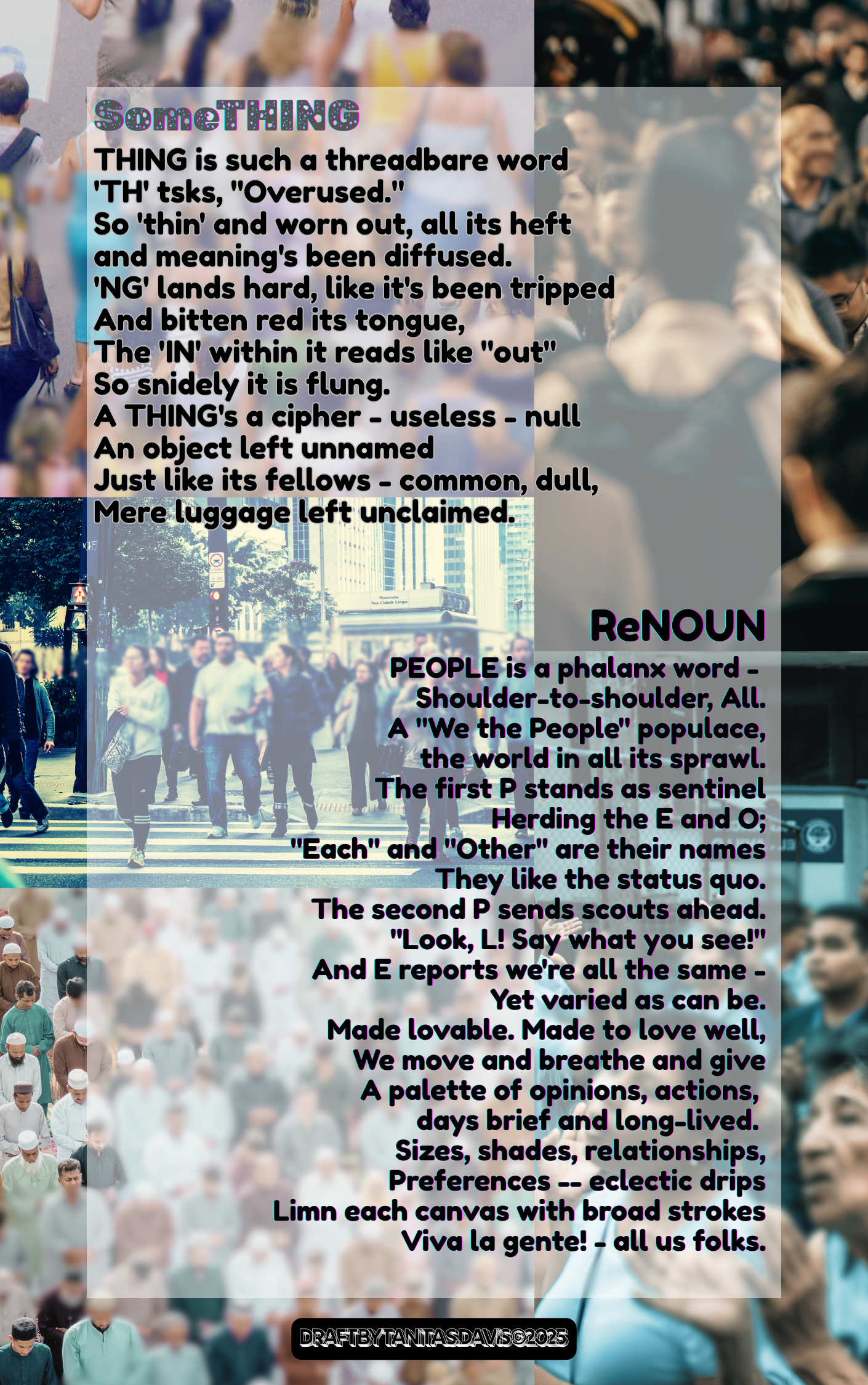
someTHING
THING is such a threadbare word
‘TH’ tsks, “Overused.”
So ‘thin’ and worn out, all its heft
and meaning’s been diffused.
‘NG’ lands hard, like it’s been tripped
And bitten red its tongue,
The ‘IN’ within it reads like “out”
So cruelly it is flung.
A THING’s a cipher – useless – null
An object left unnamed…
Just like its fellows – common, dull,
Mere luggage left unclaimed.
reNOUN
PEOPLE is a phalanx word – shoulder-to-shoulder, All.
The “We the People” populace,
The world in all its sprawl.
The first P stands as sentinel
Herding the E and O;
“Each” and “Other” are their names
They like the status quo.
The second P sends scouts ahead.
“Look, L! Say what you see!”
And E reports we’re all the same –
Yet varied as can be.
Made lovable. Made to love well,
We move and breathe and give
A palette of opinions, actions,
days brief and long-lived.
Sizes, shades, relationships,
Preferences — eclectic drips
Limn each canvas with broad strokes
Viva la gente! – all us folks.
This form lends itself to some real creativity for me, in terms of just letting my brain go and feeling my way into a word’s deeper meaning through what it remind me of, its internal sounds, the shapes of its letters, and whatnot. I like that “______is a Word” invites both wordplay and a thoughtful liberation like few other forms – I don’t have to make these poems rhyme. I don’t have to observe meter or number of lines, or anything else if I don’t want to. I just need to examine the word from all facets and let the word speak to ME – as didactically or as simplistically or as complexly and cleverly as I may. So, this was delightful – and I hope you find these word meditations delightful – useful, and illuminating – as well.
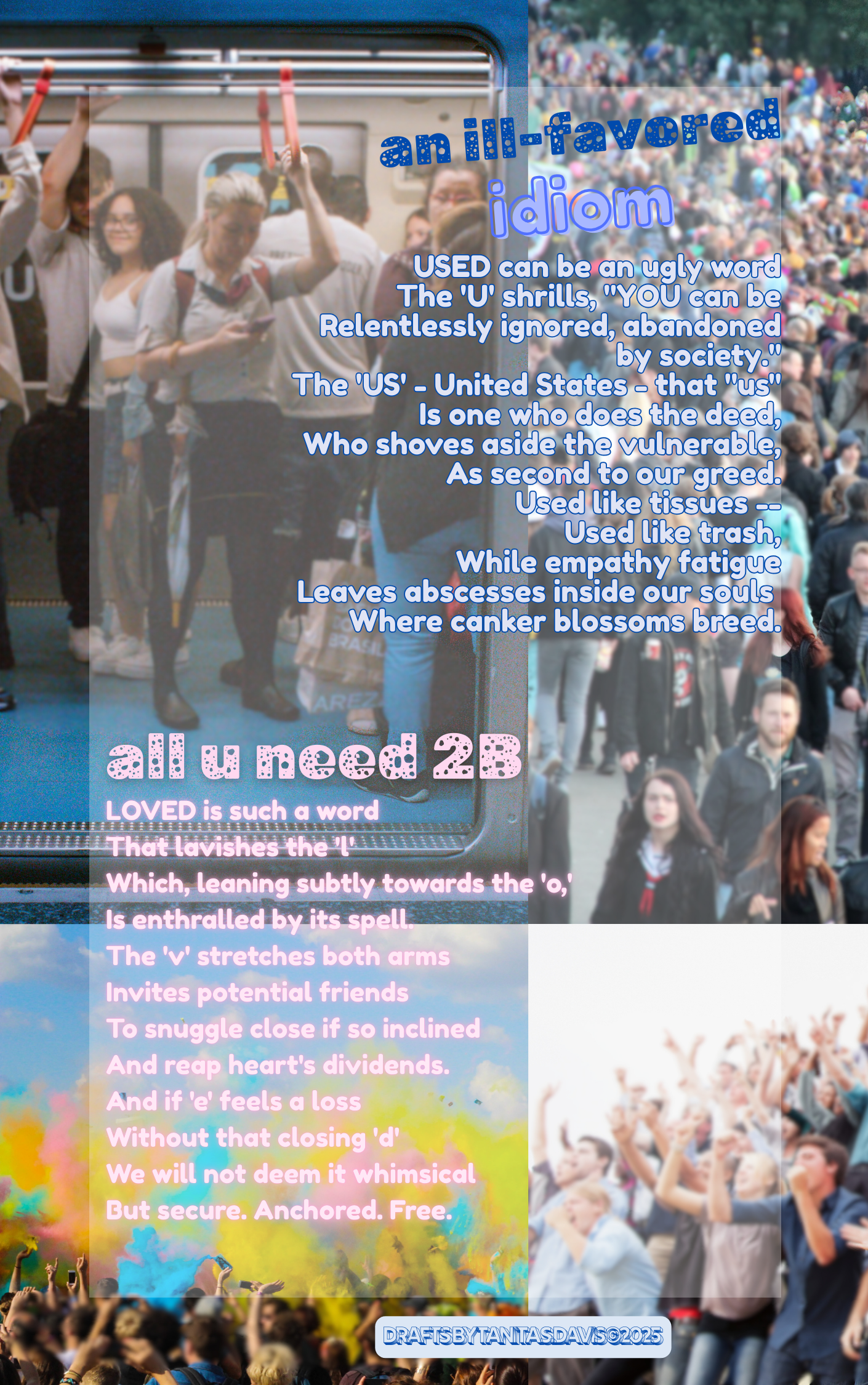
USED can be an ugly word
The ‘U’ shrills, “YOU can be
Relentlessly ignored, abandoned
By society.”
The ‘US’ – United States – that “us”
Is one who does the deed,
Who shoves aside the vulnerable,
As second to our greed.
Used like tissues —
Used like trash,
While empathy fatigue
Leaves abscesses inside our souls
Where canker blossoms breed.
all u need 2B
LOVED is such a word
That lavishes the ‘l’
Which, leaning subtly towards the ‘o,’
Is enthralled by its spell.
The ‘v’ stretches both arms
Invites potential friends
To snuggle close if so inclined
And reap heart’s dividends.
And if ‘e’ feels a loss
Without that closing ‘d’
We will not deem it whimsical
But secure. Anchored. Free.
There are quite a few other folks who dipped a toe in to the “_______is a Word” challenge this month. Laura’s post is here, and you’ll find Sara’s poem here. Liz’s poem is here. Mary Lee’s post is here, and Tricia’s poem is here. Linda B’s poem is here, and Rose joins us here. Michelle K’s poem is here. Jan from Bookseed has joined the fun, while Susan’s poem is here. More Peeps may be popping up during the weekend, so don’t forget to come back for the full roundup. Meanwhile, Poetry Friday is hosted this week by the delightful Denise Krebs, so don’t miss popping over for more poetry celebrations at Mrs. D. Krebs’ EduBlog! Thanks, Denise!
One of the MOST fun things about this style of poem is writing them with a thesaurus to hand. I often think of a word… and then look it up, and use the fifth or sixth synonym of it, so that I can sharpen my meaning – or even obscure or enlarge it. For instance, phalanx is a great word with multiple meanings, one of which was originally …log – a shoulder-to-shoulder line formation used in ancient Greek military battles. I LOVE that the plural of phalanx is phalanges… the names of the bones of the fingers or toes. People are each other’s foundation to stand on, or as Gwendolyn Brooks said it, “we are each other’s business, we are each other’s magnitude and bond.” We are each other’s hands to hold or extend in help and support – so to keep our battalion together. I appreciate the dichotomy of that – our little battalion standing with our shields linked, being both tethered and tied in, yet completely independent. Isn’t that the confidence that being loved gives to us?
I suspect Esme Weatherwax would think that nice little man in the saffron robe and wire-rimmed glasses was good people, and invite him over to sit a spell and listen to her bees. And I suspect His Holiness the Dalai Lama would get a kick out of reading about the kingdom of Lancre in the Ramtops where the strong-willed Granny Weatherwax catches babies, raises bees, and practices “headology,” which is a lot of philosophy mixed with a generous serving of stubbornness and a heavy sprinkle of common sense. The topics we find in conversation with each other sometimes aren’t that far apart after all… As more and more people are treated as things and things are cherished as people ought to be, we’ll figure out how to flip that particular script. Until then… perhaps we’ll keep this conversation simmering on the back burner – and let people who need to know, know that they are, as always, well-loved. Happy Weekend.
all poems ©2025, tanita s. davis