{npm♦4/29}

“Madea! You can’t go to the store like that!”

Our small mouths hung open, aghast. Our grandmother’s smile was pure amusement, toothsomely sweet as the Louisiana cane that papa brought us from the neighbor’s field.

“No?” she asked in her slow drawl, willing to be led by our whimsies. “Well, if y’all take ’em out, y’all gonna put ’em back up again, y’hear?” We promised faithfully that we would take care of everything, and spent some part of each day on every vacations, whether visiting her home in one-stoplight-Patterson, or she visiting our more metropolitan corner of West Coast suburbia, carefully taking out our mother’s mother’s curlers, brushing her black-brown hair into soft curls, and carefully rerolling it on our return from wherever the day had taken us. No one in our experience went out in public wearing rollers, and we didn’t know what to think of her, the sheer scarf she wore no cover to the shame. What was Madea saving up her “good hair” for, if not to be seen in public? We weren’t old enough to understand her timeline, and the years where women took out their rollers and put on a pleated dress at 5pm – when the patriarch’s work day was done, and theirs was merely continuing. We just thought she had a lot of outfits, so she liked to change in the afternoon. If we’d had as many nice shoes and dresses – and those hats she wore to church, and those gloves – we would have changed clothes, too. Wouldn’t you?

Madea – [ˈmədēˈä] – ma’deah, my dear. You smiled so often at your guileless granddaughters. I wonder what else of your many faces we failed to see.

a woman’s glory

that is what this is
she, the angel of the house
curls up in limbo
       rolling out the shopping cart
       stalks through earthbound paradise

(The B&W curlers photograph is from the book “Growing Up Female: A Personal Photo-Journal”, published in 1974 by American photographer Abigail Heyman. Click to embiggen.)

{npm♦4/28}

A collection of nostalgia fills the words, My Country, ‘Tis of Thee. Despite a tune shared with the British anthem, the song resonates, and raises longing eyes to the horizon of our imagination, in memory of a collective past most did not share. Not the land where all our fathers died. Not all descended from prideful pilgrims. Still we have craved the intimation of freedom, a definition of ‘belonging’ expanding to include us as we struggle to fit our picture into the American album. This is Nye’s shared world – not one of rejection but of acceptance, of mamool shortbread, and powdered sweetness dusting open palms.

we believed it would last forever

hold a moment more
the shape of home, of ‘country’
a sapling stretching
        in deep-rooted certainty
        of endless ripples of rings

♥•♥


{npm♦4/24}

songs & philosophies

“Should auld acquaintance be forgot and never brought to mind?” – lyrics recorded by Robert Burns.

“Those who cannot remember the past are condemned to repeat it.” – George Santayana

“I wish I were in the land of cotton, old times there are not forgotten.” – Daniel Decatur Emmett

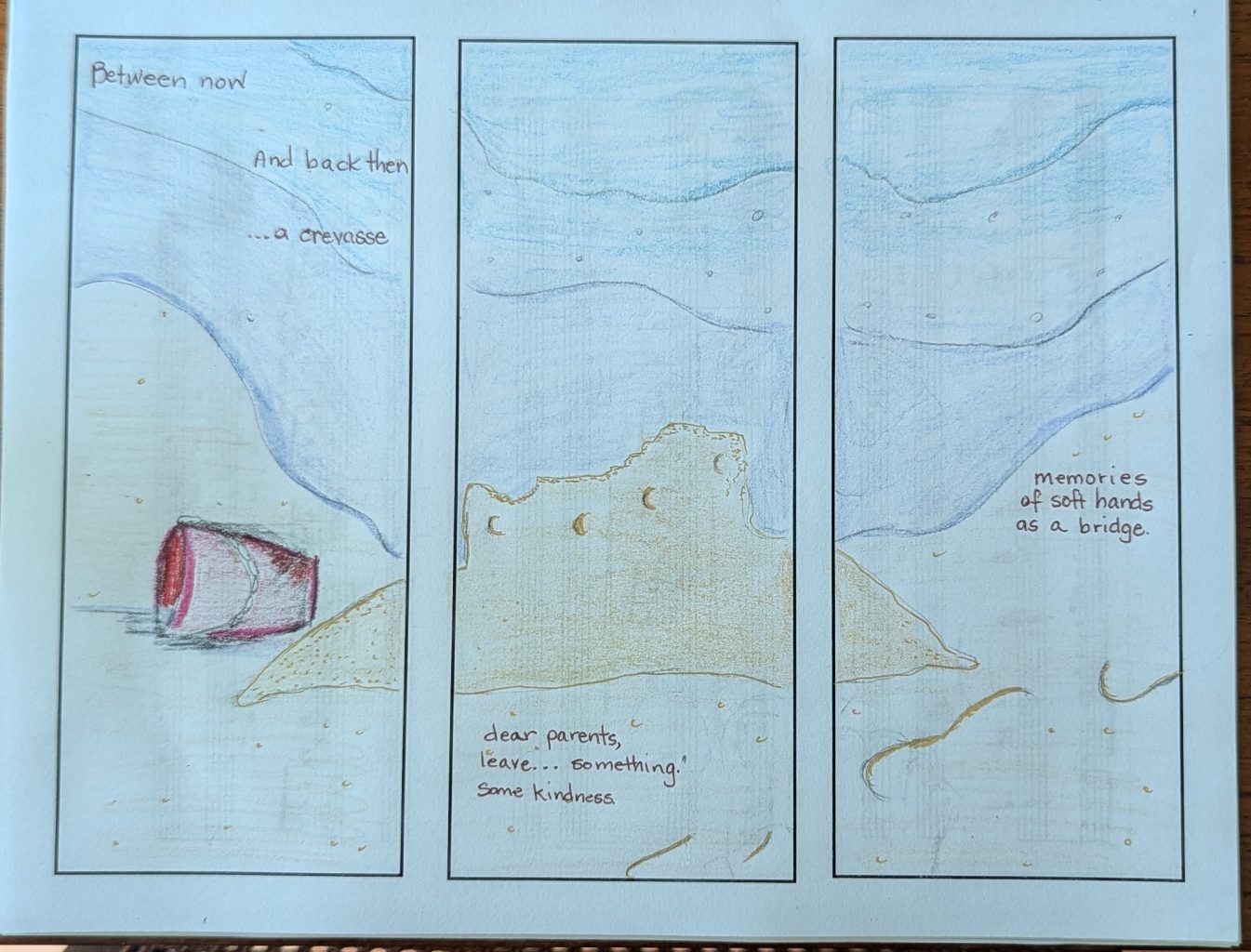
As a fifth grader carefully shaping cursive letters for our daily penmanship exercise, I was often struck by the quotations we were copying. Like so many 80’s men, my fifth grade teacher was an eager early adopter to the computer, and had us doing simple coding the last period of the day, but first period was for penmanship and famous quotations – things he insisted would benefit us greatly in the digital age. We coped quotations from Rudyard Kipling, Robert Service, Ellen G. White, and Winston Churchhill. “Remember where you came from so you appreciate where you’re going,” he was fond of saying. The words ran over us like water, wearing grooves into our brains. Remember. Remember. Remember.

Only now as the American past faces deletions and revisions through the intense ethnocentrism of our current administration do I realize where the Santayana quote fails. Too many of us remember the past – but not everyone agrees on how far ‘past’ it should be.

rising behind you
softness from red soil, sunward
pasts wrenched from sharp bolls


{npm♦4/22}

unprecedented?
nothing’s new under the sun
we’ve been here before.

“What a time,” is what people have said to me the most. Or, some variation on, ‘these are just such crazy days,’ with a rather helpless gesticulation. We all know what we mean – the tired phrase of “unprecedented times” has simply been turned inside out and had its seams ripped so it’s bigger, and usable by more people. We are still in a trackless waste with no idea of which direction to strike out for a horizon. We are still free-falling from thousands of feet into space, spinning and disorientated with nothing to grasp for safety. The only good news, as the saying goes, is that there is no ground.

Is it possible to feel safe when we’re not in control? And… have we ever really controlled anything?

I am waiting for this thought to feel like comfort.

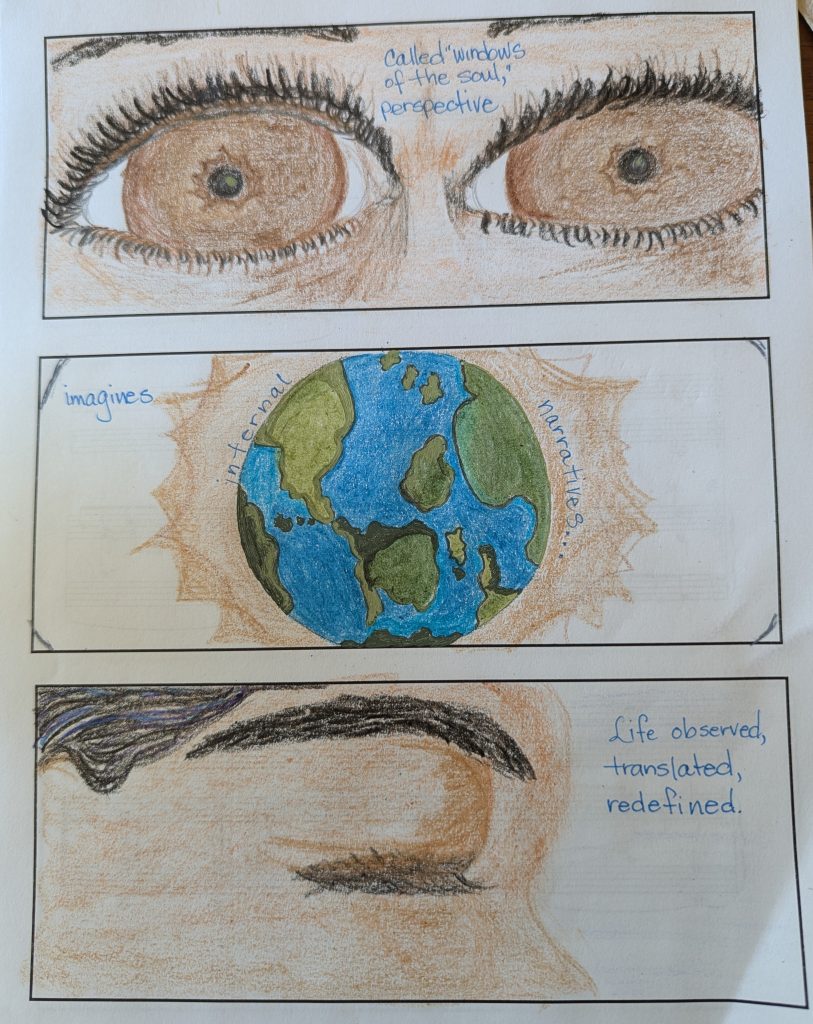
the upside-down flag
a visible inversion
of all normalcy
          Earth’s S.O.S. colors fly:
          Can we be saved from ourselves?


{npm kidlit progressive poem}

It’s time! The lovely progressive poem has “progressed” for twenty days, and now it’s my turn! Here’s the panoply of poets playing this year:

April 1 Linda Mitchell at A Word Edgewise
April 2 Tricia at The Miss Rumphius Effect
April 3 Robyn at Life on the Deckle Edge
April 4 Donna Smith at Mainely Write
April 5 Denise at https://mrsdkrebs.edublogs.org/
April 6 Buffy at http://www.buffysilverman.com/blog
April 7 Jone at https://www.jonerushmacculloch.com/
April 8 Janice Scully at Salt City Verse
April 9 Tabatha at https://tabathayeatts.blogspot.com/
April 10 Marcie at Marcie Flinchum Atkins
April 11 Rose at Imagine the Possibilities | Rose’s Blog
April 12 Fran Haley at Lit Bits and Pieces
April 13 Cathy Stenquist
April 14 Janet Fagel at Mainly Write
April 15 Carol Varsalona at Beyond LiteracyLink
April 16 Amy Ludwig VanDerwater at The Poem Farm
April 17 Kim Johnson at Common Threads
April 18 Margaret at Reflections on the Teche
April 19 Ramona at Pleasures from the Page
April 20 Mary Lee at A(nother) Year of Reading
April 21 Tanita at {fiction instead of lies}
April 22 *Patricia Franz
April 23 *Ruth at There’s No Such Thing as a Godforsaken Town
April 24 Linda Kulp Trout at http://lindakulptrout.blogspot.com
April 25 Heidi Mordhorst at My Juicy Little Universe
April 26 Michelle Kogan at: https://moreart4all.wordpress.com/
April 27 Linda Baie at Teacher Dance
April 28 Pamela Ross at Words in Flight
April 29 Diane Davis at Starting Again in Poetry
April 30 April Halprin Wayland at Teaching Authors

(EDITED TO ADD – tomorrow’s line will be found at Rose’s blog, and the poem will go forward from there. Please skip Patricia for now. Thank you!)

For those of you new to the process: this NPM children’s poetry celebration was originally begun by Irene Latham, and the mantle taken up by Margaret Simon, who wrangled this year’s distracted poets into a cohesive whole. Linda M. started us off with a gloriously open April window…

From Process…to Poetry (Line)

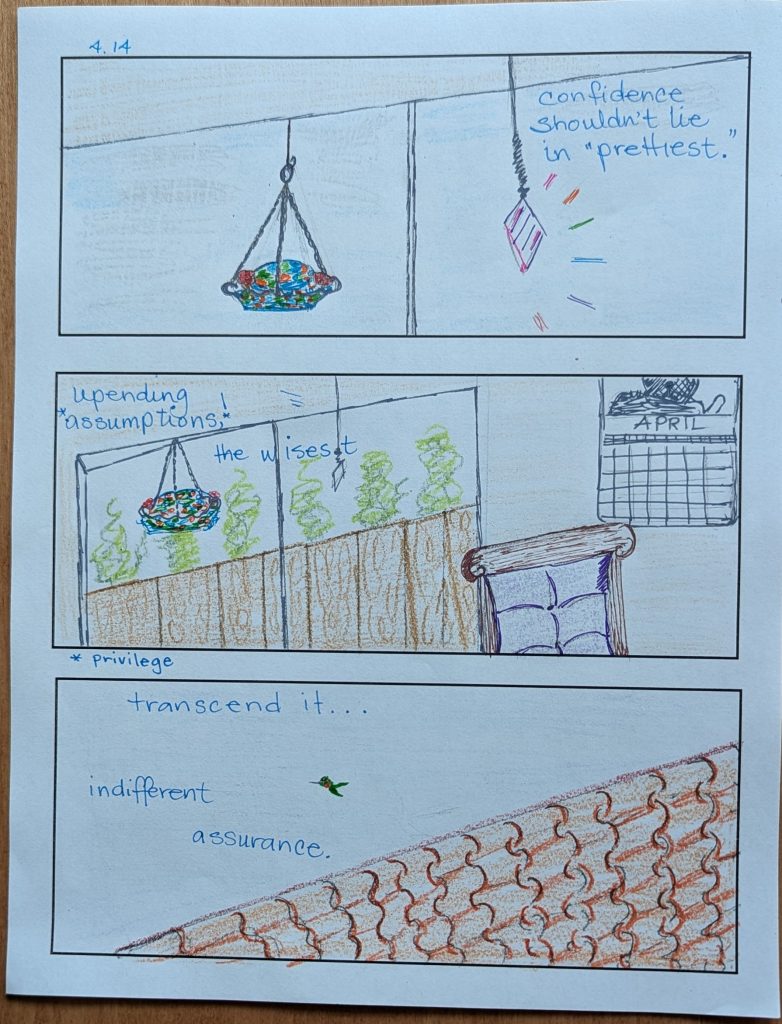
April thus far has been a particularly scattered month for me, but reading poetry has been particularly grounding, especially seeing this poem grow in creation. In this April garden, nothing yet has come to grief. It is full of the actions of joy. As I breathed the “gift of the lilacs,” and imagined myself painting and breathing and dabbling and gamboling, I thought about what we verb-y activities we haven’t yet done in this poem – eaten, spoken, shouted, screamed/squealed, or slept (we’re playing in this garden alone, which is its own kind of delightful). I also meditated on the scents on my back porch just now of an evening – orange blossoms from my dwarf citrus tree. It almost feels like we opened that April window into a glorious morning, and now… taking my cue from the thanks at the “day’s end,” and “long-ago springs,” as well as Cousin Mary Lee’s flowering shrubs, I decided to forget about eating (I couldn’t figure out how to fit it in 😂) and drink in a sense of peace and rest. That’s what this April garden has given to me this month. Since we’ve stayed in four lines per stanza, I’ll add an ellipse and begin a new one…and then it’s over to you, Patricia Rose!

Open an April window
let sunlight paint the air
stippling every dogwood
dappling daffodils with flair

Race to the garden
where woodpeckers drum
as hummingbirds thrum
in the blossoming Sweetgum

Sing as you set up the easels
dabble in the paints
echo the colors of lilac and phlox
commune without constraints

Breathe deeply the gifts of lilacs
rejoice in earth’s sweet offerings
feel renewed-give thanks at day’s end
remember long-ago springs

Bask in a royal spring meadow
romp like a golden-doodle pup!
startle the sleeping grasshoppers
delight in each flowering shrub…

Drinking in orange-blossom twilight

{npm♦4/21}

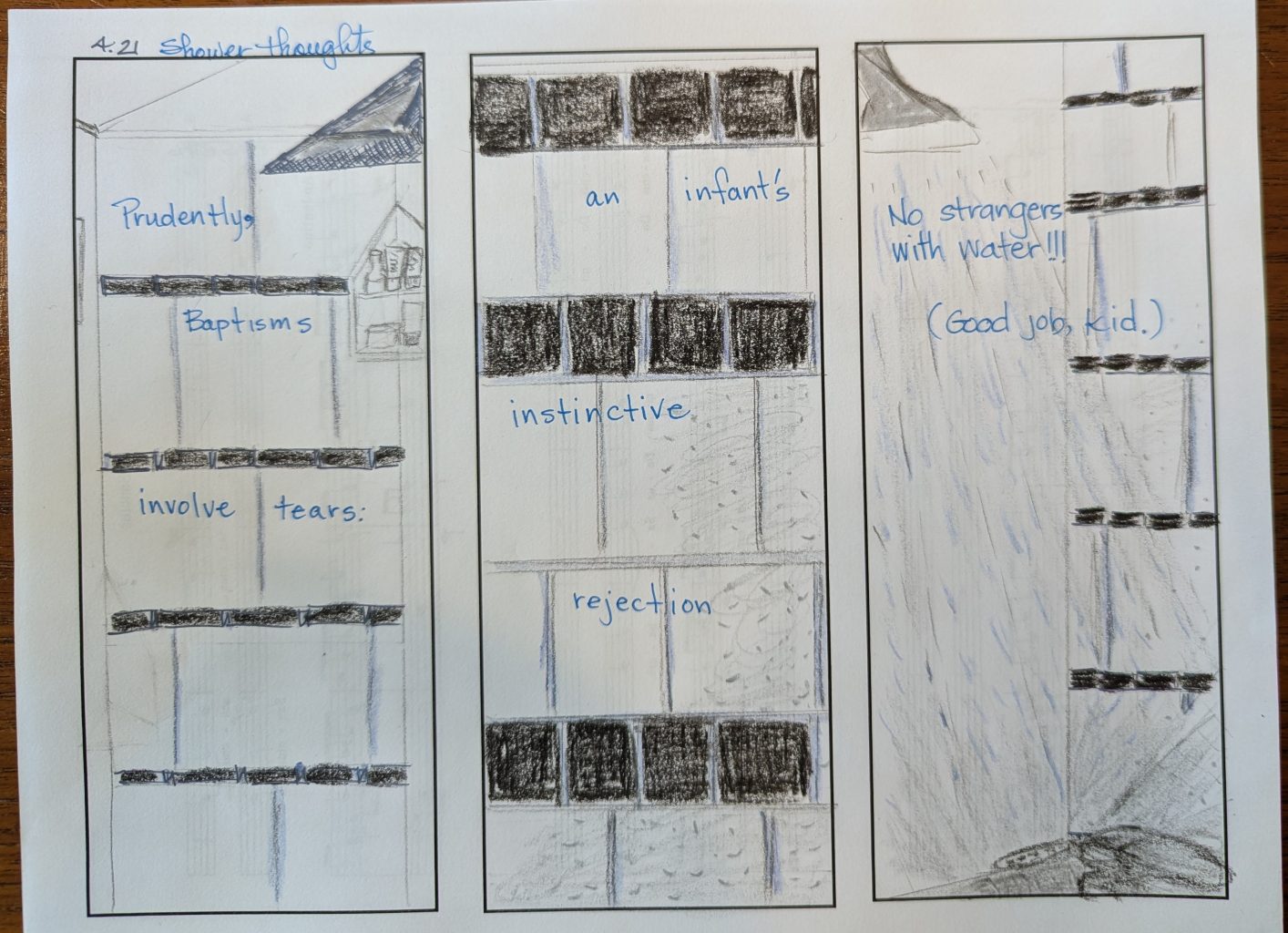
At each head-shaking headline, I wonder where these people came from.

The verb ‘graft’ is a word that means ‘corruption,’ and comes from an earlier English word for a ditch, a moat or ‘a digging.’ By 1906, in American English, it was used in the noun form and by 1915, the verb, adding weight to the already extant phrase “confidence trickster.” A grifter was a chiefly a liar, a conniver, a person involved in the graft and corruption of another, which was a low activity for lowlifes, as low as a ditch, or a moat, or a digging. We’re watching, and history is recording, how such low lives are lived, low and digging lower, together in their muck…

nota bene

Grifter,
Like calls to like:
As magnets call iron
Like waste attracts flies, fools gather
To you.


{npm♦4/18-4/20}

meditation

And blesséd are you
Embracing this blue marble
And held in return

Not every action will serve. Not every protest will move the needle. Some of us will send money. Some of us will walk empty through our days, heartbroken. Some of us only know rage. Some don’t know how to say that we were wrong, but all of us are here now. In a foreign place where we’ve never stood before, looking at each other, perhaps for the first time, we are here. Recognizing our neighbors. Watching those who run to the battle, who carry water, whose compass has always pointed to the front lines. Some of us can only watch them go, too weary or scared or ill or jaded or wounded to go with them. And some of us have only just now seen that this is all of our fight.

Blessed are you, too.

While it is yet dark,
Disbelieving miracles
Blesséd are you, too
    still drawing back the curtains
    prayerful that the sun will rise.

{npm♦4/17}

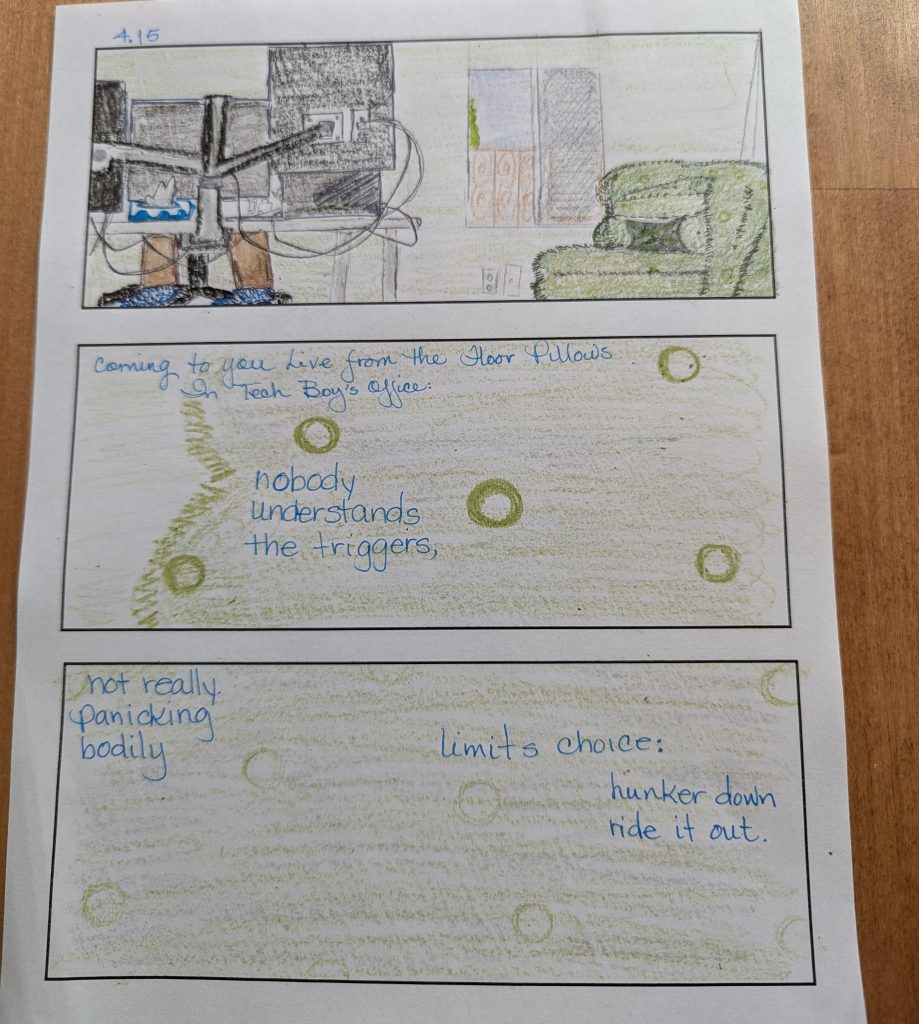
“The bond that binds us is beyond choice. We are brothers. We are brothers in what we share. In pain, which each of us must suffer alone, in hunger, in poverty, in hope, we know our brotherhood. We know it, because we have been forced to learn it. We know that there is no help for us but from one another, that no hand will save us if we do not reach out our hand. And the hand that you reach out is empty, as mine is. You have nothing. You possess nothing. You own nothing. You are free. All you have is what you are, and what you give.” – Ursula LeGuin,The Dispossessed, 1974.

No help for us but from another. No hand will save us if we do not reach out our own.

This feels vaguely wrong to say. Surely, one imagines, God will be the hand extended to our country now, in direst circumstance? But… no. The Divine has no hands but ours, to paraphrase the well-known phrase. If our hands aren’t and haven’t been extended to someone else, we surely shouldn’t be expecting an invisible reach to help to us. Of course, sometimes, miracles happen. Sometimes if you’ve fed leopards that were advertised as the face-eating sort, just sometime they don’t eat your face. Sometimes. But not often.

be-attitude

bankrupt
emptied of choice
we poor in spirit, blessed
with kingdoms far from here-and-now
don crowns

{npm♦4/16}

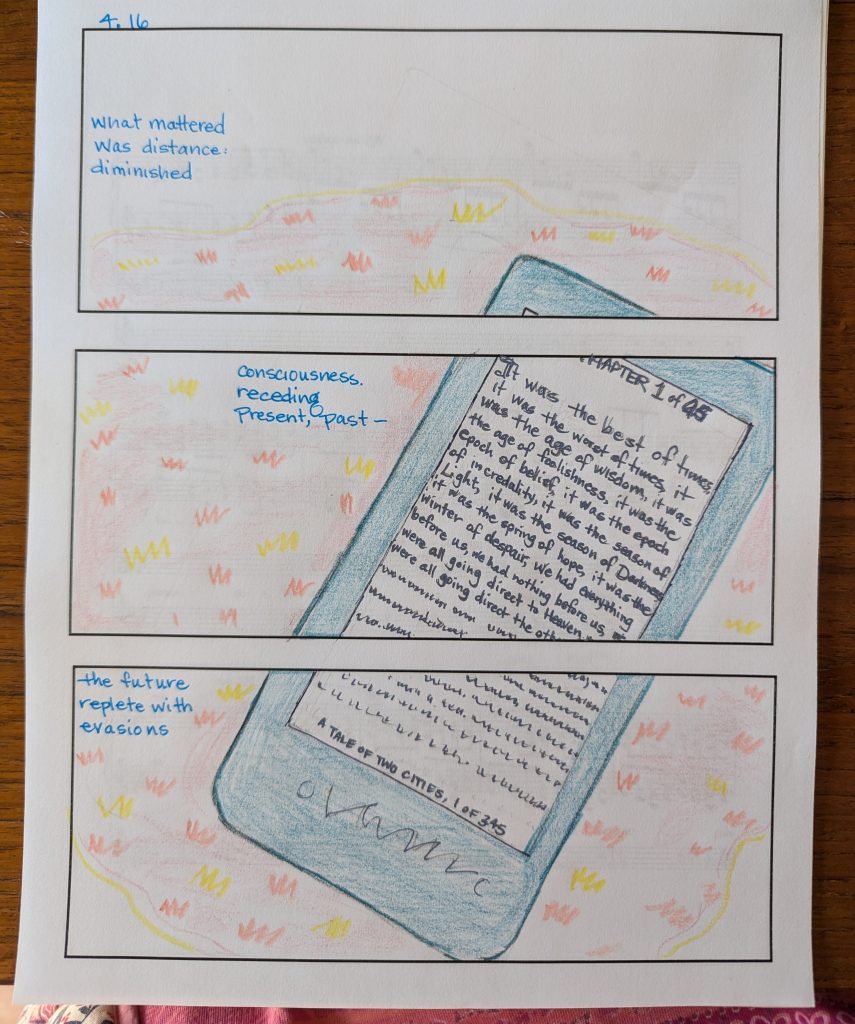
It is an odd thing to be aware of living in history. At some point I imagine archaeologists and historians will dig through the detritus of this era. I wonder what they make of the political ads, newspaper headlines and digital commentary from news reports. Taken together, I imagine this will be a confusing record. It can be nothing else, since every day, we have our own questions of how we got here – and how we’re going to get out of this place.

untitled history

Doubtless,
History’s voice
Retelling this moment
Will echo our bewilderment
“But why?”