You’ve Arrived! Welcome to Poetry Friday!
Poetry Peeps! You’re invited to the Poetry Sisters’ challenge for the month of MARCH.
 Here’s the scoop: we’re writing tight little bundles of poetry called Ovillejos! That’s exactly what the word means – a bundle of yarn. This Spanish form bundles together ten lines, made up of 3 rhyming couplets interspersed with three verrrry short lines, and a quatrain. The last line is a “redondilla,” a “little round” that collects all three of the short lines and casts off the poem, as it were. The Ovillejo plays with repetition in a way that will allow some cleverness and wordplay. I’m excited to dig into a new-to-me poetic form, first popularized sometime between the late fifteen hundreds by Miguel de Cervantes (he lived between 1547-1616 so it’s been a minute – may as well make it popular again) – and might even throw in a Spanish word or two, just to challenge myself. Are you in? Good! Take this week to craft your creation and share it March 27th in a post and/or on social media with the tag #PoetryPals. This form looks like fun, so we hope you’ll us!
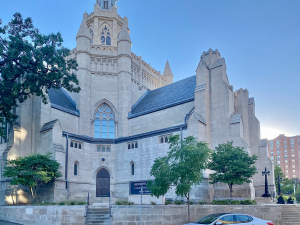
The events of January, 2026 were the crucible from which formed the Hennepin Avenue United Methodist Church’s Singing Resistance, a Minneapolis-based, grassroots movement using song to protest the illegal federal agent activity in that state and throughout the nation. Time after time in our nation’s history, protest singing has been a tool for organizers, as a form of embodied protest – from “Yankee Doodle,” sung in protest against British imperialism in the 1700’s to “The Battle Hymn of the Republic,” sung by marching suffragists and labor organizers, to “We Shall Overcome” sung through the years by protestors for civil rights in the early 1900’s to “No nos moverán” sung by Dolores Huertas and the UFW movement, and more. Every major sea change in American politics and society has come with a soundtrack of people singing together.
However, in the past several decades group singing has waned outside of religious circles. Even in some religious spaces, singing has largely become a competitive reality TV type of thing where “the best” is elevated and ‘the rest’ are meant to sit in properly awed silence. In today’s atmosphere, the commonly sung American folk song had all but vanished. Dorian Lynskey, author of “33 Revolutions Per Minute: A History of Protest Songs,” theorized in an interview that American individualism in music also has its role in this musical shift. Older songs used the word “we.” “We shall overcome.” “We shall not be moved.” Or, “All we are saying is give peace a chance.” He observed that the spirit of “we” as found in community and cooperation is largely absent in modern pop music.
…but now as the old protest songs are being taught to new voices, and as new troubadours arrive, necessary change is coming with them. Now we’re reaching across aisles, across cultures and preferences, trying to anchor ourselves, our country, and each other.
A song heard at almost every singing protest, many of you are already familiar with Heidi Wilson’s “Hold On.” The words are simple, the tune adapting easily to harmony, and it has reverberated – from the U.S. to Cornwall to Wales and Ireland to Australia and beyond. A new generation of singers is carrying this song with them, and like a stone dropped into a pond, its message of quiet, almost prayerful endurance is rippling outward.
And when you learn from writer and composer Heidi Wilson the impetus behind the song she wrote in 2020 (thank you, Liz, for sharing this), you’ll understand what a gift it truly is. In the words of the Spiritual-turned Southern-ism (or vice versa), “Trouble don’t last forever.” Or, from the Christian Bible in the book of Psalms, “Weeping may endure for a night, but joy comes in the morning.” So, while everything looks rough, feels rough, is indisputably rough – hold on.
Hold On
Hold on, hold on
My dear ones, here comes the dawn
– Heidi Wilson,
Plainfield, VT 2020
(Sheet music free at the link above, but please compensate and support the musician as you can.)
A song is simply a poem set to music, and this one is a direct, unrhymed lullaby that grounds us in persistence and courage. It’s a seed to pull us through the last, dark days of winter, a promise of renewal and green sprouts, baby goats and, someday, an end to this moment. This is a song that calls us to community. I am challenging myself to find other song-poems like this – and I hope you do so, too. And as you do, hold on, dear ones. Hold on to who you are, what you know to be right, and how you live – with open hands, helping your neighbor and community, and uplifting sanity and kindness. Hold on – to each other, too, to community, and to creating the world we want with our hands linked. And in doing so may we each in our own ways hold up our arms to carry the dawn as it comes.
Happy Friday, friends; you are so well-loved.