
Month: March 2013
{every common bush afire}
It’s Poetry Thursday, apparently.
I don’t actually like long poetry, which might come as a surprise to my English professors. (As a major, I gamely made my way through the ENTIRETY of Alfred, Lord Tennyson’s In Memorium and that poem is an epic, taking seventeen years to write, and filling an entire book, divided into thirteen cantos, which are little epic poem chapters. It nearly killed me. I, however, shall endeavor not to kill you.) If you’re not a fan of the longer poems either, I will not push Elizabeth Bennett Browning on you unless you’d like to take your own little trip to Bartleby and find her poem excerpted. Or you can find all nine cantos of Aurora Leigh, and I promise you won’t be tested – not here, at least, since I’ve never read it all.
Even without having read all of Aurora Leigh, I can say that this piece is worth reading. It’s slow; you have to take your time through it because it’s blank verse, and part of you keeps expecting a steady poetic foot which is simply not there – but there are great places to pause and ponder, and little piece of an prose to give much cause to think.
This sixty-six line section of Aurora Leigh is about the duality of the artist. We make our art with our hands, and the simple things around us – what we see of trees, leaves, rocks; what we dream of, what we think. We are, Browning posits, two halves of a thing, as humans; part of the natural world, part of the greater – higher, or Divine world, or what have you. Part of what makes us who we are, as artists, part of what turns our particular keys and unlocks us, is this duality. There is a constant push-pull in our souls to look at a thing, and be drawn in deeper. It allows us to see things:
On any peasant’s face here, coarse and lined,
You’ll catch Antinous somewhere in that clay,
As perfect featured as he yearns at Rome
From marble pale with beauty; then persist,
And, if your apprehension’s competent,
You’ll find some fairer angel at his back
As much exceeding him as he the boor,
And pushing him with empyreal disdain
For ever out of sight.
Peasant? Or Prince? It’s all in the eye of the beholder.
…Aye, Carrington
Is glad of such a creed: an artist must,
Who paints a tree, a leaf, a common stone
With just his hand, and finds it suddenly
A-piece with and conterminous to his soul.
Why else do these things move him, leaf, or stone?
In so many, many ways, nothing arrives as an incidental collection of stuff. Fractals, crystals, and Fibonacci sequences are both science and art. I will always love the spiral aloe plant, seeds in a coneflower or sunflower, the weird art of broccoli Romanesco, for their beauty and organization. This might not argue for the presence of a heaven, per se, but to me, it argues …a purposefulness to beauty, perhaps. And a need in the artist to see it.
And truly, I reiterate, nothing’s small!
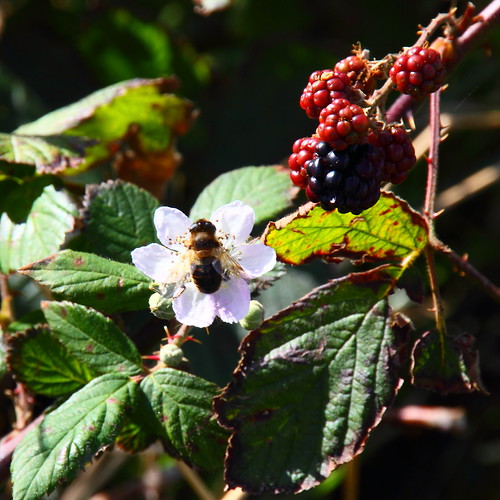
No lily-muffled hum of a summer-bee,
But finds some coupling with the spinning stars;
No pebble at your foot, but proves a sphere;
No chaffinch, but implies the cherubim;
And (glancing on my own thin, veinèd wrist),
In such a little tremor of the blood
The whole strong clamour of a vehement soul
Doth utter itself distinct.
For the artist, the world is crammed with wonder – with magic – with things we must stop and grasp and peer into.
…Earth’s crammed with heaven,
And every common bush afire with God;
But only he who sees, takes off his shoes,
The rest sit round it and pluck blackberries,
And daub their natural faces unaware
More and more from the first similitude.
Humankind in a common gutter: some see mud, others see stars; some are just sitting on the grass, stuffing their gobs and wiping their faces.
Today this poem reminds me that the world is filled with little gifts – cramming the whole earth with heaven, as it were. And all these things are visible to the ones willing to see: Look. Or, as the nephews are learning to say, mira.
{write it slant}
Tell All The Truth
Tell all the truth but tell it slant,
Success in circuit lies,
Too bright for our infirm delight
The truth’s superb surprise;
As lightning to the children eased
With explanation kind,
The truth must dazzle gradually
Or every man be blind.
~ Emily Dickinson
Rejection sucks. Even the smallest ones, from well-meaning friends who say, “Oh, I like your writing, but I hate science fiction, so I won’t bother reading yours if you publish any,” constitutes rejection-before-the-fact. When you’re rejected by an editor or a publisher, it’s some days enough to make you long to give up and go to bed with a book.
That sounds so good right now.
And yet, that’s sort of a turtle-response, retreat and withdrawal and the licking of wounds. There really are no wounds, not really. No one is rejecting my writing – actually, I get so many compliments about lovely turns of phrases and well-chosen words and such. It’s the saleability that’s at issue. “I don’t quite know what genre this is,” my agent usually says, and there’s that worry in his voice, which lets me know what my editor will say. “Oh, I like it, but I don’t think I can sell it.”
Which is… a conundrum. Am I working with people who have no vision? No. Am I working with people who know the market? Yes. Is the common denominator of this issue me? Again, yes. I am possibly more than a little out of sync with the world as it stands, and thus, I write things which probably will languish on the shelves, if the publishers take the chance on them. They don’t want to sign reams of midlist authors; editors are still looking for the next JK Rowling, the next Suzanne Collins.
And maybe I don’t know yet who the next “me” is meant to be.
I am feeling pretty rocky right now, true. But, I’m also trying to be clear-eyed. I never wanted to be a person who studied the market, who poked at it and tried to see what people wanted. I wanted to write what I wanted to write, and find the place where it fit. I remain convinced that there is a place… but, I am also wondering if I have been too stubborn for my own good. Maybe this is what we’re meant to do – to tell the truth, but tell it slant. To write to that market, but somehow, to keep hold of our own selves. I am in less doubt as to whether or not this can be done, and more doubt about whether *I* can do it.
Off to think and to reboot. Something good will come of this latest setback – it simply has to.
{in which I put on my sociolgist’s hat…}
Human beings are weird, yes. But, recent studies suggest that Americans might just be the weirdest in the world.
This is really interesting to me as I have been thinking about expatriates, and the hows/whys of people feeling so dislocated when they return to their countries. Something within living abroad creates tiny sociological dissonances which can leave a person feeling neither fish nor fowl at home OR abroad. It makes them a good outsider, and potentially a better writer, but it does leave one confused. A WEIRD look at the human mind.
{on being: happy in your head}
On NPR Krista Tippet does a lovely job with a show called “On Being,” and I tell you, I come up with something new every time I listen. This poem came from a years-ago meme, was passed from blog to blog, hand to hand, but I refuse to forget it, utterly refuse.
It is how I want to be – happy, in myself.
Happy in my head.
Happy.
by Tanya Davis ©2009, all rights reserved
Today, be happy…