{deconsecration}

Angel Building 141

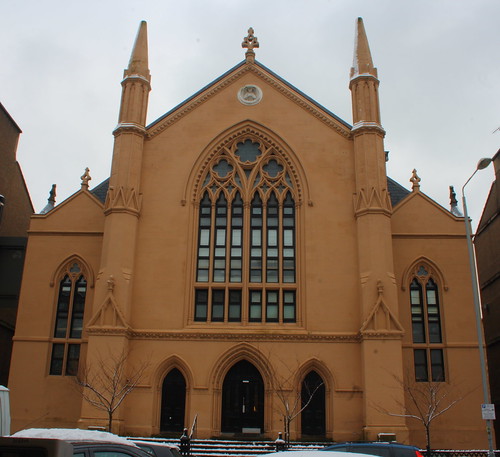
We lived in a church, our second flat in Scotland, at 69 Kent. It was a weird sensation to walk in and see a modern flat inside of a very old building. Sandstone, brick, stained glass from somewhere back in the mid-1800’s. Plaster angels still sang silent notes from above the double doors. Two bed, two baths, a mezzanine with open beams and brick, and very long, tall windows. Even a bit of colored glass.

It was gorgeous, but it was the flat where we had The Worst Boiler and Tech Boy fell down the iced front steps, and where we had to wedge a folded step-stool under the oven door so it would stay closed, so I don’t necessarily have happy memories of it. I also felt conflicted that people didn’t use it as a church anymore.

“Ah, well, they deconsecrated it back in the nineties,” the letting agent told us conversationally, as he showed us the stained glass in the lobby on the way to the ground floor flat.

“And how did they do that?” I asked.

He scratched his sideburns and looked a little shifty, caught out by my unexpected curiosity. “Er, uh, they took that bit off the top, you know. The cross. And that was it.”

I didn’t say so, but no, that wasn’t “it,” not by a long shot. A little Googling uncovered hints at ritual, ceremony. When the meeting place of any faith is no longer needed, there’s a service, lots of prayers, a few, quiet words marking the lives and spirits of a place where something once happened, which will no longer. It was the house of God, a tent of meeting, and with God moved out, it will be just a house — of people, bustling in and out, shouting for someone not to forget their keys, swearing at the neighbor who was meant to salt the steps – regular people, doing the daily business of living, with maybe a bit of room inside for God – but no longer will these be Divinity’s roof and walls.

Even moving out of a regular house isn’t as simple as our letting agent suggested. “That was it” is hardly phrase enough to contain the last, loving look at a place where once lived your heart, before you close the door for good.

{on forgiveness}

In a 2008 essay in the journal In Character, history professor Wilfred McClay writes that as a society we have twisted the meaning of forgiveness into a therapeutic act for the victim: “[F]orgiveness is in danger of being debased into a kind of cheap grace, a waiving of standards of justice without which such transactions have no meaning.” Jean Bethke Elshtain, a professor at the University of Chicago Divinity School writes that, “There is a watered-down but widespread form of ‘forgiveness’ best tagged preemptory or exculpatory forgiveness. That is, without any indication of regret or remorse from perpetrators of even the most heinous crimes, we are enjoined by many not to harden our hearts but rather to ‘forgive.’ ”

We have a day of love – Valentine’s. We have a day of repentance – Yom Kippur, the day of atonement. But, we don’t really have an acknowledged day of forgiveness in this society (no, I know – there are hundreds of random days like “Give Your Neighbors Zucchini Day” on the Insight Calendar, but let’s get real, here).

That there’s no one day set aside for “this thing” is probably because it is harder than it looks, more complex, more nuanced, than what can be experienced in a single day.

Oh, closure, schmosure, and reel in your talk of reparations. It’s not about what you’re owed, or what you need, but about what’s been done – and how you survived. It’s hard to be okay with people who aren’t really sorry for the things that they’ve done to you, who are armed with justifications for the whys of their behavior, but not with heartfelt concern for your reaction to it, and never with real remorse. It’s harder still that society, religious dogma, some psychologists, parents – loads of people are all for us forgiving an affront in the face of the most meaningless and mumbled “sorry.” Maybe it’s one of the reasons I love the blog SorryWatch so much; like an Olympic judge, I hold up my card when I hear those hurried or heartfelt words: ooh, started out well, but didn’t stick the landing, 5.5 – an honest effort, let’s see how the follow up goes; 7.5 – Hmm, sounds like we’re on the way to real remorse, here, 9.5, 9.6, 10… but, there’s never a perfect ten, is there? Is there? Do we often hear real apologies that are sincerely meant?

My least favorite apologies are like the ones my father gave us when we were really small – in third person, from the doorway, into our darkened bedrooms when we could not see him. “Daddy’s sorry,” in a mumbled sing-song. My favorite apologies these days are from my three-year-old nephew, who sweetly says, “Sorry, Auntie,” when I tell him for the umpteenth time NOT to thump something on the wooden floor and shriek while we’re trying to talk, and not to break the crayons he’s been given to draw with, and not to scribble on the floor. His apologies are always 10.0 – in that moment, he’s really, truly sorry. In that moment. The next moment, however, is but a heartbeat away…

Repeat offenders may indeed have a problem with sincerity. And believability. And we, as those offended, struggle with immense pressure from society to “forgive and forget,” and sometimes, sometimes… forgiveness can feel a whole lot like gullibility. And that’s a really yucky feeling.

When I was teaching, yard duty meant that I was breaking up petty quarrels on a every-five-seconds basis. And one of the requirements of Ms. Davis for an apology was a.) acknowledging the error, b.) telling Ms. Davis how or why it was wrong, c.) and explaining how the path of behavior would henceforth be changed. I was never one of those pushing a small child to “Say you’re sorry!” because some of us don’t even know what “sorry” means.

Journalist Emily Yoffe always speaks clearly and logically about the human condition, and here she breaks down forgiveness into bite-sized pieces. Her words on what we owe abusive or damagingly unapologetic people – parents – is food for thought.

I peruse this line of inquiry because I like to write about family, friendships, and forgiveness… but sometimes I wonder if I’m really writing honestly, and if there is yet more to say… There is a dearth of honest conversation on this topic, but the issue is real, and it’s there, and it’s one I think about often.

{♥ speaking of love…}

heart in sky

“Now that I’ve thought a good bit about Valentine’s history, I’ve had a bit of a change of heart (heh) about Valentine’s Day. I think we need a day like Valentine’s Day, but not for the reasons flower and chocolate manufacturers might think.

We see a lot of hate. It’s everywhere – hate gets a lot of headlines. And there doesn’t seem to be a shortage of it, either. If I sign on to social media of any form, or check my email, there’s usually something that’s bound to make my blood pressure go up, and my optimism go way, way down.” – Sarah Wendell, SB

Once again, SB Sarah speaks the truth.

I will own up: I have been a HATER. I hate being told what to do (teeeensy little problem with authority), and every year since I’ve paid attention there’s been the relentless Valentine’s ads on radio, TV, in my inbox — it’s seemed that this stupid holiday has been trying to boss me since first grade – forcing me to love, telling me when to love (*only one day a year), and how to love (*with the cheapest crap you can fork over to your grade school friends, followed by the most expensive crap you don’t need to impress your SO), how much chocolate and chalky conversation hearts and outlays of red foil it takes to buy someone’s affection. Enough. I’m over it. I will not be bossed. I have herewith stopped being a hater. Love wins, right? So, I’ve re-idealized what my aunt calls “VD” (eew) into Heart Day, and from hereafter, I’m all about the love.

For SB Sarah, it’s love stories. It might not just be romance which reaffirm your belief in love, but it might also be stories like the one where girl gets a new Tardis, courtesy of her community, or the one where an adopted kid – at thirteen, no less – gets his first birth announcement photos done (Who cares if his little hands and feet are a little big for a newborn?), or, that story of the one amazing day in Seattle when “going to the chapel” was a beautiful thing, or the one story where a man being slandered took each word of abuse and turned it into consciousness-raising, community supporting gold… there are hundreds of stories.

Find one. Make one. Whatever it takes to reaffirm that love wins – that it’s real for all and for always, discover it today. Hold it close. And, if you want, draw it on the sidewalk with a conversation heart.

With love,

t♥♥♥

{on running aground, lists, and adulthood}

Vallejo 103

I have a friend who looks back over years and years worth of journals every year on New Year’s eve or day – looking back to smile – and sigh – that the more things change, sometimes, the more they stay the same. I have several journals that I move between, and my sketching journals amuse me the most because I can see that same pattern. Years ago, I was worrying about finishing this deadline, making sure that that story was just right, wondering if I’d ever attain this thing I wanted. I understand now more than ever that I am luckier than I believed.

I also realize just this moment I have a lot of pictures of boats run aground, boats sunk, and boats with holes in their hulls, listing to the side, no longer seaworthy. This is, in part, because it’s a lot of work to haul those things out of the water once they’re ruined, so there are plenty of them mouldering away into the bay. But, also it’s that I like them. I like the idea that there is no futility in no longer being fit to do what you did once; that there is still beauty and purpose to be found in running aground. Just a whiff of ephemera there, a bit of fancy, perhaps. Just a thought…

“Critics who treat ‘adult’ as a term of approval, instead of as a merely descriptive term, cannot be adult themselves. To be concerned about being grown up, to admire the grown up because it is grown up, to blush at the suspicion of being childish; these things are the marks of childhood and adolescence. And in childhood and adolescence they are, in moderation, healthy symptoms. Young things ought to want to grow. But to carry on into middle life or even into early manhood this concern about being adult is a mark of really arrested development. When I was ten, I read fairy tales in secret and would have been ashamed if I had been found doing so. Now that I am fifty I read them openly. When I became a man I put away childish things, including the fear of childishness and the desire to be very grown up.”
― C.S. Lewis

O, Clive, how we adore you. We shall embrace our toads and diamonds, our chicken-legged houses, our red-hot dancing slippers and our wicked witches with joy.

A flourish of the fedora and a click of the heels to Laini Taylor‘s very childlike blog for today’s quote.

It’s been a week for lists. Several weeks ago, I found I was being nominated to the 2013 Rainbow List, which is put out by the Social Responsibilities Roundtable of the American Library Association. The Rainbow celebrates books which positively portray LGBTQ characters. A wee bow to the ALA Rainbow jury – thank you for including HAPPY FAMILIES in such august company. Another tip of le chapeau to Suite 101, whose list of 10 Great YA Novels With Strong Characters lists MARE’S WAR at #7. Thanks, guys!