Poetry Friday: Oakwood Grade 6 Poetry Project: Finis

Another day of celebrations, at least, in this neck of the woods. It’s a national holiday today, as it’s Royal Wedding Friday. Perhaps this will kick off a fashion of having weddings on weekdays? But it’s enough for our purposes that the British Royal Family has helpfully highlighted Friday as an official Day of Awesome. It’s Poetry Friday, wot, wot? Cause for celebration every single week.

This week is the last Poetry Friday of National Poetry Month, and we have one last poem from the Oakwood Poetry Project on MARE’S WAR. This week’s poet is Sophie, who shares with us via collage a number of images of working women from WWII. While we have Lady Victory, clad in the flag, we have, too, Riveter Rosie and her cohorts, hair covered, overalls on, and ready to work for the good of the nation. The focus here is strong women, capable women, soulful sisters who sang and played and made their way through what was mostly seen as a man’s world. I love the movies and musical photographs chosen as well.

Today’s poem is entitled, “Everything She Wasn’t.” As before, the poem is copyrighted to the poets, — please respect the integrity of the poet, and do not reprint without their permission. Thanks.

Motherhood was considered the highest work of an American woman during the time of the War, and Sophie’s poem focuses on both Mare, and her mother, Edna Mae, and their work as mothers. “Edna Mae Boylen was not good at it/ She was not fit,” Sophie states. And indeed, this is supported by her unpacking the first few lines of the novel, which are used in the beginning of the poem:
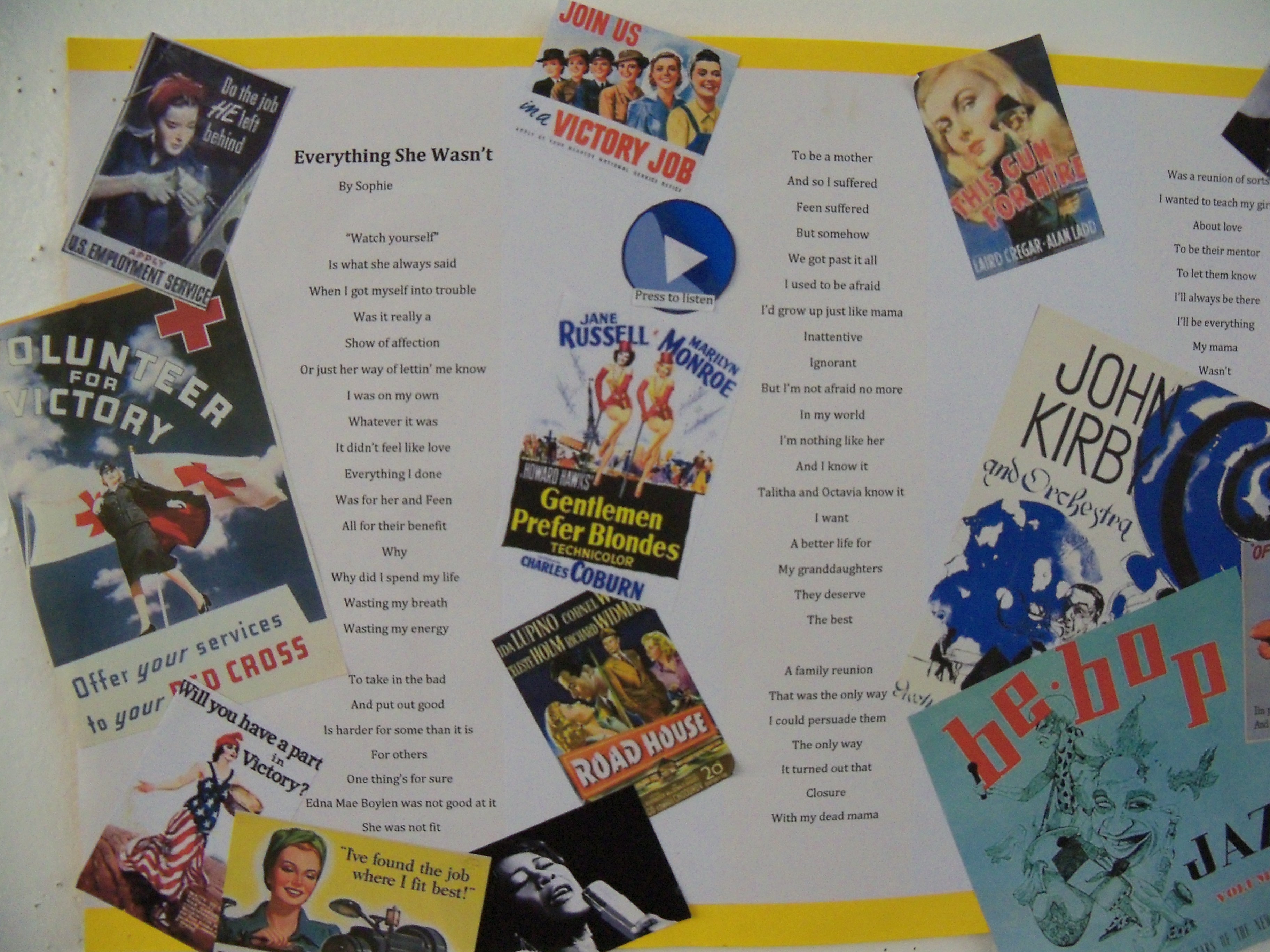
Click to enlarge and read.

“Watch yourself”/ Is what she always said/When I got myself into trouble/

Was it really a/ Show of affection/ Or just her way of lettin’ me know/ I was on my own (emphasis mine).

Whoa.

Did you ever read that phrase that way? In Sophie’s keen ear, “Watch yourself” changes from being a parental warning not to cross a line, or a caution, to “watch yourself, ’cause I’m not watching you.” What an isolating, lonely-making statement. What could have been a statement of parental care becomes the ultimate declaration of “fend for yourself, kid.”

And yet, while identifying that Mare had a sucky mother, and her mothering skills were shaky at best, the poem goes on to celebrate Mare’s relationship to her grandchildren. “In my world/I’m nothing like her/And I know it/ Talitha and Octavia know it/ I want/ A better life for/ My granddaughters.” Because of Mare’s determination and foresight, not only do her granddaughters have better, she finally knows the truth about herself: she is everything, everything her mother was not.

On that satisfying note, we end our visit with the Oakwood School — thank you so much, Diana and Michelle, for sharing your students work, and thank you, poets, for being willing to be shared on my blog! Poetry Friday is brought to you by the number 6, and is hosted today at Tabatha Yeatt’s blog.
{Poetry Friday: Oakwood Grade 6 Poetry Project III}

Felicitations, this fourth day of the Omer, smack in the middle of Passover, and the opening act of the three-part Easter celebration for all of my Jewish and Christian peeps. If none of those celebrations is for you, it’s also Earth Day, wherein we celebrate the dirt and the trees and the nematodes, and the things from the natural world which sustain us, and try not to mess it up any further. Still not enough of a party? Right – it’s also still National Poetry Month, which means you’re in the right place for a poem.

It’s probably a little quiet around the blogosphere today, but poetry is still out there all over the place. I checked this morning that The Great Gregory K’s Kickstarter Poetry: Spread the Word is 76% funded, with seventeen days left. Read today’s poem for his 30 Poets, 30 Days celebration – and consider of all the reasons why it’s really important to keep poetry programs going in schools across the states — and then, give what you can. Thanks!

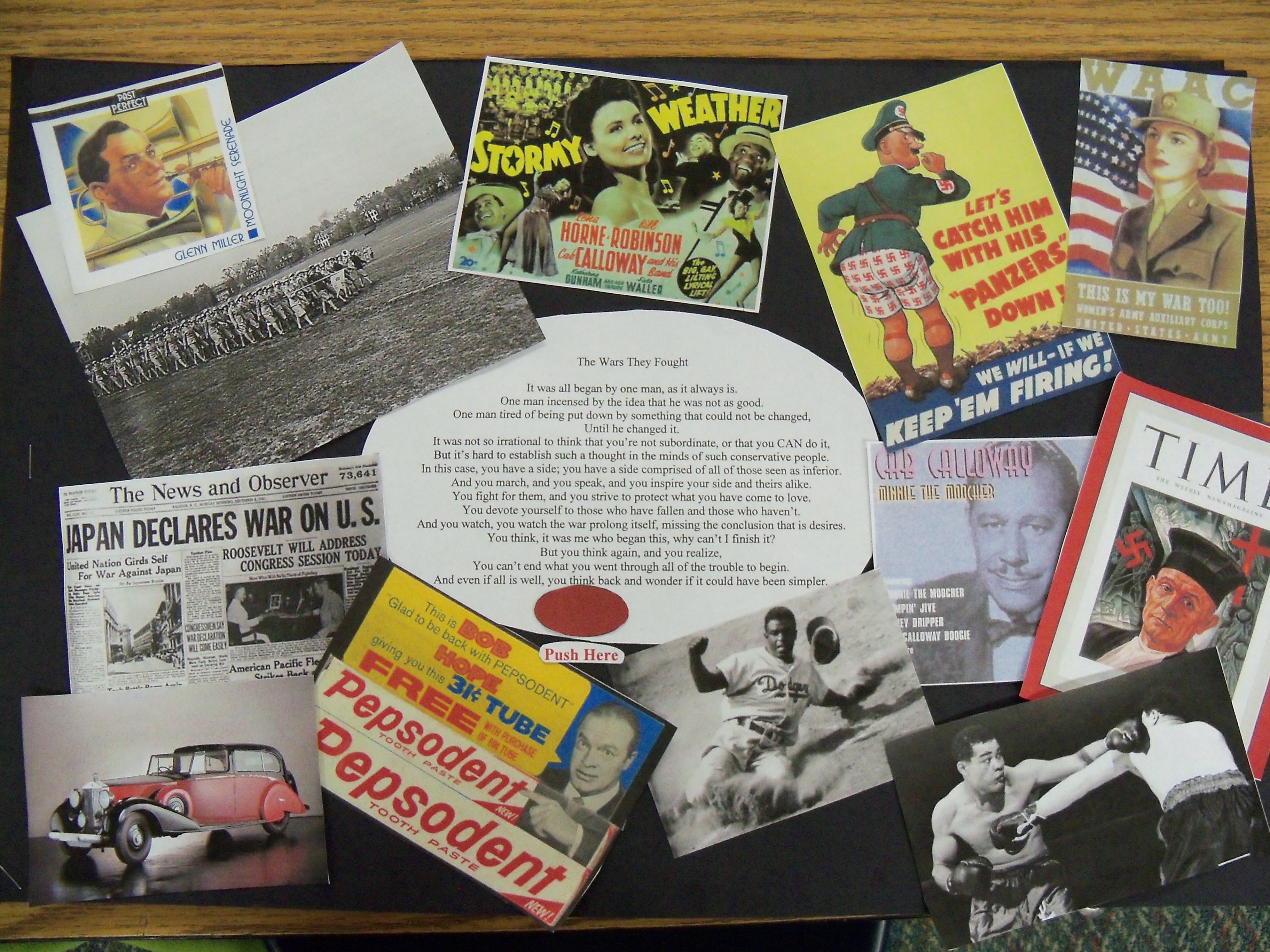
Last week, our young poets were ladies who have made friends with their vocabularies. They painted word pictures of Mare and really nailed some of her best attributes as a teen and as an adult. Today our poet is Zack, whose collage is filled with pictures depicting the time period of MARE’S WAR — but with a focus on war. As before, the poems are copyrighted to the individual poets, which is why they are only being shared as-is on their collage sheets — please respect the integrity of the poets, and do not reprint these ANYWHERE without their permission. Thanks.

You might think that a poem about war is not exactly a poem that fits MARE’S WAR, but it matches perfectly. There were two wars discussed in the novel – the World War II conflict, and the war that the African American soldiers fought for respect and equality within the military and within their nation. Zack takes the time to look at the background conflicts that prefaced MARE’S WAR from a variety of ways. Without naming names or positions, he clearly observes the grievances of the Axis nations, its charismatic leadership, and its eventual plunge into conflict. He then seems to turn to more personal reflections on disputes and how fighters struggle to make peace.

It’s a surprising irony that the things that start screaming fights among classmates can be the same things that start a war. Zack remarks on this with the opening lines:

It was all began by one man, as it always is./ One man incensed by the idea that he was not as good./ One man tired of being put down by something that could not be changed./ Until he changed it.

Just like that, we have the set up for a disenfranchised people coming together with a grievance, and demanding something happen. In MARE’S WAR, the Axis nations felt put upon and Germany felt cheated by WWI sanctions against them, leaving them an impoverished and bitter nation. One German leader who could stand up and make a difference for his people chose to do so. Too bad he made so many other poor – murderous, and downright evil – choices along the way.

My favorite lines are about the futility of conflict: And you watch, you watch the war prolong itself, missing the conclusion that it desires./ You think, it was me who began this, why can’t I finish it? Conflict, bad feelings, and war is like a ball rolling downhill. Once it picks up speed, there is often no stopping it.

This is a serious poem with a grim topic, but I’m grateful that Zack shared it with us, and did some deep thinking on a subject which affects us all.

There’s one more week of National Poetry Month, and yet more poetry at The Book Aunt, who is hosting today. Happy Poetry Friday, Happy Earth Day, Happy Pesach, Happy Easter, and Joyous Spring.

{Poetry Friday: Oakwood Grade 6 Poetry Project II}

Last week for our Grade 6 Poetry Project, we were introduced to the Oakwood School’s collage poetry assignment, and explored the perspectives of two fine poets. Ethan and Alan wrote about MARE’S WAR and Mare’s relationship to her mother, and the structure of her world. This week, poets Claire and Emily use their extensive vocabularies to speak about Mare as sister and daughter – hopeful, persevering, and tough.

As before, the poems are copyrighted to the individual poets, which is why they are only being shared as-is on their collage sheets — please respect the integrity of the poets, and do not reprint these ANYWHERE without their permission. Thanks.

Click to embiggen

Claire S. grapples with language and nuance in her six short poetic vignettes under the title of Bare Truth. In each poem, Claire unpacks the theme of truth as encountered in various portions of Mare’s life. My favorite lines are:

        “The segregation of a homogeneous democracy/Supposedly. United?”

This brings into question the idea of a unified United States, a question that the survivors of segregation and racism have no doubt encountered repeatedly.

Early on in the poem, a “murky abyss” is encountered, and poet Claire gives us the metaphor of Mare emerging from this place, rising above it and persevering. The abyss, of course, is prejudice.

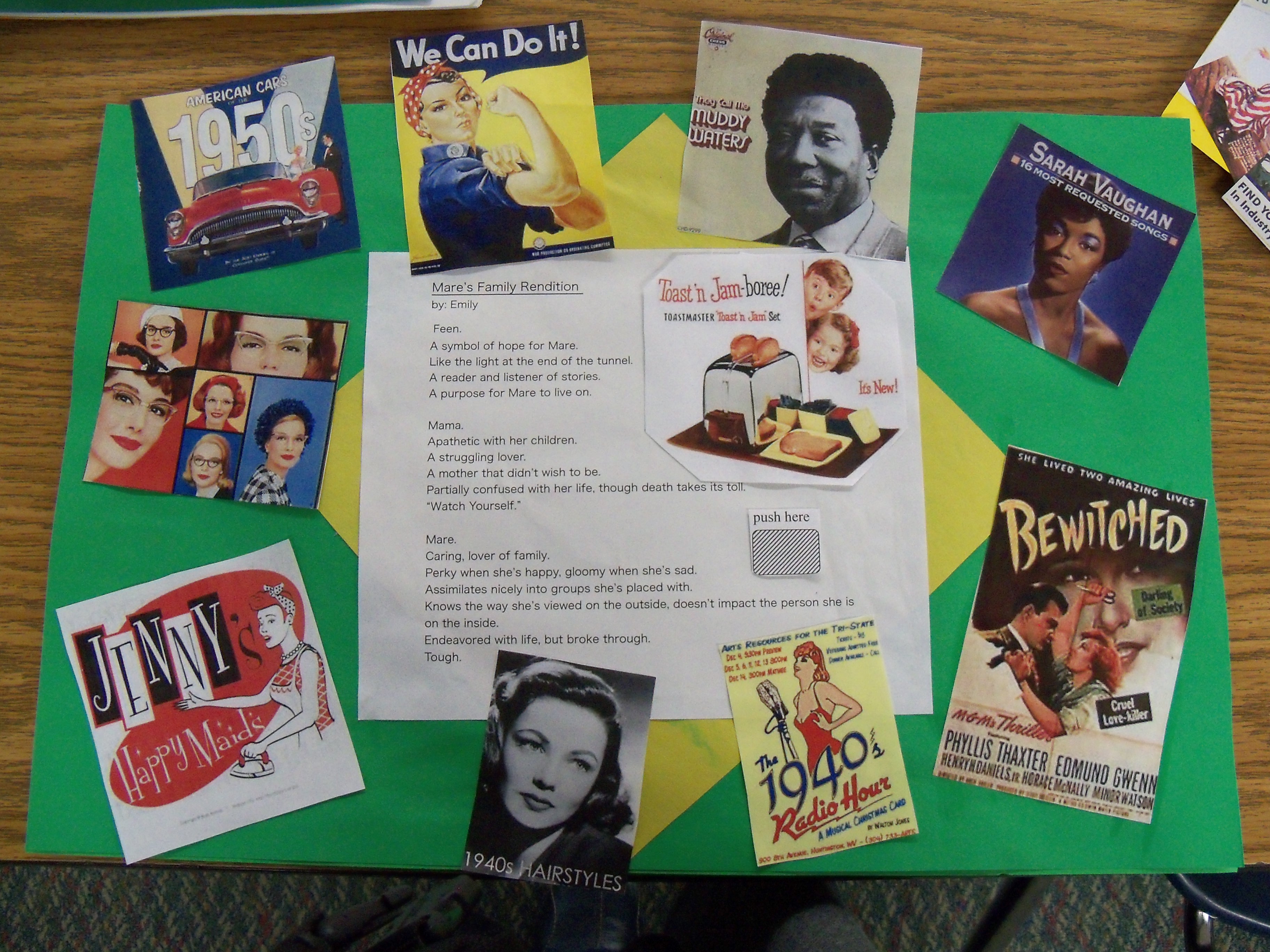
Mare’s Family Rendition is also separated into brief sections, using evocative, descriptive language to define the characteristics of the cast of MARE’S WAR. Poet Emily truly sees Mare’s relationship with Feen, describing her as “the light at the end of the tunnel,” and Mare’s purpose. I like that she also describes her as a listener, the someone to whom Mare can tell all of her stories. This really shines a light on the bond of their sisterhood.

The catch phrase, “watch yourself,” comes into play again for Mare’s mother. I find it fascinating just how many of the poets latched onto that phrase and rolled it over their thoughts.

From poet Emily, the final word on Mare is simply “tough.” Which is exactly what she is.

One thing I find intriguing is that few of the poems make mention of the “Now” sections of the book. Tali and Octavia are mentioned once as innocents with no bias, in Claire’s poem, but otherwise, most of the poets are silent on their input. Perhaps it is because the granddaughters, as listeners to Mare’s stories, are sitting next to us, the readers. Hm. Anyway, tune in next week, for a bit more poetry and chat, and some creative examples of Americans in the 1940’s through collage!


Poetry Friday today is brought to you by the number three, and the letter AWESOME, and is hosted today at Random Noodling, who made the mistake yesterday of introducing me to the animated Pearls Before Swine. I may never get any work done again.

{Poetry Friday: The Oakwood Grade 6 Poetry Project}

Oakwood School is where my inner child would attend, if I lived in Southern California and could shed a few (::cough:: Okay, more than “a few”) years. It’s an independent K-12 school in Hollywood, and is, by all descriptions, just. fabulous. They certainly have creative, incredibly gifted teachers; it’s been my privilege to work with Diana and Michelle and their 6th grade language arts classes for the second year in a row now as they read MARE’S WAR, and respond to it, and then interview me. The questions are always thought-provoking and well-presented, and I feel the love when I do my virtual visits to their classroom. The warmth of their response to the book, and to me personally, is really, really heartening.

The combined language arts group have shared a couple of their poems with me – and I’m going to put them in a special permanent collection on my site – but first, I’d like to share them with you. Since I have more poems than Fridays in April, I’m going to share a couple today. The poems are copyrighted to the individual poets, which is why they are only being shared as-is on their collage sheets — please respect the integrity of the poets, and do not reprint these ANYWHERE without their permission.

(As always, click to enlarge. You can then read the whole poem.)

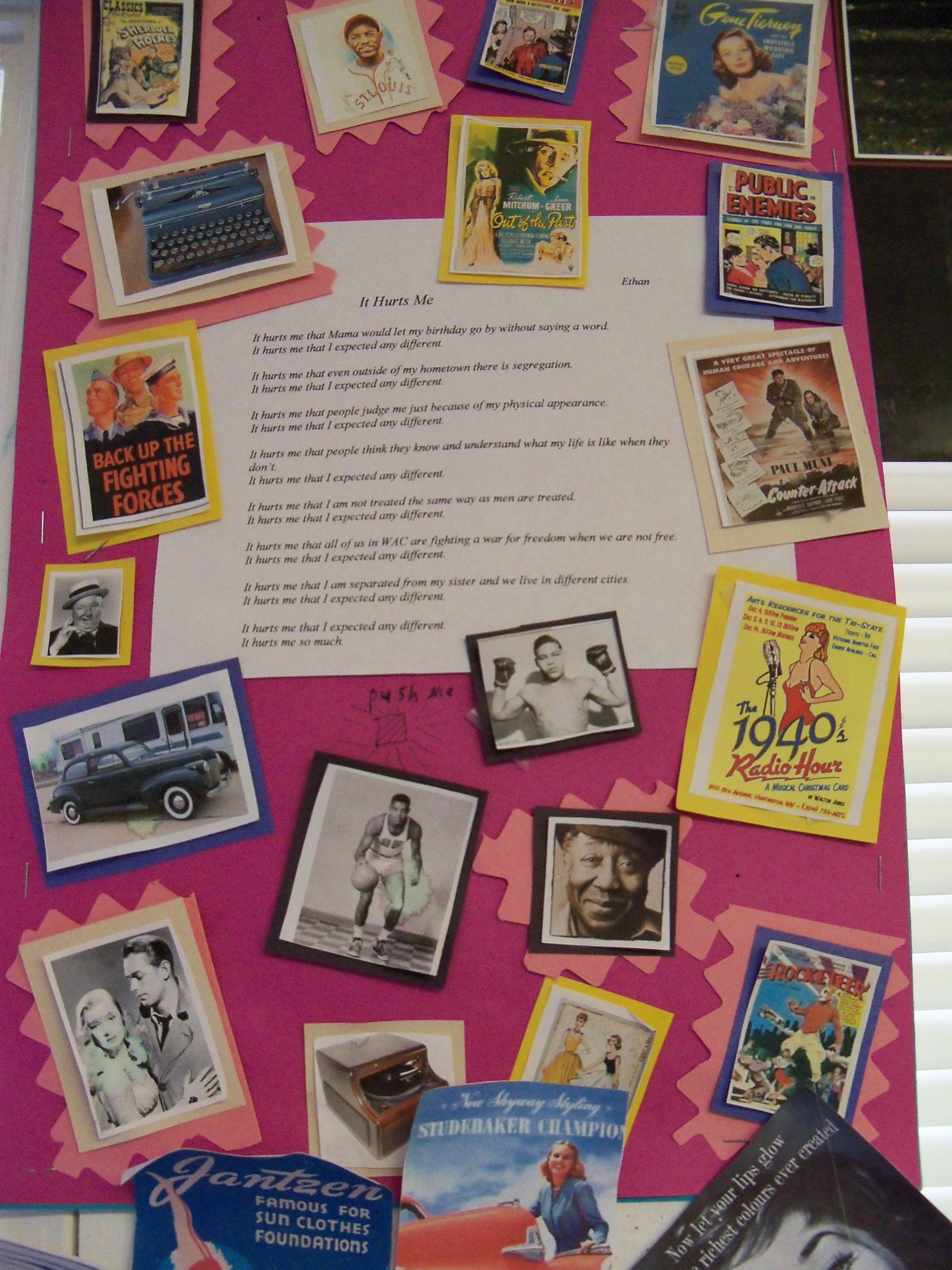
The assignment was a collage plus a poem – and if you look at the photograph, there’s a “push me” at the bottom of the poem, where you can hear the poet read their own work. Ethan’s poem is a well constructed call-and-response structure, on the topic of expectations – his take on what Mare felt about her life.

If you’re not familiar with it, call-and-response is a well-known structure of the music of West Africa. It has filtered into African American music, and is used in jazz, blues, and gospel music. It is used in Christian churches as well, to elicit democratic communication. Imagine the speaker at church saying something, and all the people agreeing with an “Amen,” or a cantor singing a prayer, and the parishioners responding with a murmured, “Lord, hear our prayer.” Call-and-response is about leading your listener, a step at a time, toward a conclusion. It’s about participation, and I imagine this poem read out, as a paean to corporate grief, the sadness of a people. With lines like, “It hurts me that I am not treated the same way men are treated,” the female soldier rails against how unfair “this MAN’S Army” comes across to her. But the real kicker is the repeated response, “It hurts me that I expected any different.” Ouch. Lord, have mercy.

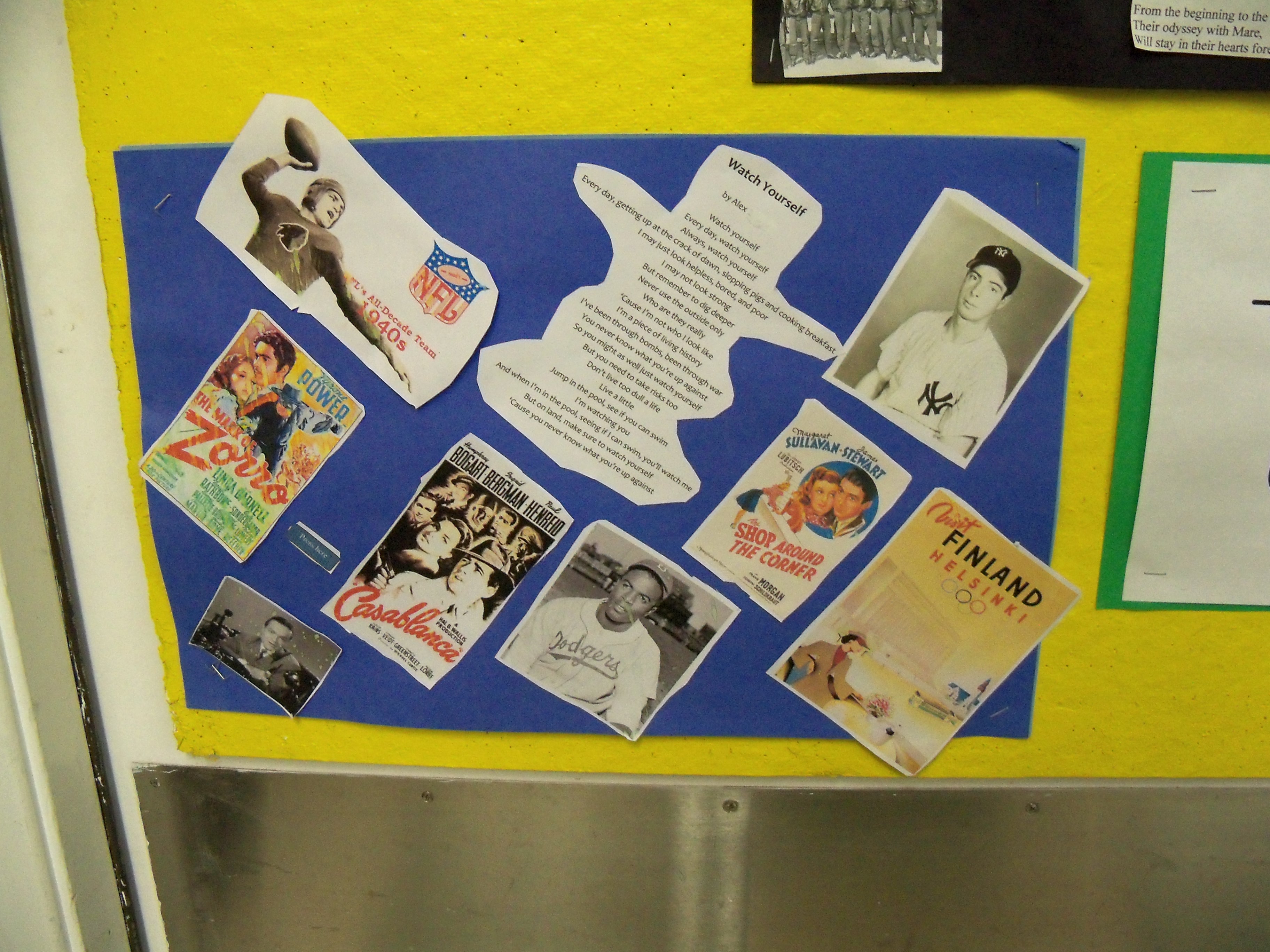
While Ethan explores Mare’s grief, Alex examines the literal and external command from Mare’s mother to “watch herself.” Alex watches Mare, through her daily chores and the grimness of her life. He writes imaginatively of Mare watching herself, commenting, “I’m not what I look like.” Mare, Alex wisely reminds us, is not just “helpless, bored, and poor;” there is more to her, and there is more to every single person we come across in this life.

My favorite lines echo an older, wiser Mare, perhaps speaking to Octavia and Talitha: “You never know what you’re up against/ So you might as well just watch yourself.”

I am, again, deeply privileged to have met these gentlemen poets, and I hope you’ve enjoyed today’s Oakwood Poetry selection! Until next week…


The Poetry Friday round-up is today hosted at Madigan Reads, and from the look of her site, she reads a lot! Drop by to discover more poets during this special National Poetry Month.

{national poetry month, HUZZAH!}

EVERY YEAR, I think, “Oh, I have too much work to do to participate in this!” And yet, EVERY YEAR, here I am – clicking through blogs, reading, commenting, sighing deliciously. The excitement for National Poetry Month is contagious. Poetry Geeking is infectious. I can’t help but take part!

The Princesses are all participating in various ways – Liz and Andi did haiku last year, and both Liz and Andi will reprise that, as they are pretty much the Haiku Queens of our group. Kelly is combining yoga, tai chi and poetry in innovative ways, and Sara is poetry-ing away with Laura, who continues her consistent poetry exercises of “15 Words or Less” poems, based on a picture, and her newest venture, “Writing After Reading, which is a thought-provoking series of discussions and prompts. Instead of interviews this time around, Tricia is hitting the teaching angle, and highlighting a poem, a theme, a book, or a poet every day and suggesting ways to make poetry a regular part of life in the classroom.

Other poetry peeps involved are the great Gregory K., who is also fundraising for a poetry crusade called Poetry: Spread the Word!, which would make the poetry celebration last for much longer than a month! I’m excited to go over and contribute and cheer him on! Reprising the Alphabet Soup Poetry Potluck is the very dear Jama K. Rattigan. My cousin, Mary Lee Hahn, is going to write a poem a day in honor of National Poetry Month. She’s also playing a QR Code poetry game, which is utterly leaving my iPhone-less self in the dust. (Oh, well. It’s good to have cousins who are smarter than me.) David Elzey is doing Burma Shave poetry/twitku – you’ll have to read to find out exactly what that means!

What’s MY contribution going to be? Well, it will probably be limited to Fridays, but I have a few poems to share — poems which were written as part of a Language Arts project for Oakwood School in Hollywood, in response to MARE’S WAR. I’ll share a few lines from a few poems — and talk about how I feel they fit with what MARE’S WAR is all about.

Meanwhile, here’s my little Poetry Friday contribution for today. It matches my mood pretty well – I’m grateful for the twelve pages I wrote yesterday, the late afternoon sun that, after a morning of rain actually gave Tech Boy a mild sunburn on the way home (hah! You know we haven’t seen the sun in awhile for THAT to happen – he’s paper-white, poor boy), the earworm from the Rossini piece we just sang (Qui Tollis, if you want to know), the wind gusts that rattled the windows and provided an interesting sideways flight effect for the pigeons and gulls, the rain across the panes — just small things which keep me going. Te Deum.

Te Deum

by Charles Reznikoff

Not because of victories
I sing,
having none,
but for the common sunshine,
the breeze,
the largess of the spring.

Not for victory
but for the day’s work done
as well as I was able;
not for a seat upon the dais
but at the common table.

Glasgow Merchant City D 7

The Latin words, “TÄ“ Deum” translate literally as “You, God,” and is generally the form for a praise poem. This one is less religious and more spiritual than some, if that makes sense, and I hope it prompts you into your own simple statements of gratitude.

For those following, the Poetry Friday round-up is today hosted by Amy @ The Poem Farm, where second-grade haiku (Petetry!) is on tap today, and where there will be poetry all month long.