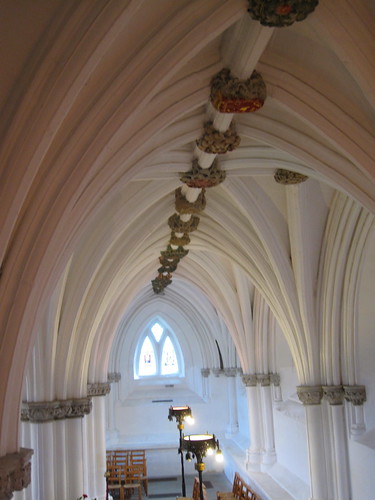
How often does anyone think to ask the behind-the-scenes people anything? (I’d like to discuss this underground chapel with the architect, for instance, but there’s the whole issue of Built In the Fifth Century, So (Hopefully) Long Dead with which to contend…) Capillya’s remembered the behind-the-scenes folk in publishing, and today at That Cover Girl, it’s all about the design! She’s talking to Kate Gartner about how she does the magic she continues to do for Knopf/Random House and its associated imprints. Don’t miss!
Month: March 2011
{here’s the link to the That Cover Girl interview!}
It’s right here. AND, tune in tomorrow to hear from Knopf/Random House book designer, Kate!
{meanwhile, while not speaking HERE…}
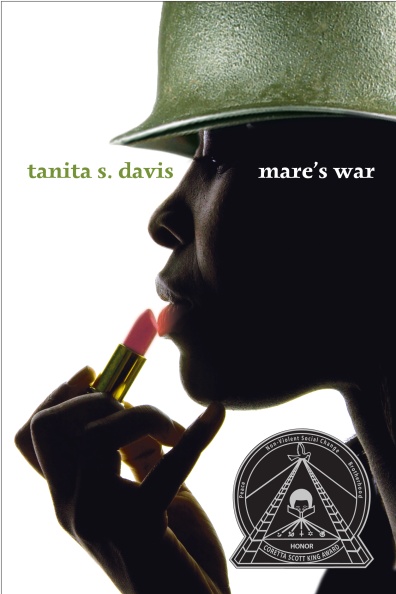
I’m going to be featured tomorrow at Capillya Uptergrove’s “Cover Love” series at That Cover Girl. Today Capillya talks about her love for the new cover of Mare’s War, and tomorrow, I’m going to talk about it, with my cover designer from Knopf/Random House.
Yep. It is still six kinds of striking, isn’t it?
If you haven’t browsed Capillya’s blog yet, she’s new to the scene, and yet her slightly snarky, offbeat YA book cover blog is quality, if not yet quantity. Check her out.
Sorry I can’t stick around – catching up on some writing. I started a NEW NOVEL while I had company. Yes, you may ask: WHY DID I DO THAT when I’m in the middle of revision on my SFF!?! Dunno… just the way my brain works.
On the other hand, all the Cool Kids are doing it; that’s how Lainey Taylor came up with Daughter of Smoke and Bone, which is going to be in bookstores shortly. Anyway – I’m excited about the new-new story, but also in dire need of catching up with my revision, as I have a date with a freelance editor at the end of April — and I’m not even halfway finished. Oops.
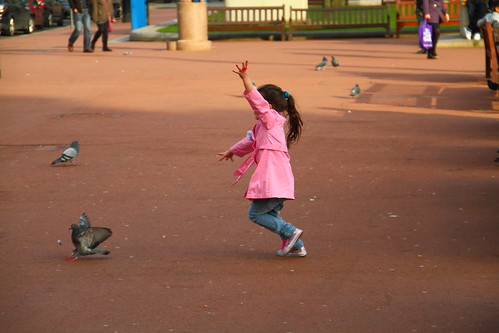
So, gotta go… Here. Have a pigeon. It’ll make you feel better.

Girl: “Pigeon! I will LOVE you and SQUEEZE you and NEEEEEVER let you go!”
Pigeon: “Aaaaaaaah! Pink human! Pink HUMAN!!!!”
Hope you, too, have fabulous bright rainwear, and don’t forget to check out That Cover Girl tomorrow. Happy week!
{little discoveries}
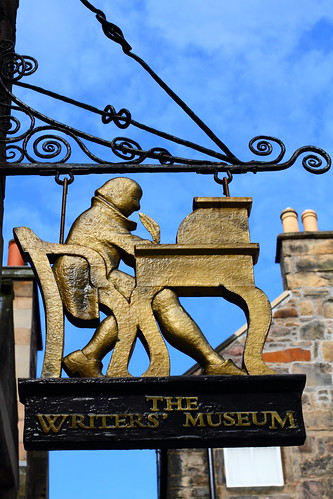
Little corners of Edinburgh always reveal such nice things. I’d seen this sign before, but hadn’t had time to stop in to the tiny museum full of Robert Lewis Stevenson and Robert Burns memorabilia, until my brother and niece came to visit.
Please note the blue sky. It was 46°F, but the sky. was. blue.
Lots of stories to tell, a few small happenings to relate, but — too tired to talk, after a week of guests. I expect to get my second wind soon!
Happy Weekend. May the sun shine at least for a little while.
{living in color}
Every time I am tempted to think that we are, as a human species, somehow inching up the ladder of microevolution and becoming better and brighter and stronger, something like the recent disasters in New Zealand and Japan occur, and the talking heads get started. Utterly horrifying to me are the alleged — and largely American — Christians who say that whatever fresh horror is somehow a karmic flashback on the Japanese people – though how Christians got involved with karma, which is strictly a fundamental doctrine in Buddhism and Hinduism, I have zero idea. Further mortifying humans with compassion, taste, and a sense of propriety are the people who can make jokes about the hundreds dead and still dying.
When I ask myself how it is that people can be so …basically wretched, the thought comes that our utter disregard for each other based on the usual suspects, ignorance and fear. Those are the key components to racism, and they poison so much of what we do. Sometimes I think we’re actually pretty wired toward racism, just with the way our language is formed.
(Maybe you’ll think this is reaching, but bear with me, please. This is one of those posts where I’m mostly thinking aloud. I have come to no solid conclusions, these are just — suppositions. Feel free to share your own.)
When I was a kid, I really hated that at church, dark or black was sin, and white was all good and God and righteousness. As a matter of fact, I purposefully referred to myself as “brown” to avoid the larger religious implications of not being washed “whiter than snow;” after all, brown wasn’t really specifically mentioned in Holy Writ! As a larger kid masquerading as an adult, I mostly understand why the dark/light/black/white thing came about, but I think it’s also prejudicial, in many ways, and that just like people have reconfigured versions of the religious writings to use less gender-divided language, it might be nice for people to take a look at limiting the use of black/white imagery to depict bad and good. On the other hand… it might not be possible to change some fundamental elements of how we think about color.
Alan Kennedy’s nifty Color/Language Project takes color idioms from myriad languages around the world, and explores what they mean. In English, someone who is green is either a.) inexperienced, b.) envious, or c.) environmentally conscious. In all kinds of languages, some colors are still a negative — take a look at just a few examples:
In Hindi, to place a black pot on the head is to bring disgrace on oneself; in Mandarin, a black pot on the back is to be scapegoated. Black work, in German, is to be working illegally. Black riding, in Dutch, is to ride public transportation without paying. For Swedes, the black disease is jealousy, for Norwegians, the black takes you when you go to hell, and in Japanese, to be black-bellied is to be deceitful. To make someone brown, in French, is to cheat them; brown doctors or lawyers are quacks, or crooked. In Spanish, to eat the brown is to be given unfair work, or blame. In Portuguese, a yellow smile is a fake smile, and in Russian a yellow house is an insane asylum. We can’t forget red’s association with anger, Communism, debt, or, in Spanish and Welsh, adult films (!). Colors are viewed pejoratively, and in some ways, the people whose ethnic background is tied to color words can be painted with that same pejorative brush.
I love language, and I am not at all suggesting that these color words shouldn’t be used or should somehow be changed or ignored. I am merely wondering if we aren’t maybe even more inclined to think badly of others, based on some of the color idioms in our speech. Yes, it’s specious to say that we don’t “see” color in this world, and color and ethnicity definitely adds richness and depth to our world — but I’m not sure that how we talk about it is working. Maybe we should stop with all the “red, and yellow, black and white,” and just think humans. And go on from there…
(Thoughts? Obviously, this is just a fragment of an idea, but it was ping-ponging around in my head, and now that it’s out, I hope I can get some work done…!)
Hat tip to Nancy Friedman at the quirky naming blog, Fritinancy, for the link to Alex Kennedy’s project. Yes, that’s Frit·i·nan·cy n. [From the Latin fritinnire, to twitter.] A chirping or creaking, as of a cricket. – Is that not the coolest blog name, EVER? That’s totally what they should have called Twitter. (This is why NANCY has the naming blog, and I don’t.)
{even among these rocks…}
Happy Lenten season to my Catholic peeps, and to the rest of us who take this time of year to recalibrate ourselves, and try to practice a bit of self control for a month. I think especially of The Brilliant Athena, who is eleven and is trying out Lenten sacrifice as a nonreligious, intellectual exercise this year for the first time. She’s given up … the internet. That is ONE. TOUGH. CHICA. Her Dad is supporting her by forgoing mainlining Coke Zero for forty days. (How much do I love that parenting style? Can they be MY parents??)
Lent, whatever your religious stripe, really is a good reminder to us that we shall not surely die without our Cherished Things. It’s an exercise in self-discovery to realize how much we suffer when we deviate from the little streambed of our usual haunts and activities. How like ants we are, only traveling along our same little lines, doing the same things the same way, whether they’re good for us or not. Lent gives people the excuse to jump out of their ruts.
We Protestant-raised folk who don’t officially “do” Lent still have our opportunity and our excuse to be open to change. March 4-5 was the National Day of Unplugging, started by a group of Jewish folk who made a modern renewal of the traditional Sabbath, and turned off their technology. The Sabbath Manifesto, a weekly sundown-to-sundown shut-off-your-tech agreement between families and friends, and open to everyone, came out of this. Disconnecting and stepping away from the conversation is a very good thing, and gives us time to read, reflect, and to think. Weekly re-creation, an invitation to recreation, in answer to a need we may not have known we had.
So, too, the Lenten season.
Every year around this time, I ATTEMPT to read and fully understand T.S. Eliot’s poem Ash Wednesday, and every year, I realize I have to settle on a single section of it, and go with that. The entire poem is rife with subtle references, both Biblical and otherwise, and there’s a lot there to miss.
Sometimes, I feel like I have to read Eliot with annotations and a dictionary on hand, but because I love his sonorous voice (I have heard recordings, people, I am not THAT old. Listen to it for yourself, or read it in its entirety here.) and can just imagine him speaking these circuitous, profound and allegorical lines, I keep knocking my head against this one. Today I read this portion aloud:
Because I know that time is always time
And place is always and only place
And what is actual is actual only for one time
And only for one place
I rejoice that things are as they are and
I renounce the blessèd face
And renounce the voice
Because I cannot hope to turn again
Consequently I rejoice, having to construct something
Upon which to rejoice
And pray to God to have mercy upon us
And pray that I may forget
These matters that with myself I too much discuss
Too much explain
Because I do not hope to turn again
Let these words answer
For what is done, not to be done again
May the judgment not be too heavy upon usBecause these wings are no longer wings to fly
But merely vans to beat the air
The air which is now thoroughly small and dry
Smaller and dryer than the will
Teach us to care and not to care Teach us to sit still.Excerpted from ASH WEDNESDAY, by Thomas Stearns Eliot, 1930
This is a poem is about doubt, about coming two steps forward in belief, and perhaps moving three steps back. It is a poem about difficulty, and faith. It is hard — very, very, very hard. In more ways than one.
I think I actually enjoy the difficulty of this poem, in a weird way. Every once in awhile, it’s okay to be challenged. It’s okay to give things up. It’s okay to try, and try, and see the edges of where we fail and fall apart.
And pick up again next year. And try again. Even among these rocks…
Poetry Friday, which this week may have even more difficult poetry to share, is hosted by Poetry Princess Liz @ Liz in Ink, who is gleeful about Spring.
{I still am sore in doubt concerning Spring.}
Yat Yee Chong‘s blog post amused me greatly the other day. At present, the sky is the color of old pewter and the thirty-some mile-per-hour wind gusts are somehow forcing their way through… well, everything. My hands are cold, and though it’s still in the forties, the forecast calls for… snow. Starting Wednesday, and rolling on through the weekend and into next week.
Ah, Christina. I, too, will not believe that “Spring” thing until I see it… But, the birds are tweeting themselves hoarse around 5 a.m. and right this minute, I smell… grass. And my nose is itching.
It approacheth, yea, verily, yet it is not quite close enough… darn it.
More than the weather, though, I am finding myself hovering on the edge of …well, grief. RIF – Reading Is Fundamental had their budget scrapped. The music program at the elementary school where I had my first solo has been… well, possibly cut altogether, possibly left in the hands of the talented community volunteers. We all acknowledge the power and importance of reading and music, so there may be some hope of salvage, but… the cuts and belt-tightening country-wide have become intensely personal. It becomes even moreso when you imagine the cuts and belt-tightening going on on a personal level. (If you’ve never played “Spent,” it is …disturbing, but eye-opening.) So many friends and family members have lost jobs, and are simply struggling to keep their heads above some very deep water.
It feels, on this gray day, like we need — something. In all the Ingalls books, isn’t this the time when there was a barn-raising or a corn-shucking, or something to pull the community together and out of their own grayness? Or is that no longer done, since everyone has all their own entertainment and social needs met on Facebook or with their Tivo, iPods, Netflix, or Smartphones at home? We can all be miserable separately, that way.
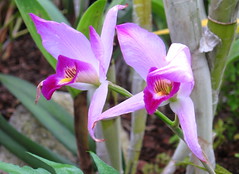
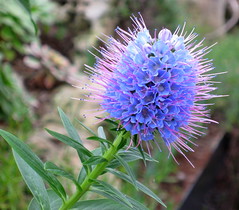
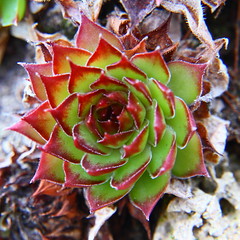
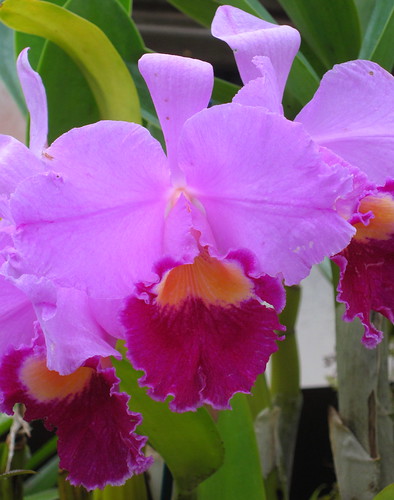
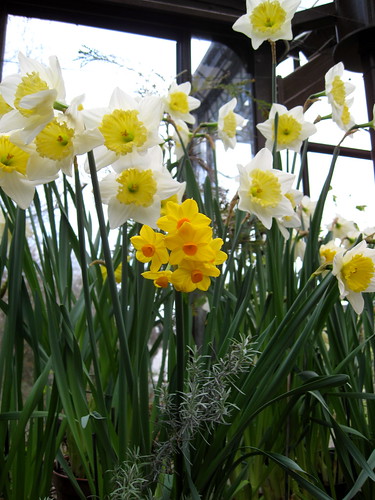
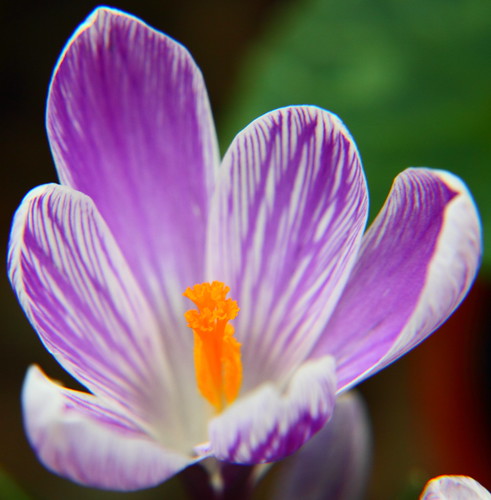
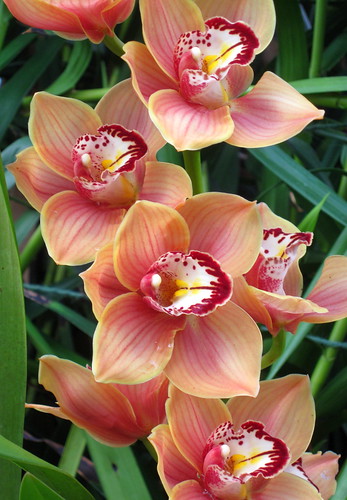
Since I can’t think of a positive solution, let’s have a flower.
Things which have made me happy: a discussion on diverse books over at The Reading Tub – I’m on a roundtable panel for Share a Story, Shape a Future, and I invite you over to take a gander!
An additional happy: Emily Asher-Perrin’s piece on Tor.com on our lives as readers. You never truly forget where you read some of the books that changed your life… I will never forget where I was when The Hobbit was read to me for the first time, and the feel of the hard plastic phone receiver against my head as I drifted off to sleep every night. (Yep. It was read to me over the phone by Tech Boy, the boyfriend who worked nights and was wide awake. Fortunately we were in the same town or I would have had the phone bill from Hades.)(Actually I did the year after that when I graduated and moved away, but that’s another story…)
A further happy: Good Night, Dune. I giggled madly. (Well, yes, I am a geek. Thanks for noticing.) The Atlas Obscura — absolutely fabulous places all over the world – as discovered by the atlas makers. There’s a nifty place in your neck of the woods you knew nothing about! Check it out.
(Video via Smart B’s)Okay, that one’s a happy, but a little envious, too. I want the world to love stories and libraries and books like the Irish do. Could that be possible, world? Could we work on it??? And stop cutting arts programs??
My last happy for the moment: the BRILLIANTLY homeschooled “Jane” Wiley has split the atom! Okay, maybe not. She’s extracted the DNA from peas, though, which is twice as cool, and didn’t cause an explosion. In all seriousness, I stand in awe of that girl’s brain – let no one tell you that homeschooling does not produce a capitol-E Education.
Okay, the wind is howling, and I’ve given up on not wrapping myself in another layer of fleece. It’s time for a treat. Let’s have another flower…or several.