{npm♦4/9}

I was obsessed with diseases as a child. I read extensively about polio because it was A Terrible Thing that happened to so many children AND a president…. and I was terrified by the ranks of iron lungs in old Life magazine images, fearing they would come back in vogue, as treatment for… something, and I’d be trapped in one for years. I memorized the symptoms for typhoid as described by Catherine Marshall in CHRISTY, because fictional interactions with disease was apparently also acceptable. I was mildly interested in Typhoid Mary, but fascinated by Jacob Riis, and Jane Hull who lifted children out of desperate circumstance. Children can become oddly fixated on disaster and destruction sometimes. My readings on child welfare and the shaky beginnings of a nation deciding that perhaps the children of the poor should also be granted a childhood instead of being bred for endless work clash painfully today against the plummeting working age in some states, and the climbing number of measles deaths in others. Somewhere, someone voted and decided that child welfare didn’t need to treat anyone well.

the smallest always pay the price

Will anyone admit they voted for this
And decided, “Sow chaos,’cause we can!”
Now whispering “Whaaaat?” or ‘How could this happen?’
Is pointlessly past tense, and done when anywhere,
Everywhere in the rot creeps. Ready or not
our dominoes fall. Change sweeps up everything,
true – but this breaking is
brutal and once again, children are lost.


{npm♦4/8}

Tax day is coming – the day my inlaws got married, to save money, they told their children, though I don’t know how that worked. Ironic, that every April I remember them when I think about them no other day (I “took” their son; they don’t forgive this). Annually at my house, we set aside our cash to ‘give the devil his due,’ and that’s the day these giddily unromantic people chose to commemorate their union. Nothing more inevitable than death and taxes. Nothing more American than tax dodgers, fraudsters, and the like, avoiding payment for the benefit of paved roads and postal services. Silver linings, I guess, to commit to the greatest fraud of all on the day you dole out your coin, the day you return on your investment in infrastructure, a time you promise to add another pair of bricks to the foundation of the world: one called love and the other, honor.

taxing

Foundational form
this infrastructure holds us
Upright. Embodied.
Our checks, balances and spines
Keep heart and soul in tune.

{npm♦4/6}

(While I don’t often explain my poems, I thought I’d explain this one. April is Autism Acceptance Month and a young man who is otherwise non-verbal read a poem for the Presbyterian service, using an alphabet sheet which deciphered his words one by one. Far from being a vacant body, we met a poet’s soul, and it shocked some of us out of the vaguely pleasant responses we give the different and disabled. It reminded me of my brother turning eleven and deciding he wanted to read the scripture for church service. Our entire family – big old sops that we are – cried.)

We cried when they told us.

He wouldn’t ever do anything, the voices told us, kind but authoritative. They knew, and we did knot know, a child’s limitations. He would never read, never cipher, never go to college, never go any further than the colorful third grade classroom where his IEP team sat. Nobody’s fault, nothing more to do – he was such a sweet boy, so well-behaved, a credit to his family, and we should be proud of that. We cried, but there was not much time for tears, as we had work to do – lunches to pack, shoes to tie, and a small boy to send to school anyway, where against all odds he learned what a joke was, and made them up, wrote lines of shaky letters that formed shaky words and sturdier sentences. Where, against all advice, he reached higher than his grasp, and leapt – and we, eyes on the sky, set to work regluing the feathers to his handmade wings as he leapt from higher and higher perches, crashed through wobbly landings, and taught us that persistence was the difference between failing and flying.

close focused, frowning
jeans creased sharp enough to slice,
minding his diction,
warming like slow winter sun
In the beginning, the Word

{npm♦4/5}

A black day, a newspaper (Hartford Daily Times, Connecticut) recorded it. “Friday, the 12th day of April, 1861, will be recorded as the Black Day in the history of our Republic. United States Forts firing upon United States Forts. American citizens directing the implements of death upon American citizens. The Civil War commenced. What a shocking record! O, how long will it be before this accursed state of things shall cease to exist in the memory of the People? No man can tell.” So little they knew, and so many black days since that they form their own black list. Black ops, black sites, and Blackwater, a black hole of secrets and death and deals, giving all involved country a black eye, a history and a bitter truth that nothing will ever black out. Nothing changes this history. No Spackle, sanding, or buffing obliterates that past.

All we have is now.

sleep shattered by song
mockingbird urges, Look!
today is made new

{npm♦pf – 4/4}

Tricia is raising the bar this month, revisiting her “try-random-poetry-form” posts for NPM. She shared the Venn Diagram poem today for Poetry Friday and it is BRILLIANT. Having committed to reflecting on lines from Naomi Shihab Nye’s “Gate A-4” this month, I immediately knew I had try this new form with one of my phrases.

From Process…

Of course, Tricia didn’t tell me this was going to be so HARD. I didn’t think it would be – it’s basically two Golden Shovels back to back, with the mentor poem phrase in the middle of the overlapping circles so that it both ends and begins two poems or poem stanzas. I don’t know why this took me forever to get my brain around, but – wow. Three hours to get eight lines is kind of ridiculous, but I am trying to go with the spirit of the phrase as well – so the lines needed to end with the idea that not everything is lost.

…To Poetry

TBH, that is DAILY the thing that takes the most time with these poems.

I refuse to be cheesy and write sermon illustrations that are sunny and cheery and essentially meaningless. I refuse to do the “it gets better” thing with such a great woman’s work – I don’t want to write Chicken Soup for the Beleaguered American’s Soul type of crap that says the sun will come out tomorrow and everything will be fine. Damage – so, so much damage – is being done, not just to institutions and systems, but to people. Much like the immigrant children separated from their parents the last time this administration’s brutality was left unchecked, some things will never be repaired. I grieve that as any person of morals and sense does. It will not be “fine,” but it will be…well, in the Julian of Norwich sense of wellness. Things are chaotic, and we’re brokenhearted, but all manner of things will be well – because we are still here. The grievously ill body politic may not recover, but God is still here. And, we are not done working to save PEOPLE yet.

*Ahem.* Anyway – off my soapbox, here’s the poem.

All Shall Be Well

It hurts – how can it not?
We assumed that The Dream was everything.
But found how fleeting a daydream is.
A handful of bubbles, captured, then lost.

Not by might do the best dreams come,
Everything will not yield to the bark of the gun.
Is our land solely gold-makes-rules thugs and no more?
Lost Dream, steel our spines. We know what we stand for.


{npm♦4/3}

They were daily wear, no little luxuries, these. Found at the ladies shop on Ingram Street, the hole-in-the-wall tea retailer, the tights department at M&S, all things from one thousand, eight hundred and twenty-five ordinary, extraordinary, rainy, windy, fascinating, boring, lonely, average days… days enshrined in a long stretches of weeks, five years worth of a life somewhere in a place I once called home. Whether sleeves of biscuits or boxes of tea, brands of hot sauce, scratchy tweed hats or lengths of woolen plaid, I kept Scotland in my hands, next to my skin, inside my pores, under my breath, and it never let me feel too far away, never let me regret the difficulty, never let me leave it alone as I learned to disconnect and resettle my heart to the rhythm of the state where I was born, let my skin revert to desert air from constant rain and mist, let my eyes learn to linger on gold instead of endless shades of green… Home wasn’t so far away, after all, as long as the post still ran, shipping me my daily wear turned little luxuries. My tea. My tights. My sleeves of biscuits. My heart.

So many sorries
My emails drip with regrets
like cracked tea kettles
    Empathy spreads across miles
    From strangers being human.


{npm ♦ 4/2}

The People’s House is on fire.

Each news story emits another disorientating plume of oily smoke as something new succumbs. The incomprehensible losses of systems and institutions is like a home invasion – each new rending means order lost and chaos blinds our eyes with the stinging dust of collapsing foundations. Is that the roar of flames I hear, or the roar of my own fearful pulse in my ears? I circle the corridors, testing doors lightly with my fingertips, but the fire is both nowhere and everywhere… where there’s smoke, there is fire, isn’t there? Is there not fire? Coughing, I wonder – is the smoke the point?

Gaslights were progress –
Steady illumination
No need for candles:
         Peer again, past the darkness –
         Through the open window, stars.

{national poetry month: “not everything is lost”}

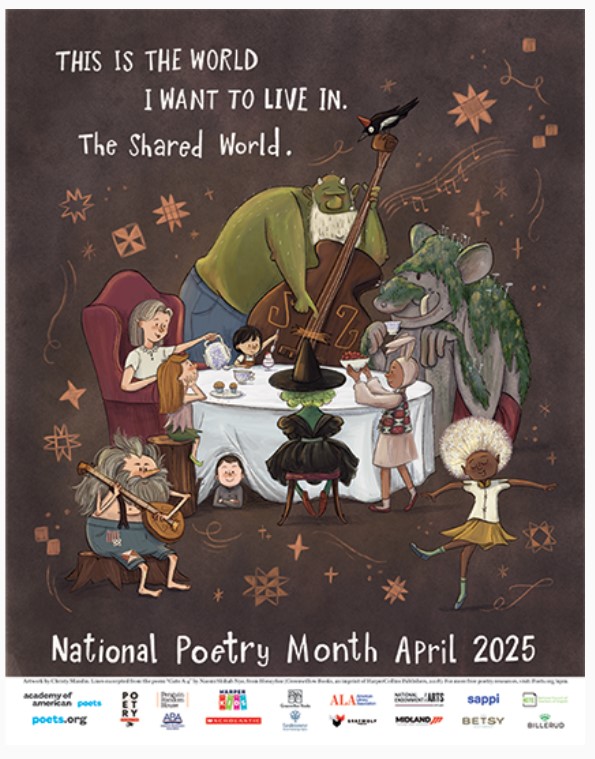
“This / is the world I want to live in. The shared world.”

The 2025 NPM poster features lines from “Gate A-4”, a poem by Naomi Shihab Nye, as well as artwork by New York Times-bestselling author and illustrator Christy Mandin. “Gate A-4” is a poem which has always resonated – because I used to love the swirl of humanity in airports, all the people-watching and the excitement of going. This was, of course, when I was in my twenties and still new to air travel, still believing in the public transportation contract of paying-to-ride, before a world where people beat a man and dragged him off a plane because they’d overbooked and wanted his seat for someone else. Post 2001, I saw air travel’s underbelly – a world wherein adults sometimes wept silently, frightened, frustrated by a language barrier and exiled from all they knew. I had the …experience of flying aboard a USAID flight where I put on the seat belts of other adults and a woman with a tiny infant because the flight attendant talked at them – and there was no translator. It was literally – for it was a flight out of Miami – a steaming hot mess. A toilets backed-up-and-overflowing – people airsick and vomiting – no AC on the whole flight – grit-your-teeth-and-endure hot mess, from Miami to Minnesota. I prayed those people found a home where they could be clean and fed and free of the wailing bewilderment they seemed mired in that day.

Suffice it to say I can almost feel the frustration of the gate attendant, the wary, xenophobic cringing of the other passengers at all that… foreign emotion, and the bleak despair of the woman on the floor wailing. Naomi Shihab Nye’s act of mercy and humanity made so many people’s lives better in that two hour wait for the next flight, but it is the final lines of the poem, rather than the two that the American Academy of Poets highlighted for this month that make me tear up and hold my breath: “This can still happen anywhere. Not everything is lost.”

Those last two sentences always make me want to whisper, “Really? Do you promise?”

Yes. Not everything is lost: because everyone who is loved is found.

Not everything is lost: because we have it within us to be maps.

Not everything is lost: because not everything we lose is a loss.

Not everything is lost: because we can find beauty and meaning in remnants.

I don’t know what’s going to come out of me for National Poetry Month, but I will be in conversation with this, and have settled on this as my theme – and my hope. “This can still happen anywhere. Not everything is lost.”

“Not everything is lost.” It’s true. It’s got to be true. Not everything, not all the time – and we will find ourselves again.

{pf: poetry peeps pass notes to superman}

Welcome to Poetry Friday!
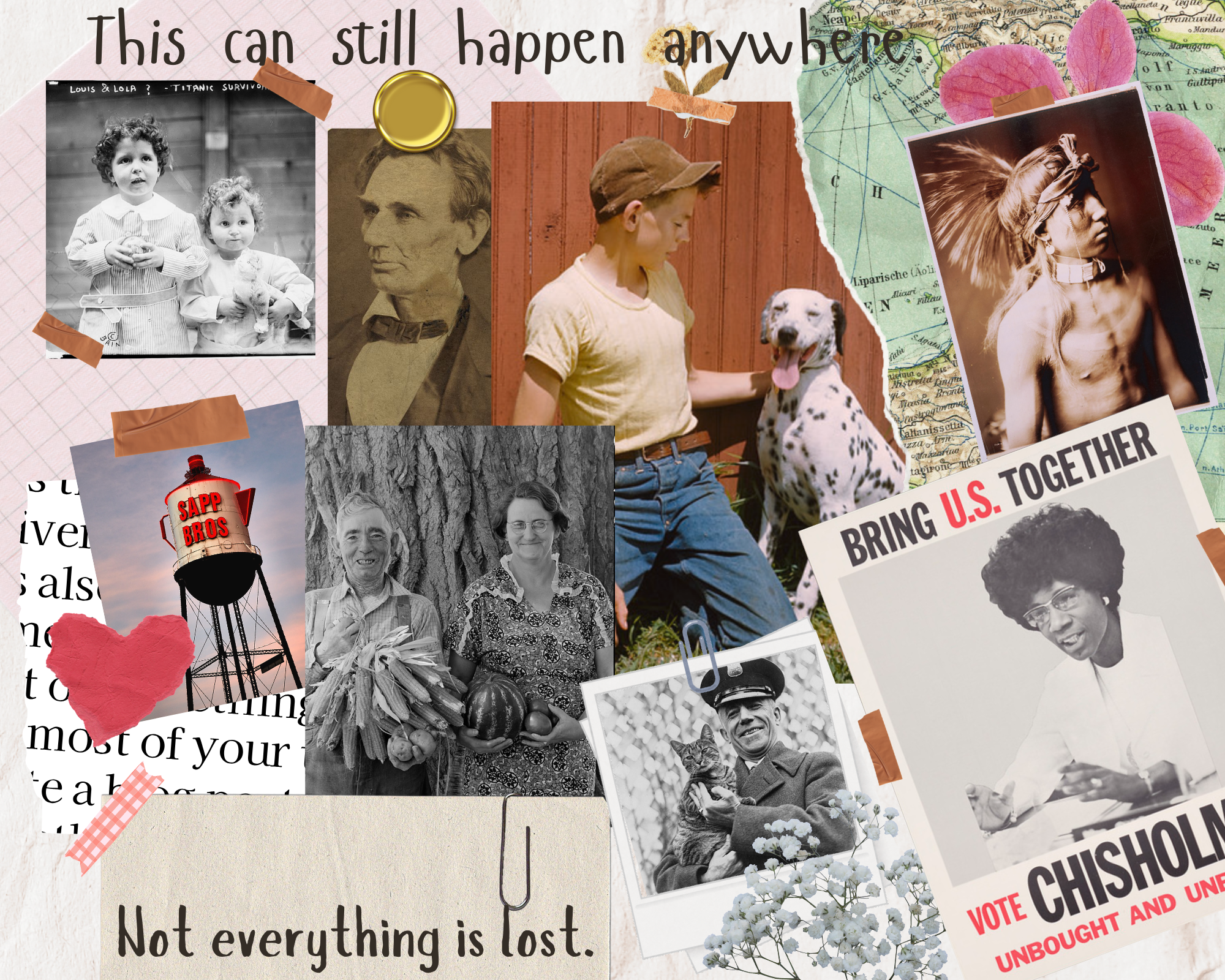
Poetry Peeps! You’re invited to our challenge for the month of April! Here’s the scoop: We’ll be in conversation with a vintage, antique, or just plain old photograph. Of course, your photograph needn’t be from either of these archival photography sites, but take a poke around, and see what you find. Your poem should be based on an image which is at least, say, forty years old, or at least something you consider “old.” Once you’ve got your image nailed down, you’ve got a month to craft your creation(s), then share your offering on April 25th in a post and/or on social media with the tag #PoetryPals. We hope you’ll join the fun!


When we chose these poems to be in conversation with, I was excited – because the poems were offbeat and a bit amusing, and I thought this would be easy.

Literally EVERY TIME I THINK THAT I should snap my wrist with a rubber band or something. Writing poetry is never a slam dunk when I think it’s going to be. Never. Ever. Why do I keep deluding myself this way???

From Process…

Clifton’s “four notes to Clark Kent” addresses the idea of a rescuer through varying personal lenses. Though she is still writing to him, Lucille Clifton seems to have misgivings about the dude who can leap tall buildings in a single bound… I mean, what good is that, her first poem seems to ask, when she’s dealing with more immediate issues between the four walls of her home? Who can save her from all of the broken dreams and emotional paucity that waits there, him? No – she doesn’t think so. She names him “tourist;” reminding the reader that he’s not from Metropolis – he’s a stranger, a literal alien. While she’s hanging by her fingernails from the edge of a ledge, waiting for rescue, he’s just visiting, isn’t he? Maybe he’s not really there to save her after all. While in her third poem, she appears to forgive him – and forgive herself – for just human and other. The idea of the Superman mythos has inflated him past life-sized and she graciously allows him to shrink. By her fourth poem, she openly decides he’s pretty hot, but I still don’t get the idea that the poet feels he’s all that super – just cute. She calls him by his Clark Kent moniker, referencing his other persona solely as an adjective rather than a name, which I found interesting.

I shared some of Clifton’s misgivings about Mr. “faster than a speeding bullet.” I didn’t grow up on Superman comic books, and the blandly handsome, lantern-jawed superhero in the movies didn’t particularly …convince me, as a kid. As a fellow four-eyes, I was completely OVER the trope of “dreamboat without his glasses,” and thought Clark and Superman looked exactly alike – because they WERE, of course.🙄 Further, his mild-mannered, awkward persona grated on my nerves (I somehow missed the point that he was acting so people wouldn’t equate him with his outgoing alter ego). He was noble to the point of ridiculousness, and I didn’t resonate with him as an American icon. Like Smokey the Bear, he somehow seemed to be just another childhood talking head in cartoon form who told you how to behave. He never seemed particularly heroic to me, so I realized that Clifton’s doubting had infected me, too. Who was this guy who was supposed to save us? And who were we, just …sitting there, waiting to be saved?

…to Poem

When we got together for our Sunday poetry chat, Cousin Mary Lee said she couldn’t find a lighthearted bone in her body and didn’t feel like she could speak to the poem. At which point I thought, “Oh, humor was an option!?” I didn’t have any lighthearted thoughts on Superman either. In my initial draft I had taken a deep dive into the idea of saviors, the idea of Americans exceptionalism, of Americans striding in to play savior – after like as not having started the conflict. I wrote about the learned helplessness of people who have lived with privilege for so long that they don’t ever think anything can happen to them, and about the non-SUPER-ness of people who stop voting and such. *cough* The poem was taking me somewhere I didn’t want to go, so I thought I’d sit down and try being funny – just – out of nowhere. I wanted to write about the really cheesy 80’s Superman movies I didn’t watch until decades later (they DID NOT age well). I wanted to write about Spanx underpants over spandex leggings and capes (“No capes!” screams Edna Mode in my brain) and battling wedgies while leaping over tall buildings in a single bound. I did NOT, however – I restrained myself! Sara probably did too. Tricia definitely wrote something classier, as did Laura. Mary Lee’s poem is here, and here’s Liz’s poem, Michelle K’s poem is here. More Peeps may be checking in throughout the day, so don’t miss the whole Clark Kent roundup. And for more poetry that fortunately doesn’t have anything to do with spandex and capes, visit the Poetry Friday round-up Marcie Flinchum Atkins’ blog. Thanks for hosting today, Marci.

While I didn’t write about wedgies, I did try to write amusingly, so… I thought about Lois Lane, who tried so hard to be cool about Superman, but… she just was not.

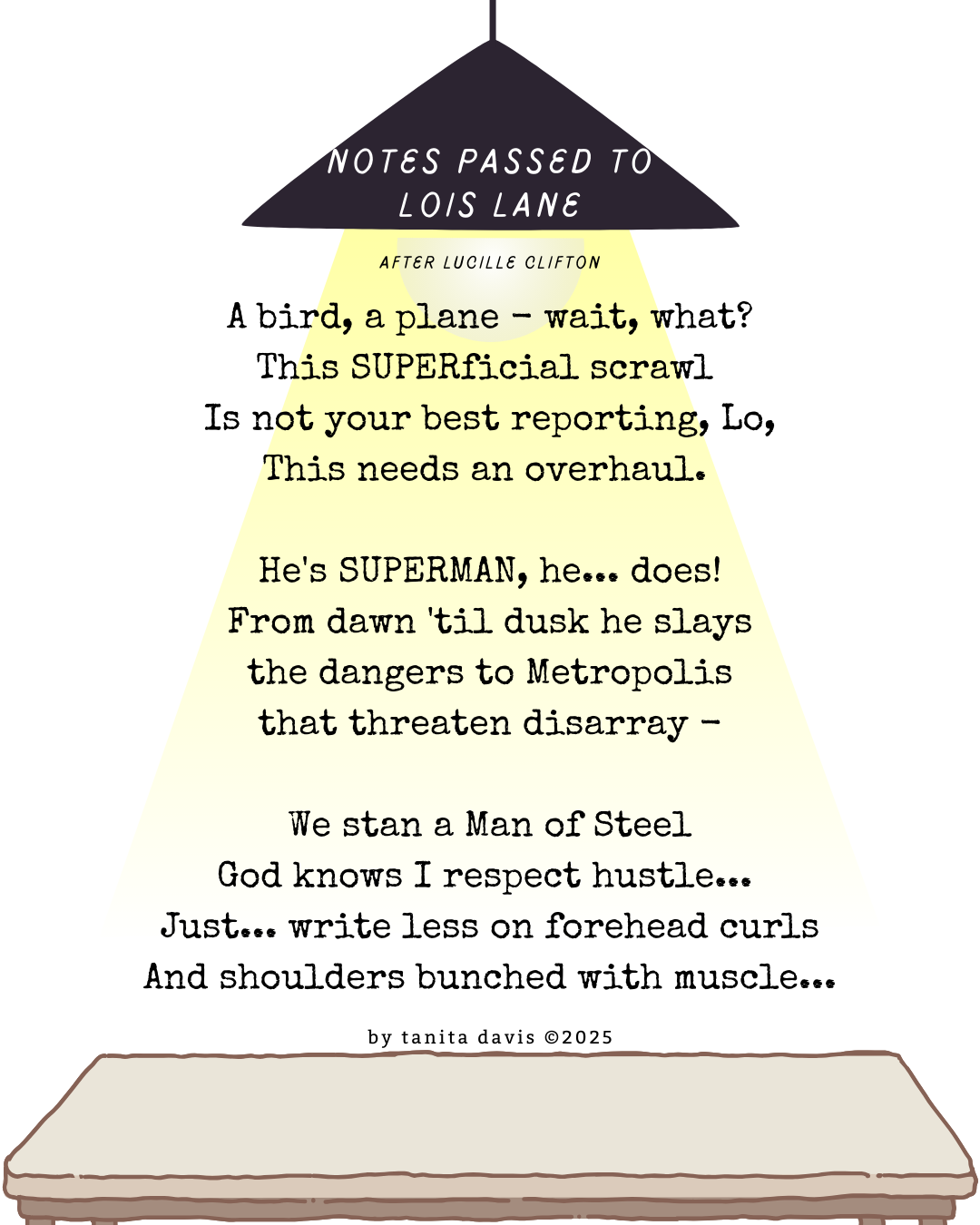
Notes Passed To Lois Lane (Probably by her editor, Perry White)

A bird, a plane – wait, what?
This SUPERficial scrawl
Is not your best reporting, Lo,
This needs an overhaul.

He’s SUPERMAN, he…does!
From dawn ’til dusk he slays
the dangers to Metropolis
that threaten disarray –

We stan a Man of Steel
God knows I respect hustle…
Just… write less on forehead curls
And shoulders bunched with muscle…

Okay, okay, I know and YOU know that Lois Lane Would Never, she was a thorough-going professional. But it still made me smile.

I’ll be honest – I couldn’t salvage this other poem. The ‘serious’ one was plunging down a lot of rabbit holes I don’t have the energy to follow, so I sort of tried to pull back on some of the over-emoting, and left it where it lay. Reminding myself that this poem is in conversation with the others is what helped me stay more on track — and while this doesn’t yet say what I need it to, it’s a start. If nothing else, I do believe that if we don’t hang together, we’re all going to hang separately, and despite my little red hats, I mean that across aisles and political divides. This is bigger than the red v. blue v. green color war, I’m afraid.

Notes In The Margin of The Daily Republic

Not any man would do, we’ll want SUPERman:
SUPERlative – from cape to brawny chest.
Spotlighting our best selves, and our SUPER land,
Our destiny to be forever blessed.
Granite jaw and steady stare – he’s sensational.
SUPERbly snaring manhood in his trap
With orphan-makes-good tropes. He’s educational
He models how to rise on our bootstraps…
…
Why an alien would show up when we’re losing,
To fight the thugs Metropolis can’t stop
No one ever seems to ask. It IS confusing
…The comics show folks screaming “Help!” nonstop,
And the victims standing, looking ’round for saviors,
Wringing hands instead of maybe calling cops…?

In MY book I’ve inserted on page borders,
Small hands cupped ’round a tiny screaming face
Which shouts, “People! Don’t just stand and wait for orders!”
In YOUR Daily Republic – your birthplace!
For future’s sake, speak up – protect what matters
Resist and rail against the treasonous.
One rock is small – a rock slide buildings shatter…
Join hands. We’ll be the ones to rescue us.

I’ll be ready Poetry Friday notes from a short beach glass hunting sabbatical, but I’ll definitely get around to answering any messages. I hope you take – and are taking – some time away to get outside and witness this slow turning of the seasons, as the earth wakes and stretches toward the possibility enshrined in Spring. Turn off the noise for a while, and just be – and then breathe. I plan to not just touch grass but touch rocks, possibly newts and beetles. (Anything squishier may require gloves.) While it’s true that no one is coming to save us, with any luck, and a bit of cooperation, there’s still enough to save of ourselves. Happy Weekend.